Healthcare facilities run on precision. A missing instrument, a non-compliant storage area, or a delayed OR case can compromise patient care and trigger regulatory citations. Full-service storage addresses these risks from the ground up — combining expert consultation, onsite space workflow assessment, custom design, professional installation, and long-term support into a single, accountable process. This guide breaks down what that process looks like at every phase, and why healthcare teams that invest in it consistently outperform those that don't.
Key Takeaways
Full-service storage goes beyond shelving and medical carts. It combines healthcare consultation, space planning, product installation, and ongoing implementation support into a single, managed process. For healthcare facilities under constant pressure to reduce costs and meet safety regulations, this integrated approach is the difference between a storage area that creates risk and one that drives results.
Poor storage directly threatens patient care. A 2024 study by Nichol et al. found that 26.16% of observed surgical cases experienced at least one instrument error. Those failures cost a single facility between $6.75 million and $9.42 million annually in lost chargeable OR minutes. Across U.S. health care settings, the aggregate burden runs into the billions.
Sterile supplies and surgical instruments suffer most when storage space is mismanaged. The Joint Commission consistently flags sterile storage deficiencies as among the most common infection control violations — items on the floor, uncontrolled temperature and humidity, overstuffed shelves, and mixed sterile and non-sterile inventory. Full-service storage resolves these failures at the system level, not symptom by symptom.
Healthcare providers need partners, not just products. The Joint Commission accredits more than 22,000 healthcare organizations — meaning safety management system compliance is a universal requirement across operating rooms and clinical use environments alike.
The results speak for themselves. A 350-bed community hospital that completed a full SPD overhaul with a full-service provider received zero citations during an unannounced Joint Commission follow-up. A newly constructed ambulatory surgery center that engaged a storage partner during design recouped the full investment within the first year through reduced waste and stronger OR efficiency.
A full-service solution starts with understanding — not assumptions. Before anyone designs or installs anything, healthcare consultation maps the real conditions across the OR, SPD, and materials management. That diagnosis shapes everything that follows.
Instrument errors are not random. Research by Nichol et al. (2024) identified the most common SPD failure types: missing instruments (160 instances), broken or poorly functioning instruments (44 instances), and tray assembly errors (13 instances). Each points to a distinct breakdown in healthcare logistics and supply chain workflow.
The downstream impact is measurable. A 42-OR academic medical center entered consultation with a 22% first-case delay rate. SPD-related issues drove roughly 40% of those delays. No single department caused the problem — the entire healthcare system chain did. Consultation across OR, SPD, and materials management is the only way to see it clearly and fix it completely.
Physical layout determines patient outcomes. An estimated 88.6% of SPD instrument errors trace back to visualization task failures — inspection, identification, and function assessment. The storage configuration either supports those tasks or undermines them. Modern technologies and design cannot compensate for a flawed layout.
An on-site space workflow assessment reveals what data alone cannot. At the same 42-OR facility, a workflow-based intervention reduced SPD-attributable first-case delays from 8.8% to 2.1% over 12 months. Assessments also surface protocol gaps invisible on paper. AAMI ST79 and AORN require loaner medical devices to arrive with at least 24 hours' notice for compliant processing — a requirement only a hands-on audit reliably catches. Patient-centered care depends on getting these details right before a single shelf is installed.
Storage design is not a layout exercise — it is a compliance and workflow engineering process. Space planning translates the findings from consultation and onsite assessment into a storage configuration that supports clinical use, meets safety regulations, and fits how each department actually operates.
Every zone in a healthcare facility has distinct requirements. AAMI ST79 — the most widely referenced standard in SPD operations — defines environmental specifications that directly govern how storage space is designed and configured:
| Zone | Pressure | Air Changes/Hour | Temperature | Relative Humidity |
| Decontamination | Negative | ≥10 ACH | 60–65°F | 30–60% |
| Preparation/Packaging | Positive | ≥10 ACH | 68–73°F | 30–60% |
| Sterilization | Positive | ≥10 ACH | 68–73°F | 30–60% |
| Sterile Storage | Positive | ≥4 ACH | 65–75°F | 30–60% |
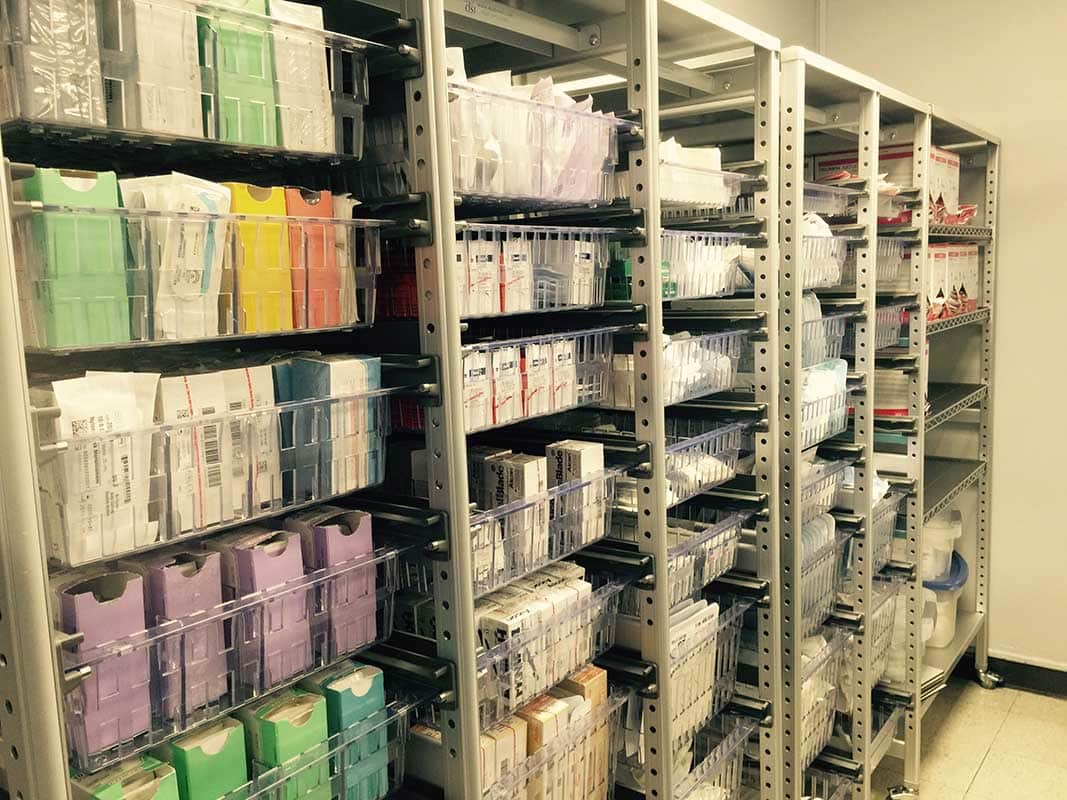
Shelving placement follows the same standard. Sterile supplies must be stored at least 8–10 inches from the floor, 18 inches from the ceiling, and 2 inches from outside walls. These are not suggestions — they are design constraints that determine every shelf configuration in a custom layout.
The results of well-executed space planning are measurable. A high-density mobile shelving redesign in one community hospital delivered a 35% increase in storage capacity within the existing footprint — no expansion required.
In a separate facility, an RFID-integrated storage system saved surgical teams an estimated 45 minutes per day in instrument retrieval time. That same hospital later achieved full HSPA program certification — a direct outcome of the physical storage improvements. Strategic space planning does not just organize a storage area. It elevates the entire health care setting.
Equipment selection is a clinical decision. The wrong storage system creates workflow friction, compliance gaps, and patient safety risk. The right one supports every handoff — from materials management to SPD to the operating room.
A medical cart selection guide frames equipment choice around outcomes, not just specifications. The data makes the stakes clear. Facilities with poor storage and service quality average a 26.2% instrument error rate and a patient safety incident rate of 8.5‰. Facilities with excellent service bring those numbers down to 3.2% and 0.9‰, respectively.
OR on-time case starts follow the same pattern. Poor-quality environments average 58% on-time starts. Excellent-quality environments reach 94% — a 36-percentage-point gap driven directly by storage and processing quality. Medical carts, case carts, and mobile equipment are not accessories. They are an infrastructure that determines patient outcomes.
Each storage system serves a specific clinical function. Selecting the wrong type for a given environment creates compliance exposure and workflow breakdown.
| System | Best Use Case | Key Compliance Note |
| Open Wire Shelving | General sterile storage, SPD | 8–10 inches off floor; allows airflow; easy to clean |
| Closed Cabinets | OR storage, high-traffic areas | Protects sterile supplies from environmental contamination |
| High-Density Mobile Shelving | SPD, central supply, pharmacy | Meets infection control standards; requires floor load assessment |
| Pass-Through Cabinets | SPD decontamination/clean interface | Critical for unidirectional workflow |
| Instrument Carts and Trolleys | SPD-to-OR transport | Must be covered during transport; easy to clean |
| Sterile Core Storage | Immediate OR sterile supply | Must meet all AAMI ST79 environmental requirements |
Industry benchmarks define the performance target: instrument tray accuracy ≥98%, OR first-case on-time start ≥90%, SPD turnaround ≤4 hours standard / ≤2 hours priority, instrument error rate ≤2 per 100 cases.
Use this guide to match storage system to clinical need:
Selecting the right equipment is only half the work. Professional product installation and implementation support determine whether a new storage system actually performs in a live health care setting — or creates new problems while solving old ones.
A full-service implementation follows a structured ~14-week timeline across six phases:
This sequenced approach ensures each phase informs the next. A new 8-OR ambulatory surgery center that followed this model from the design phase onward passed its initial Joint Commission accreditation survey with zero citations in the sterile storage and infection control domains. Structured installation removes the guesswork — and the compliance risk.
New systems installed without implementation support rarely reach their potential. Staff revert to old habits. Workflows stay broken. Compliance gaps persist.
Sustained support changes the outcome. At a large academic medical center, a joint implementation program that combined structural storage changes with workflow integration drove OR staff satisfaction with SPD services from 4.8/10 to 8.3/10. SPD staff satisfaction rose from 5.2/10 to 7.9/10.
The interventions that made the biggest difference were a daily 8:00 AM SPD/OR coordination huddle, a shared digital instrument tracking dashboard, a non-punitive error reporting system, and a cross-department training program. Implementation support is not a handoff — it is where the investment becomes operational.
Expected Outcomes
A storage system that works on day one but cannot scale is a short-term fix. Sustainability in healthcare storage means building infrastructure that stays compliant, supports growing surgical volumes, and adapts as regulations evolve — without requiring a full rebuild every few years.
Compliance is not a one-time event. AAMI ST79 and Joint Commission standards require internal SPD audits at least quarterly, covering all operational areas against current standards. A full-service ongoing support model delivers those audits with written reports, corrective action tracking, and continuous environmental monitoring — with automated alerts for out-of-range temperature, humidity, and air pressure readings.
AAMI ST79 also requires biological indicators to run at least weekly — preferably daily — with every implant load quarantined until results are confirmed. Storage infrastructure must be designed to support that monitoring rhythm, not work against it. Best practice adds an annual review of storage capacity and workflow, keeping the system aligned with operational growth rather than constantly catching up to it.
Regulatory requirements will continue to tighten. New Jersey, New York, and Tennessee have already enacted or are actively pursuing legislation mandating CRCST certification for all SPD personnel. HSPA administers four certifications now increasingly required by facilities and states: CRCST, CIS, CHL, and CER. AAMI ST108:2023 introduced water quality monitoring requirements at every reprocessing stage — a compliance layer that did not exist in prior standards editions.
Scalable systems absorb these changes. Rigid ones force costly retrofits. The clearest lesson from the evidence: the most cost-effective time to implement compliant, scalable storage is during facility design or major renovation. Building the right system from the start costs far less than rebuilding it under pressure.
Distribution Systems International has partnered with acute care facilities across the country for over 30 years — delivering full-service healthcare storage solutions that reduce costs, close compliance gaps, and keep operating rooms running on time. From your first consultation to final installation and beyond, DSI manages every detail. Contact Distribution Systems International today to schedule your complimentary onsite storage analysis and find out exactly what a better system can do for your facility.
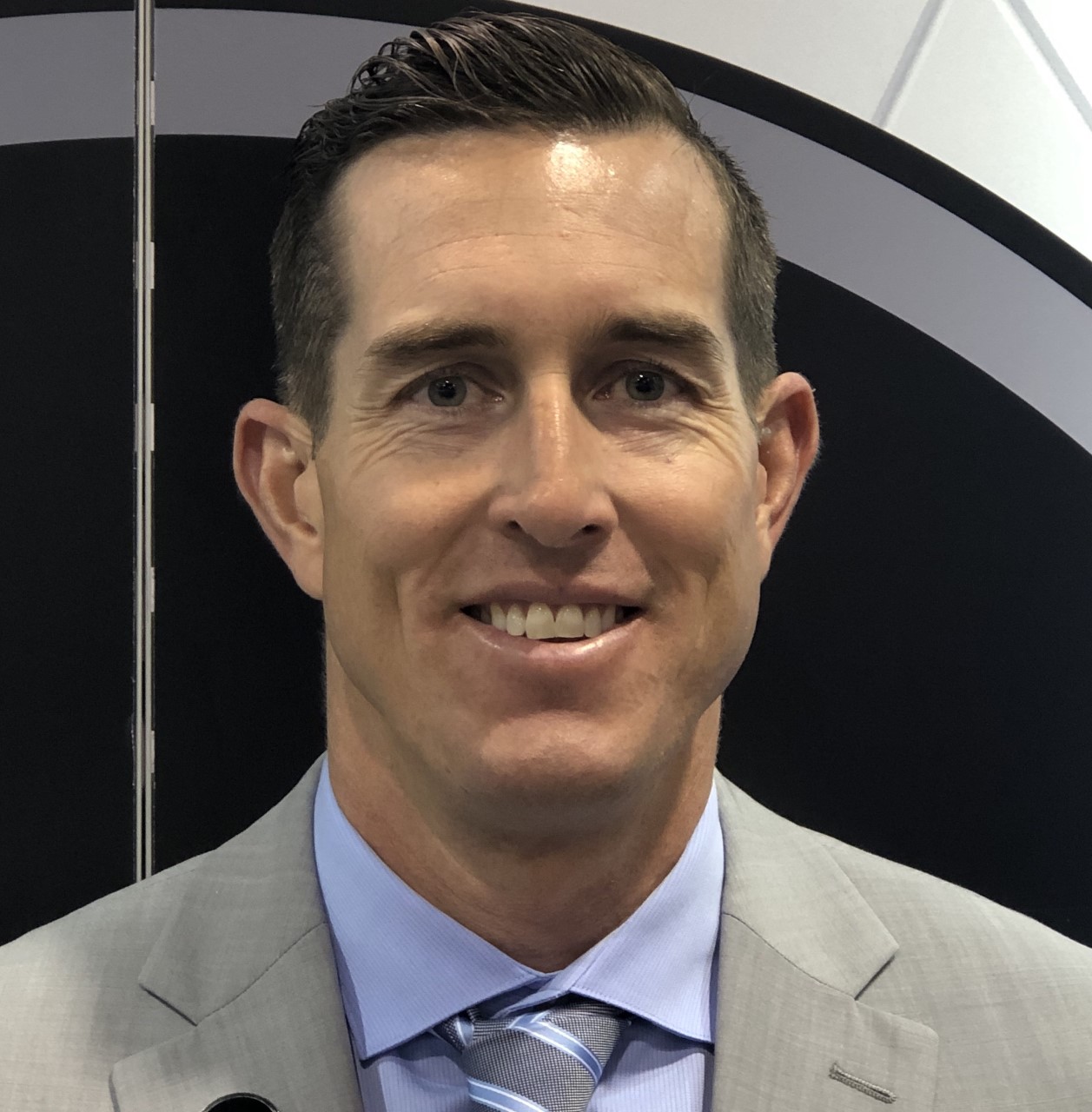
With 21 years of sales management, marketing, P&L responsibility, business development, national account, and channel management responsibilities under his belt, Ian has established himself as a high achiever across multiple business functions. Ian was part of a small team who started a new business unit for Stanley Black & Decker in Asia from Y10’ to Y14’. He lived in Shanghai, China for two years, then continued to commercialize and scale the business throughout the Asia Pacific and Middle East regions for another two years (4 years of International experience). Ian played college football at the University of Colorado from 96’ to 00’. His core skills sets include; drive, strong work ethic, team player, a builder mentality with high energy, motivator with the passion, purpose, and a track record to prove it.