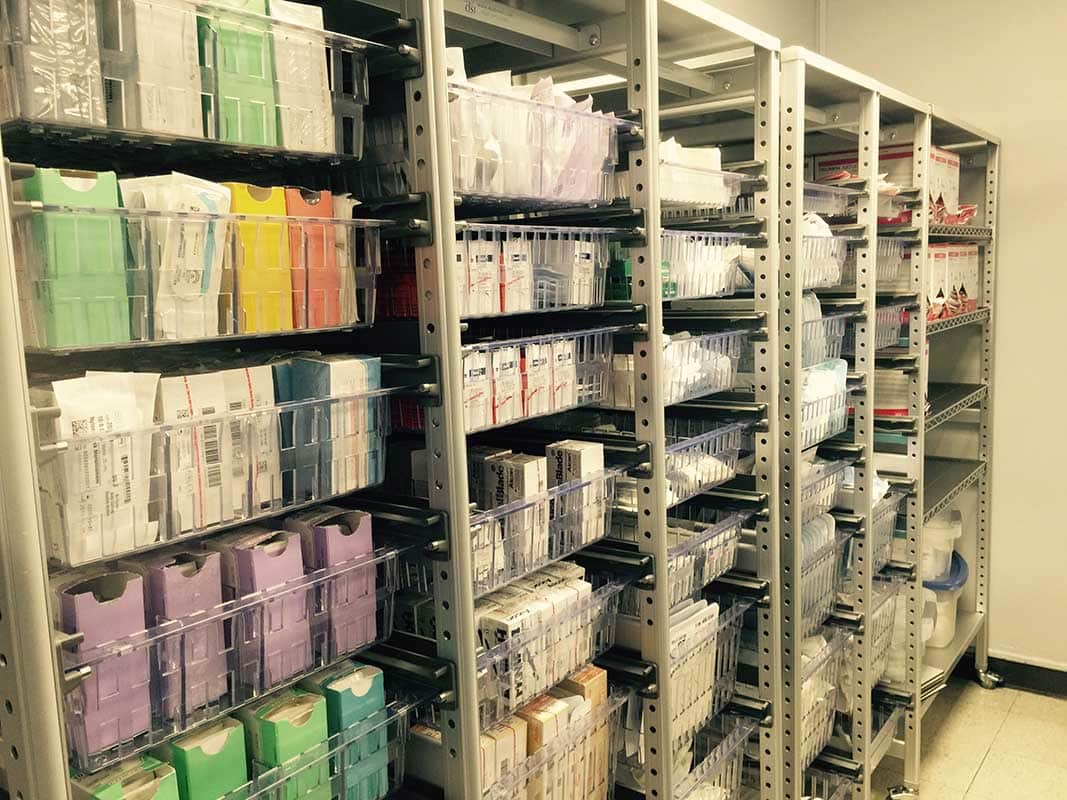
Every minute a nurse spends searching for supplies is a minute away from patients. In busy hospital environments, disorganized medical storage bins and unlabeled shelving create delays that ripple across every department — from sterile processing to the OR. Color coding and custom labeling solve this directly. They give hospital staff an immediate visual map of every storage area, cutting search time and reducing errors. This guide covers how these systems work and why implementing them is one of the highest-impact decisions a healthcare facility can make.
Key Takeaways
Disorganized hospital storage directly costs time, money, and patient outcomes. When medical storage bins and medical wire shelvings lack a clear structure, hospital staff waste critical minutes locating supplies — time that belongs at the bedside.
Disorganized storage makes inventory invisible. U.S. hospitals overspend approximately $25 billion per year on supply chain inefficiencies — roughly $12 million per hospital annually. Over one-third of some hospital operating budgets go entirely toward handling, storage, and restocking. Yet 12% of healthcare respondents still use handwriting for vital identification processes, introducing legibility errors that slow retrieval and increase search time. The Institute for Supply Management confirmed in October 2024 that hospital facilities experienced supply chain delays for 14 consecutive months. Without a reliable color-coding system and accurate inventory labels on medical storage bins and medical wire shelvings, clinical stock stays hidden in plain sight.
Poor visibility cascades into dangerous delays. When hospital storage rooms lack organized medical labels and standardized codes, surgical teams cannot locate what they need — fast. Drug shortages, often worsened by inadequate inventory visibility, add as much as 20% to hospital drug budgets. A mid-2023 survey found that over 99% of pharmacists reported experiencing drug shortages; 33% called them critically impactful.
Healthcare facilities that adopt unified inventory management strategies have realized over 30% reductions in equipment-related costs. The safety stakes go further: over 130 documented cases worldwide involved vinCRIStine administered via the wrong route due to labeling failures, causing deaths and severe neurological damage. Why safety matters in medical storage is clear — disorganization creates medical errors that no hospital protocol can fix after the fact.
Color coding gives hospital staff an instant visual language. In high-pressure hospital environments, a well-designed color-coding system eliminates guesswork — medical staff locate clinical stock faster, with fewer errors.
The human brain processes color approximately 60,000 times faster than text. That speed matters in medical emergencies. The ANSI Z535.1-2022 standard establishes the foundation for color coding in hospitals: Red signals danger or emergency equipment, Orange marks warnings, Yellow indicates caution, Green designates safe conditions, Blue conveys information, and Purple identifies radiation hazards.
Applied to medical storage bins, a standard color zone system looks like this: Red for emergency and critical care, Blue for respiratory and airway, Green for wound care and sterile supplies, Yellow for isolation and infection control, Orange for medications and pharmacy, and White for general administrative stock. Color-coded wristbands extend this system to patient identification — Red for allergies, Yellow for fall risk, Purple for DNR — a standard the Oklahoma Hospital Association actively promotes statewide. One critical rule: approximately 8% of males have color blindness. Always pair color with text or symbols. Never rely on color alone.
Custom color coding for robotic surgery storage gives surgical teams immediate instrument identification without reading a single word. ASTM standards define perioperative medication label colors: Blue for opioids, Red for muscle relaxants, Yellow for induction agents, Orange for sedatives, and Violet for vasopressors. Dedicated cart colors extend this logic — each color identifies a cart's function or department at a glance.
Standardization is non-negotiable. A 2005 Pennsylvania incident nearly harmed a patient because DNR color coding differed between hospital facilities. The ISMP is clear: color coding complements identification — bar-coding remains the primary method, especially outside the OR.
Custom labeling turns storage rooms into self-navigating systems. When every shelf, bin, and location on medical wire shelvings carries a clear, consistent label, hospital staff retrieve supplies without hesitation — and put them back in the right place every time.
Label design directly affects retrieval speed. Clinical best practices call for a minimum 12pt font on shelf labels and 18pt or larger on bin labels. Sans-serif fonts — Arial or Helvetica — maximize legibility under pressure. High-contrast combinations, such as black on yellow, ensure readability at a glance. Materials must be chemical-resistant and moisture-proof to survive healthcare environments.
Every label should carry four data points: item name, SKU or barcode, PAR level, and storage location code. Placement belongs at eye level, front-facing, and consistent across all modular storage systems. The 5S methodology formalizes this — "Set in Order" calls for labeling every bin, shelf, and location; "Standardize" locks in uniform formats and placement facility-wide. Electronic Shelf Labels (ESLs) go further, displaying live item data on the shelf with a one-click replenishment button, cutting both put-away time and reorder friction simultaneously.
The results from structured labeling implementations are measurable. At Sheba Medical Center, a 3-month pilot reduced weekly inventory orders from 7.3 to 2.8 — a 62% drop — following PAR label and bin system implementation. Storeroom organization improved directly, increasing storage capacity and optimizing shelf space. Across multiple 5S hospital studies, inventory turnover improved by 30% and space utilization increased by 25%. Inventory visibility doesn't just support efficiency — it reclaims space and reduces the ordering burden on medical staff.
The data is direct: visual storage systems cut search time. Across healthcare facilities, color coding and custom labeling consistently return measurable time savings — for logistics staff, nurses, and surgical teams alike.
Visual systems reduce supply search times by 45–80% across documented hospital settings. The results hold across institution types and departments:
In each case, a structured color-coding system and consistent inventory labels gave medical staff an immediately navigable environment — no searching, no guessing.
When combined, color coding and custom labeling don't just accelerate retrieval — they transform hospital workflow. At Sheba Medical Center, nurse satisfaction rose from 53% to 90% within three months. Nursing staff inventory ordering time dropped to zero after visual PAR bin labeling was automated, which eliminated that function entirely. A creatinine lab turnaround study recorded a 57% reduction in processing time following visual organization implementation.
The benefits extend beyond speed. A longitudinal study published in PubMed found that staff reporting positive working conditions increased from 48% to 74% after consistent visual management tool use. A PMC 5S review found face-to-face patient time climbed from 45% to 72% of each nursing shift. Better hospital storage organization directly improves patient outcomes.
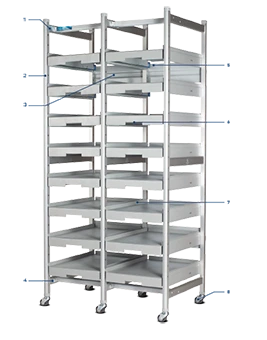
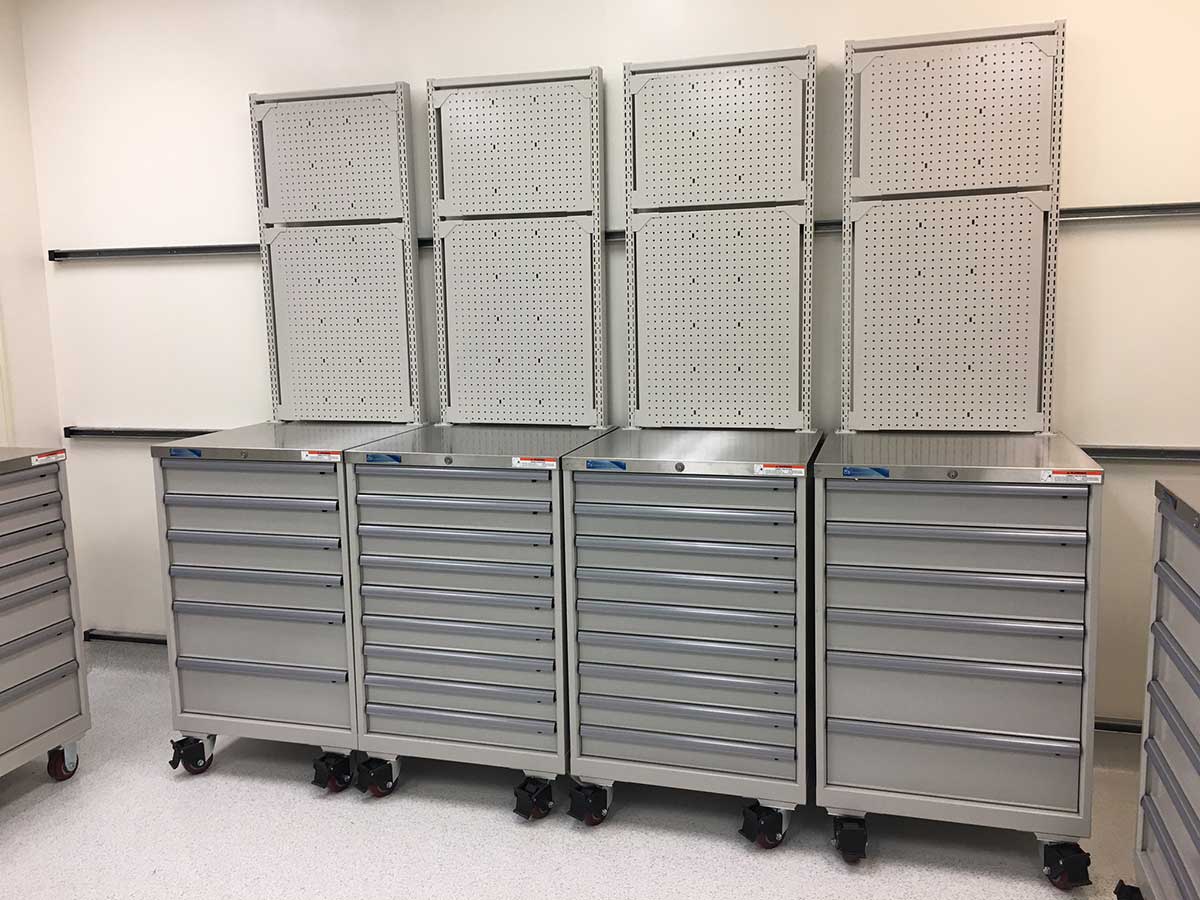
Modular storage systems give color coding and custom labeling a structural foundation. When hospital storage rooms are built on organized, reconfigurable frameworks, applying and maintaining a consistent color-coding system becomes significantly more practical.
The 5S methodology — Sort, Set in Order, Shine, Standardize, Sustain — is the most widely used organizational framework in healthcare facilities. Pioneered in Japanese manufacturing and adapted for hospitals by institutions like Virginia Mason Medical Center, 5S delivers documented benefits: reduced space usage, quality control improvement, waste elimination, increased staff morale, and improved operational efficiency.
The results scale. A Texas Healthcare Center applied a comprehensive 5S program — reorganizing hospital storage rooms and installing floor markings — and achieved a 32% increase in bed space without building a new extension. A landmark longitudinal study (Williamsson et al., 2019) tracking nearly 1,000 nurses found that daily visual management tool users reported better work overviews, stronger team collaboration, higher clinical engagement, and greater access to job resources.
Modular medical storage bins make categorization physical and immediate. When bins are sized, colored, and labeled consistently across medical wire shelvings, clinical stock stays visible and retrievable without searching. As SixSigma.us states, visual management tools "significantly boost productivity by making information readily available and easy to understand."
The same Williamson study found that non-daily users of visual systems experienced measurably higher mental stress and fewer development opportunities — confirming that the absence of visual systems carries real costs.
Technology compounds the gains at each stage. Printed color-coded labels establish the foundation. Barcode labels add scanning and automated reordering. RFID tags enable real-time asset location. Electronic Shelf Labels (ESLs) deliver dynamic inventory management. Each layer builds on the last — progressively reducing search time and manual effort across hospital environments.
Why safety matters in medical storage comes down to one fact: disorganized storage kills. Regulatory bodies have codified labeling requirements precisely because the consequences of failure — in emergency situations, in the OR, at the medication cart — are irreversible.
In 2012, $3.6 billion was paid out for 12,142 medical malpractice suits in the U.S. — many linked directly to medication and identification errors. Hospital protocols exist to prevent exactly this. Three regulatory frameworks define the minimum standard for medical labels in U.S. hospital facilities:
Organized visual systems don't just support compliance — they deliver measurable financial returns. Hospitals implementing 5S labeling systems report potential annual savings of up to $2.8 million per institution. Across healthcare systems, 62% of hospitals report direct cost savings from labeling technology. Visual labeling cuts logistics staff time by more than 50%, freeing medical staff to redirect hours toward direct patient care.
The ASHE and Joint Commission require utility system controls for emergency shutdown to be clearly labeled — because in medical emergencies, every unlabeled control is a liability. Organized hospital storage is not an operational preference. It is a patient safety mandate.
Distribution Systems International has served acute care facilities exclusively since 1990 — over 30 years of specialized focus that general storage vendors cannot match. DSI operates as a consultative partner, not just a supplier. The process begins with an on-site workflow analysis, moves through custom CAD-designed storage layouts, and ends with full turnkey implementation — assembly, labeling, and inventory transfer included.
Choose DSI if your facility needs a single-source partner to design, supply, and implement a complete color-coded and labeled storage system across multiple departments. DSI’s direct-selling model means you work with storage specialists from first conversation to final walkthrough — no third-party contractors, no coordination gaps.
Distribution Systems International designs and implements custom storage systems built around color coding, organized medical storage bins, and structured visual labeling. From sterile processing to the OR, DSI's turnkey solutions help hospital staff locate supplies faster, maintain compliance, and redirect time to patient care. Every implementation starts with a complimentary on-site analysis — no obligation, just a clear picture of where efficiency gains are possible. Contact Distribution Systems International today to get started..

With 21 years of sales management, marketing, P&L responsibility, business development, national account, and channel management responsibilities under his belt, Ian has established himself as a high achiever across multiple business functions. Ian was part of a small team who started a new business unit for Stanley Black & Decker in Asia from Y10’ to Y14’. He lived in Shanghai, China for two years, then continued to commercialize and scale the business throughout the Asia Pacific and Middle East regions for another two years (4 years of International experience). Ian played college football at the University of Colorado from 96’ to 00’. His core skills sets include; drive, strong work ethic, team player, a builder mentality with high energy, motivator with the passion, purpose, and a track record to prove it.