Hospital storage systems run on speed and accuracy. When supplies are misplaced, unlabeled, or inconsistently organized, clinical teams lose time they don't have. Visual labeling solves this directly — assigning every bin, shelf, and storage zone a clear, standardized identity that staff can read and act on instantly. From fixed shelving to mobile medical carts, labeled systems ensure every restocking touchpoint supports faster put-away, fewer errors, stronger staff morale, and a work environment built for sustained efficiency. This article breaks down exactly how visual labeling delivers those outcomes across healthcare storage.
Key Takeaways
Visual labeling is a structured identification system that uses color, text, and symbols to mark storage locations, supply bins, and equipment in medical facilities. It is a core component of healthcare workflow management — reducing administrative bottlenecks, eliminating duplication of processes, and keeping clinical workflows moving without interruption. Every labeled zone tells staff exactly what belongs there and where to find it. In high-volume acute care facilities, that clarity is the difference between a workflow that runs and one that stalls.
The human brain processes color 60,000 times faster than text. In high-pressure hospital workflows, that speed directly impacts put-away efficiency and retrieval time. Yet 12% of healthcare respondents still use handwriting for vital identification — introducing legibility errors that slow clinical teams and add unnecessary friction to daily tasks.
The data is clear. Across multiple 5S hospital studies, supply search time dropped 45% — from 60 to 33 minutes. At Sheba Medical Center, logistics staff rounds were cut by 55%, from 161 to 73 minutes per day, after implementing a visual labeling system. Faster identification means faster workflow design execution across the entire supply chain.
Inconsistent labeling in SPD and OR environments is a patient safety failure. Over 130 cases worldwide involved vinCRIStine administered via the wrong route due to labeling errors — many fatal. A 2005 Pennsylvania incident showed that mismatched DNR color coding across hospitals nearly cost a patient their life.
Regulatory standards exist for this reason. The Joint Commission's NPSG.03.04.01 requires all medications and containers to be labeled on and off the sterile field, including name, strength, amount, diluent, and expiration date. The ANSI Z535.1-2022 standard establishes the universal color framework — red for danger, yellow for caution, green for safe conditions — that supports employee safety in healthcare storage and consistent workflow procedure across every department.
Visual labeling does more than organize shelves. It removes the daily friction that drains clinical teams — missed items, repeated searches, and manual ordering tasks that pull nurses away from patient care. The result is measurable improvement in both put-away efficiency and workplace culture. When a labeled system is in place, staff spend less time searching and more time delivering care. That shift directly improves morale, reduces stress, and supports a work environment where clinical teams can perform at their best.
When storage locations are clearly marked, staff stop guessing. Items go back where they belong — every time. That consistency eliminates duplication of processes and keeps supply chains moving without interruption.
At Sheba Medical Center, a visual PAR/Kanban system reduced nursing time spent on inventory ordering to zero. Weekly orders dropped from 7.3 to 2.8 per week — a 62% reduction over a 12-week pilot. Total order volume fell from 51 to 22 per period, a 57% decrease. Across 5S hybrid implementations, inventory turnover improved by 30%. Structured workflow design at the storage level produces compounding operational gains.
A disorganized work environment creates stress. A labeled one reduces it. When staff can locate and return supplies without searching, cognitive load drops — and employee engagement rises.
At Sheba Medical Center, nurse satisfaction jumped from 53% to 90% after visual labeling implementation. In a separate longitudinal study, staff reporting positive work conditions increased from 48% to 74% following consistent use of visual management tools.
Williamsson et al. (2019) tracked nearly 1,000 nurses across three time points. Daily users of visual management tools reported better workflow overview, stronger care collaboration, and greater access to job resources. Non-daily users experienced increasing mental stress. The study concluded that daily visual management use had a statistically significant buffering effect on nurse stress — a direct link between labeling systems and a healthier workplace culture.
Labeled storage areas eliminate ambiguity. Every zone has a purpose. Every bin has a home. That structure compresses handling time, reduces errors, and gives clinical teams a repeatable workflow procedure they can execute without hesitation. It also allows new staff to navigate storage areas without extensive training — the labels do the instructing. Across departments, that consistency reduces put-away errors and creates a self-sustaining system that holds up under the pressure of daily hospital operations.
When storage zones are clearly defined, staff don't decide where items go — the label does. That single shift removes a hidden source of delay embedded in daily restocking tasks across every department.
The performance data supports this at scale. Leeds Teaching Hospitals NHS Trust cut administrative test processing time by 80% — from 75 to 15 minutes per batch — after implementing a barcode labeling system. A Jordan inpatient pharmacy 5S+DMAIC study reduced the drug dispensing cycle by 45%. A hospital 5S review of creatinine lab turnaround showed a 57% reduction, from 54 to 23 minutes. Across multiple 5S studies, space utilization improved by 25% following labeled zone implementation — reclaiming capacity without expanding physical footprint.
Medical carts and hospital workstations are restocking touchpoints. When visual labeling is integrated at those points, supply return becomes a closed-loop process — items are placed, confirmed, and reordered without leaving the workflow.
Electronic Shelf Labels (ESLs) extend this further. Each label displays item name, current stock level, and a one-click replenishment button directly on the shelf — cutting cognitive effort and eliminating separate ordering steps. Sheba Medical Center’s hybrid Kanban/PAR solution paired autonomous weight-based bins with digital restock tags and a scan-and-restock mobile app, showing real-time stock data at every bin. The impact extended beyond storage: a PMC systematic review of 5S in healthcare found that face-to-face patient time increased from 45% to 72% of shift time when visual labeling was integrated into supply workflows — proof that healthcare workflow management at the storage level directly improves healthcare delivery.
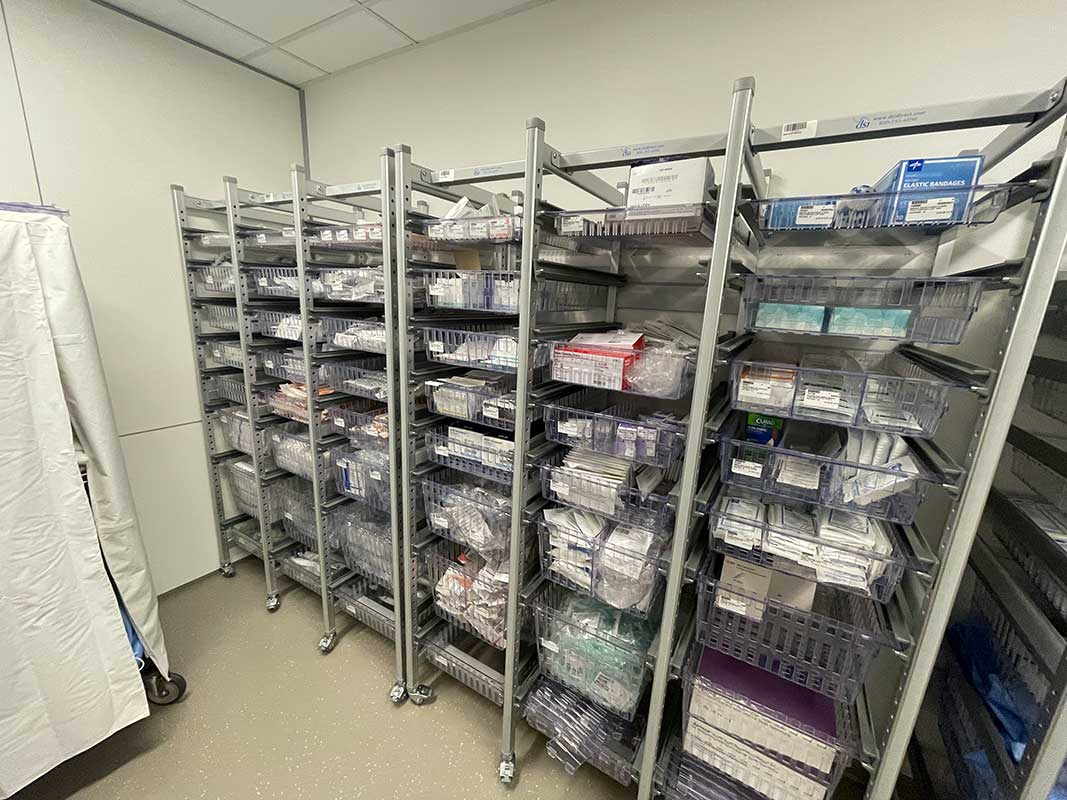
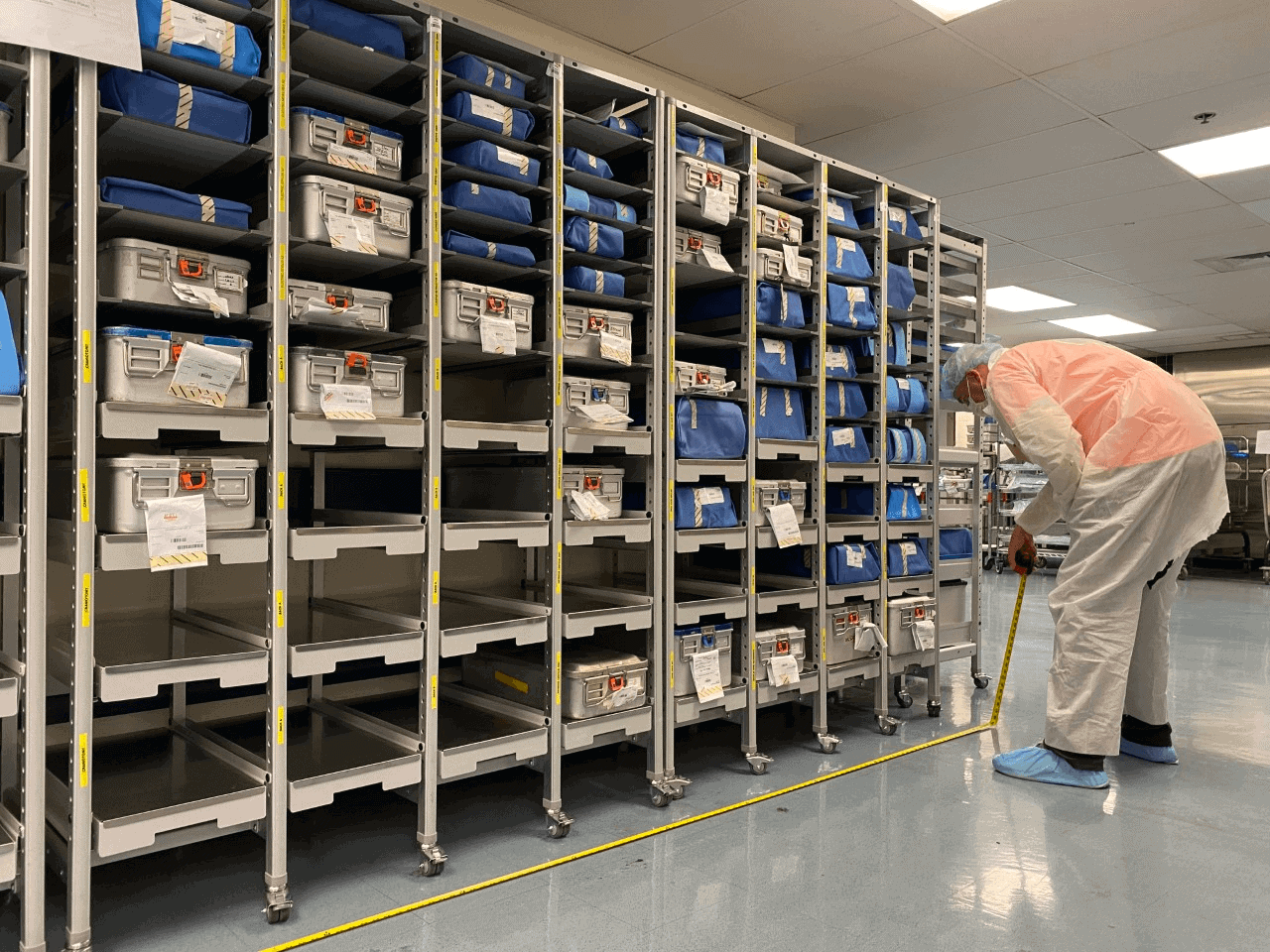
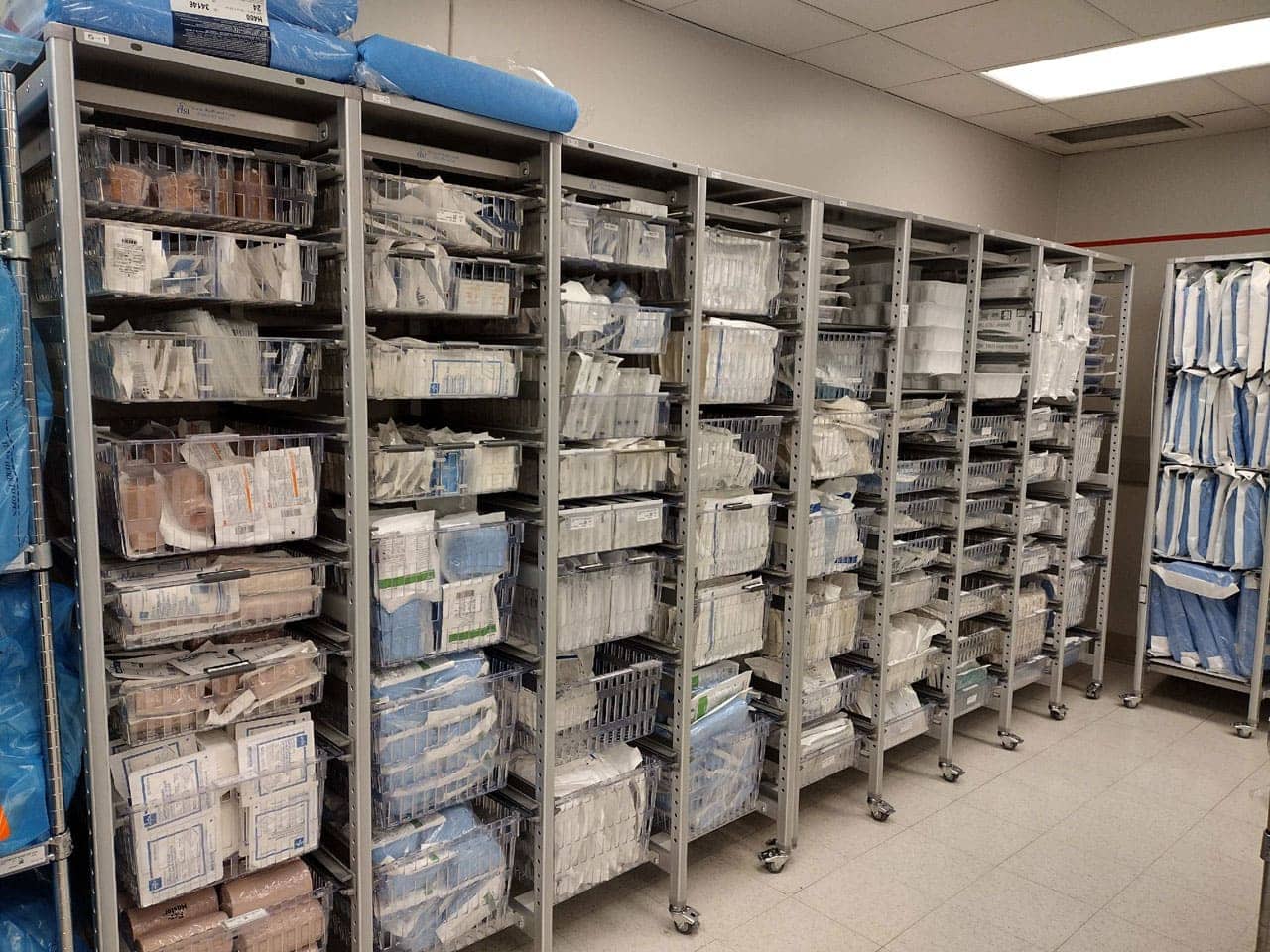
Visual labeling only works when the storage layout supports it. Poorly planned spaces create blind spots, crowded shelves, and inconsistent label placement. Structured layout — including vertical space planning — gives labeling systems a stable foundation and makes workflow redesign sustainable over time. When shelves are organized vertically and zones are defined clearly, labels remain visible, consistent, and actionable. A well-planned layout turns a labeling system from a one-time project into a permanent operational asset.
Vertical space is underused in most healthcare storage areas. When shelving is planned top to bottom with labeled zones at each level, clinical teams gain immediate visual access to every supply category without digging or repositioning items.
The financial case is equally clear. U.S. hospitals overspend approximately $25 billion per year on supply chain inefficiencies — roughly $12 million per hospital annually. Over one-third of some hospital operating budgets are consumed by handling, storage, and restocking alone. Maximizing vertical space storage directly reduces that burden. A Texas healthcare center implemented a 5S program with floor marking and storage reorganization and achieved a 32% increase in bed space utilization — from 68% to 90% — without building a new extension.
A well-designed shelving layout makes labels predictable. Staff know where to look. That consistency is what allows visual labeling systems to scale across departments without retraining.
Label design standards matter here. Best practice requires a minimum 12pt font for shelf labels, 18pt or larger for bin labels, sans-serif typefaces, high-contrast text-to-background combinations, and chemical-resistant materials built to survive repeated disinfectant exposure. Color alone is insufficient — approximately 8% of males are color blind, so every label must pair color with text or symbols.
Maintenance requires structure too. Weekly audits in high-traffic areas and monthly reviews in lower-traffic storage prevent organizational drift and keep the work environment accurate and operationally reliable.
Visual labeling and ergonomic design for storage systems work together. Labels tell staff where items are. Ergonomic layouts ensure those items are physically accessible without strain. Combined, they reduce both the mental and physical load on clinical teams during every restocking cycle. When storage areas are designed with both ergonomics and visual clarity in mind, staff can move through routine supply tasks quickly and safely — protecting employee wellbeing and sustaining the workflow standards that acute care environments depend on.
Disorganized storage creates cognitive overload. Staff managing complex clinical decisions shouldn't also be holding shelf locations, bin numbers, and PAR levels in working memory. Visual management systems externalize that information — freeing staff to operate on autopilot for routine supply tasks and reserving cognitive capacity for patient care.
The productivity gains are measurable. Visual management tools significantly boost output by making information immediately available and easy to act on (SixSigma.us). Hospitals implementing a unified healthcare technology management strategy have realized over 30% reductions in equipment-related costs — a direct return on organized, accessible storage integrated into the work environment.
Repetitive supply tasks compound physical fatigue. When storage areas are poorly positioned — wrong heights, inconsistent locations, unlabeled zones — staff absorb that friction on every shift. Ergonomic workflow design eliminates unnecessary reaching, searching, and backtracking.
The operational consequences of poor inventory visibility are severe. Poor inventory visibility adds as much as 20% to hospital drug budgets — up to $4 billion industry-wide. A mid-2023 University of Utah survey found over 99% of hospital pharmacists reported drug shortages, with 33% calling them critically impactful. The Institute for Supply Management reported in October 2024 that hospitals had experienced supply chain delays for 14 consecutive months. Ergonomic storage systems with clear visual labeling reduce the compounding burden those conditions place on supply staff — protecting both employee safety in healthcare storage and long-term workflow efficiency.
Clear labeling is a safety system, not just an organizational tool. When supplies are consistently identified and correctly stored, the risk of errors drops — for patients, for staff, and for the institution. Long-term storage efficiency depends on that foundation holding across every shift, every department, and every year. Regulatory compliance, malpractice risk reduction, and operational cost savings all connect back to one thing: a labeled, organized storage environment that staff can trust and sustain.
Mislabeled and unlabeled supplies carry direct liability. In 2012, $3.6 billion was paid out across 12,142 medical malpractice suits in the United States — many linked to medication and identification errors tied to inadequate labeling. Employee safety in healthcare storage is inseparable from labeling accuracy.
Regulatory requirements reinforce this. OSHA's Hazard Communication Standard, aligned with the Globally Harmonized System, mandates that all hazardous chemicals carry a product identifier, signal word, hazard statements, precautionary statements, pictograms, and responsible party contact information. Only a structured, maintained labeling system can meet those requirements consistently. The return is measurable — 62% of hospitals report direct cost savings after implementing labeling technology.
Visual labeling systems degrade without a sustaining framework. Embedded within a LEAN methodology, they hold and compound. 5S implementation studies project potential annual savings of up to $2.8 million per institution when visual labeling is maintained within a sustained LEAN program.
Virginia Mason Medical Center pioneered the adaptation of 5S and visual management from Japanese manufacturing into U.S. healthcare, establishing the model now standard across acute care facilities nationwide. Industry standards have been followed. The American Society for Health Care Engineering, in collaboration with the Joint Commission, developed utility system labeling standards under NFPA requirements — covering color conventions, naming protocols, and flow directional arrows — to ensure safe emergency shutdown identification and preserve long-term system integrity across the healthcare organization.
What makes DSI different: DSI is not a product vendor — it is a storage optimization partner. Since 1990, DSI has delivered full turnkey implementations for acute care facilities across all 50 states, combining LEAN methodology, on-site workflow analysis, CAD-designed layouts, and labeled storage systems into a single managed process. DSI handles every step from consultation to post-installation support.
Choose DSI when: your facility needs a structured, data-driven storage redesign with clear visual labeling built in from the start — not a generic product purchase. DSI is especially suited for OR, SPD, and materials management environments where compliance, sterile integrity, and workflow speed are non-negotiable.
DSI may not be the right fit if: you are looking only for individual product purchases without a broader workflow assessment. DSI’s model is consultative and implementation-focused — best suited for facilities ready to commit to a full storage optimization process.
Distribution Systems International has helped acute care facilities across the country transform disorganized storage into high-performance systems built on LEAN principles and visual management. From labeled shelving and medical carts to full turnkey implementation, DSI delivers storage solutions that improve put-away efficiency, protect employee safety, and support clinical workflows long after installation. If your facility is ready to reduce waste and strengthen staff productivity, contact DSI today for a complimentary storage analysis.

With 21 years of sales management, marketing, P&L responsibility, business development, national account, and channel management responsibilities under his belt, Ian has established himself as a high achiever across multiple business functions. Ian was part of a small team who started a new business unit for Stanley Black & Decker in Asia from Y10’ to Y14’. He lived in Shanghai, China for two years, then continued to commercialize and scale the business throughout the Asia Pacific and Middle East regions for another two years (4 years of International experience). Ian played college football at the University of Colorado from 96’ to 00’. His core skills sets include; drive, strong work ethic, team player, a builder mentality with high energy, motivator with the passion, purpose, and a track record to prove it.