Every surgical case depends on a sterile instrument tray arriving complete, compliant, and on time. Most hospital administrators know sterile processing exists. Few know what it actually costs. The reprocessing cost of a single tray averages $48.00, and that figure assumes nothing goes wrong. Add errors, delays, failed sterilization loads, and inadequate sterile instrument storage, and the true cost climbs fast. This guide breaks down where the money goes, what drives it up, and what high-performing facilities do differently.
Key Takeaways
Reprocessing sterile instrument trays is one of the most resource-intensive functions in a hospital's operations. Every surgical case depends on it. Understanding what it costs — and why — is the first step toward any meaningful strategy for optimization.
Sterile processing departments follow a fixed sequence for every surgical tray: decontamination, manual cleaning, ultrasonic treatment, mechanical washing, inspection, assembly, packaging, sterilization, and storage. Each phase consumes labor, supplies, equipment capacity, and time. None is optional.
The industry benchmark — Worked Hours Per Unit (WHPU) — sets the standard at 24 minutes of labor per tray cycle. At that rate, the average cost of sterilization per tray reaches approximately $48.00. Facility size, geographic labor market, equipment age, and tray complexity all move that number. Surgical specialties with larger, more complex instrument sets push it higher.
Reprocessing cost is not fixed — it responds directly to workflow discipline. Indirect costs represent just 12% of per-tray expenses at baseline. When process inefficiencies enter the picture, that share escalates 65%–210%. That spread represents a controllable hospital operational expense, not an inevitability.
Staffing compounds the problem. A 2025 national survey found SPD wages have not kept pace with inflation, driving high turnover across the technician workforce. Every departure triggers recruitment and training spend — a recurring burden with no ceiling. Health systems that treat sterile processing departments as a cost center rather than a clinical asset absorb those losses without recourse. Stable, well-supported SPD teams are a prerequisite for consistent instrument management and predictable reprocessing costs.
Every sterile instrument tray carries a layered cost structure. Labor dominates, but equipment, utilities, consumables, and compliance each add measurable supply costs that compound across thousands of cycles annually.
Labor accounts for 38% of the per-tray cost — approximately $18.24. The average SPT earns $22.81/hour, producing a direct technician cost of ~$9.12 per tray. Benefits, supervision, overtime, and training close the gap to $18.24.
Equipment depreciation adds another 18% (~$8.64/tray). Large-capacity autoclaves run $80,000–$150,000+. Standard units start at $45,000–$60,000, depending on capacity. Most washer-disinfectors perform optimally for 8–10 years. Facilities running them past that window absorb rising maintenance costs and reduced throughput — a slow drain on hospital operational expense.
Maintenance alone runs $500–$3,000 per autoclave annually without a service contract. Individual parts add up fast: safety valves ($336–$357), solenoid repair valves ($140–$385), other components ($98–$248). Emergency calls cost $225–$1,500 per visit. Energy and utilities contribute another 10% (~$4.80/tray). A University of Alabama-Birmingham study found steam-jacketed autoclaves consumed 44–50 gallons per cycle versus fewer than 2 gallons for non-jacketed models — costing one facility ~$74,000 annually across 100+ units.
Chemicals and sterilization materials represent 14% of the per-tray cost (~$6.72). Enzymatic cleaners run $50–$118/gallon. Sterilization wraps cost $240+ per 1,000 sheets. Biological indicators — required to confirm sterilization efficacy — add $150–$300 per 50 units.
Compliance and documentation add ~$2.40/tray. ANSI/AAMI ST79 access costs $399–$457 annually. CRCST renewals for a 20-person department run $1,000–$1,200/year. Instrument replacement and baseline OR delay costs add another $1.92 and $1.44 per tray, respectively — figures that escalate sharply when sterile processing workflows break down.
The visible line items — labor, equipment, consumables — are only part of the picture. Tray errors, rework, and operating room delays generate a second layer of cost that rarely appears on a single budget line but consistently damages surgical workflows and patient care.
A 2024 BMC Surgery study observed 236 errors across just 147 surgical cases at a single academic medical center. Missing instruments accounted for 160 of them. Broken or malfunctioning instruments added 44 more. Tray assembly issues contributed 13. In total, 34.37% of all surgical cases at the facility — approximately 9,281 per year — were affected by at least one instrument error.
The root cause: 88.6% of errors traced back to failures in visualization tasks — inspection, identification, and function verification. These are manual process failures. When they occur repeatedly, rework labor costs rise 65%, and instrument replacement costs climb 85%. A University Medical Center with 29 ORs eliminated $250,000 in annual instrument replacement costs and $12,000 in wet-load rework costs through a structured process improvement initiative.
OR time costs $60–$270 per minute. Over 50% of surgical cases with documented instrument errors experienced a delay. The average: 10.16 minutes per case. That translates to $600–$2,700 in lost chargeable time per event.
MetroHealth was absorbing 2,600 lost OR hours annually — $925,880 per year for a 6-OR facility. OR delays carry the highest inefficiency cost multiplier of any SPD failure category: +210% over baseline. Sterilization failures and recalls add +140%. A single biological indicator failure at a New Jersey hospital network triggered a 1.5-hour OR stoppage and a potential $24,000 loss in one event. Compliance breakdowns add another +120%, and FDA penalties can reach $1 million per violation.
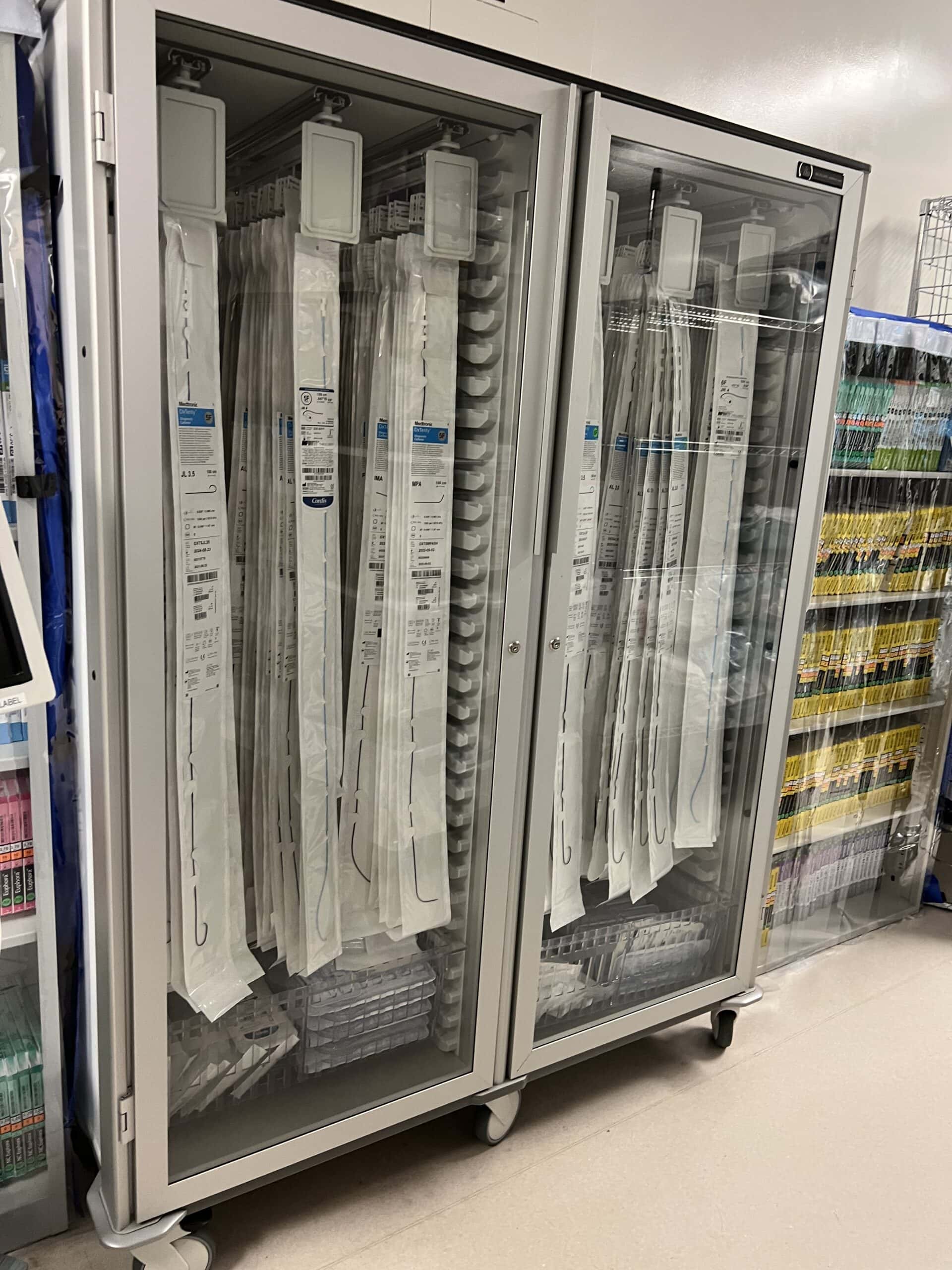
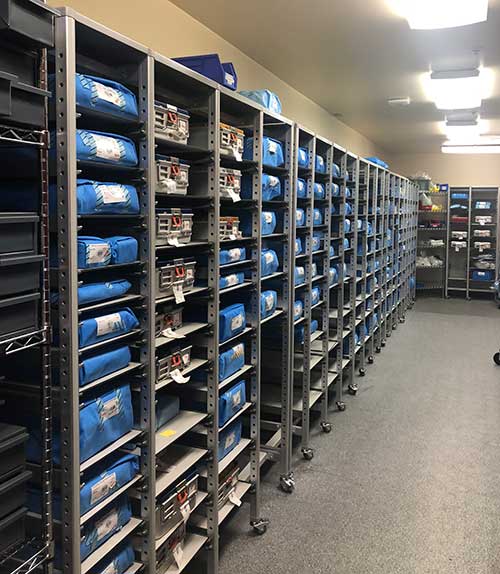
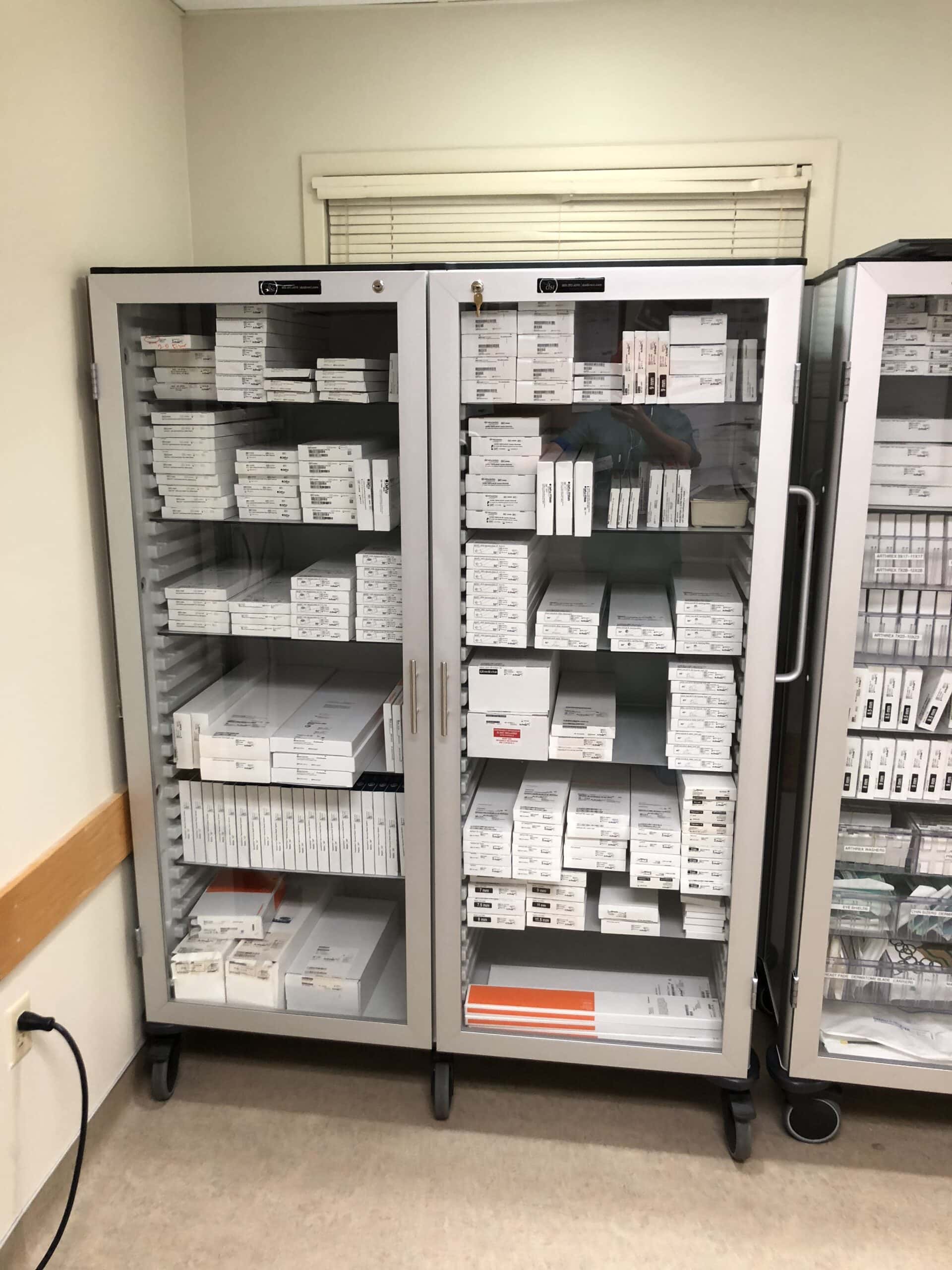
Where sterile instrument trays are stored — and how — directly determines whether they stay sterile. Poor medical storage doesn't just risk patient safety. It triggers reprocessing cycles that consume labor, consumables, and OR time that facilities can't afford to waste.
Improper sterile instrument storage creates contamination events that force full reprocessing runs. Under ANSI/AAMI ST79, a single failed biological indicator test requires an immediate recall of every sterilization load processed since the last successful result. That can mean dozens of trays pulled, reprocessed, and re-sterilized — plus a potential halt to OR operations.
The cost of a BI test is $3–$6. The cost of the recall event it prevents is exponentially higher. Equipment choices compound the problem. A legacy washer-disinfector consuming 98.9 gallons per cycle versus a modern unit using 35.5 gallons represents a difference of over 165,000 gallons of water annually — a preventable resource utilization burden tied directly to how facilities manage their sterilization and processing infrastructure.
Proper medical storage is a compliance requirement, not a best practice. ANSI/AAMI ST79 governs every stage of the reprocessing cycle, including post-sterilization storage protocols. Sterile-packed kits, surgical trays, and sterilization containers must be stored in controlled environments that protect packaging integrity and prevent bacterial contamination.
The Joint Commission cites infection control non-compliance among its most frequently identified deficiencies during accreditation surveys — with consequences reaching Medicare and Medicaid reimbursement eligibility. FDA holds hospital-based reprocessors of single-use devices to manufacturer-equivalent standards, placing storage and handling failures directly within regulatory scope. Health systems that treat sterile instrument storage as secondary to processing assume a compliance risk they cannot budget for.
Medical storage systems do more than organize supplies — they determine how efficiently sterile instrument trays move through the processing cycle. Disorganized storage slows instrument management, inflates resource utilization, and feeds directly into reprocessing costs that compound across every surgical case.
MetroHealth implemented AI-driven tray optimization across 350 tray types and generated $3.7 million in annual savings. The initiative recovered 24,267 SPD hours — equivalent to 11.5 FTEs — without adding headcount. A 33% reduction in instrument inventory saved an additional $31,810 annually and freed 208 SPD hours per year. On the OR side, 327 recovered hours enabled 130 additional surgical procedures annually.
Equipment capacity reinforces storage gains. Modern automated washer-disinfectors process 240 trays per 8-hour shift versus 130 trays on older semi-manual units — a 45% throughput improvement. High-density supply storage reduces queue backlogs, shortens instrument turnaround, and keeps surgical trays available when surgical operations demand them.
Tray weight and configuration have a direct effect on reprocessing cost. Lighter, optimized surgical instrument trays consume less chemical detergent per cycle, reduce mechanical wear on processing equipment, and decrease assembly time. Fewer instruments per tray also means fewer opportunities for missing-instrument errors — the leading cause of SPD-related OR delays.
Structured OR-SPD communication closes the loop. A formal task force with defined operating room performance metrics — error rate per 100 cases, on-time tray delivery rate — creates accountability between departments. Facilities that track these KPIs consistently translate medical storage systems discipline into measurable throughput gains and reduced hospital operational expense.
Reducing reprocessing costs and maintaining compliance are not competing goals. The data shows they move together when sterile processing departments invest in the right people, equipment, and medical storage systems.
Workforce stability is the foundation. Penn Medicine's "Earn-to-Learn" program — which pays SPD technicians through CRCST certification training — achieved a 94% pass rate and measurably improved retention at the largest off-site SPD facility in the United States. Certified technicians make fewer errors. Fewer errors mean less rework, fewer OR delays, and lower infection risk.
Automation compounds those gains. Switching from manual to automated reprocessing cuts labor cost per cycle from $18.50 to $7.20 — a 61% reduction. Cycle time drops from 60 minutes to 17 minutes, a 72% improvement in turnaround. Error rate falls from 3.5 to 0.8 per 100 cases — a 77% reduction driven by eliminating technician-to-technician variability. For sterile processing departments managing high surgical instrument tray volumes across multiple surgical specialties, that consistency is both a patient safety and a cost savings outcome.
Automation ROI is well documented. A STERIS case study found that replacing two aging washer-disinfectors with a single modern unit generated $7,183 in hard cost savings over five years. Manual cleaning time dropped 25% per instrument set. Direct labor decreased by 66 minutes per set of four robotic instruments. Full ROI is typically realized within 3–5 years.
The operational savings extend further. Annual maintenance costs drop from ~$3,200 (manual) to ~$1,400 (automated) — a 56% reduction. Water use falls from 12 gallons per cycle to 5 — a 58% reduction. For health systems evaluating long-term strategies for optimization, modern medical storage systems and automated reprocessing infrastructure deliver cost, compliance, and patient care benefits simultaneously.
Distribution Systems International (DSI) has served acute care facilities across all 50 states since 1990. Unlike generalist storage vendors, DSI focuses exclusively on healthcare environments — SPDs, ORs, materials management, and pharmacy. Every engagement begins with a complimentary on-site analysis and ends with full turnkey implementation, including inventory transfer, labeling, and after-sales support. DSI doesn’t sell storage products. It engineers storage systems around your workflows, your compliance requirements, and your reprocessing cost reduction targets.
DSI is built for acute care facilities with complex, multi-department storage needs. If your facility is a small outpatient clinic requiring only off-the-shelf shelving with no installation support, a general-purpose supplier may be a faster fit. DSI’s model is consultative and implementation-focused — it delivers the most value where storage complexity, compliance requirements, and reprocessing cost are all active concerns.
Sterile instrument tray reprocessing is expensive. Disorganized storage makes it more so. Distribution Systems International designs and implements medical supply storage systems built specifically for acute care facilities — from high-density sterile instrument storage to fully optimized SPD and OR layouts. Our consultative process starts with a complimentary on-site analysis and ends with a turnkey solution your team can operate from day one. Contact Distribution Systems International today to find out how much your current storage setup is costing you.

With 21 years of sales management, marketing, P&L responsibility, business development, national account, and channel management responsibilities under his belt, Ian has established himself as a high achiever across multiple business functions. Ian was part of a small team who started a new business unit for Stanley Black & Decker in Asia from Y10’ to Y14’. He lived in Shanghai, China for two years, then continued to commercialize and scale the business throughout the Asia Pacific and Middle East regions for another two years (4 years of International experience). Ian played college football at the University of Colorado from 96’ to 00’. His core skills sets include; drive, strong work ethic, team player, a builder mentality with high energy, motivator with the passion, purpose, and a track record to prove it.