Sterile processing technicians and OR nurses perform high-demand, repetitive work in environments where poor workstation design directly drives injury, inefficiency, and staff turnover. Ergonomic workstations reduce that burden, protecting staff, accelerating instrument flow, and improving OR workflow from decontamination through case readiness. When paired with high-density supply storage, the gains compound: better organization, shorter retrieval times, and fewer physical stressors at every stage of the reprocessing cycle. This guide covers what ergonomic design requires, what the data shows, and how to implement it.
Key Takeaways
Ergonomic workstations are hospital workstations designed to fit the physical demands of the people using them. In sterile processing and the operating room, poor workstation setup drives repetitive strain, work-related injuries, and staff burnout. The data is clear: this is a patient safety issue, not just a comfort issue.
Sterile processing technicians face one of the highest injury rates in healthcare. Research shows 88.3% reported active work-related MSDs, with 59.2% still experiencing symptoms after one year (Chanchai et al., 2025). The lower back was the most affected region at 88.8%, followed by the upper back at 84.9%.
Risk compounds quickly. Demanding schedules, repetitive motion, and heavy medical instrument handling all drive injury rates up. Across healthcare facilities, MSDs account for 34% of all lost workdays (Warrick, USF 2024). Ergonomic features like adjustable heights and optimized reach zones directly address these risks in the sterile processing department.
OR workflow puts equal strain on medical teams. Nearly 46% of OR nurses experienced upper limb WMSDs (Clari et al., 2019). Across the surgical team, up to 90% of anesthesiologists and 70% of surgeons report musculoskeletal pain tied to their work environment (Hallet & Alam).
Ergonomic design for storage systems in hospitals reduces the repetitive reaching, bending, and static postures that drive these numbers. Height-adjustable designs and smart inventory placement protect staff, improve worker satisfaction, and support a broader safety culture. Healthcare institutions that invest in ergonomic hospital workstations see measurable gains in employee productivity and quality and safety outcomes.
Ergonomic workstations share a common foundation: they adjust to the worker, not the other way around. In the sterile processing department and operating room, the right ergonomic features eliminate the awkward postures that cause repetitive strain and work-related injuries.
OSHA recommends height-adjustable work surfaces to minimize head tilt and reduce prolonged bending. The target: elbows at or slightly below the work surface, shoulders relaxed, wrists neutral. A 28"–48" adjustment range covers the 5th through 95th percentile of staff — meaning the workstation setup fits nearly every sterile processing technician on the floor.
In decontamination, height-adjustable sinks keep the back straight and elbows near 90 degrees. Where full replacement isn't feasible, basin inserts offer a practical interim fix (ANSI/AAMI ST79:2017). In prep and pack, OSHA and AAMI both require adjustable workstations. Effective configurations add pegboard walls, color-coded bins, and integrated task lighting — keeping medical instruments within reach zones and reducing repetitive motion across the shift.
In the operating room, table height is a clinical variable. For laparoscopic procedures, the optimal surgical table height places instrument handles at the surgeon's elbow level — 64–77 cm above the floor. At that position, EMG activity in the deltoid and trapezius drops measurably and discomfort ratings are lowest (Berguer et al., 2002).
Mayo stands should adjust from 32–52 inches to support both sitting and standing procedures. Adjustable two-tier back tables expand usable workspace and reduce tray stacking, cutting awkward retrieval postures for scrub technicians. Integrated instrument tracking — including STERIS KeyDot™ 2D barcode labels across 300+ identification options — further reduces search time and supports quality and safety across medical teams.
Ergonomic workstations don't just protect staff — they accelerate throughput. Fewer injuries mean less absenteeism. Better posture means less fatigue. Less fatigue means faster, more accurate work. The gains are measurable at every stage of sterile processing and OR workflow.
Ergonomic interventions increase productivity by up to 25% and cut muscle fatigue by up to 60% (Warrick, USF 2024). The evidence behind those numbers is consistent. A 398-bed Midwestern hospital recorded 19 injuries over two years in its sterile processing department. After implementing height-adjustable workstations and anti-fatigue matting, the facility recorded zero injuries the following year (Boynton & Darragh, 2008).
Anti-fatigue mats are a foundational component. A crossover study confirmed that 15 mm rubber mats significantly reduced pain and fatigue in surgical team members compared to standard flooring (p < .05). ANSI/AAMI ST91:2021 requires these mats to withstand the heavy cleaning demands of SPD environments. Pairing mats with sit-stand stools promotes postural variation throughout the shift — reducing static load and repetitive strain across the sterile processing program.
Workstation position drives instrument flow. A rural hospital SPD combined workstation repositioning with a unidirectional layout redesign and cut instrument processing cycle time by 30% — while eliminating cross-contamination incidents entirely (Nino et al., 2020). AORN's design guidelines support this approach, recommending strict dirty-to-clean instrument flow across the sterile processing department.
Lighting compounds the effect. ANSI/AAMI ST79/ST91 standards set recommended lux levels by zone: 300 lux for general areas, 750 lux for prep/pack and sinks, and 1,500 lux for detailed inspection. In the operating room, advanced lighting systems reduce color vision errors by 13% and improve visual acuity by 11% — directly supporting quality and safety during procedures.
Medical carts extend the ergonomic workstation into the flow of work. When carts and stationary workstations are designed around the same principles — reach zones, load positioning, and ease of movement — sterile processing operations run faster and safer.
Cart selection starts with reach zones. Items stored outside the primary reach zone force workers to extend their arms, elevate their shoulders, or rotate their trunk — all of which increase musculoskeletal load (OSHA / Pure-Processing). A practical medical cart selection guide addresses this directly: heavy instrument trays and supply containers belong on middle shelves, between knee and shoulder height.
Mobility matters equally. Medical carts should be equipped with large, low-resistance wheels. High-resistance casters require more push force per transport, adding cumulative strain across a full shift of sterile processing work. The right cart minimizes that load at every step.
Mobile workstations bring ergonomic features to the point of use. AORN guidelines require staff to carry loads close to the body and avoid twisting during instrument handling — standards that fixed infrastructure alone cannot support (AORN, 2023). Mobile carts make compliance practical at both the sterile processing department and OR workflow levels.
The financial case is direct. Replacing one registered nurse who leaves due to a back injury costs between $25,450 and $38,280 (Dimick et al., 2007). Mobile ergonomic workstations reduce the repetitive strain that drives those departures. Hands-free lumen flushing systems further reduce repetitive motion during decontamination, cutting injury risk without slowing throughput. Worker satisfaction and staff retention improve when healthcare facilities invest in the right equipment.
Ergonomic workstations and high-density supply storage solve different problems — but they compound each other's benefits. When storage systems are organized around the same ergonomic principles as the workstation itself, sterile processing efficiency improves at every stage of the reprocessing cycle.
The primary reach zone is the foundation of ergonomic storage design. All frequently used tools, medical instruments, and packaging materials belong between elbow and shoulder height, directly in front of the worker. Anything outside that zone adds mechanical load with every retrieval.
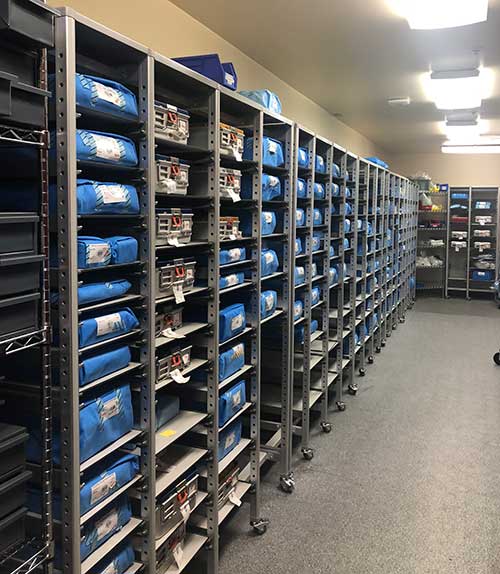
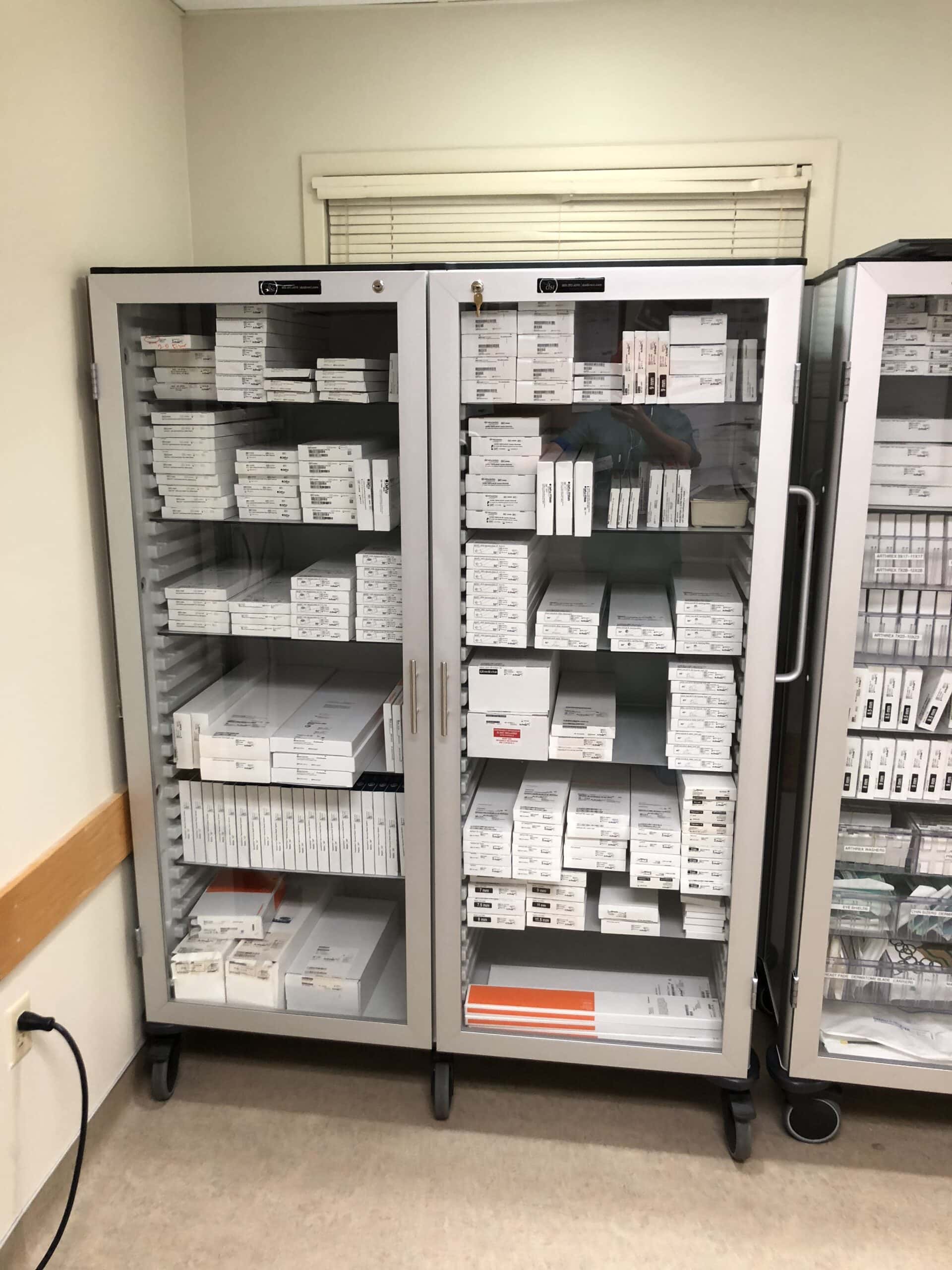
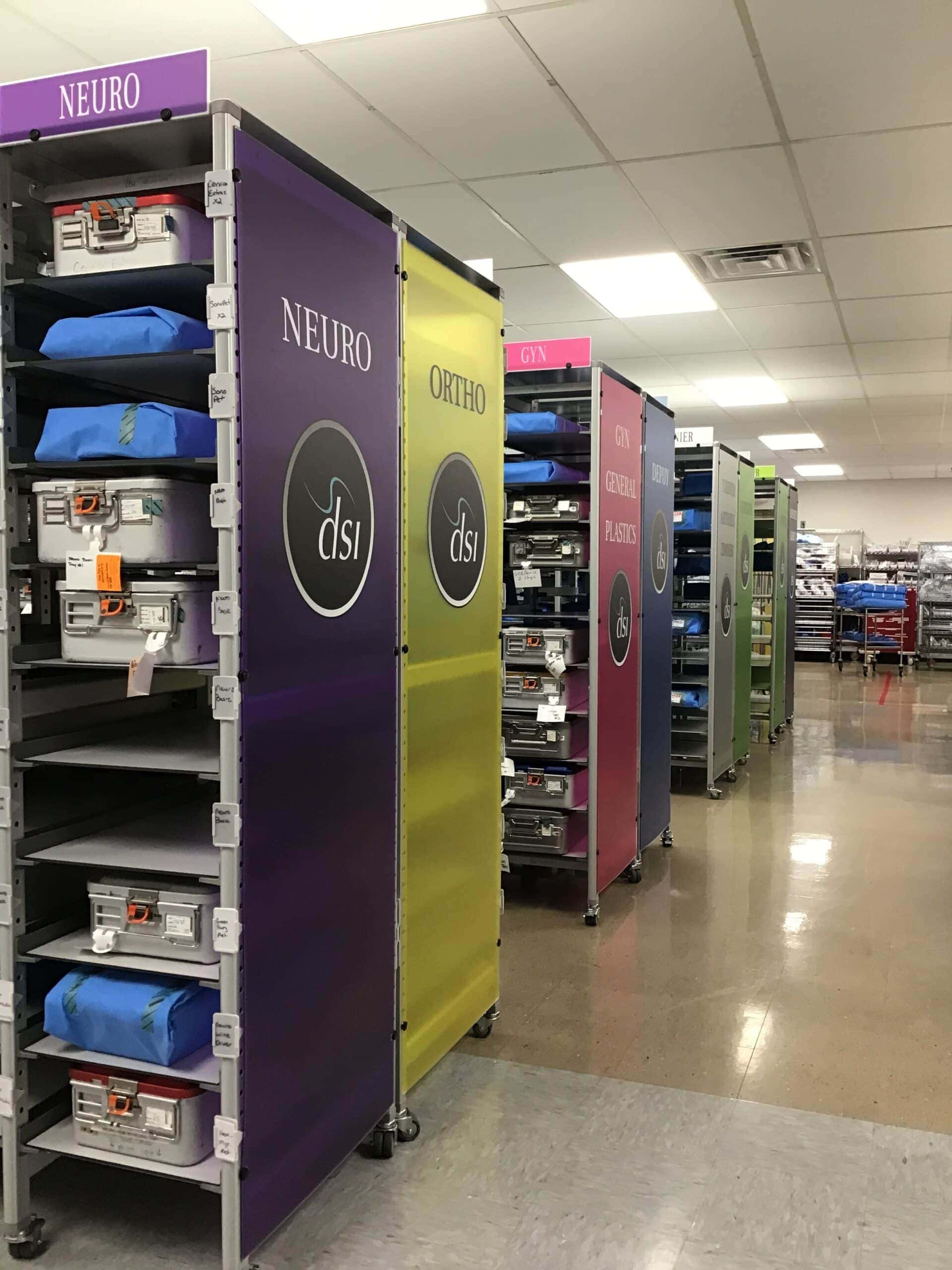
High-density supply storage supports this through adjustable pegboards, angled bin systems, and modular shelving — all of which maintain primary-zone organization as workstation height changes. Color coding by instrument type, tray, or procedure reduces the time spent searching during assembly and lowers the risk of misplacement. Inventory placement drives both staff ergonomics and instrument accountability.
The ROI on ergonomic hospital workstations is well-documented. Every dollar invested in health and safety programs returns 57.3 cents in measurable savings (Warrick, USF 2024). When combined with optimized storage systems, the gains scale further.
One documented case saw workers' compensation costs drop from $227,620 to $26,010 in a single year — an 89% reduction — following ergonomic workstation implementation (Ergotron Case Study Collection). Error rates fell by 56%. Absenteeism dropped by 75%. Net cumulative ROI over three years reached $295,000, with a typical payback period of 23 months.
For healthcare institutions evaluating ergonomic design for storage systems in hospitals, the business case is straightforward: reduced work-related injuries, lower costs, and measurable gains in employee productivity across the sterile processing program.
Successful implementation starts before a single workstation is purchased. Healthcare facilities that skip the assessment phase often invest in the wrong equipment, in the wrong locations. A structured evaluation process prevents that.
An on-site space workflow assessment reveals problems that specifications and floor plans cannot. Spaghetti diagram analysis at a rural hospital SPD exposed excessive walking distances and hazardous cross-traffic between dirty and clean instrument flows — neither visible without a formal assessment (Nino et al., 2020). Validated tools like the Rapid Upper Limb Assessment (RULA) and the NIOSH Lifting Equation quantify risk levels and prioritize where to act first.
The results speak for themselves. Beth Israel Deaconess Medical Center replaced fixed-height workstations with adjustable-height tables and back-support seating — and recorded a 10% reduction in injury-related days away from work, alongside measurable gains in staff morale, engagement scores, and retention (Ergotron Case Study Collection).
Phased planning drives sustainable results. Height-adjustable decontamination sinks, prep and pack tables, anti-fatigue matting, and task lighting deliver the highest return relative to cost and should lead any capital investment plan. Ergonomic criteria belong in procurement specifications from day one — not added after purchase.
Sustained adoption requires ongoing commitment. Annual ergonomic assessments, injury tracking, and near-miss monitoring keep the sterile processing program calibrated over time. A participatory ergonomics committee — built around frontline sterile processing technicians and OR nurses — provides the operational insight no external consultant can replicate.
The outcome: staff satisfaction improves by an estimated 40% with ergonomic workstation implementation (Boynton & Darragh, 2008; Skytron, 2023). Healthcare institutions that build safety culture into their workstation setup retain staff, reduce costs, and sustain quality and safety gains long-term.
DSI has delivered ergonomic workstation systems to acute care facilities across all 50 states since 1990. Every project begins with an on-site space workflow assessment — analyzing your current SPD layout, instrument flow patterns, and departmental workflows before recommending a single piece of equipment. That consultative process is what separates DSI from standard equipment vendors.
DSI manages full turnkey implementation — from CAD-designed layouts and height-adjustable workstation configuration to anti-fatigue matting, high-density supply storage integration, and staff transition support. We don’t deliver a spec sheet and walk away. We manage the project through completion and provide after-sales support to protect your long-term outcomes.
Distribution Systems International has partnered with acute care facilities across the country since 1990, delivering ergonomic workstation solutions and high-density supply storage systems built for the real demands of sterile processing and OR workflow. Our team conducts on-site space workflow assessments, designs custom layouts, and manages full turnkey implementation — so your staff works more safely, and your instruments move faster. Contact Distribution Systems International today to schedule your complimentary storage analysis.

With 21 years of sales management, marketing, P&L responsibility, business development, national account, and channel management responsibilities under his belt, Ian has established himself as a high achiever across multiple business functions. Ian was part of a small team who started a new business unit for Stanley Black & Decker in Asia from Y10’ to Y14’. He lived in Shanghai, China for two years, then continued to commercialize and scale the business throughout the Asia Pacific and Middle East regions for another two years (4 years of International experience). Ian played college football at the University of Colorado from 96’ to 00’. His core skills sets include; drive, strong work ethic, team player, a builder mentality with high energy, motivator with the passion, purpose, and a track record to prove it.