Operating room storage failures don't stay in the storage room. They slow surgical prep, delay case turnover, and create compliance risk that follows a facility into every Joint Commission audit. High-density shelving directly addresses all three. This guide covers how these systems work, what they store, how they're selected, and how to implement them correctly in OR core environments — so hospitals can maximize storage capacity, protect sterility, and keep surgical teams focused on patients.
Key Takeaways
High-density shelving is a storage solution that maximizes storage capacity by eliminating wasted aisle space. In operating room storage, that means more supplies in the same footprint — and faster access to all of them.
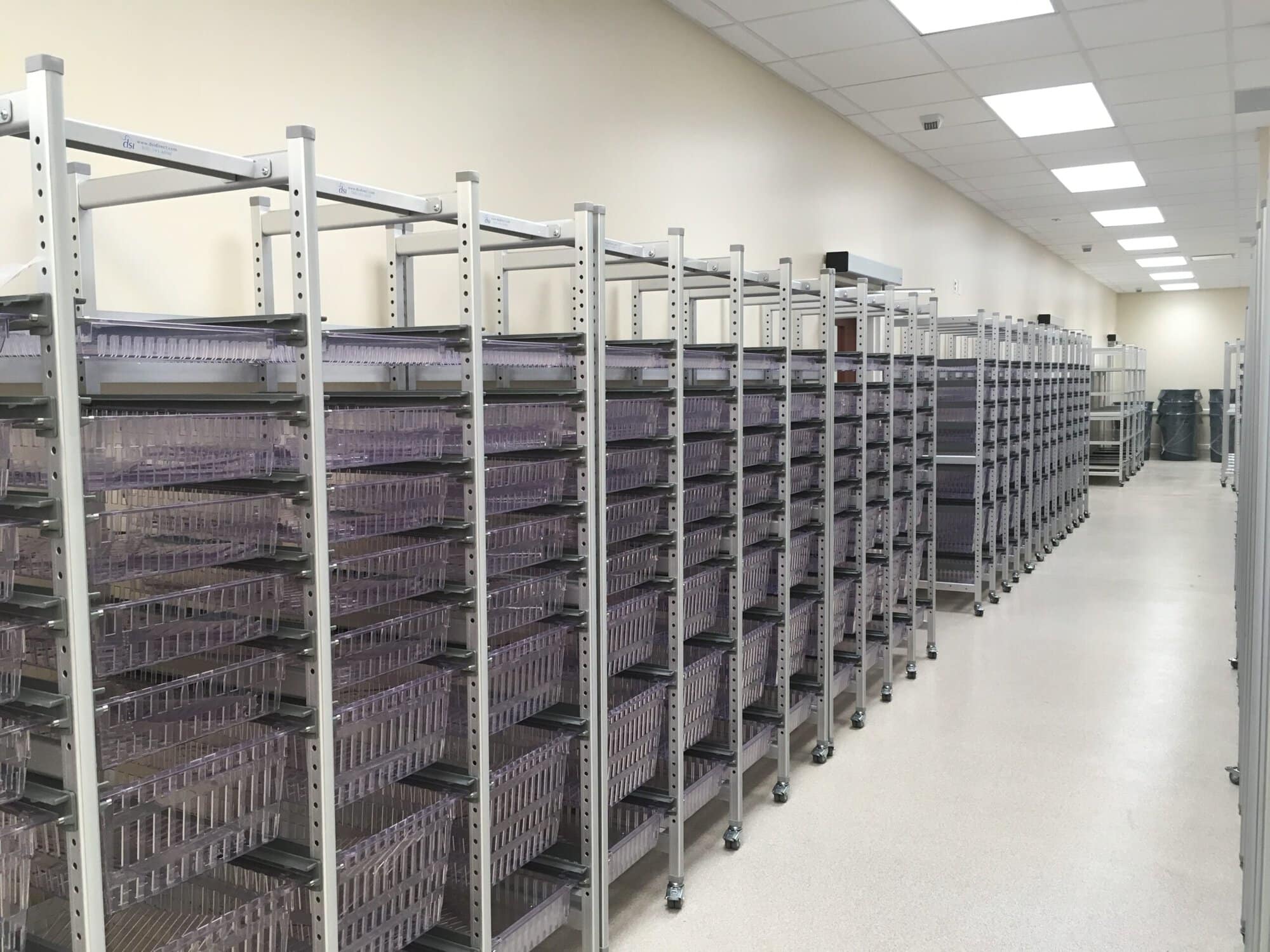
High-density mobile shelving mounts units on wheeled carriages that travel along floor-installed rails. Aisles open only when needed, which can effectively double storage capacity compared to traditional fixed-aisle layouts.
Systems are available in three control types: manual, mechanical-assist, and powered push-button. All modern high-density mobile shelving includes safety sweeps, photo sweeps, and aisle entry sensors that automatically stop carriage movement when an obstruction is detected — protecting both staff and stored items.
The OR core — also called the sub-sterile room or OR corridor — is the central hub for sterile instruments, surgical case carts, and disposable supplies. Space is tight, and every inch counts.
High-density storage systems address this by using vertical space from floor to ceiling. Multilevel storage and mobile units replace underperforming OR cabinets and standard wire shelving, expanding usable capacity without touching the room's footprint. Because OR core rooms are compact by design, storage configuration directly determines how much inventory stays close to the surgical field. The closer supplies are to the point of care, the less time staff spend leaving the sterile environment to retrieve them — a critical efficiency factor during active procedures.
Traditional static shelving — the hospital supply closet standard — creates cluttered aisles, slow retrieval, and sterility risks. It's the lowest-performing option across every measured category.
Static open shelving scores 40% space efficiency, 5/10 on sterility protection, and 5/10 on workflow speed. High-density shelving storage systems outperform it on all fronts. Where static cabinets and wire shelving meet basic storage and shelving needs, high-density mobile wire shelving and movable storage systems meet the demands of a modern surgical environment — including sterile processing department standards and OR readiness requirements.
OR core rooms don't get bigger. Surgical volumes do. High-density shelving lets hospitals expand storage capacity without expanding square footage.
The capacity gains are significant across every system type. High-density mobile shelving delivers an 80% storage capacity gain and 50% floor space reduction versus traditional static shelving. Automated vertical carousel and VLM systems lead all categories: 120% capacity gain and 80% floor space reduction.
Even lower-investment options move the needle. Wall-mounted systems yield a 25% capacity gain and 15% floor space reduction. Modular vertical shelving reaches 45% and 30%, respectively.
Space constraints have a direct cost. One hospital implemented a moving shelving system and increased surgical supply storage by 80% within its existing footprint. That added capacity enabled bulk purchasing — cutting surgical supply costs by 46%.
Surgical volumes are rising. Instrumentation is growing more complex. OR leadership can't afford storage systems that cap capacity or slow operations. Every procedure requires more instruments and disposables than it did a decade ago. Storage systems that can’t scale with demand become operational liabilities — forcing hospitals to choose between overstocking limited space or running the risk of mid-case supply shortages.
Layout determines speed. Point-of-use storage keeps high-frequency items where staff already are, reducing unnecessary movement. Logical grouping of supplies and instruments cuts search time. Clear, unobstructed pathways keep staff, equipment, and sterile supplies moving safely — and reduce contamination risk in the process. These principles apply directly to high-density shelving design. When storage systems are configured to mirror surgical workflow — organized by procedure type, access frequency, and sterility level — staff spend less time navigating and more time focused on patient care. That alignment is where operational efficiency and clinical quality intersect.
Disorganized operating room storage costs time. In surgical environments, time directly affects patient outcomes and case throughput. High-density storage systems recover that time at every step.
Automated vertical carousel and VLM systems reduce staff retrieval time by 65% compared to traditional static shelving — the highest reduction of any evaluated system type.
The mechanism is straightforward. The goods-to-person delivery model brings items directly to an ergonomic access point. Staff don't walk aisles or search shelves. That eliminates wasted motion, reduces physical strain, and compresses prep time significantly.
High-density mobile shelving achieves a 35% reduction in retrieval time versus the static baseline at an average implementation cost of $85K. A large regional hospital that installed high-density storage in its sterile core reported the same result — a 35% retrieval time reduction, with immediate instrument access driving measurable gains in surgical workflow efficiency.
Faster retrieval means faster room turnover. Faster turnover means more cases per day.
Technology extends the efficiency of a well-designed storage solution. RFID tracking provides real-time visibility into instrument and supply location — reducing search time and preventing loss.
Automated dispensing cabinets (ADCs) such as Pyxis and Omnicell add a second layer. They provide secure, controlled access to medications and high-value supplies while integrating with inventory management systems to automate reordering and maintain optimal stock levels. Combined with high-density mobile shelving, they form a complete, accountable operating room storage system.
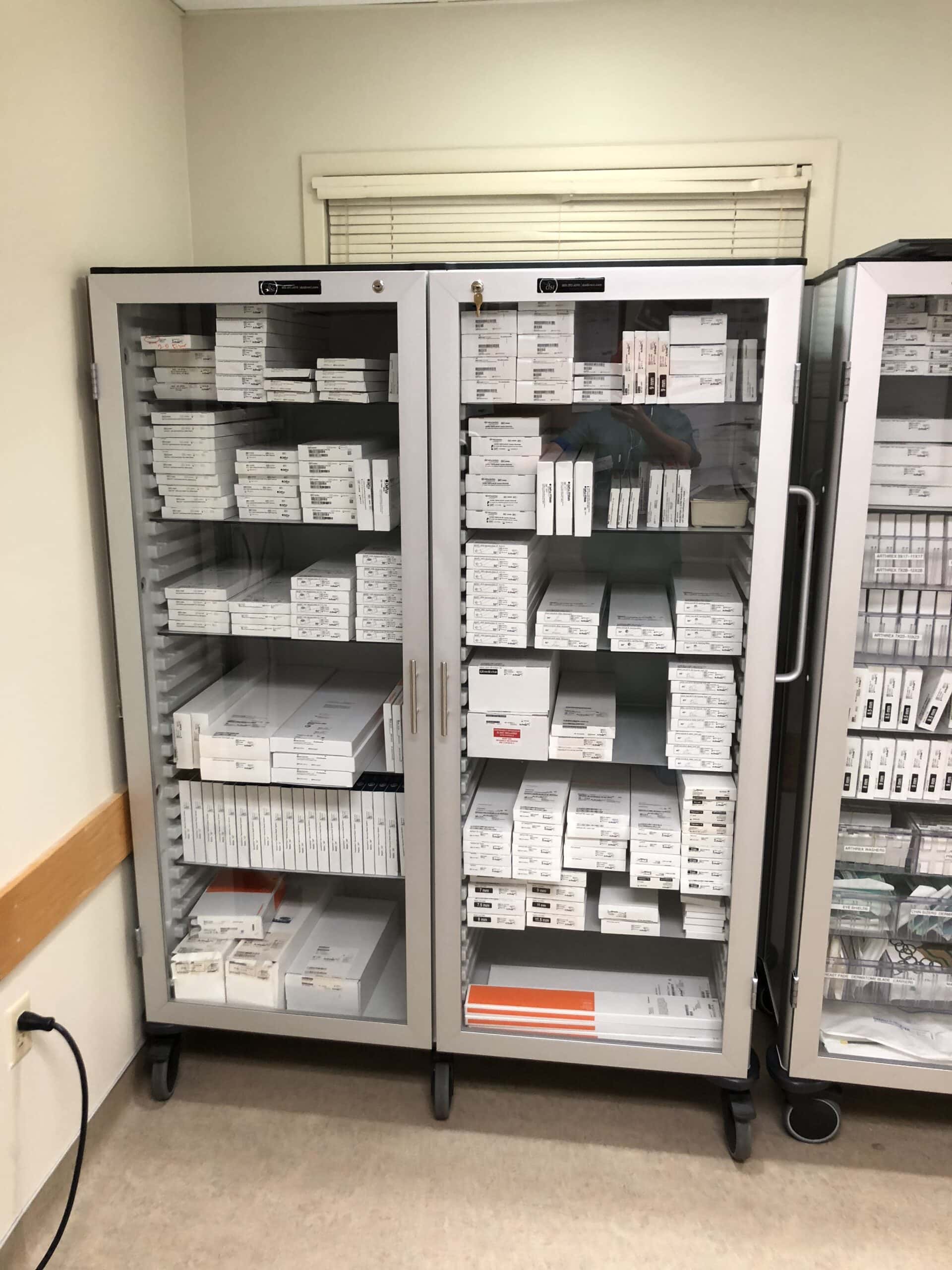
OR core high-density storage systems hold everything a surgical team needs — sterile instrument kits, case cart supplies, and disposables — organized for immediate, reliable access.
Volume and sterility protection are both non-negotiable in the sterile processing department. One large regional hospital's high-density sterile core system accommodated more than 200 individual items with up to two months of supply on hand — without expanding its footprint.
System selection matters for compliance. VLM systems score a perfect 10/10 on sterility protection and AAMI compliance ease. Automated vertical carousels score 9/10 on both. No other storage solution in the evaluated range comes close.
Efficient surgical case cart staging depends on disciplined inventory management. Just-In-Time (JIT) principles keep on-hand stock lean by ensuring supplies arrive when needed — reducing waste and keeping OR cabinets and mobile units from becoming overcrowded.
FIFO (First In, First Out) rotation is equally critical. Industry-wide compliance averages 86%, but it carries a High Risk citation rating under Joint Commission standard IC.02.02.01. A well-organized high-density shelving storage system makes FIFO easier to enforce consistently.
Disposables require fast, visible access. Wall-mounted pegboard and track systems keep lightweight items and small supplies off the floor and immediately reachable — freeing vertical space for mobile storage racks and multilevel storage units holding higher-volume stock.
Modular storage units use interchangeable shelves, bins, and drawers that reconfigure as surgical procedure demands shift. Wall-mounted systems deliver a 10% retrieval time reduction versus static baselines; modular vertical shelving reaches 20% — practical gains that compound across a full surgical day.
The right high-density storage system balances space efficiency, compliance, accessibility, and cost. No single solution fits every facility — but the data makes the tradeoffs clear.
Mobile units offer the strongest combination of capacity and adaptability for operating room storage. High-density mobile shelving in its powered configuration achieves 80% space efficiency and an accessibility score of 8/10, with an AAMI compliance ease score of 8/10 at a Cost Index of 3.5.
Manual high-density mobile shelving is a strong entry-level alternative — 70% space efficiency, AAMI compliance, ease of 7/10, and a lower Cost Index of 2.5. Both outperform static wire shelving and traditional OR cabinets across every performance category.
Surgical inventory changes. Storage and shelving needs evolve as procedures, instruments, and supply volumes shift. Modular units with interchangeable shelves, bins, and drawers reconfigure without replacing the entire system — protecting the investment as OR demands grow.
For facilities prioritizing maximum space optimization, VLM systems reach 95% space efficiency with perfect scores on workflow speed and accessibility. Automated vertical carousels reach 90% at a lower Cost Index of 5.0 versus 6.0 for VLMs. Both come with higher maintenance complexity — a factor to weigh against long-term operational capacity.
Static closed cabinets remain a cost-effective complement to mobile storage rack and multilevel storage systems. They score 8/10 on sterility protection and 7/10 on AAMI compliance ease at a Cost Index of just 1.5.
Closed storage is preferred over open shelving in the sterile processing department because it protects package integrity from dust, traffic, and airflow. Under event-related sterility standards — now the industry norm — storage design itself is the primary defense against contamination.
Use this guide to match your OR core’s specific constraints to the right storage solution before committing to a system type.
Implementation success depends on audit-first planning, compliant layout design, and disciplined post-installation monitoring. Each phase builds on the last.
Phase 1 is a comprehensive audit of existing sterile storage areas against AAMI ST79 and Joint Commission standards — identifying gaps in environmental controls, spatial clearances, and shelving types.
Environmental baselines to verify: temperature 18–23°C (88% industry compliance, Critical Risk under EC.02.06.01); relative humidity 30–60% (82% compliance, Critical Risk). Ventilation minimums: 4 ACH for sterile storage areas (91% compliance) and 10 ACH for decontamination areas. Any deficiency here is a citation waiting to happen.
AAMI ST79 spatial clearances are non-negotiable: sterile items must be stored 8–10 inches off the floor, 18 inches from ceiling and sprinkler heads, and 2 inches from outside walls.
Industry compliance rates reveal where facilities most often fall short. Floor clearance sits at 79% — High citation frequency, High Risk. Closed/covered shelving compliance is 72%, the only requirement in Critical Gap territory, with High citation frequency and Critical Risk. That single gap accounts for significant Joint Commission exposure. IC.02.02.01 drives 50% of all sterile storage citations; EC.02.06.01 accounts for 33%; IC.06.01.01 for 17%.
Post-installation, four metrics demand continuous monitoring: Environmental Monitoring Logs (77% compliance, Critical Risk), Positive Air Pressure (85%), IFU Accessibility and Adherence (84%), and Staff Competency Documentation (80%).
Facilities that invest in monitoring infrastructure see measurable results. An academic medical center's VLM installation directly supported successful Joint Commission audits. A community hospital eliminated sterile storage citations after installing a dedicated HVAC unit. A children's hospital received a surveyor commendation for deploying wireless environmental sensors facility-wide.
One commonly cited installation error: allowing corrugated cardboard shipping boxes into the sterile storage area. Remove all external cartons before any item enters the sterile environment.
Distribution Systems International has spent over 30 years helping acute care facilities transform inefficient storage into a clinical and financial asset. From high-density mobile shelving to full OR core redesigns, DSI delivers turnkey storage solutions built around your workflow, your inventory, and your compliance requirements. Every engagement starts with a complimentary on-site analysis — no obligation, no guesswork. Contact Distribution Systems International today to schedule yours and see exactly what your OR core storage could become.

With 21 years of sales management, marketing, P&L responsibility, business development, national account, and channel management responsibilities under his belt, Ian has established himself as a high achiever across multiple business functions. Ian was part of a small team who started a new business unit for Stanley Black & Decker in Asia from Y10’ to Y14’. He lived in Shanghai, China for two years, then continued to commercialize and scale the business throughout the Asia Pacific and Middle East regions for another two years (4 years of International experience). Ian played college football at the University of Colorado from 96’ to 00’. His core skills sets include; drive, strong work ethic, team player, a builder mentality with high energy, motivator with the passion, purpose, and a track record to prove it.