Healthcare facilities must balance infection control, regulatory compliance, and budget constraints when selecting sterile storage systems. Traditional open shelving offers accessibility and low initial costs, while closed cabinet storage provides superior contamination protection. The choice directly impacts patient safety outcomes, regulatory citations, and long-term operational expenses.
Material selection and environmental controls determine whether storage systems meet evolving infection prevention standards. Chrome wire shelving remains prevalent despite documented contamination risks, while polymer and stainless steel alternatives demonstrate measurable improvements in cleanability and durability.
Key Takeaways
Open shelving and closed cabinet storage represent distinct approaches to organizing sterile medical supplies. Open systems prioritize visibility and airflow, while closed systems emphasize environmental protection and contamination prevention.
The fundamental difference lies in exposure to ambient conditions and airborne particles. Open designs allow direct access but expose supplies to dust, humidity fluctuations, and handling contamination. Closed systems create physical barriers, maintaining controlled microclimates around sterile packages.
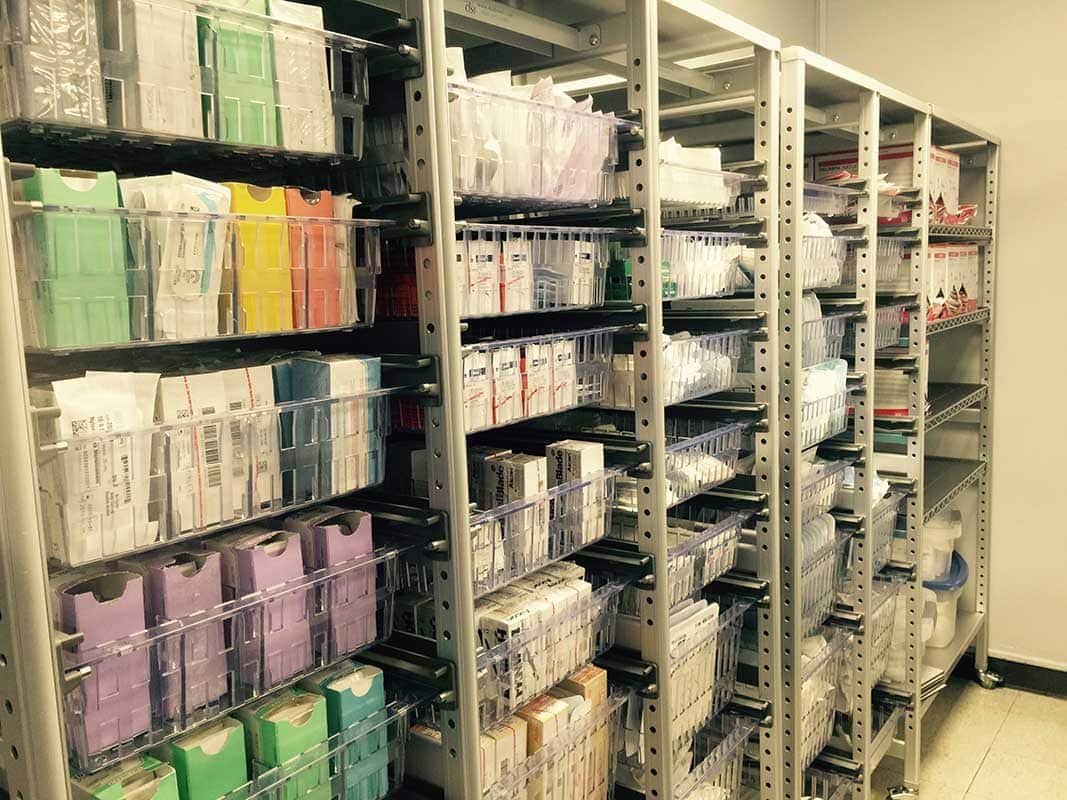
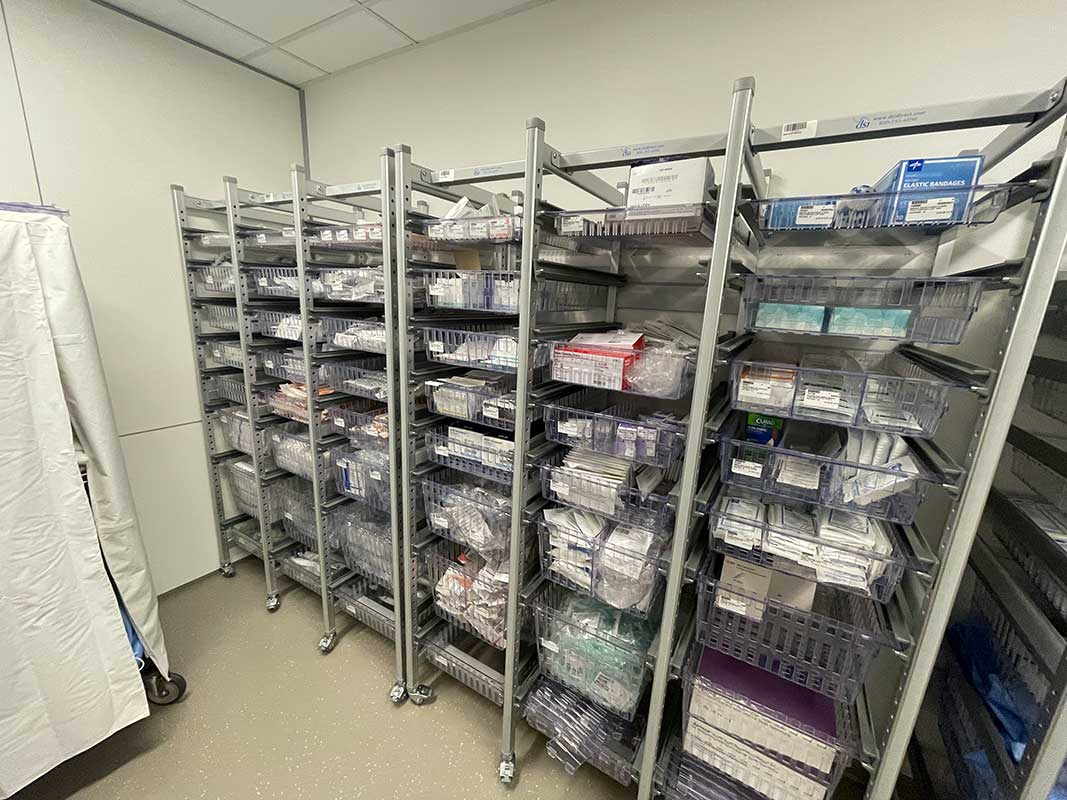
Open shelving systems feature exposed horizontal surfaces, allowing unobstructed visibility and air circulation. Chrome wire shelving dominates this category with individual shelf capacities ranging from 600 to 800 pounds. Standard 5-shelf chrome wire units cost between $100 and $390, making them the most economical initial purchase.
The open design permits dust accumulation and exposes supplies to airborne contamination. Wire shelving holds 18% market share despite infection control limitations. Stainless steel wire alternatives range from $300 to $800 per unit and offer improved corrosion resistance.
Closed cabinet storage features solid or transparent doors sealing supplies inside controlled environments protected from external contamination. Standard stainless steel and polymer cabinets range from $2,000 to $15,000+ per unit, depending on size and features. These systems account for 35% of the market share.
Temperature-controlled cabinets with active environmental monitoring represent the premium tier at $8,000 to $25,000+ per unit. These specialized systems maintain precise temperature and humidity parameters required for sensitive instruments and biological materials.
The primary distinction involves environmental exposure and the resulting impact on sterile package integrity and contamination risk. Open systems expose supplies to continuous air movement, creating opportunities for bacterial settlement in high-traffic areas. Cross-contamination occurs when clean and dirty items share pathways without physical separation.
Closed systems create barriers preventing airborne particles from contacting sterile packages and reducing handling contamination through controlled access points. Modular interiors allow facilities to configure storage compartments for specific instrument sets and supply types.
Compliance with regulatory standards protects patients from preventable infections and shields facilities from financial penalties and accreditation loss. Storage system selection directly determines whether facilities can demonstrate adherence to Joint Commission, CDC, and AAMI guidelines. Non-compliant storage creates documented gaps resulting in citations, mandatory corrective action plans, and potential accreditation loss.
Healthcare-associated infections attributed to inadequate storage generate measurable costs through extended hospital stays and additional treatments. Selecting compliant storage systems represents proactive investment in patient safety rather than a reactive response to regulatory pressure.
Joint Commission standards specify requirements for sterile storage environments, with standard EC.02.06.01 addressing equipment maintenance and cleanable surfaces. Compliance and regulatory standards rank at 98% importance among healthcare decision-makers. Facilities must demonstrate that storage surfaces can be effectively cleaned and equipment remains free from rust and corrosion.
Event-related shelf-life practices have replaced time-based expiration protocols, meaning packages remain sterile indefinitely unless specific events compromise integrity. Current regulatory frameworks require documentation of environmental conditions and equipment maintenance schedules supporting sterility assurance programs.
Storage system design directly influences contamination rates through material selection, surface characteristics, and environmental protection capabilities. Infection control and contamination risk considerations rank at 95% importance in purchasing decisions. Advanced storage systems reduce healthcare-associated infection incidence by 55.7% compared to traditional wire shelving through improved cleanability and environmental barriers.
Chrome wire shelving demonstrates an 85% contamination rate due to corroded surfaces harboring bacteria in microscopic pitting. Bacterial colonies established in damaged plating resist standard cleaning protocols. Polymer alternatives reduce contamination risk to 12%, representing an 86% improvement attributable to seamless construction and chemical-resistant surfaces.
Environmental parameters directly affect bacterial multiplication rates and sterile packaging integrity. Temperature increases of 5°C double bacterial multiplication rates, requiring facilities to maintain storage areas at or below 75°F. Relative humidity must remain between 20% and 60% to prevent microbial growth and packaging degradation.
Temperature and humidity-controlled cabinets represent 7% of market share but address the most stringent compliance requirements. These systems maintain precise environmental parameters through active monitoring and HEPA filtration, achieving ISO 4 cleanliness levels.
Material composition determines surface cleanability, corrosion resistance, and potential for bacterial colonization. Chrome wire shelving fails in clinical applications due to thin plating degrading rapidly under chemical disinfection and moisture exposure. Superior alternatives include solid stainless steel, engineered polymers, and specialized coatings designed for healthcare infection prevention.
Design features, including seamless construction, radius corners, and smooth surfaces, eliminate crevices where bacteria accumulate beyond cleaning reach. Material durability directly correlates with long-term infection control effectiveness as degraded surfaces become progressively difficult to disinfect.
Chrome wire shelving carries an 85% contamination rate stemming from inherent material vulnerabilities. The chrome plating measures only 12.7 micrometers thick and is extremely susceptible to rust and corrosion. Micro-scratches from bins and chemical degradation from hospital-grade disinfectants quickly breach this protective layer.
Corroded surfaces create pitting harboring bacterial colonies resistant to standard cleaning protocols and disinfection procedures. Plating failure accelerates in environments with high humidity and frequent chemical exposure, typical of sterile processing areas. These material failures directly contribute to Joint Commission citations under standard EC.02.06.01.
Polymer systems reduce contamination risk to 12%, representing an 86% improvement over chrome wire through advanced material engineering. Products utilizing materials like AireCore feature seamless construction, eliminating bacterial harboring points. These surfaces remain impervious to rust and resist chemical degradation from repeated disinfectant exposure over 15+ year lifespans.
Solid stainless steel provides inherent corrosion resistance without relying on surface coatings that can fail. Both materials support effective cleaning protocols and maintain surface integrity under chemical and physical stresses. Polymer systems typically cost $500 to $1,200 per unit while delivering durability, eliminating the 3-to-5-year replacement cycle required for chrome wire.
Modular systems account for 28% of market share through adaptability, accommodating changing inventory requirements without complete replacement. Features like FlexCell interiors allow facilities to reconfigure storage compartments for different instrument sets and supply sizes. This flexibility reduces waste from obsolete fixed configurations and supports efficient space utilization.
Closed cabinets provide physical barriers protecting supplies from environmental contamination while maintaining visibility through transparent doors. These systems reduce manual workload by 25% through organized storage, eliminating time spent searching for supplies. The combination of infection control and operational efficiency makes modular closed cabinets the preferred choice for sterile processing departments.
Facility size, budget constraints, and regulatory environment determine which storage systems align with operational requirements and financial capabilities. Large hospitals possess capital resources and space to implement comprehensive closed-cabinet systems with environmental controls. Smaller facilities must balance infection control objectives against limited budgets and physical footprints.
Geographic location influences access to service providers, regulatory stringency, and competitive pressures shaping purchasing decisions. Urban facilities face different space constraints and patient volumes than rural hospitals operating with limited technical support.
Large hospitals with 500+ beds demonstrate 78% adoption rates for advanced storage systems supported by substantial capital budgets and dedicated infection prevention departments. Medium hospitals, ranging from 100 to 500 beds, show 62% adoption as they balance compliance requirements against moderate budget constraints. These facilities often select modular solutions, providing flexibility for future expansion.
Small hospitals under 100 beds face significant space and budget constraints, limiting adoption to 38% despite equivalent compliance obligations. Clinics and urgent care centers show only 25% adoption, frequently utilizing basic closed cabinetry rather than advanced systems.
Northeast and West Coast regions demonstrate the highest penetration of premium temperature-controlled and modular systems, driven by stringent state regulations. These areas contain higher concentrations of large academic medical centers with substantial capital budgets. Southeast and Midwest facilities favor mid-range solutions, balancing essential compliance requirements with regional cost pressures.
Urban versus rural facility adoption reveals significant disparities related to capital availability and service access. Rural facilities face capital budget constraints and geographic isolation from service providers, complicating installation and ongoing maintenance.
Baby Boomer healthcare leaders prioritize established technologies with proven track records and focus heavily on initial capital expenditure. Generation X managers balance cost considerations with operational efficiency improvements, reducing staff burden. Millennial administrators increasingly advocate for data-driven, technologically integrated solutions offering real-time monitoring and environmental analytics.
These generational differences influence evaluation criteria, with younger leaders more receptive to total cost of ownership analyses versus upfront pricing. Millennial decision-makers prioritize systems generating operational data supporting continuous improvement initiatives.
Initial purchase prices reveal substantial differences between budget open shelving and premium closed cabinet systems, requiring comprehensive financial analysis. Chrome wire units costing $100 to $390 appear economical compared to closed cabinets starting at $2,000 and reaching $15,000+. However, upfront costs represent only one component of total financial impact when replacement cycles and maintenance expenses are included.
Total cost of ownership calculations demonstrate that apparent savings from budget systems disappear over operational lifespans through frequent replacements. Polymer systems with 15+ year durability eliminate the 3-to-5-year chrome wire replacement cycle, generating recurring capital expenses.
Chrome wire shelving offers the lowest initial investment at $100 to $390 per 5-shelf unit but requires replacement every 3 to 5 years. Polymer systems cost $500 to $1,200 upfront but deliver 15+ year lifespans without performance degradation or compliance concerns. Fixed systems represent 12% of market share with premium pricing reflecting permanent installation.
Budget tier options create false economies as frequent replacements and maintenance accumulate costs exceeding premium alternatives over operational lifespans. Mid-range stainless steel and polymer solutions provide an optimal balance between initial investment and long-term durability.
Ten-year total cost of ownership for chrome wire units reaches approximately $14,500 per unit, including replacement cycles and maintenance. Comparable polymer units demonstrate a 10-year TCO of approximately $8,500, generating $6,000 savings per unit through eliminated replacements. This represents a 41% reduction in total costs.
Cost and total cost of ownership rank at 88% importance among healthcare decision-makers evaluating storage investments. Facilities replacing 100 chrome wire units with polymer alternatives realize $600,000 savings over 10 years through reduced replacement frequency.
Payback periods of 5.6 months for polymer system replacements demonstrate rapid return on investment through eliminated replacement cycles. Advanced systems generate additional returns through reduced healthcare-associated infection rates, preventing costly complications and extended hospital stays. The 55.7% reduction in HAI incidence translates to substantial savings in treatment costs and liability exposure.
Labor efficiency improvements contribute to ROI through reduced time spent managing disorganized supplies and searching for needed items. Modular systems reduce manual workload by 25%, allowing skilled sterile processing technicians to focus on instrument reprocessing rather than inventory management.
Effective sterile storage requires integrated approaches combining appropriate equipment selection with standardized workflows and environmental monitoring. Sterile processing departments must separate clean and dirty pathways to prevent cross-contamination. Closed cabinets become essential in high-traffic areas where air disturbance creates bacterial settlement risks.
Environmental parameter maintenance, including temperature and humidity control, prevents conditions accelerating bacterial multiplication and packaging degradation. Regular equipment inspection identifies corrosion and damage requiring repair or replacement before surfaces become uncleanable compliance violations.
Sterile processing department workflows must ensure clean instruments move along dedicated pathways separated from contaminated items. Specialized storage solutions for delicate instruments like endoscopes require controlled environments, preventing damage and contamination. PAR level management systems utilize modular storage with clear labeling to maintain adequate inventory without overstocking.
High-traffic areas require closed cabinet protection as air disturbance from personnel movement creates bacterial settlement on exposed surfaces. Storage design should facilitate efficient instrument retrieval without requiring staff to sort through disorganized supplies during time-sensitive procedures.
Temperature maintenance at or below 75°F prevents accelerated bacterial multiplication occurring with every 5°C temperature increase. Relative humidity between 20% and 60% inhibits microbial growth while preventing packaging material degradation. Facilities must document environmental monitoring results to demonstrate compliance with CDC and AAMI guidelines during accreditation surveys.
Advanced systems with active environmental controls maintain these parameters automatically through integrated sensors and climate management systems. Standard closed cabinets provide passive protection by isolating supplies from ambient condition fluctuations. Event-related sterility practices require storage conditions preventing physical damage, moisture exposure, and contamination events compromising package integrity.
The Ethical Infection Prevention and Control framework provides structured decision-making processes for evaluating storage system investments. Step 1 requires identifying specific compliance gaps or infection risk associated with current storage, creating patient safety concerns. Step 2 involves gathering comprehensive information about the total cost of ownership, clinical efficacy, and regulatory compliance of alternative systems.
Step 3 analyzes alternatives based on patient safety impact, staff efficiency improvements, and budget constraints. Step 4 makes final decisions selecting systems providing the highest patient protection levels while delivering long-term financial value. This framework ensures systematic evaluation rather than reactive purchasing driven by immediate cost considerations.
The global sterile storage cabinet market reached $3.46 billion in 2024, and projects continued expansion through 2035. Closed cabinets dominate with 35% market share, reflecting prioritization of infection control over initial cost savings. Modular systems rapidly gain adoption at 28% market share through flexibility, accommodating changing clinical requirements without complete replacement.
Open shelving maintains 18% market share primarily in verified dry, non-clinical storage environments. Temperature and humidity-controlled cabinets represent 7% of the market despite premium pricing, as facilities recognize the necessity for sensitive materials.
Global sterile storage cabinet market valuation reached $3.46 billion in 2024, with projections of $3.60 billion in 2025 and $5.50 billion by 2035. The compound annual growth rate of 4.3% during the forecast period reflects sustained investment in infection prevention infrastructure.
Medical supply storage cabinets specifically reached $2.82 billion in 2024, while surgical instrument storage, valued at $1.41 billion, represents specialized segment growth.
Market expansion from $3.15 billion in 2022 to $3.31 billion in 2023 demonstrated 5.1% growth, followed by 4.8% growth, reaching $3.46 billion in 2024. Medical cabinetry projects $11.71 billion by 2027 with 4.7% CAGR, indicating broader industry investment.
Advanced polymer materials like AireCore provide seamless surfaces, eliminating bacterial harboring points while resisting chemical degradation over extended lifespans. Modular interior systems, including FlexCell, allow facilities to reconfigure storage compartments without purchasing entirely new cabinets as needs change. Temperature and humidity monitoring integration enables real-time environmental tracking, supporting compliance documentation.
Durability and lifespan considerations rank at 82% importance as facilities recognize that frequent replacement cycles disrupt operations and increase total costs. Ease of use and efficiency rate 78% importance reflecting focus on reducing staff time spent managing supplies versus clinical activities.
Modern storage systems reduce manual workload by 25% through organized configurations, eliminating time-consuming supply searches. Clear visibility through transparent doors combined with logical organization enables rapid location of needed items. PAR level management becomes more effective with modular systems, allowing precise inventory control without overstocking.
Staff efficiency improvements translate directly to cost savings by allowing highly trained technicians to focus on critical instrument processing. Reduced handling of sterile packages minimizes contamination risk from unnecessary touching while searching through disorganized storage.
Evidence clearly demonstrates that closed cabinet sterile storage provides superior infection control, regulatory compliance, and long-term financial value compared to traditional open shelving. While chrome wire open shelving offers low initial costs, the 85% contamination rate and 3-to-5-year replacement cycle create ongoing compliance risks and hidden expenses. Polymer and stainless steel closed cabinets eliminate corrosion-related bacterial harboring while delivering 15+ year lifespans, reducing the total cost of ownership by 41%.
Healthcare facilities must evaluate storage decisions through a comprehensive total cost of ownership analysis rather than focusing exclusively on purchase prices. The 55.7% reduction in healthcare-associated infections achieved with advanced systems protects patients while generating measurable financial returns. Organizations like DSIDirect provide specialized expertise in translating evidence-based principles into practical storage solutions tailored to specific facility requirements.
Making informed sterile storage investments requires balancing patient safety priorities against realistic budget limitations and operational requirements. Facilities should utilize the Ethical Infection Prevention and Control framework to systematically evaluate alternatives based on compliance capabilities, infection control effectiveness, and long-term financial impact.
Upgrade Your Sterile Storage System with Distribution Systems International
Chrome wire shelving's 85% contamination rate isn't a compliance gray area — it's a patient safety risk with a known cost. Distribution Systems International helps SPD teams replace underperforming storage with polymer and modular solutions proven to reduce contamination, meet Joint Commission standards, and deliver a 41% lower total cost of ownership over 10 years.
Our complimentary storage analysis identifies your current compliance gaps, maps your workflow, and delivers a custom design with full ROI projections — at no cost to you.
Contact Distribution Systems International today to schedule your free sterile storage consultation.

With 21 years of sales management, marketing, P&L responsibility, business development, national account, and channel management responsibilities under his belt, Ian has established himself as a high achiever across multiple business functions. Ian was part of a small team who started a new business unit for Stanley Black & Decker in Asia from Y10’ to Y14’. He lived in Shanghai, China for two years, then continued to commercialize and scale the business throughout the Asia Pacific and Middle East regions for another two years (4 years of International experience). Ian played college football at the University of Colorado from 96’ to 00’. His core skills sets include; drive, strong work ethic, team player, a builder mentality with high energy, motivator with the passion, purpose, and a track record to prove it.