Operating rooms run on precision. Every delayed instrument, every missing supply, every disorganized storage area slows surgical teams down and puts patients at risk. Yet most hospitals are still trying to solve modern surgical volume demands with outdated static shelving and inefficient layouts. OR core storage is where that problem starts — and where it gets fixed. This guide covers operating room core storage from the ground up: what it is, why it fails, and how space maximization strategies help hospitals do more without adding a single square foot.
Key Takeaways
OR core storage is the operational backbone of any hospital operating room. How it's designed directly determines whether surgical teams can work efficiently — or spend valuable time searching for what they need.
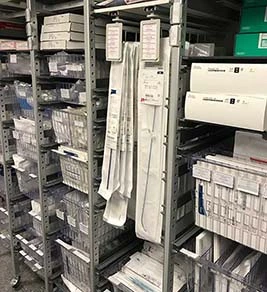
OR core rooms — also called sub-sterile rooms or OR corridors — are the centralized hub between operating rooms. Sterile instruments, surgical supplies, and sterile kits all stage here before each procedure. Every surgical procedure depends on this space functioning without friction.
Storage placement matters. Strategic layout reduces staff travel distances, lowers fatigue, and keeps supply items accessible at the point of use. High-density mobile storage systems take this further — automated goods-to-person delivery brings inventory directly to staff, eliminating search time and physical strain entirely.
Disorganized sterile core storage racks aren't just an efficiency problem — they're a patient safety risk. Sterility breaches lead to surgical site infections, a leading driver of morbidity, mortality, and excess cost across healthcare facilities.
Regulators agree. Joint Commission data shows IC.02.02.01 (Reducing Infection Risks) accounts for 50% of all citations in sterile storage audits. EC.02.06.01 follows at 33%, IC.06.01.01 at 17%. Sterile instrument organization isn't optional — it's audited.
OR core storage houses surgical instruments, sterile supplies, hospital carts, medical carts, and surgical case carts used across every surgical procedure — from routine cases to complex neurosurgery suite demands.
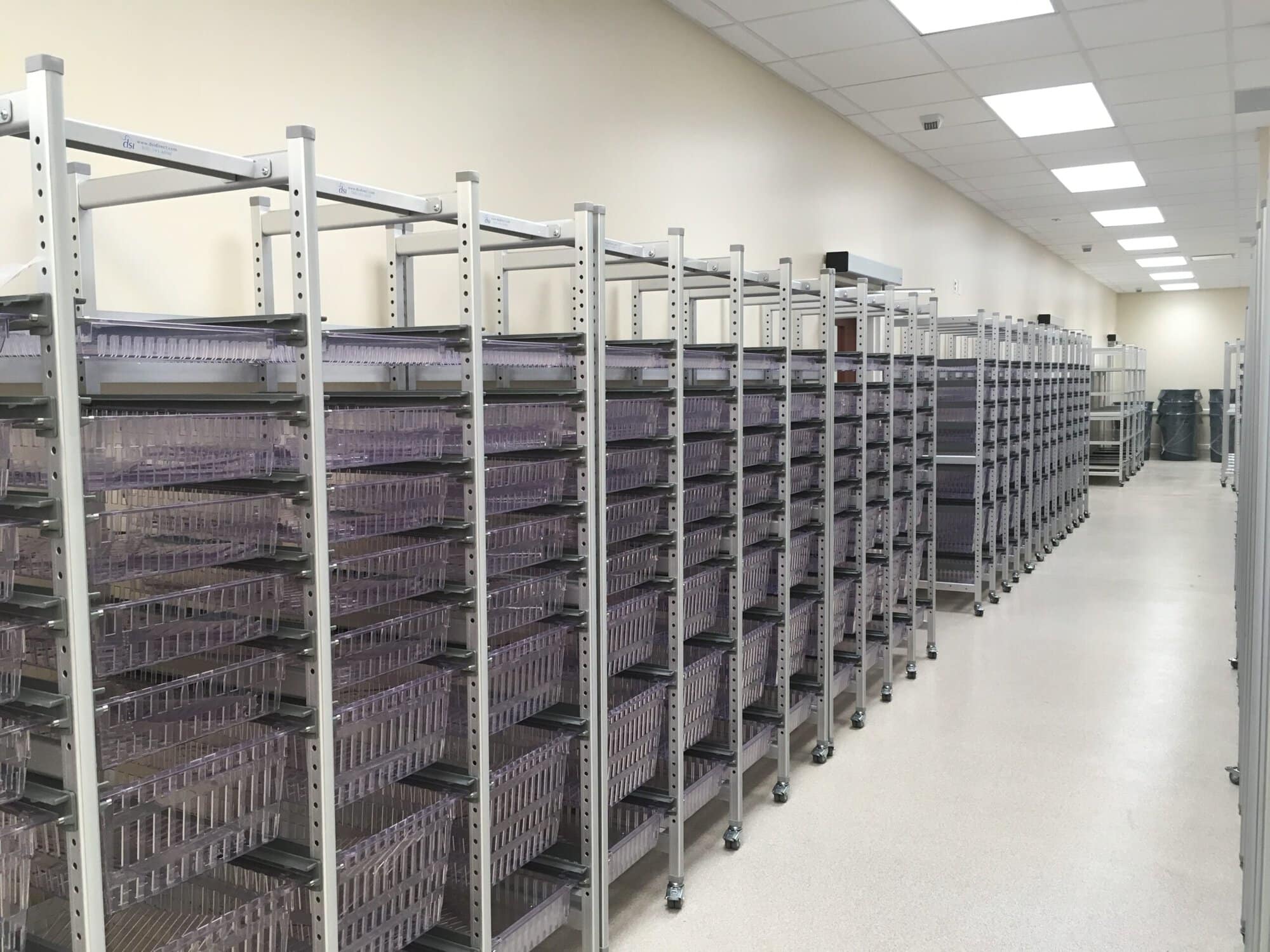
Mobile shelving systems handle the volume. One large regional hospital used high-density supply storage to maintain a two-month supply of over 200 item types within their existing storage area — without adding square footage. From basic consumables and sterile packs to powered equipment and case carts, every item stored in the OR core needs a designated, accessible location to keep surgical procedures running on schedule.
Most hospital operating room storage problems aren't from lack of space — they're from poor use of it. As surgical volumes grow, the gap between what facilities have and what they need widens fast.
Surgical procedures are more complex than ever. More instrumentation, more sterile kits, more surgical supplies per case. But the storage area hasn't grown to match.
Traditional static shelving delivers zero improvement in storage capacity, floor space reclamation, or retrieval time compared to every high-density alternative. It's not a neutral choice — it's a documented liability. Healthcare facilities still relying on static systems are losing ground with every added surgical case.
When operating room inventory isn't organized logically, surgical teams pay the price. Staff spend clinical hours hunting for supply items instead of supporting patient care. In a surgical setting, those delays aren't minor — they cascade into late starts, extended turnover times, and increased patient risk.
Poor hospital operating room surgical supply storage doesn't just inconvenience staff. It compromises the standard of care. Every minute a surgical team spends searching for missing supply items is a minute taken directly from the patient on the table — a risk no healthcare facility can afford to accept.
Joint Commission compliance data identifies three consistent failure points across healthcare facilities:
If your storage area scores low on any of these, it's not a sign you need more space. It's a sign you need better hospital storage solutions.
Adding square footage isn't realistic for most hospitals. The better question is how to extract more capacity from the storage space already available.
High-density mobile storage systems deliver measurable results. Compared to traditional static shelving, high-density mobile shelving produces an 80% storage capacity gain and 50% floor space reduction — within the same footprint.
The investment is higher (~$85K vs. ~$15K for static shelving), but the return is concrete. One hospital implementing a mobile shelving system increased surgical supply storage by 80%, unlocking bulk purchasing that cut surgical supply costs by 46%.
Not every facility needs a full mobile system. Vertical and modular options offer meaningful square footage savings at lower entry points:
| System | Capacity Gain | Floor Space Reduction | Est. Cost |
| Wall-Mounted Systems | 25% | 15% | ~$25K |
| Modular Vertical Shelving | 45% | 30% | ~$40K |
| Automated Vertical Carousel / VLM | 120% | 80% | ~$200K |
Floor-to-ceiling shelving captures overhead space that most facilities leave completely unused — freeing eye-level storage for the surgical supplies teams' access most. Choose wall-mounted systems when the budget is limited, and floor space is the primary concern. Choose modular vertical shelving when reconfigurability is a priority and surgical supply inventories change frequently. Choose an Automated Vertical Carousel or VLM when maximum capacity gain and the highest infection control standards are both required.
Hardware alone isn't enough. Layout strategy drives day-to-day efficiency.
Three proven approaches:
The right equipment does more than store supplies — it protects sterility, accelerates case prep, and keeps surgical teams moving.
Open shelving is economical. It's also the wrong choice for sterile core storage.
Closed operating room cabinets outperform open shelving on every sterility metric. They block dust, limit traffic exposure, and control ambient airflow around sterile supplies. Solid top shelves add another layer of protection against dust accumulation on items below.
The data reflects it. Static closed cabinets score 8/10 for sterility protection and 7/10 for AAMI compliance ease. Static open shelving scores 5/10 on both. In a Joint Commission audit, that gap is the difference between a citation and a pass.
Surgical case carts bring organization directly to the point of procedure. When sterile kits and surgical supplies are grouped by procedure or surgical team — and staged on hospital carts ready to move — retrieval becomes systematic rather than reactive.
One large regional hospital installed high-density systems inside its sterile core and cut retrieval times by 35%. Faster access to surgical instruments means faster case starts and tighter OR turnover throughout the day.
Retrieval speed varies significantly by system type. For high-frequency surgical supply storage, the performance gap is substantial:
| System | Retrieval Time Reduction | Infection Control Rating |
| Wall-Mounted Systems | 10% | 3.5/5 |
| Modular Vertical Shelving | 20% | 3.8/5 |
| Automated Vertical Carousel / VLM | 65% | 4.8/5 |
For operating rooms running high surgical volumes, automated systems aren't a luxury — they're the most efficient storage solution available. Choose wall-mounted systems if budget is the primary constraint and retrieval speed is secondary. Choose modular vertical shelving when flexibility matters more than maximum throughput. Choose an Automated Vertical Carousel or VLM when retrieval speed and infection control performance are the deciding factors.
Switching to high-density supply storage isn't just a purchasing decision — it's a process. The right implementation sequence prevents costly mismatches between system design and actual workflow.
Before selecting any hospital storage solution, storage specialists need three things from a baseline assessment:
Durability and safety determine long-term value in any hospital operating room environment.
Modern high-density mobile systems include safety sweeps, photo sweeps, and aisle entry sensors — automatically stopping carriage movement when an obstruction is detected. Stainless steel products and antimicrobial-coated finishes resist microbial growth and hold up under healthcare cleaning protocols.
Maintenance complexity is a real cost factor. Manual mobile systems rate 2.0/5. Powered systems rate 2.5/5. Automated Vertical Carousels reach 3.5/5, and VLMs 4.0/5. Factor this into the total cost of ownership before committing.
The most workflow-compatible approach is hybrid. Mobile high-density shelving handles bulk surgical supply storage and lower-frequency inventory. Automated or static systems serve high-demand surgical assets at the point of access.
Performance benchmarks support this:
| System | Space Efficiency | Workflow Speed | AAMI Compliance Ease |
| Mobile High-Density (Manual) | 70% | 7/10 | 7/10 |
| Mobile High-Density (Powered) | 80% | 8/10 | 8/10 |
RFID tracking adds real-time visibility across surgical instruments and supply items. Automated Dispensing Cabinets — Pyxis, Omnicell — connect directly to inventory management systems, automating reordering and reducing operating room inventory gaps.
Storage planning that only solves today's problem creates tomorrow's bottleneck. Long-term efficiency requires systems that scale, align across departments, and maintain compliance without constant intervention.
Modular systems handle growth without requiring full replacement. Interchangeable shelves, bins, and drawers reconfigure as surgical procedures evolve and operating room inventory expands.
For facilities planning maximum scalability, automated systems lead every performance category:
| System | Space Efficiency | Accessibility | Sterility Protection | AAMI Compliance Ease |
| Automated Vertical Carousel | 90% | 9/10 | 9/10 | 9/10 |
| Vertical Lift Module (VLM) | 95% | 10/10 | 10/10 | 10/10 |
One large academic medical center redesigned its SPD sterile storage area around automated vertical lift modules — streamlining inventory management, reducing environmental exposure, and passing subsequent Joint Commission audits without issue.
OR core storage doesn't operate in isolation. AAMI ST79 sets shared standards that span the entire sterile supply chain:
Industry compliance gaps reveal where misalignment costs facilities most: FIFO Inventory Rotation 86%, IFU Accessibility 84%, Staff Competency Documentation 80% — all high-risk requirements shared across SPD and OR functions. Sterile Processing, Infection Prevention, and Facilities Management must coordinate to close these gaps.
Environmental controls show the clearest compliance picture. Air Changes/Hour leads at 91%. Wall Clearance follows at 90%. But temperature (88%) and relative humidity (82%) carry critical risk designations — both flagged for high citation frequency under EC.02.06.01.
Two facilities demonstrate what proactive planning achieves. A community hospital installed a dedicated HVAC unit after environmental citations — and recorded zero related citations in its next Joint Commission audit. A children's hospital deployed wireless environmental sensors throughout its sterile storage areas, earning direct commendation from surveyors for its real-time monitoring program.
Strategic healthcare storage solutions don't just organize surgical supplies. They build the compliance infrastructure that protects patients, staff, and accreditation status simultaneously.
Not every storage vendor approaches OR core challenges the same way. Here’s how DSI is different — and how to know if we’re the right fit for your facility.
DSI doesn’t sell storage products and walk away. With over 30 years serving acute care facilities across all 50 states, DSI brings a consultative, LEAN-based methodology to every OR core storage engagement. Every project starts with an on-site analysis — measuring inventory, workflow, and space — before a single product is specified. The result is a fully turnkey solution: custom CAD design, ROI calculation, installation, inventory transfer, and after-sales support. DSI is a single-source provider for the entire storage optimization lifecycle.
Choose DSI when your facility needs more than a product catalog. DSI is the right partner when you’re facing a Joint Commission audit, expanding surgical capacity, renovating OR core rooms, or struggling with inventory costs and workflow inefficiencies that generic storage solutions haven’t fixed. If you need a storage system designed around your specific workflows, departments, and compliance requirements — with a single partner managing every phase — DSI is built for that.
DSI focuses exclusively on acute care facilities — hospitals, ambulatory surgery centers, and medical office buildings. If you’re looking for a quick off-the-shelf purchase with no consultation or implementation support, DSI’s process-first approach may be more than your project requires. DSI is built for facilities that want a lasting, measurable outcome — not just new shelving.
Inefficient storage costs hospitals more than space — it costs time, compliance, and patient safety. Distribution Systems International has spent over 30 years helping acute care facilities design smarter, leaner storage systems that perform under real surgical demands. From high-density mobile shelving to full OR core redesigns, DSI delivers turnkey solutions built around your workflow. Don't wait for a Joint Commission citation to make the change. Contact DSI today for a complimentary storage analysis and see exactly where your facility is losing ground.
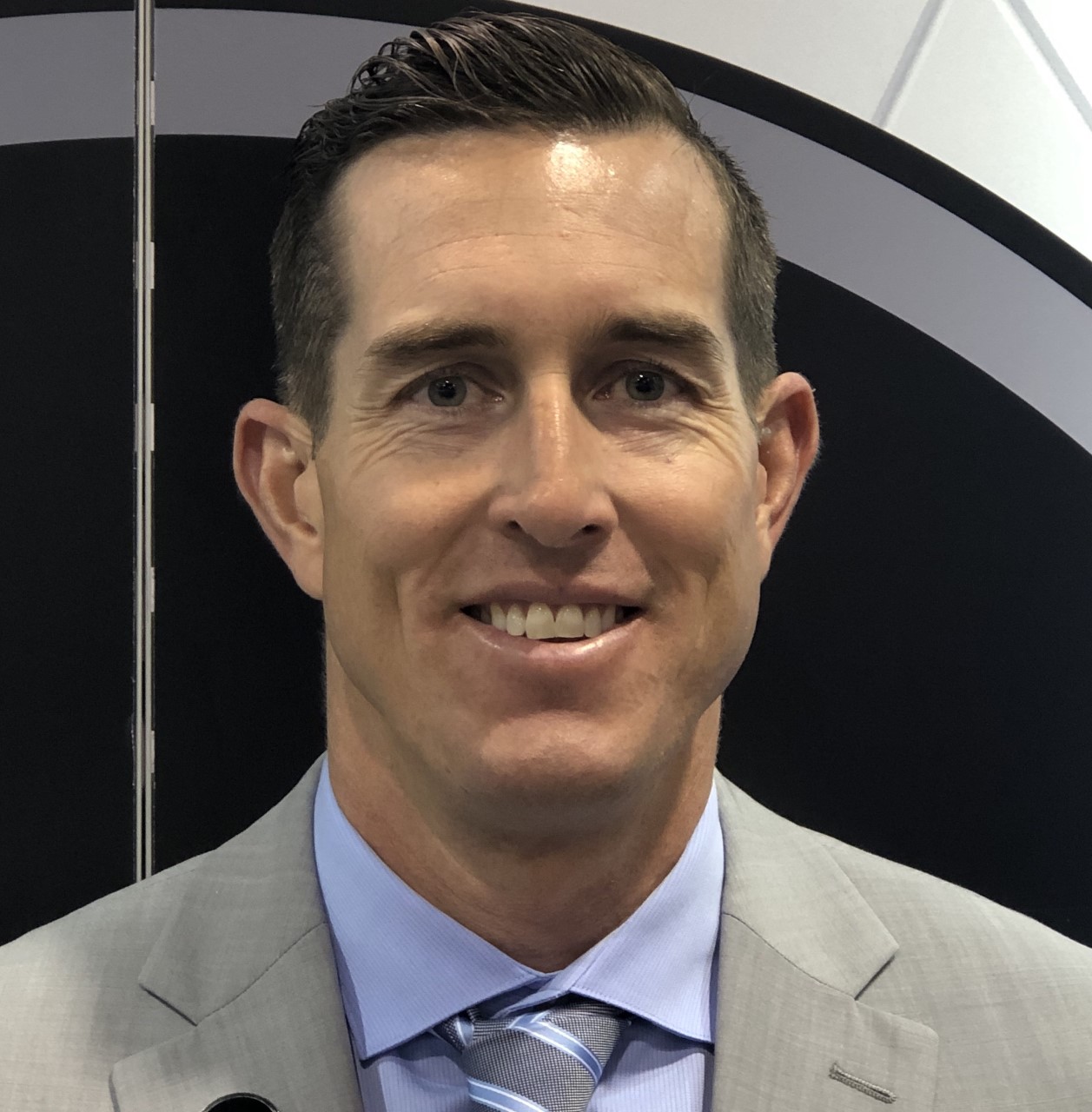
With 21 years of sales management, marketing, P&L responsibility, business development, national account, and channel management responsibilities under his belt, Ian has established himself as a high achiever across multiple business functions. Ian was part of a small team who started a new business unit for Stanley Black & Decker in Asia from Y10’ to Y14’. He lived in Shanghai, China for two years, then continued to commercialize and scale the business throughout the Asia Pacific and Middle East regions for another two years (4 years of International experience). Ian played college football at the University of Colorado from 96’ to 00’. His core skills sets include; drive, strong work ethic, team player, a builder mentality with high energy, motivator with the passion, purpose, and a track record to prove it.