Joint Commission accreditation surveys scrutinize sterile processing departments more closely than almost any other hospital environment — and for good reason. Compliance gaps here directly threaten patient safety and put accreditation status at risk. Proper sterile instrument storage is what stands between a sterilized device and a preventable infection. This guide covers exactly what AAMI and Joint Commission standards require, where healthcare facilities most commonly fall short, and how the right storage systems and workflows keep SPD teams audit-ready long term.
Sterile storage is a controlled environment where sterilized instruments and disinfected devices are held until use. Done correctly, it protects patient safety and keeps healthcare facilities audit-ready. Done poorly, it triggers Joint Commission citations and puts hospital patients at risk.
Every surgical procedure depends on instruments that have been properly stored from the moment they left the sterilizer. When storage conditions break down — through temperature drift, clearance violations, or compromised shelving — consequences reach directly into the OR. For SPD teams and OR directors, understanding what compliant sterile storage requires is the foundation of every audit preparation effort.
Sterile instrument storage is a frontline infection prevention measure. Surgical site infections (SSIs) are a leading cause of patient morbidity, mortality, and avoidable healthcare costs — and compromised sterile processing storage is a direct contributing factor.
Today's sterilization standards follow an event-related model. A sterilized instrument stays sterile until something compromises it — torn packaging, moisture exposure, or an accidental drop. This means the storage environment itself carries the full weight of maintaining sterilization efficacy between the SPD and the OR.
Sterile processing is one of the highest-scrutiny areas in Joint Commission accreditation surveys. Three standards drive nearly all sterile storage citations:
Surveyors examine sterile processing storage closely because failures here create direct, measurable risk. Regulatory compliance in this area is non-negotiable.
AAMI ST79 sets the baseline for sterile processing storage in every accredited healthcare facility. Meeting these standards isn't optional — it's the foundation of regulatory compliance and Joint Commission accreditation.
AAMI ST79 covers every dimension of sterile storage — from air circulation in the storage room to the distance between a sterile tray and the floor. These are enforceable standards that Joint Commission surveyors check during every accreditation cycle. Facilities that treat these parameters as guidelines rather than requirements consistently appear in audit citation data as the ones with the most preventable violations.
AAMI Standards specify exact environmental parameters for sterile storage areas:
Spatial clearances are equally non-negotiable:
These requirements govern how sterile processing storage is physically designed and maintained day to day.
Structured compliance practices exist because gaps are common — and costly. Industry data shows where most healthcare facilities stand:
| Requirement | Typical Compliance Rate | Status |
| FIFO Inventory Rotation | 86% | Good |
| IFU Accessibility & Adherence | 84% | Good |
| Staff Competency Documentation | 80% | Good |
| Environmental Monitoring Logs | 77% | Needs Attention |
| Closed/Covered Shelving | 72% | Critical Gap |
Closed shelving has the lowest compliance rate of any measured requirement — well below the 85% industry target. This is where infection prevention programs most often fall short, and where Joint Commission audits most frequently find violations.
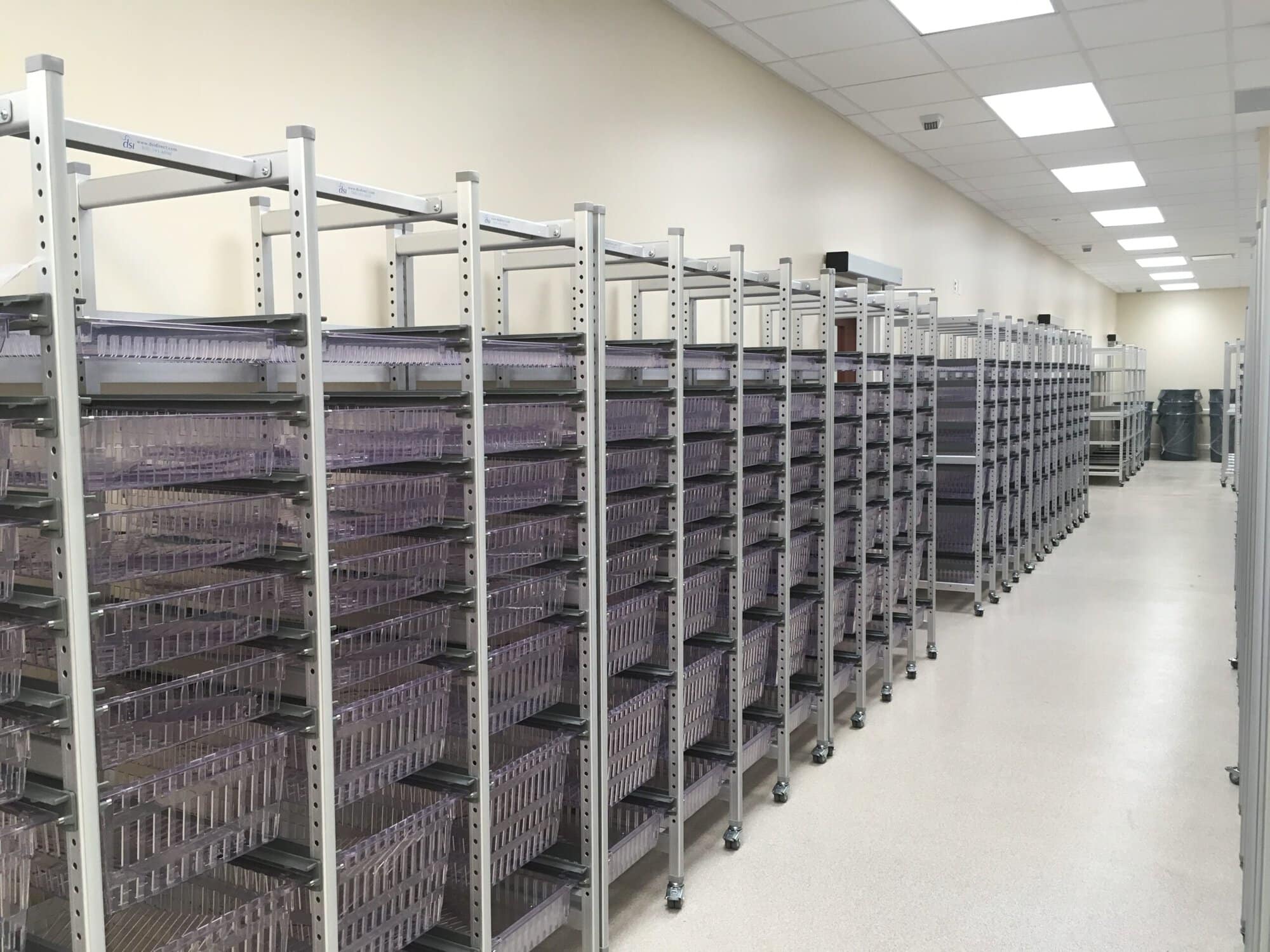
Sterile storage compliance depends on the right combination of physical infrastructure, environmental controls, and storage systems. High-density storage and proper shelving design are where AAMI standards and Joint Commission audit readiness converge.
Achieving Joint Commission accreditation means demonstrating that every layer of your sterile storage environment — from shelving type to airflow controls — operates within AAMI parameters. Facilities that build compliance into their physical infrastructure from the start spend less time scrambling before audits and more time focused on patient care. The right storage systems make compliance the default, not an effort.
High-density supply storage systems increase capacity while directly supporting infection prevention and regulatory compliance. Performance data by system type:
Enclosed automated systems also score highest for sterility protection and AAMI compliance ease — their sealed design shields sterilized instruments from dust, traffic, and environmental contaminants.
Real-world result: One children's hospital deployed wireless sensors for continuous environmental monitoring throughout sterile processing storage. Joint Commission surveyors responded with a formal commendation during accreditation review.
Which system is right for your facility?
Choose Automated VLMs or Vertical Carousels if your facility handles high surgical volumes, needs the highest sterility protection, and prioritizes AAMI compliance ease above all other factors. These systems deliver the highest storage capacity gains (120%) and score highest on AAMI compliance ease.
Choose Powered Mobile High-Density Shelving if you need strong capacity gains with a better ROI than fully automated systems. With a composite benefit score of 7.7/10 against a cost index of 5.8, it is the strongest value option for budget-conscious facilities.
Choose Modular Vertical or Wall-Mounted Systems if you are working within a constrained budget or a limited footprint and need a practical, compliant entry point into high-density sterile storage.
Audit readiness is built requirement by requirement. Current industry compliance rates show where healthcare facilities are meeting the mark — and where risk remains:
| Requirement | Compliance Rate | Rating |
| Air Changes/Hour (min. 4 ACH) | 91% | Excellent |
| Wall Clearance (2 inches) | 90% | Excellent |
| Positive Air Pressure | 85% | Good |
| Ceiling Clearance (18 inches) | 83% | Good |
| Relative Humidity (30–60%) | 82% | Good |
| Floor Clearance (8–10 inches) | 79% | Needs Attention |
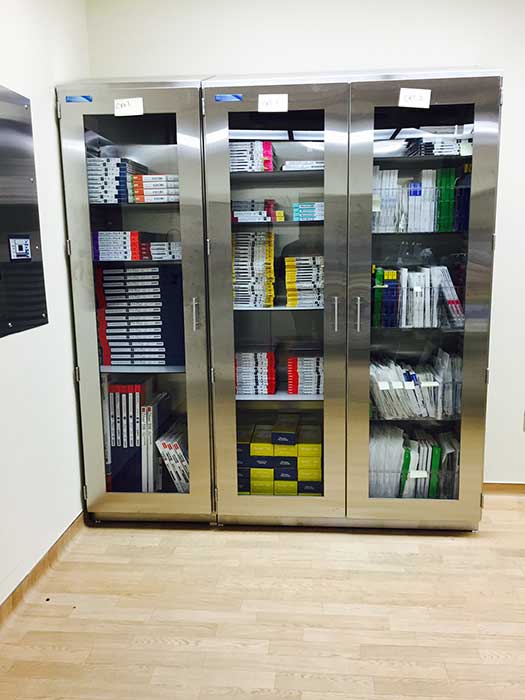
Closed shelving is the preferred standard. Open shelving exposes sterile instrument storage to dust and ambient airflow, requiring more frequent cleaning and tighter environmental controls to maintain sterile processing storage integrity.
The sterile processing department is the operational backbone of sterile storage compliance. SPD teams control instrument decontamination, sterilization efficacy, and the integrity of sterilized instruments before they ever reach the OR.
From instrument decontamination through sterilization and into storage, SPD teams are responsible for every link in the sterile instrument chain. A breakdown at any point creates infection risk and audit exposure. Understanding the SPD’s role in sterile storage compliance is essential for OR directors, infection prevention teams, and facility administrators working toward sustained Joint Commission accreditation.
SPD teams use structured workflow systems to maintain sterile processing storage at audit-ready standards. The 5S methodology — Sort, Set in Order, Shine, Standardize, Sustain — is a core lean practice that keeps sterile storage organized, clean, and consistently compliant with AAMI standards.
Workflow optimization at the storage system level produces measurable compliance results. One large academic medical center redesigned its SPD sterile storage around automated vertical lift modules. The outcome: reduced environmental exposure for sterilized instruments, streamlined inventory management, and successful Joint Commission accreditation audits.
Infection control doesn't end when instruments leave the sterilizer. The handoff between SPD and OR staff is a high-risk point for sterile package compromise. Three practices directly reduce that risk:
Together, these practices align SPD operations with the infection prevention requirements that Joint Commission audits evaluate directly.
Most sterile storage failures are preventable. They stem from documentation gaps, physical storage violations, and shelving decisions that don't meet AAMI compliance requirements. Knowing the most cited failures is the first step to avoiding them.
Joint Commission surveyors follow predictable patterns. The same citations appear across facilities of all sizes, in every region, year after year. Healthcare facilities that audit themselves against these common failure points consistently outperform those that wait for surveyors to find them first.
Joint Commission surveyors cite the same sterile processing storage failures repeatedly across healthcare facilities:
One community hospital received citations for environmental excursions during a Joint Commission audit. After installing a dedicated HVAC unit for its sterile storage area, the facility passed its next survey with zero sterile storage environmental citations.
Disorganized sterile instrument storage creates compounding infection control risks — and audit exposure:
Long-term sterile storage compliance requires intentional system design — not just policy updates. The right storage infrastructure reduces audit risk, improves workflow optimization, and protects sterilized instruments at every stage.
Facilities that build compliance into their storage infrastructure — rather than layering policies onto non-compliant systems — achieve more consistent results across every audit cycle. The difference between a facility that passes its Joint Commission survey and one that accumulates citations is rarely policy. It’s the physical environment where sterile instruments are stored, tracked, and retrieved every single day.
High-density supply storage systems deliver measurable gains across capacity, floor space, and retrieval time. Powered mobile high-density systems achieve an 80% storage capacity gain, 50% floor space reduction, and approximately 35% retrieval time reduction. Modular vertical shelving produces 45% capacity gain and 30% floor space reduction. Wall-mounted systems offer 25% capacity gain with 15% floor space reduction — a practical entry point for facilities with limited budgets.
For facilities weighing cost against performance, powered mobile high-density systems score approximately 7.7 out of 10 on composite benefit against a normalized cost index of 5.8 — a stronger ROI than fully automated alternatives.
One large regional hospital installed high-density storage across its sterile supply area and expanded capacity to store a two-month supply of over 200 items while cutting retrieval times by 35%.
Organized sterile processing storage layouts directly reduce cost and infection risk. One hospital implementing a moving shelving system achieved an 80% increase in surgical supply storage within its existing footprint — enabling bulk purchasing that cut surgical supply costs by 46%.
Sustaining that performance requires a structured approach. A six-phase compliance roadmap covers: Assessment & Gap Analysis → Environmental Control Upgrade → Storage System Redesign → Policy & Procedure Development → Staff Training & Competency → Continuous Monitoring & Internal Audits.
Across all phases, close collaboration between Sterile Processing, Infection Prevention, and Facilities Management is the documented best practice for maintaining an audit-ready sterile storage program.
DSI is not a product vendor. We are a consultative storage partner with over 30 years of exclusive focus on acute care facilities. Every recommendation we make is grounded in LEAN methodology, on-site workflow analysis, and a direct-to-facility model that eliminates distributor markups and delivers better value to your SPD and OR teams.
Your facility is preparing for a Joint Commission accreditation survey and needs a storage system built to AAMI standards from day one. Your SPD has received sterile storage citations and needs a partner who can assess, design, and implement a compliant solution end to end. You need to expand storage capacity without expanding square footage. You want a turnkey partner — from on-site analysis through installation and after-sales support.
DSI is purpose-built for facilities that want a consultative, full-process engagement. If your facility needs only a single product purchase with no design consultation or implementation support, a standard equipment supplier may be a better match for that specific need.
Distribution Systems International has helped healthcare facilities across the country close compliance gaps, upgrade sterile processing storage, and pass Joint Commission audits with confidence. Our team assesses your current setup, identifies risks, and designs a storage system built to AAMI standards — from high-density shelving to full SPD workflow optimization. Don't wait for a citation to prompt a change. Contact DSI today for a complimentary storage analysis and take the first step toward long-term sterile storage compliance.

With 21 years of sales management, marketing, P&L responsibility, business development, national account, and channel management responsibilities under his belt, Ian has established himself as a high achiever across multiple business functions. Ian was part of a small team who started a new business unit for Stanley Black & Decker in Asia from Y10’ to Y14’. He lived in Shanghai, China for two years, then continued to commercialize and scale the business throughout the Asia Pacific and Middle East regions for another two years (4 years of International experience). Ian played college football at the University of Colorado from 96’ to 00’. His core skills sets include; drive, strong work ethic, team player, a builder mentality with high energy, motivator with the passion, purpose, and a track record to prove it.