Sterile processing departments operate at the intersection of infection control, regulatory compliance, and surgical readiness. Every instrument that reaches the operating room passes through the SPD first. When something goes wrong there, the entire surgical case feels it. Customer service from sterile processing department partners is not a secondary concern — it shapes how well storage systems perform, from choosing the right medical cart to resolving compliance gaps quickly and confidently. This guide explains why service quality matters and what healthcare leaders should look for in a long-term partner.
Key Takeaways
Customer service is not a soft metric in sterile processing — it is a compliance factor. Healthcare facilities operate under strict safety regulations, and the SPD partners they choose must meet those standards consistently. The stakes are significant. SPD failures lead directly to instrument errors, delayed surgical cases, and accreditation citations. A partner who treats service as secondary will ultimately cost a facility more than they save.
The Joint Commission accredits more than 22,000 healthcare organizations across the United States. Regulatory compliance is the floor, not the ceiling. States like New Jersey, New York, and Tennessee already mandate or are moving toward mandatory CRCST certification for sterile processing department personnel — raising expectations for every partner involved in instrument processing.
The most cited Joint Commission deficiencies in SPD operations are consistent: failure to follow manufacturer's IFUs, inadequate sterilization and disinfection documentation, improper sterile storage practices, and gaps in staff competency verification. A reliable SPD partner helps healthcare workers avoid these citations before surveyors find them.
The data is clear. At a large academic medical center with 42 operating rooms, OR staff rated SPD services at 4.8 out of 10. After structured service improvements — daily coordination huddles, a shared instrument tracking dashboard, a non-punitive reporting system, and cross-training between surgical services departments — that score rose to 8.3 out of 10.
Partnership satisfaction is not one-sided. SPD staff satisfaction climbed from 5.2 to 7.9 out of 10 during the same period. When medical teams on both sides of the sterile field trust each other, patient outcomes improve. Strong customer service is the foundation that makes process optimization possible across the entire surgical case workflow.
Poor service in sterile processing has a direct cost — measured in delayed surgeries, instrument errors, and patient safety risk. The right SPD partner reduces that exposure through responsive support and workflow-aligned solutions. When storage systems are misaligned with SPD workflow, instrument errors increase, turnaround times suffer, and OR teams lose confidence in their supply chain. Responsive service closes that gap before it becomes a liability that affects patient safety.
A 2024 study by Nichol et al. found that 26.16% of observed surgical cases experienced at least one instrument error. Of those errors, 88.6% traced back to failures in visualization tasks during instrument processing — inspection, identification, and function assessment. The three most common failure types were missing instruments (160 instances), broken or poorly functioning medical instruments (44 instances), and tray assembly errors (13 instances).
These are not random failures. They reflect gaps in SPD's organizational capacity requirements — storage practices, instrument inventory management, and workflow solutions that an aligned SPD partner should help address from day one. Customer service means proactively identifying where sterile processing department workflows break down before errors reach the operating room.
When operating room storage solutions are poorly supported, adoption stalls and errors persist. The Nichol et al. study estimated that SPD-related instrument delays cost a single facility between $6.75 million and $9.42 million annually in lost chargeable OR minutes.
At the academic medical center referenced in the previous section, the first-case delay rate was 22% — with SPD-related issues driving roughly 40% of those delays. Responsive support from storage partners accelerates the adoption of systems that protect medical teams, improve quality and safety, and reduce the operational drag that delays surgical case starts. The speed of support directly affects patient outcomes.
Storage planning is where compliance is won or lost. A knowledgeable partner does not just deliver equipment — they assess the space, map the workflow, and design a system built to pass inspection from day one. Facilities that skip proper planning often find themselves retrofitting storage solutions after Joint Commission citations — a far more disruptive and expensive process than building compliance into the design from the start.
An onsite space workflow assessment removes guesswork from operating room storage installation. A structured implementation starts with a Needs Assessment and Compliance Audit in Weeks 1–2 — stakeholder interviews, a current-state audit, a regulatory gap analysis, a volume and workflow study, and budget scoping. Space Planning and Design follows in Weeks 3–5, covering floor plan analysis, traffic flow mapping, shelving system design, and compliance alignment.
The results speak for themselves. An ambulatory surgery center with eight operating rooms engaged a full-service healthcare storage provider six months before opening. They passed their initial Joint Commission accreditation survey with zero citations in sterile storage or infection control. Early engagement makes the difference.
Best practices for sterile processing department storage are defined by AAMI ST79 and enforced by the Joint Commission. Sterile items must be stored at least 8–10 inches from the floor, 18 inches from the ceiling, and 2 inches from outside walls. Sterile storage areas require positive air pressure, a minimum of 4 air changes per hour, temperatures between 65–75°F, and relative humidity between 30–60%. Decontamination areas must maintain negative air pressure and at least 10 air changes per hour at 60–65°F.
The Joint Commission consistently cites sterile storage deficiencies — items on floors, uncontrolled humidity, overstuffed shelves, and mixed sterile and non-sterile storage. Service guidance from experienced SPD partners keeps healthcare personnel from making these cited mistakes.
Not all storage systems serve the same purpose. Expert guidance from an experienced SPD partner helps medical teams match the right equipment to each department's specific compliance requirements and workflow demands. Open wire shelving, high-density mobile systems, pass-through cabinets, and sterile core storage each serve distinct functions. Without expert guidance, facilities risk ordering equipment that fails compliance requirements or disrupts workflow from the moment of installation.
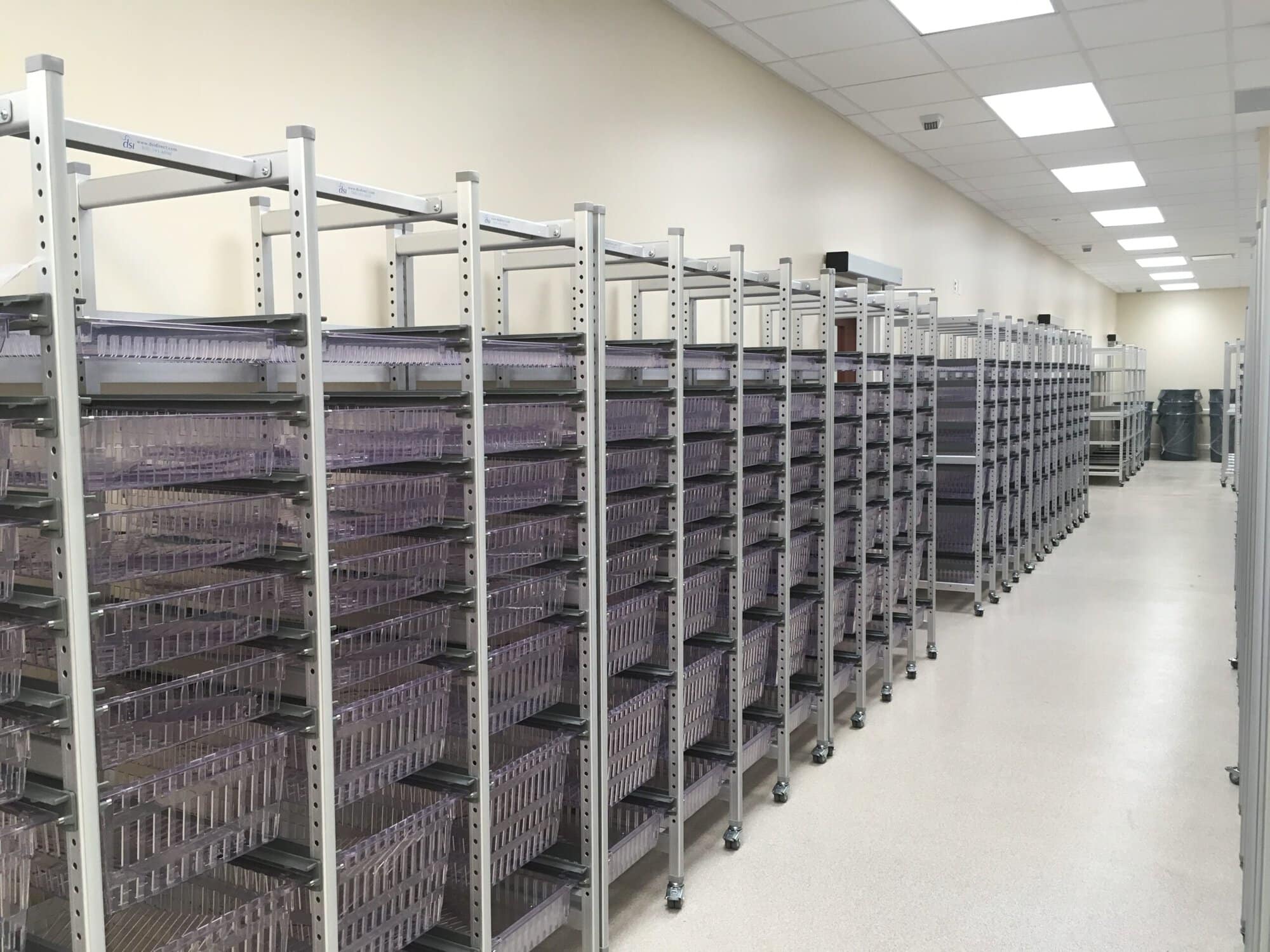
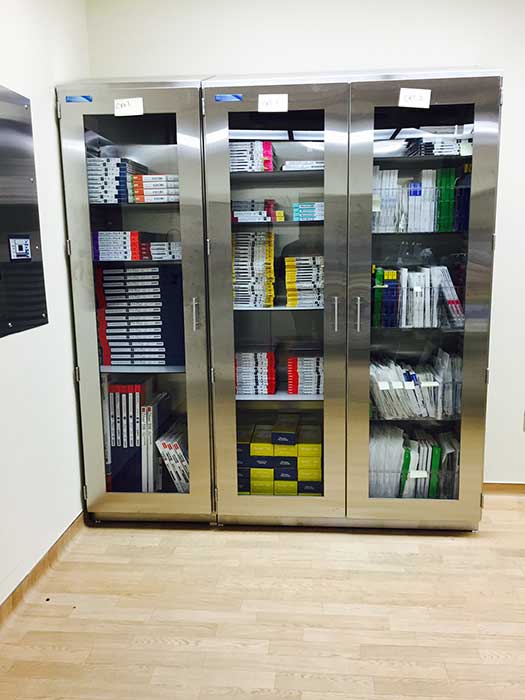
Choosing the right medical cart or storage system requires more than a product catalog. Each category serves a distinct function. Open wire shelving suits general sterile storage and SPD areas. Closed cabinets protect surgical devices in high-traffic OR environments. High-density mobile shelving maximizes capacity in SPD, central supply, and pharmacy. Pass-through cabinets maintain unidirectional workflow at decontamination and clean area interfaces. Instrument carts and trolleys move instrument inventory between SPD and the operating room. Sterile core storage provides immediate access to supplies adjacent to the OR suite.
Compliance requirements differ across every category. Instrument carts must be covered during transport and easy to clean. High-density mobile shelving requires a floor load assessment before installation. A knowledgeable partner identifies these requirements before equipment is ordered.
Choose open wire shelving if your SPD needs maximum airflow and easy disinfection access. Choose high-density mobile shelving when space is constrained and storage capacity must increase without expanding the footprint. Choose pass-through cabinets if maintaining a strict unidirectional workflow between decontamination and clean areas is the priority. Choose sterile core storage when your OR requires immediate point-of-use access to sterile supplies adjacent to the surgical suite.
Operating room storage installation is not a drop-and-go transaction. A full implementation spans approximately 14 weeks — installation runs Weeks 9–12, with staff training and go-live in Weeks 13–14. Responsive customer service during this window determines whether the system goes live on schedule and in full compliance.
At a 350-bed community hospital with multiple Joint Commission citations, a full-service provider redesigned the SPD storage area using high-density mobile shelving — delivering a 35% increase in storage capacity while maintaining all AAMI ST79 environmental requirements. At the ASC referenced earlier, an integrated RFID-based sterilization assurance technology system cut instrument location time by an estimated 45 minutes per day across the surgical team.
Service quality is not just about satisfaction scores — it directly affects patient safety incident rates, instrument error rates, and OR efficiency. The data shows a clear, measurable relationship between how well a partner serves a facility and how well that facility performs. Facilities with excellent service partners see patient safety incident rates nearly 90% lower than those with poor service. That is not a coincidence — it is the direct result of proactive support, structured oversight, and rapid issue resolution.
The correlation between service quality and patient outcomes is stark. Compliance audit scores range from 58 at poor service quality to 94 at excellent service quality. Patient safety incident rates drop from 8.5 per thousand surgical cases at the lowest tier to just 0.9 per thousand at the highest.
Instrument error rates tell the same story. Poor service quality correlates with a 26.2% instrument error rate. Excellent service quality brings that rate down to 3.2%. OR case delay rates fall from 22.0% to 2.8% across the same range, while healthcare worker satisfaction climbs from 4.2 to 9.4 out of 10. Employee safety in healthcare storage solutions improves when the partner behind the system is actively engaged in its performance.
Storage systems degrade in performance without structured oversight. Phase 6 of a full-service model delivers quarterly compliance audits with written reports and corrective action tracking, inventory optimization reviews, continuous environmental monitoring with automated alerts, preventive maintenance, and an annual storage capacity and workflow review.
Internal SPD audits should occur at least quarterly against current industry standards. Biological indicators must be tested weekly at minimum — preferably daily — and in every implant load, with those loads quarantined until results are confirmed. Ongoing support keeps infection control practices current and sterile storage compliant between accreditation surveys.
The right SPD partner is not just a vendor — they are a long-term compliance asset. Healthcare leaders should evaluate partners against measurable service capabilities, not sales pitches. The criteria that matter most: healthcare-specific expertise, full-service implementation capability, proven references, technology integration, and a commitment to ongoing compliance support. Anything less leaves the facility managing gaps the partner should be closing.
The SPD Compliance Scorecard sets the minimum acceptable threshold at 80 across all compliance domains. Leading benchmarks by body: AAMI scores 98 in both Sterilization Validation and Biological Monitoring; the Joint Commission scores 98 in Audit and Continuous Improvement and 95 in Documentation and Records; HSPA scores 95 in Staff Competency; AORN scores 92 in Instrument Cleaning. A reliable partner knows these standards and operates within them.
Key evaluation criteria include healthcare-specific expertise across AAMI, AORN, and Joint Commission requirements; full-service capability from consultation through ongoing support; product durability under frequent hospital-grade disinfection; verifiable references from comparable medical facilities; and technology integration for instrument tracking and inventory management. A partner that enforces a minimum 24-hour notice policy for loaner instruments — with full processing per AAMI ST79 and AORN guidelines — signals real-world compliance fluency.
Choose a full-service SPD partner if your facility needs comprehensive support from initial needs assessment through ongoing compliance monitoring and annual optimization. Choose a product-only vendor only if your internal team has the certified expertise to independently manage implementation, staff training, compliance verification, and structured ongoing oversight.
Long-term relationships produce measurable results. The 350-bed community hospital that redesigned its storage, documentation, and competency assessment program received zero citations across all three domains on an unannounced Joint Commission follow-up visit — and achieved full HSPA certification. At the academic medical center, SPD-attributable first-case delays dropped from 8.8% to 2.1% over 12 months.
Well-performing SPD–OR partnerships target clear KPIs: instrument tray accuracy ≥98%, first-case on-time start rate ≥90%, SPD turnaround time ≤4 hours standard and ≤2 hours priority, instrument error rate ≤2 per 100 cases, and staff satisfaction ≥8/10. These are the outcomes that define a partnership worth keeping.
Distribution Systems International has spent over 30 years helping acute care facilities optimize sterile storage, reduce compliance risk, and build operating rooms that run on time. From onsite workflow assessments to full turnkey implementation and ongoing support, DSI delivers the expertise your sterile processing department needs — and the responsive customer service your team deserves. Contact DSI today to schedule a complimentary storage analysis and see what the right partner makes possible.
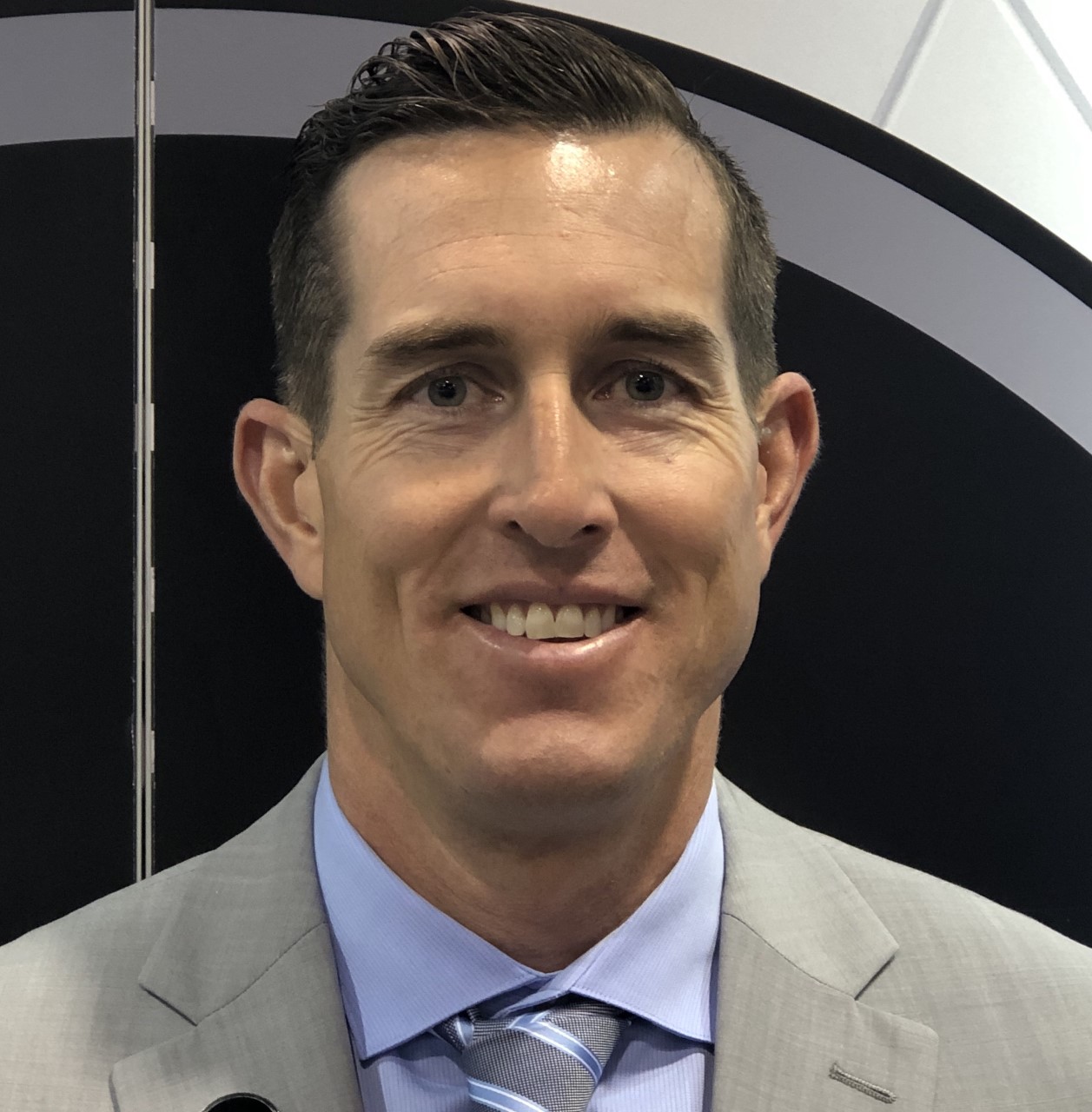
With 21 years of sales management, marketing, P&L responsibility, business development, national account, and channel management responsibilities under his belt, Ian has established himself as a high achiever across multiple business functions. Ian was part of a small team who started a new business unit for Stanley Black & Decker in Asia from Y10’ to Y14’. He lived in Shanghai, China for two years, then continued to commercialize and scale the business throughout the Asia Pacific and Middle East regions for another two years (4 years of International experience). Ian played college football at the University of Colorado from 96’ to 00’. His core skills sets include; drive, strong work ethic, team player, a builder mentality with high energy, motivator with the passion, purpose, and a track record to prove it.