Key Takeaways
Robotic surgery instrumentation presents unique organizational challenges—specialized instruments cost $200 per tip with only 10-14 uses, while procedures average $3,500 to $6,000 and system investments reach $2,500,000. Custom color-coding storage addresses these challenges through evidence-based OR error reduction strategies that leverage human factors engineering principles.
Color-coded storage systems transform surgical instrument storage from manual verification processes into intuitive visual identification protocols, cutting error detection time and reducing sterile processing errors by 50%. This approach supports robotic surgery organization by creating clear visual matches between instruments and designated storage locations, minimizing delays that disrupt workflow and compromise patient safety.
Understanding implementation best practices enables healthcare facilities to protect high-value assets while optimizing operational efficiency through sterile instrument storage solutions designed for complex surgical environments.
Custom color-coding storage transforms surgical instrument organization by reducing cognitive load and accelerating visual identification. This evidence-based approach addresses the complexity of robotic surgery instrumentation, where specialized instrument sets and high-stakes time pressure create significant error potential.
Automated instrument tracking systems utilizing color-coded visual cues cut tray assembly time by over 50%. This dramatic improvement directly impacts OR error reduction by eliminating ambiguity during instrument preparation. One facility color-coded its entire department by service line—assigning distinct colors to Orthopedics, Urology, and Robotics—to streamline instrument tray and case cart management. Medical storage bins with color differentiation enable staff to instantly identify correct instruments without manual verification, protecting expensive robotic equipment that costs $200 per instrument tip with only 10-14 uses per tip.
Color-coded compartmentalized trays detect errors 1.9 seconds faster than conventional storage (11.1 seconds versus 13.0 seconds). While seemingly modest, this improvement represents a measurable reduction in cognitive load during time-critical procedures where cost per surgery averages $3,500 to $6,000. Color-coded storage systems reduce fixation time—the mental effort required to locate correct instruments—minimizing delays when surgical teams work under pressure. Choosing the right storage system for your healthcare facility means prioritizing visual differentiation that supports rapid instrument identification.
Virginia Mason Medical Center reduced its sterile processing error rate from 3% to 1.5% over 37 months by implementing quality improvement tactics including shadow boards and color-coding. This 50% error reduction demonstrates how color-coded storage locations facilitate rapid put-away and retrieval while minimizing misplacement that could compromise sterility. Sterile instrument storage with dedicated color-coded zones ensures robotic surgery organization maintains contamination-free workflows, protecting patients and preserving instrument integrity throughout the reprocessing cycle.
Robotic surgery instrumentation demands precision-focused storage solutions due to equipment complexity and high replacement costs. Color-coded storage systems address the critical intersection of patient safety, workflow efficiency, and asset protection in surgical environments where instruments cost between $500,000 and $2,500,000 per system.
Complex, specialized robotic instrument sets create significant misidentification risk during assembly and deployment. Custom color-coding storage leverages the brain's innate ability to rapidly recognize visual cues, reducing human error potential in high-pressure surgical environments. This approach proves essential when managing instruments with limited 10-14 use lifecycles, where mishandling or incorrect selection creates both patient risk and substantial financial loss. Color-coded storage systems transform surgical instrument storage from a manual verification process into an intuitive visual matching system.
Research in high-acuity settings like anesthesia confirms that visual cues deliver superior accuracy and faster error detection than conventional storage methods. These findings validate color-coded storage implementation rooted in human factors engineering (HFE) principles, specifically designed to reduce cognitive load and improve visual search efficacy. Medical storage bins with color differentiation enable staff to process information faster during high-stress OR procedures, where disposables cost $2,500 per procedure and any delay impacts surgical outcomes and operational costs.
Color-coded medical storage bins facilitate immediate identification of the correct carts or trays for specific procedures, eliminating search time and verification delays. This advantage directly addresses a common source of OR errors and flow disruptions—selecting incorrect instrument sets during case preparation. Robotic surgery organization benefits from visual differentiation that enables quick retrieval while maintaining sterility standards, protecting both patient safety and expensive instrumentation throughout the surgical workflow.
Custom color-coding storage delivers measurable operational advantages through visual differentiation, workflow standardization, and compliance support. These systems address both immediate error reduction needs and long-term efficiency goals in facilities managing robotic surgery instrumentation with annual service costs averaging $190,000.
Color-coded storage systems create clear visual matches between instruments, trays, and designated storage areas, eliminating ambiguity during retrieval and put-away. This visual differentiation minimizes time spent searching for correct instruments under time pressure, directly reducing human error potential when managing equipment where each instrument tip costs $200 and delivers only 10-14 uses. OR error reduction through surgical instrument storage optimization protects both patient safety and asset longevity by ensuring staff select correct instruments on first attempt without manual verification delays.
Standardization by procedure or service line enables consistent, hospital-wide identification that transcends individual staff knowledge. Formalized color schemes eliminate delays caused by ambiguous instrument location and uncoordinated movement between OR, sterile processing, and supply areas. This robotic surgery organization approach proves critical when procedures cost $3,500 to $6,000 per surgery—every minute saved through efficient storage solutions directly impacts operational capacity. Medical storage bins with procedure-specific color coding support rapid case turnover while maintaining sterility protocols.
Intuitive Surgical (da Vinci) explicitly recommends implementing standardization, including instrument color coding for easy visibility, as best practice to optimize OR efficiency. This manufacturer guidance validates color-coded storage systems as industry-standard compliance tools. Integration with tracking systems—barcodes or RFID technology—automates tray assembly verification, confirming correct instruments are present before cases begin. Choosing the right storage system for your healthcare facility means prioritizing solutions that support both visual identification and digital tracking, creating comprehensive accountability for high-value robotic instrumentation throughout its lifecycle.
Successful implementation requires strategic planning, manufacturer compliance, and facility-wide standardization. A systematic approach to custom color-coding storage protects instrumentation investments ranging from $500,000 to $2,500,000 while supporting OR error reduction through consistent visual identification protocols.
Implement a consistent, hospital-wide color scheme where each color corresponds to specific surgical services—green for General Surgery, blue for Urology/Robotics—or individual robotic procedure types. This standardization ensures instant recognition across all staff and departments. Utilize manufacturer-approved methods such as heat-fused color coatings or color-coded tags and rings to permanently identify individual instruments, linking them to correct sets or trays. These permanent markings withstand repeated sterilization cycles while maintaining visual clarity, protecting instruments averaging $200 per tip throughout their 10-14 use lifecycle.
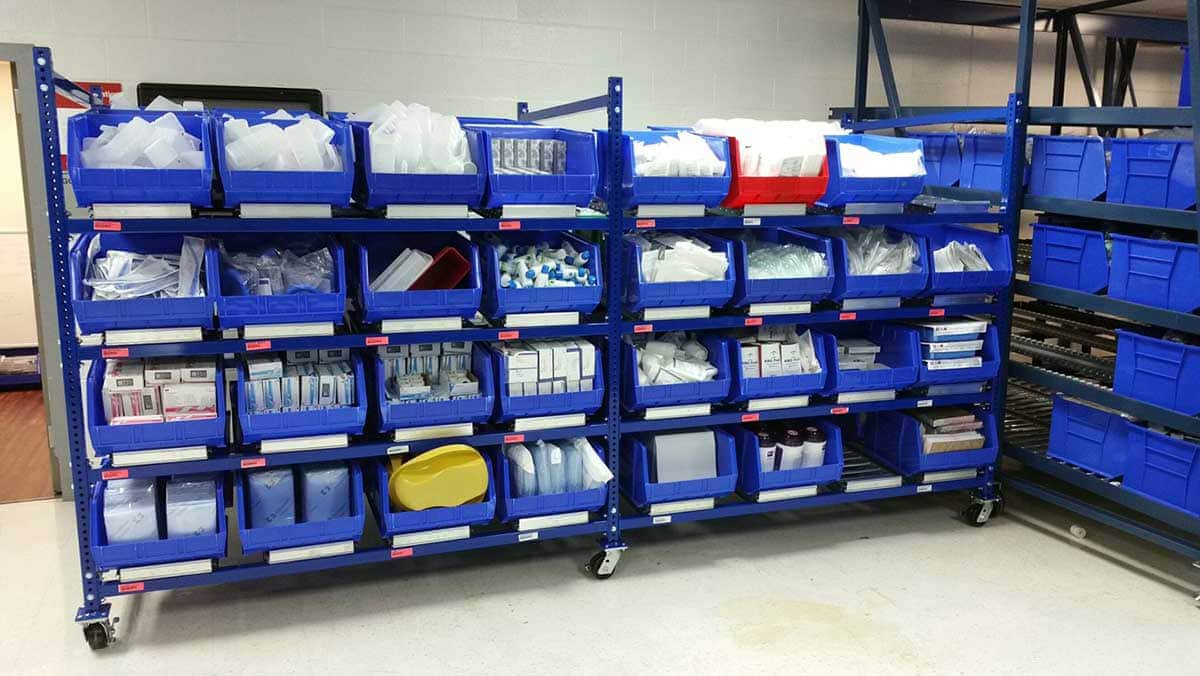
Apply color-coding to multiple storage locations—shelving, drawers, and instrument tray tags—creating layered visual cues that reinforce correct placement. Use color-coded tags on instrument trays that integrate with tracking and management systems through barcodes or RFID technology, enabling automated verification and inventory control. Medical storage bins with color differentiation create clear visual matches between instruments, trays, and designated storage areas for rapid put-away and retrieval. Choosing the right storage system for your healthcare facility means selecting modular solutions like high-density baskets or hanging systems that support both color-coding and sterile instrument storage requirements while optimizing space utilization.
Ensure all perioperative and sterile processing staff receive thorough training on the color-coding system before implementation. Conduct regular audits to ensure compliance and prevent introduction of non-standardized color schemes, which negate system benefits and reintroduce error potential. Maintain consistency across the entire surgical department to maximize efficiency gains—inconsistent application creates confusion that undermines robotic surgery organization. Color-coded storage systems require ongoing oversight to preserve their effectiveness, particularly when managing equipment with annual service costs averaging $190,000 and procedure costs reaching $6,000 per surgery.
Implementation challenges center on organizational change management, material durability, and initial investment justification. Understanding these obstacles enables facilities to develop mitigation strategies that preserve the OR error reduction benefits of color-coded storage systems while managing transition complexities.
Training requirements present the primary adoption barrier—all perioperative and sterile processing staff must master the new color-coding system before full implementation. This comprehensive training demand creates temporary workflow disruptions in departments already operating at capacity. Standardization requires buy-in across multiple departments and roles, from surgical teams to sterile processing technicians to supply chain managers. Resistance often stems from established habits and skepticism about new surgical instrument storage protocols. Success depends on demonstrating immediate benefits: faster instrument location, reduced verification time, and fewer errors that delay cases costing $3,500 to $6,000 per procedure.
Color-coded medical storage bins must withstand repeated sterilization cycles without degrading or losing visual clarity. Use manufacturer-approved methods like heat-fused color coatings specifically designed for high-temperature sterilization environments, protecting investments in equipment already costing $500,000 to $2,500,000 per system. Implement permanent identification methods that link instruments to correct sets or trays throughout the instrument lifecycle—critical when managing tips limited to 10-14 uses. Inferior color-coding materials that fade or peel negate system benefits and create new error risks, undermining robotic surgery organization efforts.
Initial investment in custom color-coding storage requires balancing upfront costs against measurable error reduction and efficiency gains. ROI demonstrates through reduced sterile processing errors—Virginia Mason Medical Center cut errors from 3% to 1.5%—and faster tray assembly times exceeding 50% improvement with automated tracking integration. Choosing the right storage system for your healthcare facility means calculating costs against avoided errors, reduced instrument replacement, and improved case turnover. Facilities managing annual service costs of $190,000 and disposables averaging $2,500 per procedure find that sterile instrument storage optimization pays for itself through prevented delays and extended instrument lifecycles.
Custom color-coding storage represents both current best practice and foundation for next-generation surgical instrument management. As robotic surgery programs expand—with systems costing $500,000 to $2,500,000 and annual service exceeding $190,000—optimized storage solutions become critical operational infrastructure rather than optional enhancements.
Tracking technology integration continues evolving, with RFID and barcoding systems building on color-coded storage foundations to create comprehensive instrument lifecycle management. These emerging automated solutions combine visual identification with digital verification, enabling real-time inventory tracking and predictive maintenance for instruments limited to 10-14 uses. Medical storage bins increasingly incorporate smart technology that alerts staff to missing instruments, expired sterility, or incorrect placement before cases begin. Choosing the right storage system for your healthcare facility now means anticipating technology convergence—where color-coded visual cues work alongside automated tracking to deliver unprecedented accuracy in robotic surgery organization.
Color-coded storage systems deliver measurable OR error reduction through evidence-based strategies rooted in human factors engineering principles. Facilities implementing these systems achieve quantifiable improvements: 1.9-second faster error detection, 50% reduction in sterile processing errors, and over 50% faster tray assembly with integrated tracking. Surgical instrument storage optimization through color-coding addresses the core challenge of robotic surgery instrumentation—managing complex, expensive equipment under time pressure while maintaining patient safety. Sterile instrument storage with custom color-coding transforms reactive error management into proactive prevention, protecting both patients and the substantial financial investments that robotic surgery programs represent. The evidence confirms that color-coded storage systems are not cosmetic improvements but essential infrastructure for modern robotic surgery operations.
Distribution Systems International delivers comprehensive robotic instrument storage systems designed to protect, organize, and manage high-value surgical instrumentation. Our custom color-coding storage solutions—including MODU-MAX hanging systems, high-density baskets, and SterileShelf technology—reduce OR errors while maximizing space efficiency and maintaining sterility protocols.
With 30-40% space savings versus traditional shelving and proven contamination prevention features, Distribution Systems International's medical storage bins support instrument lifecycles from reprocessing through deployment. Our systems integrate with tracking technologies to ensure correct instruments reach surgical teams when needed, protecting investments averaging $500,000 to $2,500,000 per robotic system.
Contact Distribution Systems International to implement evidence-based robotic surgery organization solutions that reduce errors and optimize workflow efficiency.

With 21 years of sales management, marketing, P&L responsibility, business development, national account, and channel management responsibilities under his belt, Ian has established himself as a high achiever across multiple business functions. Ian was part of a small team who started a new business unit for Stanley Black & Decker in Asia from Y10’ to Y14’. He lived in Shanghai, China for two years, then continued to commercialize and scale the business throughout the Asia Pacific and Middle East regions for another two years (4 years of International experience). Ian played college football at the University of Colorado from 96’ to 00’. His core skills sets include; drive, strong work ethic, team player, a builder mentality with high energy, motivator with the passion, purpose, and a track record to prove it.