The Sterile Processing Department serves as the operational backbone of any healthcare facility, directly impacting patient outcomes and surgical efficiency. Implementing new sterile storage systems requires careful coordination to maintain continuous operations while upgrading infrastructure. Healthcare facilities must balance improved storage needs with the reality that SPD operations cannot pause for renovations.
This guide provides practical strategies for implementing sterile storage upgrades without compromising daily operations. Whether transitioning from wire shelving to high-density units or integrating automated tracking systems, the methodology remains consistent: plan thoroughly, implement gradually, and monitor continuously.
Key Takeaways
Sterile storage systems protect sterilized instruments from contamination until they reach the point of use. The SPD serves as the critical hub of any healthcare facility, making proper storage essential for maintaining instrument readiness. Patient safety depends on maintaining the sterile barrier from the sterilizer through storage to the operating room.
Quality storage systems directly impact compliance ratings and operational efficiency. Advanced storage solutions extend the shelf life of sterilized instruments while improving inventory accuracy and reducing waste.
Sterile storage maintains instrument integrity through environmental controls and physical protection from contamination. Temperature and humidity levels must remain within AAMI specifications to prevent condensation that compromises sterile wrap. Proper shelving systems protect wrapped instruments from dust, physical damage, and air currents that could breach packaging.
The sterile barrier remains intact only when storage areas meet strict regulatory standards for cleanliness and airflow. Storage units with enclosed designs prevent particulate matter from settling on wrapped instrument sets during extended storage.
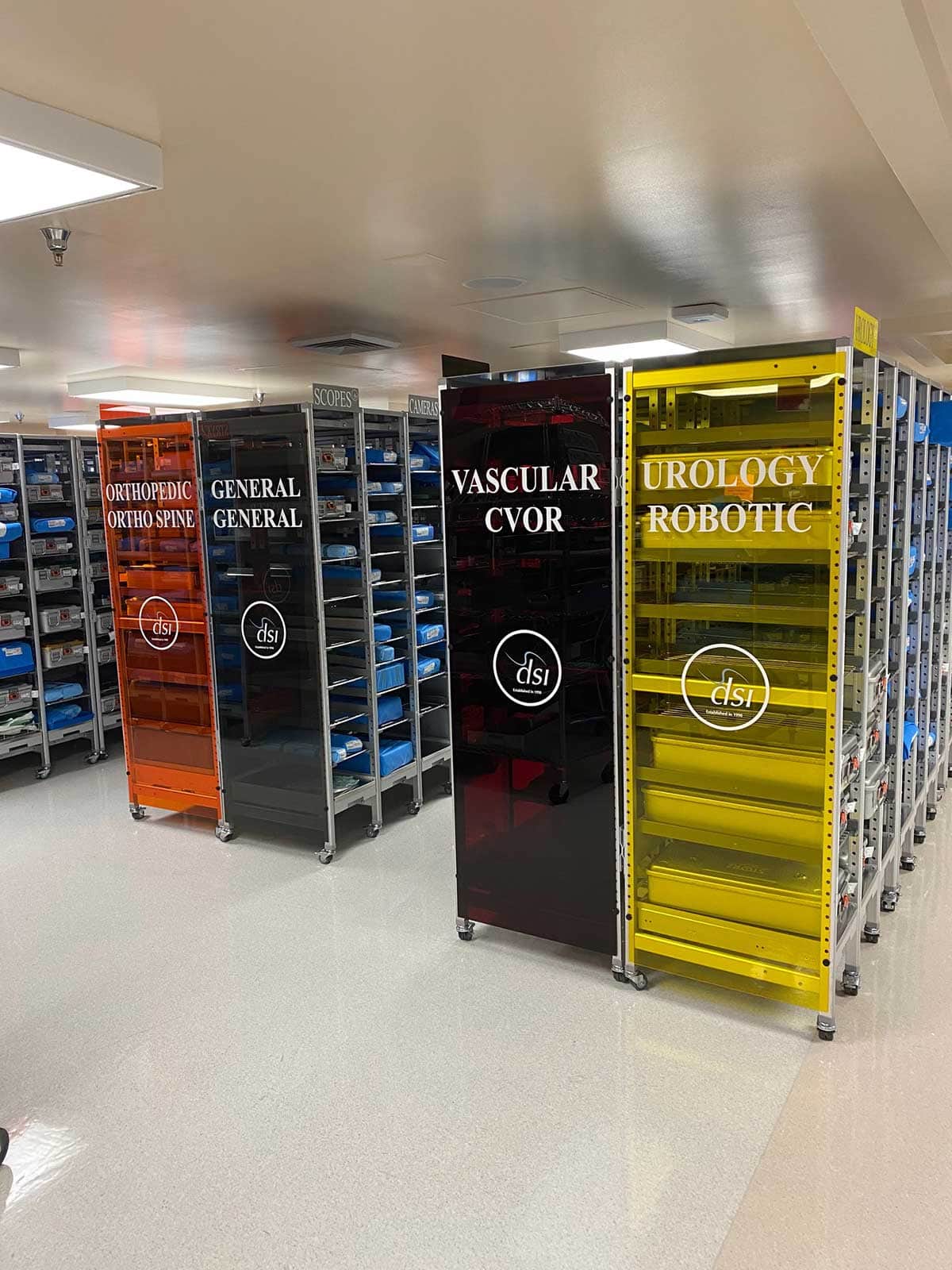
Advanced sterile storage solutions incorporate modular designs that adapt to changing inventory requirements and facility layouts. Modular storage units provide adjustable shelving heights and configurations to accommodate various instrument tray sizes efficiently. High-density systems maximize vertical space while maintaining accessibility for staff during instrument retrieval.
Climate-controlled storage areas with integrated monitoring systems alert staff immediately when conditions deviate from acceptable parameters. Automated retrieval systems reduce manual handling errors and improve turnaround time for instrument preparation.
Proper sterile storage directly protects patients by preventing surgical site infections caused by compromised instrument sterilization. Patient safety ranked at 95% importance level in healthcare decision-making criteria, making storage infrastructure a critical investment. Quality and compliance ranked at 90% importance level, reflecting the direct connection between storage conditions and regulatory adherence.
Joint Commission surveys frequently cite improper storage conditions as compliance violations that endanger patient safety. Healthcare facilities face significant financial and reputational consequences when storage deficiencies lead to instrument contamination or infection outbreaks.
Different SPD operational models create distinct storage requirements based on processing location and turnaround time expectations. In-house facilities need immediate-access storage adjacent to sterilization equipment, while outsourced models require receiving areas for transported instruments. Storage configuration must align with the chosen SPD model to maintain SPD workflow efficiency and instrument availability. Hybrid models demand the most complex storage planning because they accommodate both in-house processed and externally sterilized instruments.
In-house SPD is a centralized sterilization facility located within the hospital that controls all processing activities. On-site services accounted for 31.8% in the U.S. in 2024, indicating substantial investment in internal processing infrastructure. High capital expenditure for in-house equipment includes sterilizers, washers, and adequate sterile storage capacity.
High operational costs stem from maintaining climate-controlled storage environments and dedicated staff for inventory management. Space requirements often exceed initial projections because facilities must store peak inventory volumes plus safety stock.
The outsourced model involves contracting third-party service providers to handle sterilization at off-site processing facilities. Offsite sterilization services accounted for 68.2% market share in the U.S. in 2024, reflecting widespread adoption of external processing. The third-party outsourcing market, estimated at $4.5 billion in 2025, demonstrates the significant economic scale of outsourced sterilization services.
The third-party market projected CAGR of 8.5% through 2033 indicates continued growth in facilities choosing external processing. Transportation logistics remain impractical for rural hospitals, which must maintain in-house capabilities despite higher operational costs.
Hybrid models combine in-house and outsourced services to balance cost control with operational flexibility for varying case volumes. One hospital avoided $1.2 million in capital expenditure by transitioning to a hybrid model that outsourced specialized instrument processing. Complex vendor management requires dedicated storage areas that separate in-house from outsourced instrument inventory.
Higher workflow coordination complexity demands clear storage protocols to prevent mixing instrument sets from different sources. Detailed instrument inventory analysis determines which sets require immediate in-house storage versus delayed external processing.
Workflow disruption represents the primary concern when implementing new storage systems in operational SPD environments. Staff must continue processing instruments while contractors install new shelving, creating safety hazards and efficiency losses during transition. Resistance to change often emerges from experienced technicians comfortable with existing systems despite recognized inefficiencies.
Budget constraints force facilities to balance immediate operational needs against long-term infrastructure improvements requiring capital investment. Coordination between multiple departments becomes essential because storage upgrades affect not only SPD but also operating room schedules.
Minimal disruption can be achieved through careful scheduling that implements storage changes during periods of reduced surgical volume. Installing compact track systems in sections allows continued use of existing storage while new systems come online gradually. Maintaining temporary storage areas ensures instrument availability throughout the transition without compromising sterility or accessibility.
Communication with operating room leadership prevents scheduling conflicts when storage upgrades might delay instrument availability. Designating specific SPD staff as implementation liaisons helps identify potential workflow conflicts before they disrupt operations.
Staff training needed for automated storage systems includes both technical operation procedures and workflow integration protocols. Training programs must address retrieval processes, inventory documentation requirements, and troubleshooting common system errors independently. Staff recruitment and training challenges increase when new storage systems require technical competencies beyond traditional SPD technician skills.
Hands-on practice sessions during low-volume periods allow staff to develop proficiency before full system activation. Cross-training multiple staff members prevents operational bottlenecks when primary system operators are unavailable.
Integration challenges with existing hospital systems require IT department involvement to ensure data compatibility and network connectivity. Implementation complexity increases when integrating with electronic health records and supply chain management platforms. Multiple compliance requirements demand documentation proving storage systems meet AAMI, AORN, and Joint Commission standards simultaneously.
Vendor selection should prioritize suppliers offering integration support and compliance documentation as part of implementation services. Regular compliance audits during implementation identify gaps before external surveyors discover deficiencies.
Comprehensive audits reveal hidden deficiencies in current storage that compromise instrument integrity and regulatory compliance. Physical assessment of storage areas must evaluate environmental conditions, structural integrity, and accessibility for staff during normal operations. Documentation of existing conditions provides baseline data for measuring improvement after implementing new storage solutions.
Preparation should include clearing obsolete inventory and addressing deferred maintenance before installing new storage systems. Strategic planning during audits prevents costly modifications after installation begins.
Audit current storage conditions for AAMI and AORN compliance regarding temperature ranges, humidity levels, and airflow patterns. Measuring actual environmental conditions often reveals significant deviations from assumed parameters, particularly in older facilities with aging HVAC systems. Structural assessment should identify water damage, pest infiltration, and inadequate lighting that compromise storage integrity and staff safety.
Traffic pattern analysis determines whether current storage locations create inefficient movement patterns that waste staff time during instrument retrieval. Capacity utilization measurements reveal whether facilities need additional storage volume or simply better organization of existing space.
Compliance with regulatory storage guidelines requires detailed documentation of environmental monitoring, shelf life protocols, and sterility assurance processes. AAMI standards specify exact temperature and humidity ranges that storage areas must maintain continuously, not just during surveys. AORN guidelines address proper shelving materials, clearance from floors and ceilings, and separation from contaminated processing areas.
Joint Commission surveyors frequently test staff knowledge of storage protocols, making training documentation as important as physical compliance. Implementing organized plastic bin systems helps maintain visual organization that demonstrates compliance during unannounced surveys.
Storage infrastructure requires immediate replacement when physical deterioration creates contamination risks or fails to meet current regulatory standards. Facilities experiencing repeated compliance violations related to storage deficiencies cannot delay upgrades without risking accreditation and patient safety. Growth in surgical volumes that exceeds current storage capacity indicates the need for expansion regardless of the existing system condition.
Technological obsolescence occurs when manual storage systems cannot support modern tracking requirements like RFID and barcode integration. Cost-benefit analysis should compare ongoing maintenance expenses and inefficiency costs against capital investment in modern storage solutions.
Phased implementation allows facilities to maintain operational continuity while systematically upgrading storage infrastructure. Breaking large projects into manageable phases reduces financial burden and allows lessons learned to improve subsequent installations. Comprehensive storage solutions should be implemented gradually rather than attempting facility-wide conversion in a single disruptive event.
Successful implementation requires detailed project management that coordinates multiple contractors, internal stakeholders, and regulatory compliance requirements. Each phase must reach full functionality before beginning the next to prevent cascading failures.
Phased rollout during low-volume surgical days or weekends minimizes impact on critical instrument processing and availability. Implementing modular solutions by transitioning from wire shelving to high-density units section by section maintains operational capacity throughout the project. Temporary storage arrangements must be established before dismantling existing systems to prevent loss of instrument accessibility.
Creating a detailed transition plan with contingency protocols addresses unexpected delays without compromising patient care. Staff involvement in rollout planning improves adoption rates and identifies practical concerns that project managers might overlook.
Coordination with surgical scheduling prevents conflicts when storage system installation might delay instrument availability for scheduled procedures. Operating room directors must receive advance notice of any phase that could impact specific instrument sets or specialties. Efficient workstation layouts should be installed during periods when affected surgical services experience reduced volume or scheduled maintenance.
Block-scheduling surgical cases around implementation phases allows facilities to consolidate similar procedures when certain instrument sets remain accessible. Emergency surgical capability must remain uncompromised regardless of storage upgrade activities.
Daily monitoring during implementation tracks key performance indicators, including instrument retrieval time, staff satisfaction, and compliance deviations. Feedback mechanisms should include brief daily huddles where staff report issues encountered with new storage systems. Rapid response protocols address identified problems before they compound into major workflow disruptions or safety concerns.
Performance metrics comparing pre-implementation and post-implementation efficiency validate investment decisions and identify areas requiring additional refinement. Documentation of lessons learned during each phase improves planning and execution of subsequent storage upgrades.
Inventory tracking integration transforms sterile storage from passive shelving into active management systems that provide real-time visibility. Digital tracking eliminates manual documentation errors that lead to lost instruments, expired inventory, and compliance documentation gaps. Modern storage systems that integrate tracking technology reduce staff time spent searching for instruments and verifying locations.
Automated tracking provides data analytics that reveal usage patterns, turnover rates, and optimization opportunities invisible in manual systems. Investment in tracking technology delivers measurable returns through reduced instrument loss, improved turnover efficiency, and enhanced compliance documentation.
Integrating tracking technology with RFID or barcode systems provides automated inventory counts and location verification without manual documentation. RFID systems track individual instruments through the entire processing cycle from decontamination through storage to the point of use. Barcode systems offer lower implementation costs while still providing substantial improvements over manual tracking methods.
Automated tracking reduces instrument loss rates by immediately identifying when items leave designated storage areas or fail to return. Compliance documentation becomes automated, generating audit trails that satisfy regulatory requirements without additional staff effort.
Real-time location systems (RTLS) for inventory management eliminate time wasted searching for instruments that were misplaced or misfiled. Staff can locate any instrument set instantly using mobile devices, reducing preparation time before surgical procedures begin. Automated reorder triggers prevent stockouts of critical items by monitoring usage rates and flagging inventory below established minimums.
Workflow efficiency improves when digital tracking provides data showing bottlenecks, underutilized capacity, and process inefficiencies requiring correction. Predictive analytics forecast instrument demand based on surgical schedules, enabling proactive preparation rather than reactive scrambling.
Integration of IT systems for tracking requires careful planning to ensure compatibility with existing hospital information systems. Network infrastructure must support additional data traffic from tracking devices without degrading the performance of critical clinical systems. Ongoing software licensing costs for workflow systems must be factored into total cost of ownership calculations.
Vendor selection should prioritize suppliers offering robust technical support and regular software updates addressing emerging security threats. Data security protocols must protect patient information embedded in instrument tracking records from unauthorized access or breaches.
Total cost analysis must extend beyond initial purchase price to include installation, training, maintenance, and operational impact expenses. Capital investment in storage infrastructure competes with other facility priorities, requiring detailed justification through ROI projections and risk mitigation. Hidden costs often emerge during implementation when facilities discover needed infrastructure upgrades like electrical capacity or floor reinforcement. Long-term ownership costs include ongoing maintenance contracts, replacement parts, software licensing fees, and periodic system upgrades.
In-house capital equipment ranges from budget tier $500,000-$1,000,000 to premium tier $1,500,000-$2,000,000+, depending on automation and capacity. Outsourced annual contracts span the budget tier, $50,000-$150,000 per year, to the premium tier, $300,000-$500,000+ per year, based on volume. Washers/disinfectors cost $100K-$400K each while sterilizers cost $50K-$300K each, representing substantial capital requirements for in-house processing.
Per-tray costs range from $0.50 to $3.00 per instrument set, making volume projections critical for outsourcing decisions. Large hospital systems use purchasing power to negotiate favorable pricing while smaller facilities weigh capital costs carefully against operational flexibility.
Balancing capital investment with operational savings requires quantifying efficiency gains, reduced instrument loss, and improved compliance that new storage delivers. Operational savings accumulate through reduced labor costs, fewer lost instruments, and decreased regulatory compliance failures. Professional implementation services minimize disruption costs that erode projected savings from storage upgrades.
Financing options spread capital costs over time, aligning payments with realized operational savings rather than requiring upfront expenditure. Lease-to-own arrangements provide flexibility for facilities uncertain about long-term storage needs or facing potential facility changes.
Total Cost of Ownership (TCO) analysis factors in labor, utilities, space utilization, and cost of delayed procedures when evaluating storage investments. ROI projections should include avoided costs from instrument damage, reduced replacement frequency, and eliminated compliance penalties from storage violations. Energy-efficient storage systems with LED lighting and climate controls reduce ongoing utility expenses compared to legacy systems.
Productivity improvements from centralized storage configurations reduce staff time per instrument set processed, generating measurable labor savings. Facilities typically achieve positive ROI within three to five years when implementing comprehensive storage system upgrades.
Successful implementation requires understanding that SPD workflow never stops for renovations or upgrades, regardless of improvement urgency. Organizations must implement storage improvements incrementally, maintaining full operational capacity throughout the transition period. Detailed planning that anticipates complications prevents cascading failures when unexpected issues emerge.
The key to minimal disruption lies in treating storage implementation as an ongoing process rather than a discrete project. Facilities adopting continuous improvement methodologies integrate storage enhancements seamlessly into normal operations. Healthcare organizations implementing new sterile storage systems position themselves to maintain competitive advantages in patient safety, operational efficiency, and regulatory compliance. DSIDirect has supported healthcare facilities nationwide through storage transitions that maintain workflow continuity while delivering measurable improvements.
Implementing new sterile storage is complex — but it doesn't have to stall your department. Distribution Systems International provides turnkey sterile storage solutions designed specifically for active SPD environments. From phased rollout planning and CAD-based layout design to full installation and staff transition support, our team manages every step so your workflow stays intact. Contact DSI today for a complimentary storage analysis and see how a smarter system can improve compliance, instrument readiness, and OR throughput from day one.

With 21 years of sales management, marketing, P&L responsibility, business development, national account, and channel management responsibilities under his belt, Ian has established himself as a high achiever across multiple business functions. Ian was part of a small team who started a new business unit for Stanley Black & Decker in Asia from Y10’ to Y14’. He lived in Shanghai, China for two years, then continued to commercialize and scale the business throughout the Asia Pacific and Middle East regions for another two years (4 years of International experience). Ian played college football at the University of Colorado from 96’ to 00’. His core skills sets include; drive, strong work ethic, team player, a builder mentality with high energy, motivator with the passion, purpose, and a track record to prove it.