Hospitals face mounting pressure to expand capacity without adding square footage. High-density storage solutions address hospital space constraints by recovering floor area through aisle elimination, vertical height utilization, and workflow-optimized placement.
The global shelving market reached USD 26.03 billion in 2024 and is forecast to grow to USD 41.07 billion by 2035 at 4.23% CAGR. Healthcare facilities represent a strategic growth segment because storage decisions directly impact clinical efficiency, regulatory compliance, and operational cost control.
High-density storage solutions compress inventory into smaller footprints through mechanical movement, vertical stacking, or workflow-integrated placement. These systems reduce wasted aisle space and recover floor area that would otherwise remain empty between fixed shelving units.
Healthcare environments require storage formats that support sterile processing workflows, rapid supply retrieval, and infection control protocols. Static shelving, mobile systems, vertical modules, medical carts, and specialized cabinetry each serve distinct clinical functions within hospital operations.
Static warehouse racking refers to fixed uprights and shelves with no tracks. This category held USD 9.71 billion in 2024 and remains the baseline option for budget-conscious facilities requiring simple installation.
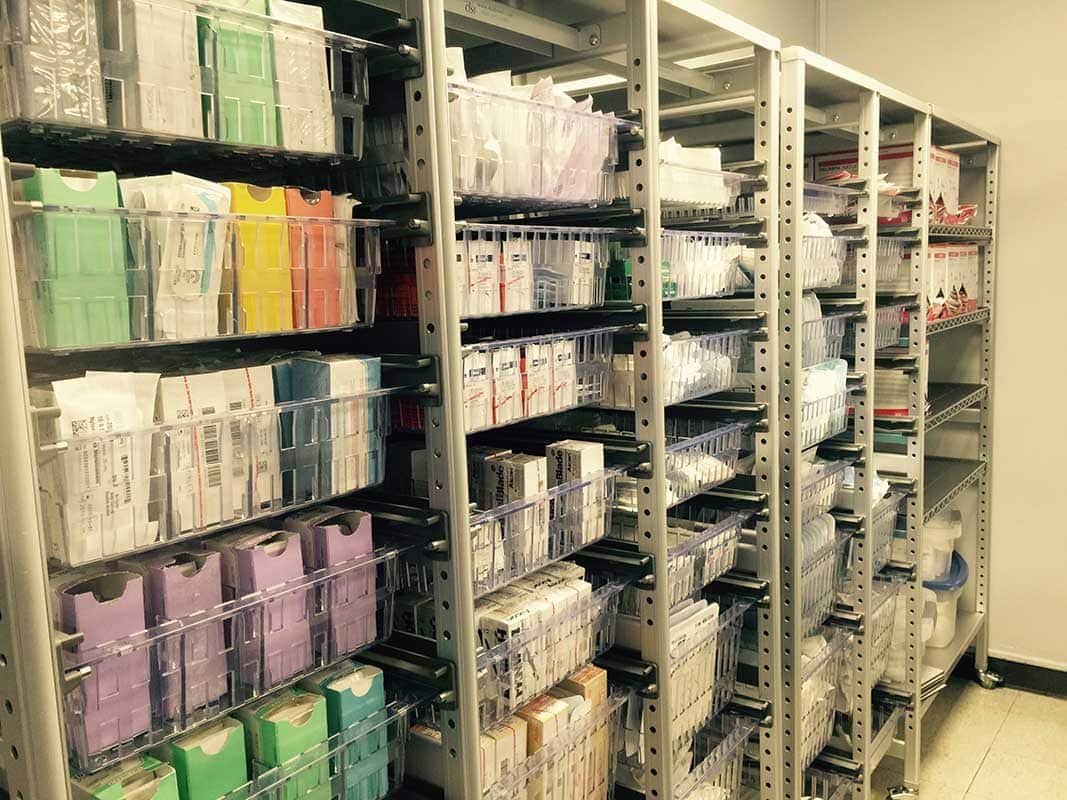
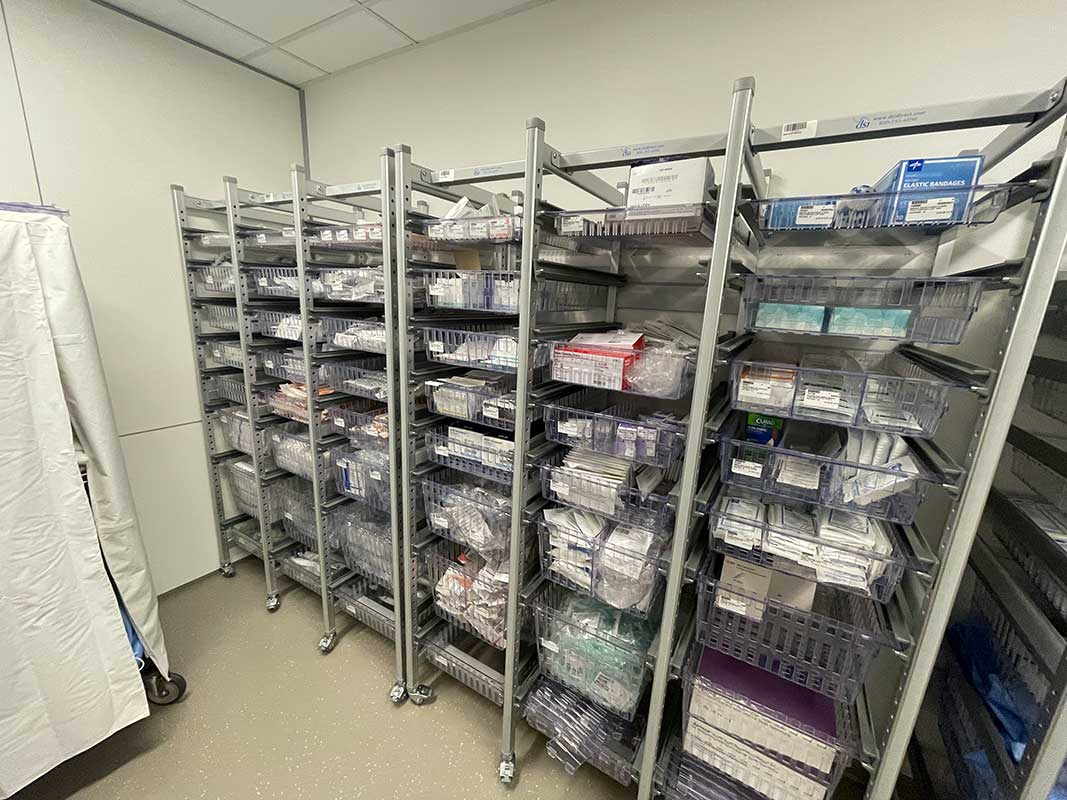
High-density mobile shelving uses carriage-mounted shelving on floor tracks with aisle elimination. Vertical lift modules are automated trays in enclosed towers with software control, reaching USD 1.56 billion in 2023 with 9.1% CAGR growth.
Medical carts are mobile units with casters, drawers, and locks for point-of-care supply delivery. Medical cabinetry includes operatory, sterilization, and secure storage systems valued at USD 9.31 billion in 2022.
Mobile systems compress horizontal aisles by allowing shelving units to slide along floor tracks. Only one working aisle opens at a time, which eliminates the permanent aisles required by static shelving.
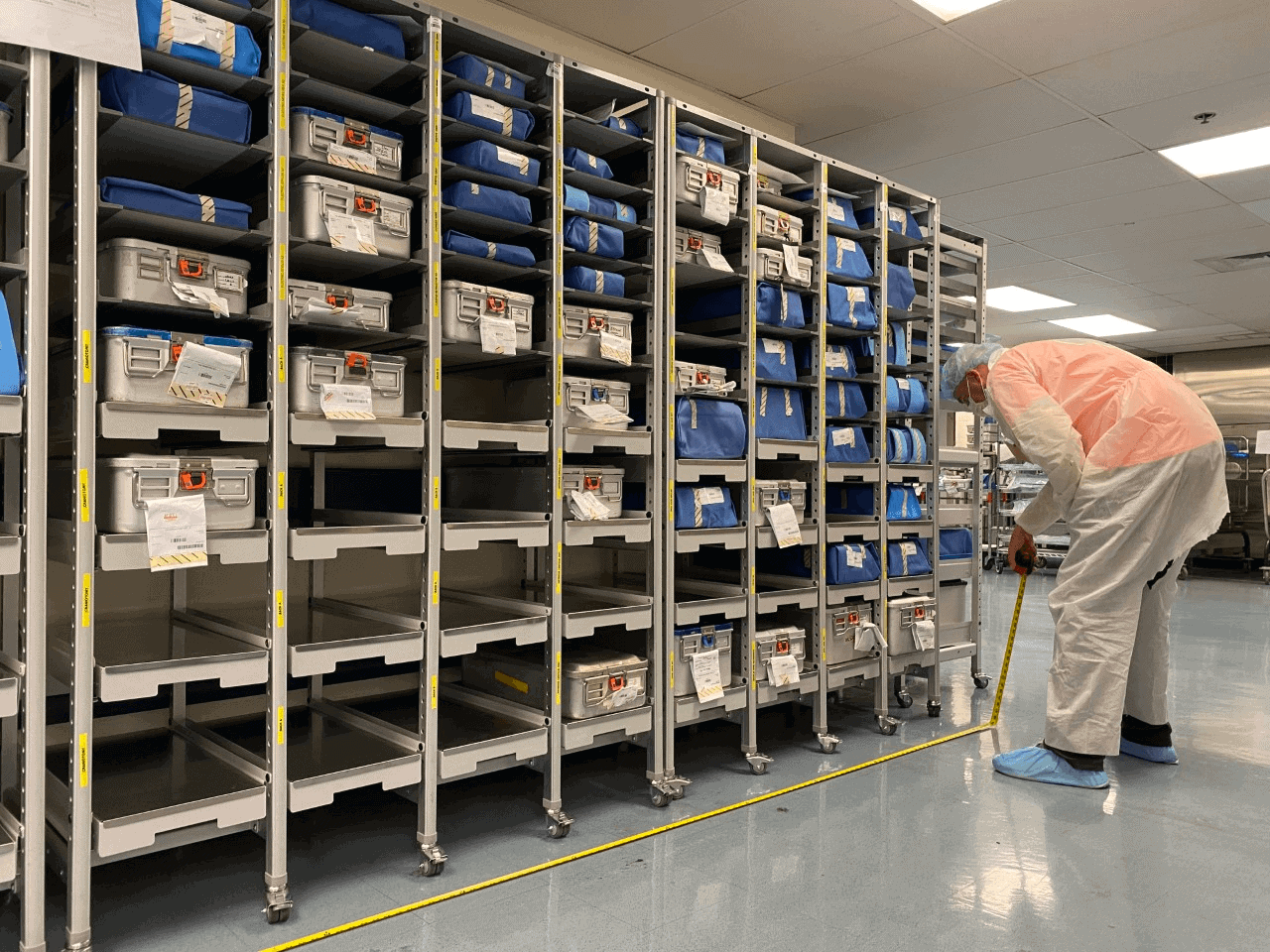
Vertical systems exploit unused building height by storing inventory in tower-based automated trays. The Storage Wall system implemented at Morristown Medical Center holds 40% more inventory than the legacy arrangement it replaced.
Healthcare demand bifurcates between mobile point-of-care systems and fixed sterilization-oriented cabinetry. Mobile computing carts held 72.38% of the medical carts market in 2024 because clinical staff require immediate access to supplies during patient care.
Morristown Medical Center processes roughly 100 surgical cases per day. The facility required a storage solution flexible enough to accommodate changing tray sizes and stackability requirements as surgical protocols evolve.
Space optimization allows hospitals to increase inventory capacity and improve workflow without costly facility expansion. Real estate costs per square foot in urban healthcare markets make floor space recovery a direct financial benefit.
High-density systems reduce the physical footprint required for equivalent inventory levels. This recovered space can be reallocated to clinical functions, revenue-generating services, or future case volume growth.
Limited space forces hospitals to choose between expanding inventory and maintaining clinical workflow areas. Morristown was considering growth from 28 to 30 operating rooms, which would require proportional increases in sterile supply storage without adding square footage.
Inadequate storage capacity leads to supply chain inefficiencies, including expired product waste and staff time lost searching for items. Proper storage density directly impacts OR readiness and procedure scheduling reliability.
Mobile shelving and VLMs win on storage density per square foot. These systems deliver measurable gains in floor space recovery while maintaining or improving retrieval speed compared to static shelving.
Hackensack University Medical Center improved retrieval times after implementing high-density storage designed for medical carts and central supply operations. The system supported faster case turnover and reduced clinical staff time spent locating sterile instruments.
Efficiency drivers include retrieval speed, labor reduction, and inventory accuracy. Compliance drivers include infection control protocols, secure storage for controlled substances, and ergonomic access standards.
The Joint Commission requires healthcare facilities to maintain sterile storage systems that prevent contamination and support proper inventory rotation. High-density systems with lockable bays and cleanable surfaces help facilities meet these regulatory requirements.
Mobile shelving and vertical lift modules represent the two primary space-saving storage options for hospitals. Each system achieves density through different geometric principles and serves different operational contexts.
Mobile shelving compresses horizontal floor space by eliminating fixed aisles. Vertical lift modules recover floor space by utilizing ceiling height and automating vertical retrieval.
High-density mobile shelving was valued at USD 1.89 billion in 2026. The category is projected to reach USD 3.78 billion by 2035 at 8.0% CAGR.
Mobile shelving performs best in lower-ceiling or retrofit spaces where vertical construction is impractical. Systems can be installed over existing floors with minimal structural modifications, making them attractive for hospital renovations.
Vertical lift modules reached USD 1.56 billion in 2023. VLMs are forecast to USD 2.78 billion by 2030 at 9.1% CAGR.
Single-level delivery held 63.4% share in VLMs in 2023. Non-refrigerated systems held 56.1% VLM share in 2023, indicating that most applications focus on general inventory rather than temperature-controlled pharmaceuticals.
VLMs perform best where ceiling height, software readiness, and inventory discipline are present. These systems require electronic inventory management and staff training, but deliver the highest floor space recovery per installed unit.
Budget mobile wire units are priced from $220-$465. Mid-range mobile products cost around $553-$3,000, while premium mobile systems can exceed $25,000.
Used VLM systems cost about $35,000-$75,000. New VLM systems range from $75,000-$140,000+, with premium configurations approaching $250,000 depending on height, capacity, and software integration requirements.
Specialized healthcare storage solutions align storage placement with clinical workflow patterns. Point-of-care systems bring supplies to bedside and OR locations, while fixed cabinetry supports sterile processing and secure medication storage.
The distinction between mobile and fixed systems reflects different workflow priorities. Mobile units prioritize accessibility and flexibility, while fixed systems prioritize density and security.
The medical carts market was estimated at USD 2.60 billion in 2024. Medical carts are expected to reach USD 6.63 billion by 2030 at 16.95% CAGR.
Mobile computing carts held 72.38% share in medical carts in 2024. Emergency carts led with 40.53% share in medical cart types, while hospitals held 35.94% end-use share in medical carts.
The medical cabinetry market was USD 9.31 billion in 2022. Medical cabinetry is projected to reach USD 11.71 billion by 2027 at 4.7% CAGR.
Fixed cabinetry provides dedicated space for sterile processing, endoscope storage, and controlled substance security. Scope cabinets maintain infection control standards by isolating reprocessed instruments from potential contamination sources.
Static shelving wins on purchase price. Wire shelving systems cost $81-$500 for budget units and remain appropriate for low-density storage areas with ample floor space.
Medical carts have limited density compared with built-ins. Medical cabinetry is less flexible once installed, making it best suited for permanent workflow zones like sterile core and pharmacy areas.
Hospitals should evaluate storage systems against five ranked decision criteria. Space efficiency, retrieval speed, flexibility, total cost of ownership, and compliance requirements determine which system type delivers optimal ROI.
The ranking reflects both frequency of mention in research and impact on operational outcomes. Space efficiency ranks first because real estate costs drive most high-density storage investments.
Space efficiency measures how much inventory fits into a given floor area. Density gain is the primary justification for investing in mobile shelving or vertical lift modules over static racking.
Hospitals calculate space efficiency by comparing the current inventory footprint to the projected footprint after system installation. A 40% density improvement means the same inventory occupies 40% less floor space, freeing area for clinical use.
Retrieval speed determines how quickly staff can locate and access needed supplies. Fast retrieval reduces procedure delays and improves OR turnover rates.
Track systems for mobile shelving maintain acceptable retrieval speeds by allowing staff to open aisles with hand cranks or powered drives. VLMs deliver items to ergonomic access windows, eliminating reaching and climbing.
Hospitals should ask how much density is needed. Facilities facing severe floor space constraints justify higher capital costs through real estate savings.
Buyers must determine how quickly supplies must be retrieved. Assess how frequently the layout will change, identify infection-control and security requirements, and determine if optimizing a room, department, or mobile workflow.
Regional and demographic factors influence storage adoption through urbanization patterns, facility age, and available capital budgets. Urban hospitals in high-rent markets show stronger demand for compact shelving and vertical systems.
Demographic data on self-storage usage serves as a proxy for broader storage behavior patterns. These patterns suggest which facility types and geographic markets will adopt high-density solutions most aggressively.
38% of Americans had used or expected to use self-storage in 2021. Gen X showed 54% self-storage usage or intent, reflecting peak household accumulation and multigenerational storage needs.
Boomers reached 51% self-storage usage or intent. Millennials stood at 40% self-storage usage or intent, with 24% of Millennials not currently renting expected to do so later as household formation progresses.
87.8% of Northeast operators expect long-term demand to remain stable or increase. This reflects mature but resilient storage demand in established urban healthcare markets.
66.4% of Southeast operators cite economic downturn as top concern. 69.8% of West Coast operators cite economic downturn as top concern, indicating price sensitivity in expansion markets.
Texas, Nevada, and Florida cities showed strong search intensity. Urban migration patterns in these states drive demand for space-saving storage options that maximize inventory capacity without proportional facility expansion.
The global shelving units and shelves market was valued at USD 26.03 billion in 2024. The market is projected to reach USD 41.07 billion by 2035 at 4.23% CAGR.
The static warehouse racking market was USD 9.71 billion in 2024. Static racking is expected to reach USD 12.41 billion by 2030 at 4.2% CAGR, maintaining its role as the volume baseline.
U.S. self-storage inventory surpassed 2.1 billion square feet. This expansion reflects both consumer demand and commercial adoption of compact storage formats across multiple facility types.
Hospitals should begin implementation by conducting a storage capacity audit. This audit documents current inventory levels, physical footprint, retrieval frequency, and workflow bottlenecks.
The implementation process follows a structured sequence: assess capacity needs, map workflow integration points, calculate ROI, and schedule installation to minimize operational disruption. Comprehensive solutions require coordination between materials management, SPD, and clinical departments.
Facilities must inventory current storage usage by department and supply category. Count shelf positions, measure floor area, and document retrieval patterns for high-turnover items.
Calculate density targets by comparing the current footprint to planned inventory growth. A hospital planning 10% case volume growth requires proportional supply storage unless high-density systems offset that expansion.
The Morristown Medical Center central-supply renovation case study demonstrates workflow integration principles. The facility implemented the LISTA Storage Wall system to support 100 daily surgical cases while maintaining flexibility for changing tray configurations.
The system improved retrieval times and provided 40% more inventory capacity in the same footprint. Modular high-density systems allow hospitals to reconfigure storage as surgical protocols and packaging standards evolve.
Total cost of ownership includes capital cost, installation cost, maintenance cost, and operational savings. Calculate ROI by comparing storage system investment against avoided facility expansion costs.
A VLM costing $100,000 that eliminates the need for 500 square feet of expansion delivers positive ROI when construction costs exceed $200 per square foot. Professional services help facilities model these calculations using actual operational data.
High-density storage solutions deliver measurable operational benefits when matched to specific clinical workflows and facility constraints. Mobile shelving systems excel in retrofit applications with standard ceiling heights, while vertical lift modules achieve maximum floor space recovery in facilities with available height and software infrastructure.
Healthcare storage investments should prioritize workflow efficiency alongside density metrics. The strongest ROI emerges when systems reduce both floor space and labor time while maintaining infection control compliance and supporting future case volume growth.
Facilities facing hospital space constraints must evaluate each system type against five decision criteria: space efficiency gain, retrieval speed impact, layout flexibility, total cost of ownership, and regulatory compliance support. This framework ensures that capital investments align with operational priorities and deliver sustainable long-term value.
For over 30 years, DSIDirect has partnered with acute care facilities nationwide to implement LEAN inventory management systems and high-density storage solutions. Their consultative approach helps materials management directors and SPD managers translate space constraints into strategic storage investments that support clinical excellence and operational efficiency.
Trust Distribution Systems International to turn your facility's space constraints into measurable storage gains. Our team designs high-density storage systems that recover floor space, support SPD and OR workflows, and uphold infection control standards. We assess your inventory, map your workflow, and calculate ROI before a single shelf is installed. Choose DSI for a complimentary on-site storage analysis and see how much capacity your hospital can reclaim. Contact us today to schedule your consultation.

With 21 years of sales management, marketing, P&L responsibility, business development, national account, and channel management responsibilities under his belt, Ian has established himself as a high achiever across multiple business functions. Ian was part of a small team who started a new business unit for Stanley Black & Decker in Asia from Y10’ to Y14’. He lived in Shanghai, China for two years, then continued to commercialize and scale the business throughout the Asia Pacific and Middle East regions for another two years (4 years of International experience). Ian played college football at the University of Colorado from 96’ to 00’. His core skills sets include; drive, strong work ethic, team player, a builder mentality with high energy, motivator with the passion, purpose, and a track record to prove it.