Healthcare materials management mistakes directly determine whether hospitals protect margins while maintaining care quality. Medical supplies represent the second-largest controllable cost after labor, consuming 15 to 30 percent of operating expenses. Mid-sized hospitals routinely carry $20 to $40 million in preventable supply-chain waste, yet process gaps healthcare leaders overlook drive inventory errors and cost overruns that compound into systemic operational failures.
The financial impact of materials management mistakes extends beyond dollar losses to patient safety and workforce stability. When supply availability problems force surgical rescheduling or delay emergency care, clinicians resort to gray-market purchasing and workarounds that increase harm risk. Below, you'll find how chronic overstocking feeds expiration waste, siloed purchasing creates duplicate SKUs, and abandoned storage optimization programs allow gains to decay, along with the fixes that protect both margins and clinical hours.
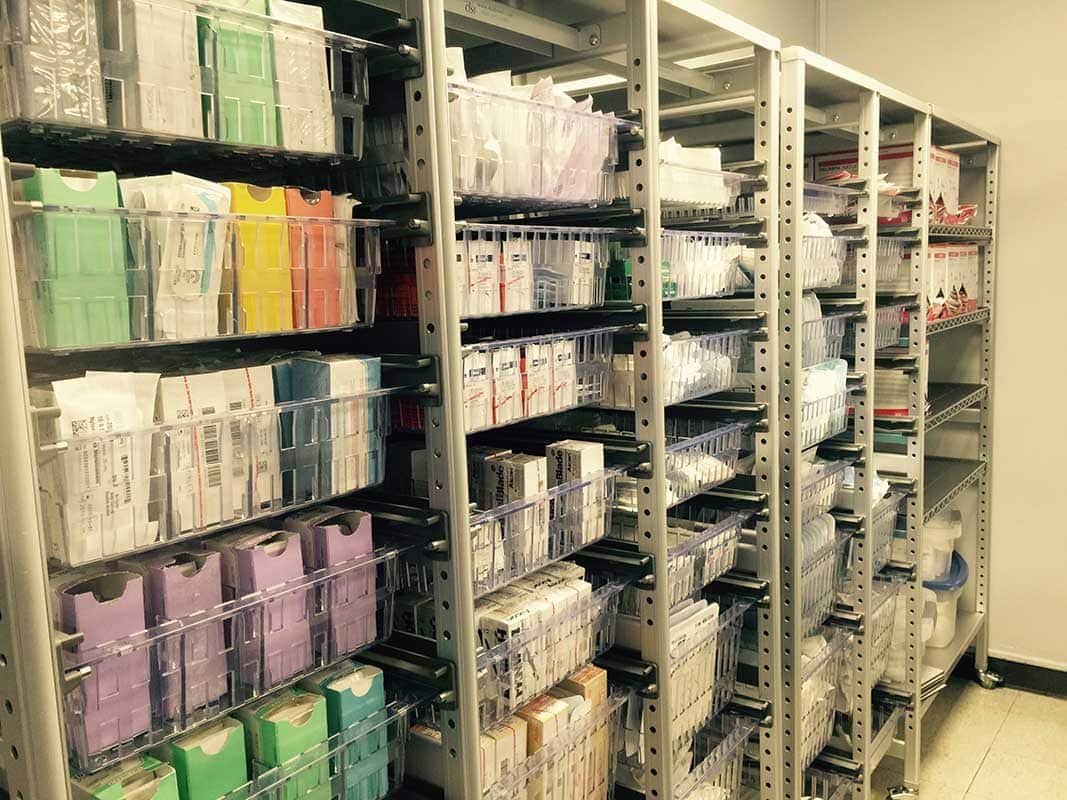
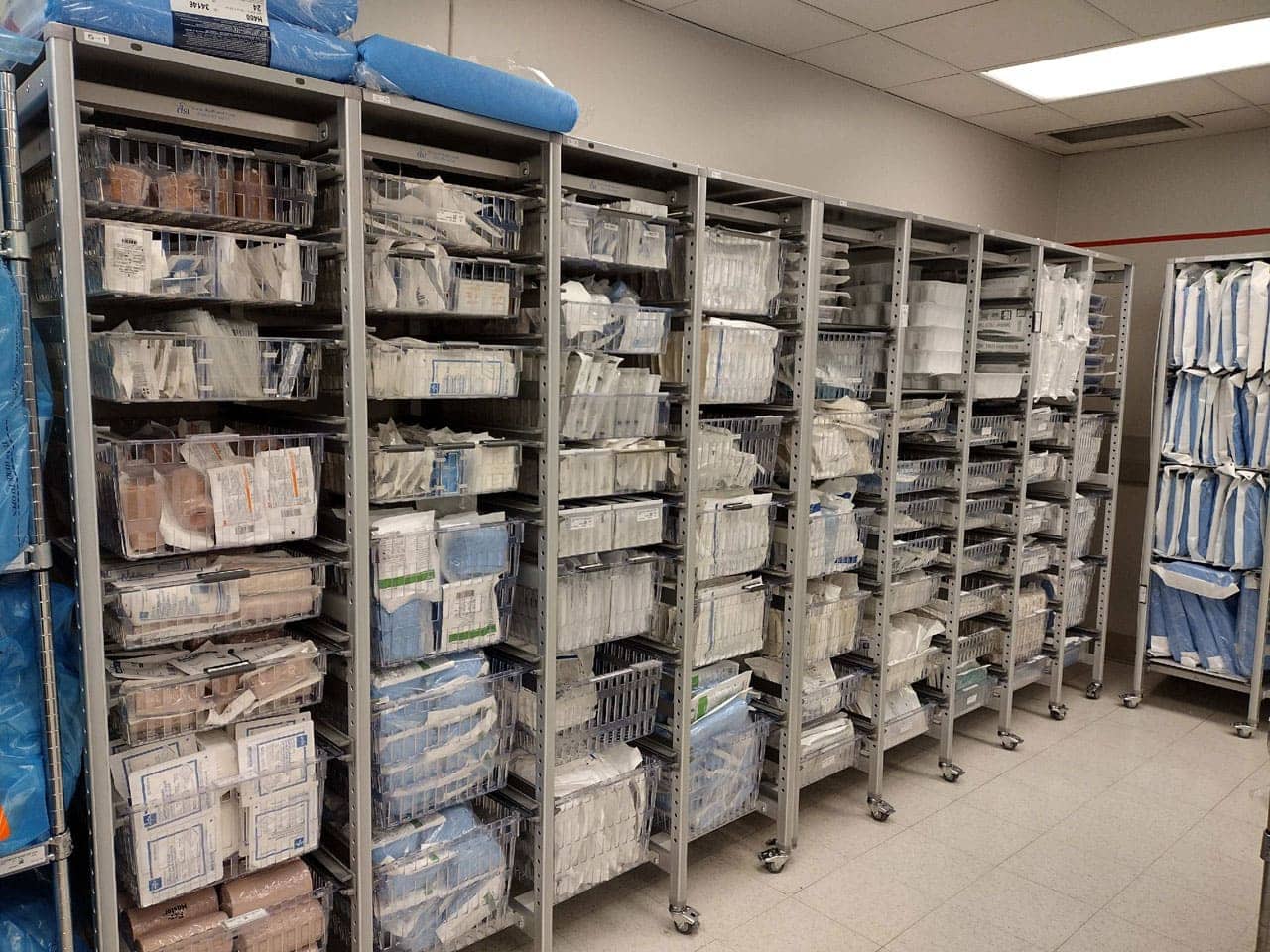
Healthcare materials management encompasses the end-to-end process of acquiring, storing, tracking, and distributing medical supplies across clinical departments. A 2-bin KANBAN system holds each item in two containers at the point of use, creating visual replenishment signals when the first bin empties. Par levels set minimum stock thresholds that trigger reorder, while perpetual inventory tracking provides continuous visibility rather than periodic cycle counts.
Value Analysis Committees bring clinical staff, supply chain leaders, and finance into one decision process to evaluate products against quality and cost criteria. SKU proliferation occurs when multiple similar products accumulate due to uncoordinated clinical preference items, fragmenting purchasing power. Formulary standardization consolidates approved products across departments to reduce variation and unlock volume pricing.
Medical supplies are the second-largest controllable cost in hospitals after labor, consuming 15 to 30 percent of operating expenses. Mid-sized hospitals routinely carry $20 to $40 million in preventable supply-chain waste driven by overstocking, expiration, and fragmented purchasing. Hospitals typically hold 20 to 30 percent of annual supply spend as inventory, with annual carrying costs reaching 20 to 30 percent of that inventory's value.
Inventory turns at typical US hospitals range from 8 to 12 per year, far below optimized thresholds. High-density storage retrofits using modular track systems can reclaim 1,000 to 3,000 square feet per facility when inventory levels drop 20 to 30 percent. New healthcare construction costs $400 to $730 per square foot, making space reclamation one of the highest-leverage moves available to materials management leaders seeking working capital release.
Supply shortages affect care quality across every clinical department, with 74 percent of respondents reporting surgery and anesthesia care compromised by materials management failures. Emergency care suffers in 64 percent of organizations, while 60 percent report shortages of more than 20 drugs, supplies, or devices within six months. Pain management and cardiology services face disruption rates of 52 percent and 45 percent, respectively.
Hematology-oncology care is affected in 44 percent of cases, and 35 percent of respondents resort to gray-market purchasing to maintain supply availability. Perioperative staff report delaying cases while tracking down missing supplies 69 percent of the time, translating supply chain inefficiencies directly into compromised surgical schedules. These shortages cause preventable patient harm, demonstrating that materials management discipline protects patients, not just margins.
LEAN inventory management using 2-bin KANBAN replenishment reduces inventory holding costs by approximately 35 percent while cutting out-of-stock rates to near zero. This demand-driven approach triggers replenishment based on actual consumption rather than fixed schedules. A three-year quality improvement study found weekly consumable costs dropped from $8,500 to $4,300 after KANBAN implementation, while staff compliance rose from 76 percent to 95 percent.
BlueBin hospital deployments consistently report 5 to 7 percent reductions in annual medical supply expense and 15 to 25 percent decreases in overall inventory. Supply chain operational efficiency gains reach 30 percent, returning up to 50 percent of clinician time previously spent on supply tasks back to patient care. Organizations implementing plastic bin systems for KANBAN see staff satisfaction rise from 79 percent to 90 percent within the first year.
Par levels set by staff estimation create chronic overstocking because fear of running out drives buffer stock higher than consumption warrants. Resetting par levels against actual usage data releases working capital within a single replenishment cycle. Before optimization, hospitals discard 10 to 20 percent of consumables due to expiration, and stockouts occur 20 to 30 times per 1,000 patient days.
Between 20 and 40 percent of SKUs remain overstocked relative to actual usage across BlueBin health-system engagements. Inventory turns at AHRMM benchmark facilities lag at 3 to 5 per year, while optimized hospitals achieve 10 to 20 turns. At 10 turns, facilities hold 36 days of supply; at 20 turns that figure drops to 18 days.
Manual cycle counts produce data that becomes stale immediately because supply rooms change continuously between counts. Barcode tracking improves accuracy to 85 to 90 percent but requires manual scanning, while RFID achieves 99 percent accuracy by reading tagged items automatically. RFID adopters report an 82 percent improvement in inventory tracking capability and 73 percent better data availability for optimizing surgical kit contents.
Recall management improves 64 percent with RFID implementation, and 68 percent of large hospitals in North America and Europe are transitioning to automated tracking systems. Automation reduces inventory costs by 18 to 30 percent and cuts average carrying costs by 24 percent. Equipment search time falls 35 percent while clinical workflow efficiency improves 23 percent, but adoption succeeds 62 percent more often when a dedicated ownership role exists.
Standardizing products and storage layouts across sterile processing departments, operating rooms, pharmacy, and materials management reduces training burden and eliminates duplicate SKUs. Navigant analysis found hospitals can safely cut supply expense by an average of 17.7 percent, approximately $11 million per hospital per year, by reducing variation and waste. Formulary standardization in ostomy care produces 40 percent lower average costs through consolidated purchasing.
Rush University Medical Center reduced shoulder replacement spend by 21 percent, saving $800,000 in under a year through single-category standardization. Purchased services now represent over 20 percent of total system spend, making standardization increasingly critical to cost containment. Facilities implementing dedicated workstations for sterile processing find standardized layouts reduce setup time and improve compliance with infection control protocols.
Fragmented multi-vendor purchasing multiplies purchase orders, hides total spend, and forfeits volume discounts. Hospital purchasing leaders report working closer with distributors than two years prior in 74 percent of cases, prioritizing supplier reliability over price alone. Reliability ranks as the primary value driver for 76 percent of purchasing leaders, while cost efficiency remains a priority for 78 percent.
Estimated annual waste tied to supply-chain fragmentation reaches approximately $25 billion industry-wide, driven by duplicate SKUs and contract non-compliance. Single-source partnerships improve price predictability and administrative simplicity but concentrate supply risk, which is why reliability evaluation now precedes vendor selection. Organizations implementing comprehensive storage solutions as part of vendor consolidation report faster deployment and better post-implementation support.
Value Analysis Committees dissolve departmental silos by bringing clinicians, supply chain leaders, and finance into one structured decision process. Clinicians and nursing staff judge clinical fit, workflow impact, and safety, while supply chain and contracting review existing contracts to avoid duplication. Finance confirms alignment with cost-containment goals and return-on-investment expectations.
Effective committees track financial impact, operational improvement, and patient outcomes after product approval rather than stopping at purchase. Many committees still run on spreadsheets and email, slowing decisions and raising compliance risk. Cross-functional collaboration prevents the materials management mistakes that arise when departments purchase independently, creating SKU proliferation and missed volume discounts.
Space utilization audits identify how much floor area inventory consumes and reveal opportunities to reclaim clinical or revenue-generating space. Cutting inventory 20 to 30 percent reclaims 1,000 to 3,000 square feet per facility, avoiding new construction costs of $400 to $730 per square foot. Annual operating costs for hospital space run $50 to $100 per square foot, making space reclamation a recurring operational savings.
Optimizing inventory levels frees $3.75 million to $6.25 million in working capital for mid-sized facilities, capital that can fund clinical equipment or offset revenue shortfalls. Space audits typically reveal storage layouts that predate current process standards, forcing staff into workarounds like hallway staging and off-site overflow. Upgrading to high-density mobile storage eliminates fixed aisles and recovers 40 to 50 percent of floor area within the same footprint.
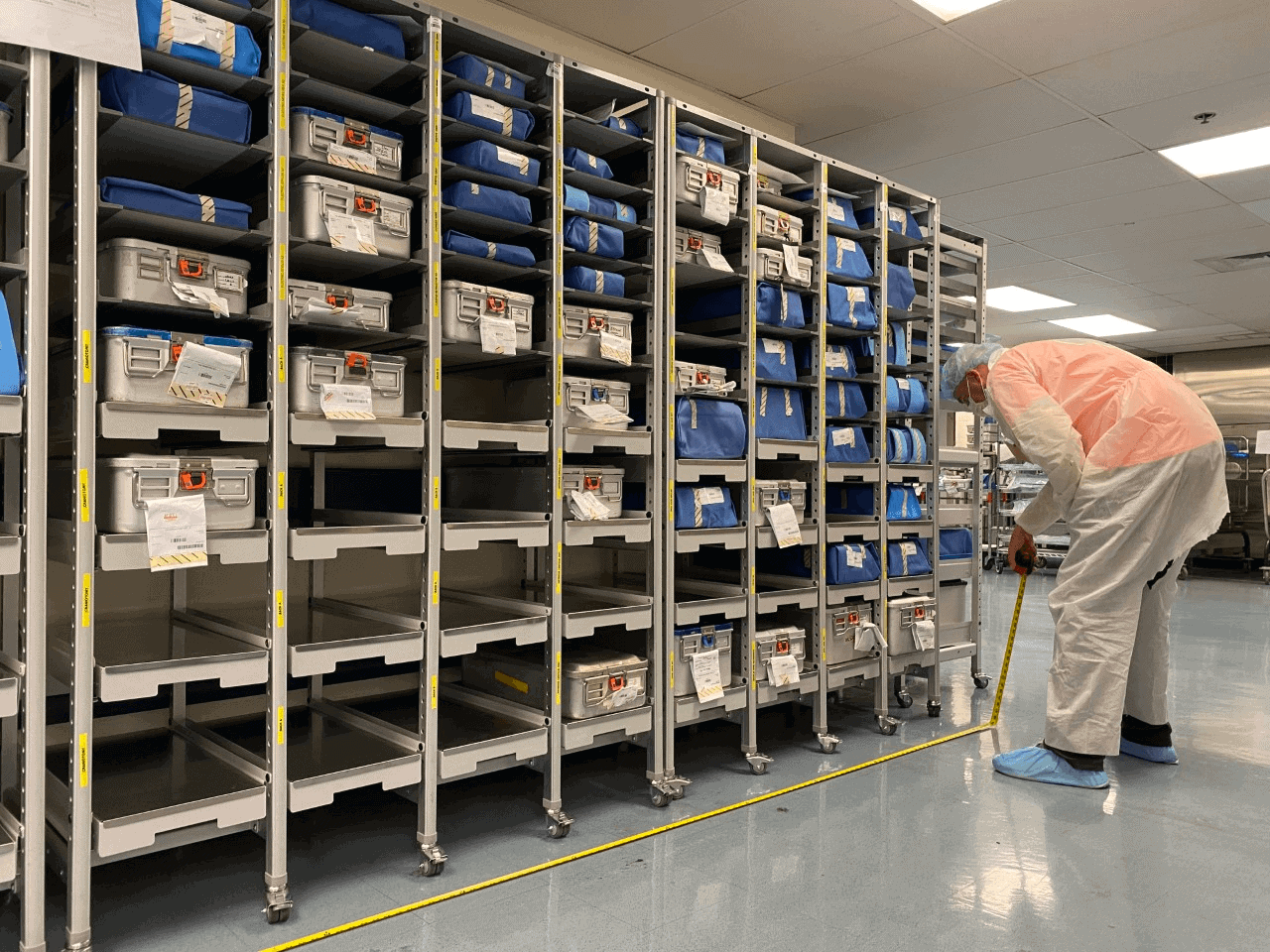
High-density mobile shelving eliminates fixed aisles by mounting shelving on tracks, allowing staff to open only the needed aisle while keeping others compressed. Floor area recovery ranges from 40 to 50 percent compared to traditional open shelving, and storage capacity increases up to 50 percent in sterile processing departments. High-density systems save 25 to 50 percent of storage space across all hospital departments.
These retrofits are cost-effective and non-invasive compared to expansion or new construction. Facilities considering renovation should evaluate compact track storage before committing to building expansion, as reclaiming existing square footage almost always costs less. Proper infrastructure prevents workflow failures that occur when inadequate storage forces improvised staging and slows item retrieval.
Inadequate storage infrastructure forces staff into workarounds that compound other materials management mistakes and slow clinical workflows. Cramped sterile processing storage raises the risk of instrument damage and contamination, threatening accreditation when infection control protocols cannot be maintained. Hallway staging and off-site overflow obscure inventory visibility, making perpetual tracking impossible and driving expiration waste that reaches 8 to 10 percent industry-wide.
Poor layout directly increases the time clinicians spend hunting for supplies, a cost that reaches $12 million annually at a 300-bed hospital. When retrieval takes longer, staff overorder to compensate, creating fear-based overstocking that ties up 20 to 30 percent of annual supply spend. Addressing storage infrastructure is a prerequisite for sustained improvement in inventory accuracy and cost control.
Most hospital LEAN programs stall by year three as attention shifts to newer priorities and small deviations accumulate into systemic backsliding. Treating LEAN as rules and tools rather than an operating philosophy causes failure because staff perceive the program purely as cost-cutting. When external consultants depart without transferring ownership, most organizations see improvement decline within six months.
Applying 5S as a standalone tool rarely delivers durable savings because it is a housekeeping method, not a replenishment system addressing root causes. Sustained programs require leadership commitment visible through action. Without structured capability transfer and continuous feedback loops, process gaps healthcare organizations closed during rollout reopen as training fades and accountability weakens.
Organizations that sustain LEAN results invest 15 to 20 percent of total transformation budget in capability development, embedding documented training and mentored practice. Sustained programs require leadership commitment visible through consistent action, staff engagement with frontline ownership, and continuous-improvement mechanisms that catch small problems early. Structured capability transfer ensures staff can troubleshoot issues without external support.
Facilities that skip change management investment typically see efficiency gains erode within six to 36 months, forfeiting the 15 to 50 percent reductions in inventory value, holding costs, and clinical time that demand-driven replenishment delivers. When staff perceives improvement initiatives as compliance exercises rather than workflow enhancements, engagement fades. Retrofitting sustainability frameworks onto stalled programs is far harder than building them into the design from day one.
Automated inventory systems deliver 18 to 30 percent reductions in inventory costs and 24 percent decreases in carrying costs, but adoption succeeds 62 percent more often when a dedicated ownership role exists. Without a named system owner, technology implementations stall during configuration, training gaps persist, and data quality degrades. Equipment search time falls 35 percent and clinical workflow efficiency improves 23 percent when automation is paired with clear accountability.
Higher automation adoption correlates directly with leadership investment in capability transfer and role definition before technology deployment. Organizations that name an owner, fund training, and establish feedback loops see faster ROI and sustained accuracy improvements. Facilities that treat automation as plug-and-play without process redesign often abandon systems within 18 months as cost overrun multiplies.
Chronic overstocking is the costliest and most widespread materials management mistake, driven by fear-based ordering when staff lacks usage visibility. Without consumption data, defensive ordering creates buffer stock that ties up 20 to 30 percent of annual supply spend as inventory carrying costs of 20 to 30 percent of its value. Mid-sized hospitals routinely carry $20 to $40 million in preventable waste, with typical overstock ranges reaching 20 to 50 percent above actual need.
Optimizing inventory levels releases $3.75 million to $6.25 million in working capital for facilities spending $100 million annually on supplies. Overstock drives expiration waste, consumes floor space, and obscures visibility into actual needs. Fear-based ordering is the root cause that cascades into expired supplies, duplicate SKUs, and stockouts that send clinicians hunting for items records claim are on the shelf.
Skipped or inaccurate audits let expired and obsolete inventory accumulate unnoticed until items are purchased, stored, never used, and then repurchased. Industry-average expiration rates on medical supplies reach 8 to 10 percent, climbing to 10 to 30 percent on some med-surg and pharmacy categories. Facilities spending $100 million annually on supplies lose $8 to $10 million to expiration, while GHX identified approximately $9 million in expired product across organizations in 2024, averaging $90,000 per facility.
Fifty percent of hospitals remain unable to proactively identify and manage expired supplies, and approximately 20 percent of hospital leaders lose more than $10,000 monthly to obsolete or expired inventory. One neurosurgery study found OR supply waste per procedure reached $968 per case, totaling $2.9 million annually. Inventory errors compound when records show stock on hand but items have expired, creating both overstock and shortage simultaneously.
Siloed departmental purchasing creates duplicate SKUs for the same or similar products, forfeits volume discounts, and obscures total spend. Annual waste tied to supply-chain fragmentation reaches approximately $25 billion industry-wide, driven by SKU proliferation from uncoordinated clinical preference items. Departments buying independently do not know how much variation exists until they measure it, and fragmented purchasing forces higher per-unit prices while driving overstocking.
Organizations rarely realize the scale of duplication until a cross-functional Value Analysis Committee maps SKUs across departments and discovers three vendors supplying functionally identical products at different prices. Siloed purchasing prevents the standardization that unlocks Navigant's documented 17.7 percent safe supply-expense reduction averaging $11 million per hospital annually. Consolidating purchasing authority and implementing formulary controls interrupts this waste at the source.
When inventory records drift from shelf reality due to inadequate audits and overstocking, clinicians lose up to 60 minutes per shift hunting for supplies. Aggregate US nurse supply-hunting cost reaches approximately $14 billion annually, with a 300-bed hospital with 800 nursing full-time equivalents losing roughly $12 million per year. Sixty-nine percent of perioperative staff report delaying a case while tracking down missing supplies.
Clinical hours returned annually per system reach 14,000-plus hours when demand-driven replenishment eliminates hunting, hours that return to direct patient care and reduce overtime expense. Supply-hunting cost never appears as a budget line item, making it one of the largest operational drains in healthcare. When staff spend more time searching than caring, dissatisfaction rises and turnover follows, compounding workforce costs.
Supply availability ranks among the most-cited nurse dissatisfaction drivers, and if turnover rises 2 to 3 percent due to materials management failures, nurse replacement costs add $1 million to $2 million annually at a 300-bed hospital. Seventy-four percent of respondents report surgery and anesthesia care quality affected by shortages, while 64 percent report emergency care compromised. Thirty-five percent resort to gray-market purchasing, introducing unvetted products and compliance risks.
Hematology-oncology care is affected in 44 percent of cases, forcing delays in chemotherapy administration. Staff burnout accelerates when clinicians perceive supply problems as chronic and unaddressed, eroding morale and driving experienced personnel to leave. These departures remove institutional knowledge and further destabilize workflows.
Materials management mistakes cascade into systemic operational breakdowns when root causes remain unaddressed, and process gaps healthcare leaders overlook widen over time. Fear-based overstocking consumes floor space, forcing hallway staging that obscures inventory visibility and prevents perpetual tracking. Skipped audits allow 8 to 10 percent of stock to expire unnoticed, costing facilities spending $100 million annually up to $10 million in write-offs.
Stockouts occur 20 to 30 times per 1,000 patient days when records show inventory on hand, but items have expired or been misplaced, sending clinicians hunting and triggering rush orders at premium pricing. These delays compromise care in 74 percent of surgery cases and 64 percent of emergency cases. Financial drain, regulatory exposure, degraded care quality, and workforce attrition compound into systemic failure when improvement programs stall.
Healthcare materials management mistakes cost mid-sized hospitals $20 to $40 million annually in preventable waste, but the financial impact extends beyond dollar losses to patient safety and workforce stability. Evidence shows that demand-driven replenishment using 2-bin KANBAN systems reduces inventory holding costs by 35 percent while cutting stockouts to near zero, and optimizing par levels based on usage data releases $3.75 million to $6.25 million in working capital within a single replenishment cycle. Automated tracking with RFID improves accuracy to 99 percent and raises recall management capability by 64 percent, but adoption succeeds 62 percent more often when a dedicated ownership role and change management framework sustain gains past year three.
Facilities that close the gap between proven practices and recurring mistakes report 15 to 50 percent reductions across inventory value, holding costs, and clinical time lost to supply hunting. Distribution Systems International has supported acute care facilities for over 30 years by delivering LEAN inventory management systems, high-density storage retrofits, and turnkey implementation that includes delivery, assembly, inventory transfer, and after-sales support. Organizations that invest 15 to 20 percent of transformation budgets in capability development and continuous feedback loops protect both margins and patient safety while avoiding the cost overrun causes that compound when improvement programs stall.
| Mistake | Root Cause | Financial Impact | Proven Fix |
| Chronic overstocking | Fear-based ordering without usage data | $20M to $40M in preventable waste at mid-sized hospitals | 2-bin KANBAN demand-driven replenishment |
| Expired and obsolete supplies | Skipped or inaccurate audits | $8M to $10M in expired inventory at facilities spending $100M annually | Scheduled audits paired with automated tracking |
| Siloed departmental purchasing | Uncoordinated clinical preference items | Approximately $25B in industry-wide waste from fragmentation | Value Analysis Committees and formulary standardization |
| Inadequate storage infrastructure | Layouts that predate current inventory volume | Up to $12M a year in clinician search time at a 300-bed hospital | High-density mobile storage retrofits |
| Abandoned improvement programs | No dedicated ownership or capability transfer | 15 to 50 percent of potential savings lost within 6 to 36 months | Sustained investment in capability development |
Chronic overstocking, expired supplies, and siloed purchasing quietly drain hospital budgets every year. Distribution Systems International has helped acute care facilities close these gaps for more than 30 years with LEAN inventory systems, 2-bin KANBAN replenishment, and high-density storage that free up capital and clinical hours. Call Distribution Systems International at (800) 393-6090 or request a free storage and supply chain quote to see where your facility stands today.
Chronic overstocking driven by fear-based ordering is the costliest and most widespread materials management mistake. Without consumption data, staff orders defensively, tying up 20 to 30 percent of annual supply spend as inventory that later expires or goes unused. Resetting par levels against actual usage data is the fastest way to release that working capital.
Mid-sized hospitals routinely carry $20 million to $40 million in preventable supply-chain waste from overstocking, expiration, and fragmented purchasing. Clinician time lost hunting for supplies adds roughly $12 million a year at a 300-bed hospital. Industry-wide, fragmented purchasing alone accounts for approximately $25 billion in waste.
A 2-bin KANBAN system holds each item in two containers at the point of use, creating a visual signal to reorder only when the first bin empties. This demand-driven approach reduces inventory holding costs by approximately 35 percent and cuts stockouts to near zero. One three-year study found weekly consumable costs dropped from $8,500 to $4,300 after implementation.
A space and usage audit is the logical starting point, since it reveals how much floor area and working capital current inventory levels consume. Facilities typically reclaim 1,000 to 3,000 square feet and free $3.75 million to $6.25 million in working capital once they cut inventory 20 to 30 percent. From there, par-level resets and automated tracking build on that baseline.
Par-level resets and KANBAN conversions can show measurable results within a single replenishment cycle, often weeks rather than months. Sustained, facility-wide gains take longer and depend on leadership commitment. Most LEAN programs stall by year three without a named system owner and continued capability development, so budgeting 15 to 20 percent of the transformation budget for training protects long-term results.
With 21 years of sales management, marketing, P&L responsibility, business development, national account, and channel management responsibilities under his belt, Ian has established himself as a high achiever across multiple business functions. Ian was part of a small team who started a new business unit for Stanley Black & Decker in Asia from Y10’ to Y14’. He lived in Shanghai, China for two years, then continued to commercialize and scale the business throughout the Asia Pacific and Middle East regions for another two years (4 years of International experience). Ian played college football at the University of Colorado from 96’ to 00’. His core skills sets include; drive, strong work ethic, team player, a builder mentality with high energy, motivator with the passion, purpose, and a track record to prove it.