Healthcare facilities face unprecedented pressure to optimize storage infrastructure as real estate costs rise and operational margins tighten. The global healthcare supply chain management market reached USD 3.93 billion in 2025 and is projected to reach USD 4.52 billion in 2026, growing at 6.33% CAGR through 2035. These healthcare storage trends demonstrate how smart systems and automation address space constraints, labor shortages, and inventory accuracy challenges.
High-density storage encompasses technologies that maximize vertical and horizontal space utilization while improving inventory visibility and access speed. These systems range from basic mobile shelving to advanced robotic automation, each addressing specific operational requirements and budget constraints. Healthcare facilities allocate 20-45% of their supply chain budgets to storage and logistics infrastructure.
The market reflects diverse facility needs across rural clinics, community hospitals, and urban medical centers. Market demand increasingly favors solutions integrating with electronic health records and providing real-time inventory tracking capabilities.
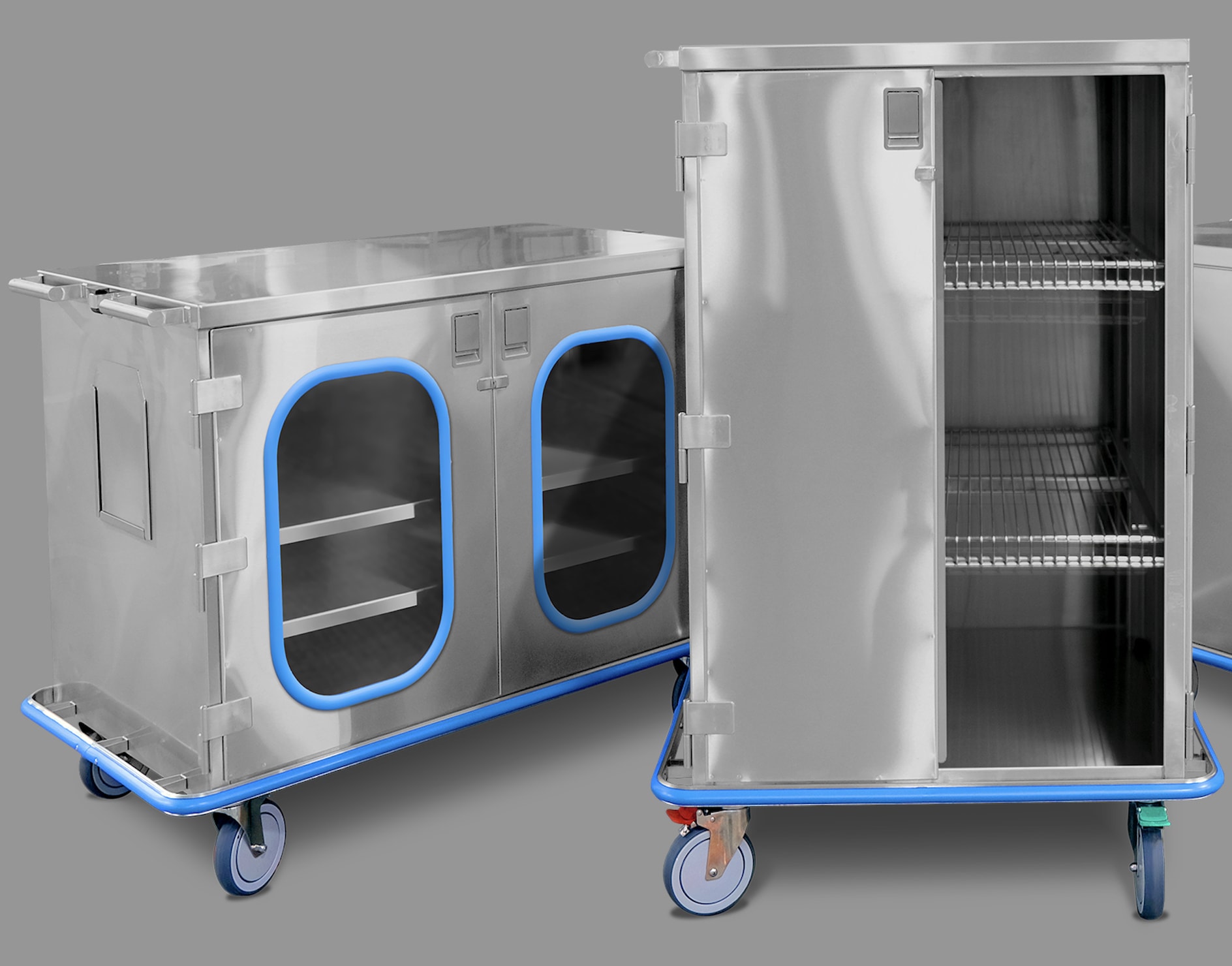
Static shelving consists of fixed stainless steel or aluminum units mounted to walls or floors. Up to 50% of the static shelving footprint represents dead space consumed by fixed access aisles, making it the least space-efficient option.
Manual inventory management creates labor intensity and error susceptibility. Adoption rates decline in larger facilities as space costs and labor expenses exceed justification thresholds. Smaller rural clinics with limited capital budgets continue using static configurations despite inefficiency because upfront costs remain under $50,000.
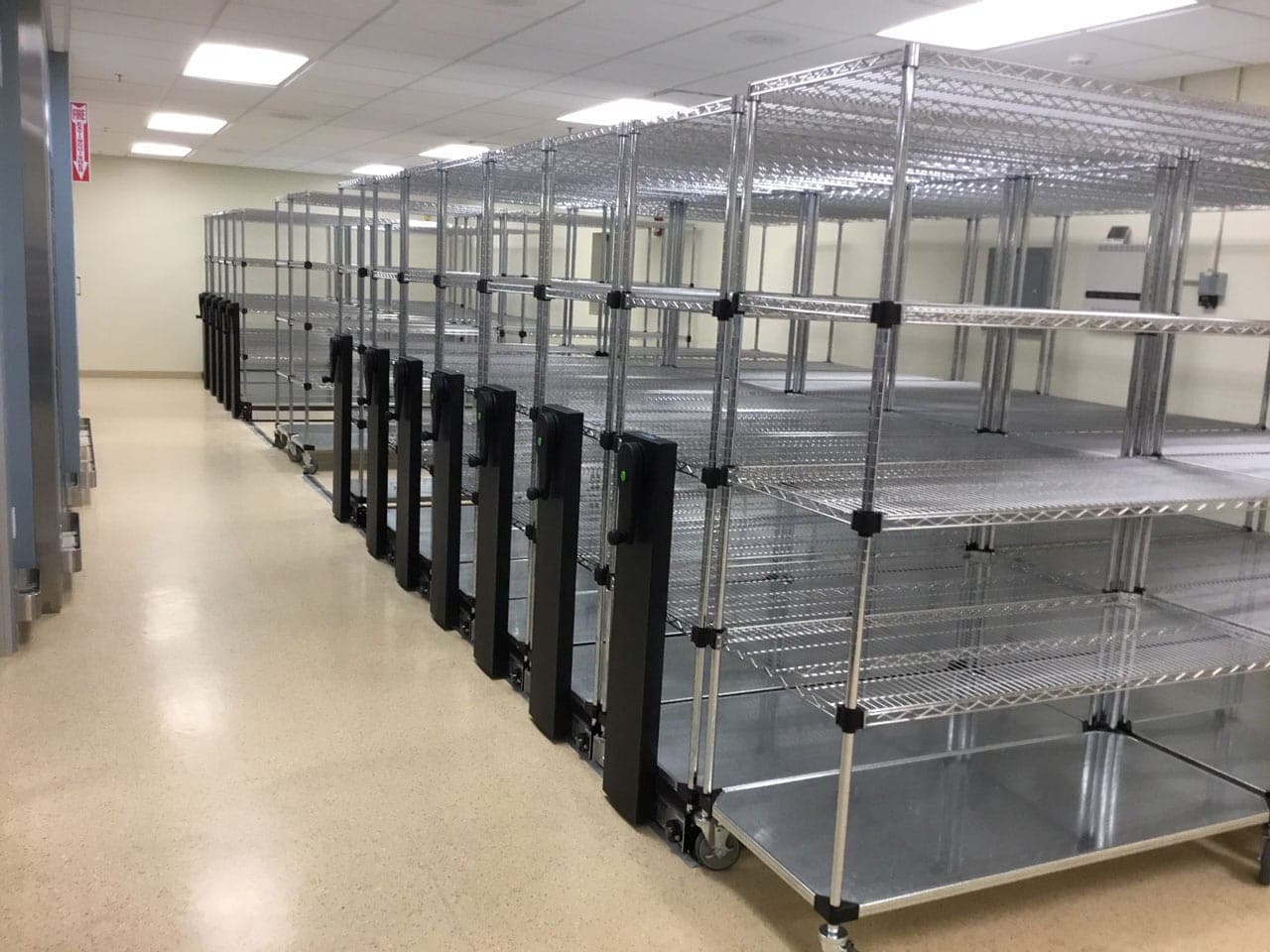
High-density mobile shelving eliminates fixed aisles by mounting shelving units on track systems with wheeled carriages. These systems create a single movable access aisle, delivering 50-66% floor space savings compared to static configurations. Over 850 hospitals have adopted these solutions, representing approximately 55% of the open mobile shelving market demand.
Space optimization allows facilities to double storage capacity within existing footprints or compress inventory into half the original area. These systems best suit general supplies, medical records, and slower-moving inventory rather than high-velocity pharmacy dispensing.
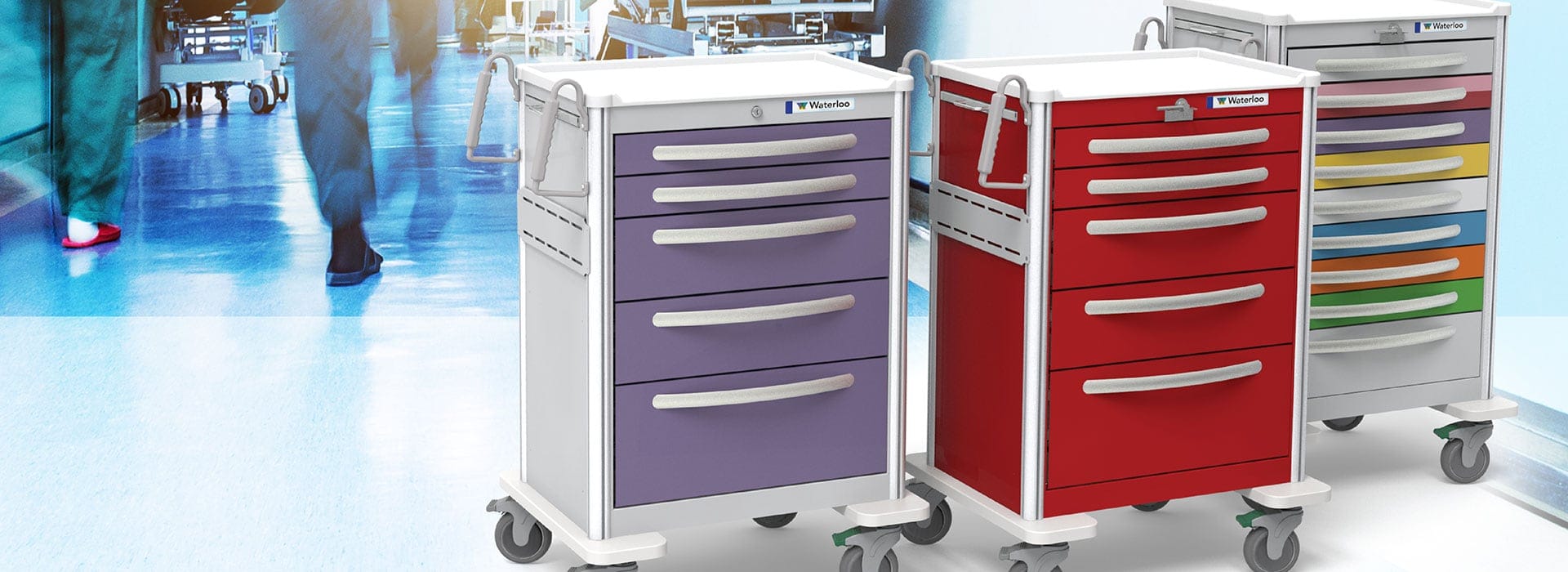
Automated Dispensing Cabinets serve as specialized medication management units featuring secure access controls and EHR integration. Vertical Lift Modules utilize enclosed, elevator-like systems, maximizing ceiling height to deliver space savings up to 90%. Robotic cube storage employs independent robotic units retrieving items at speeds reaching 1,000 lines per hour.
ADCs incorporate barcode or RFID tracking with real-time billing system connections to reduce medication errors. VLMs feature central extractors delivering trays to waist-high picking windows at 300+ lines per hour with 99%+ accuracy. Robotic systems remain reserved for massive distribution centers and the largest urban research hospitals due to implementation complexity and costs ranging from $300,000 to $2,000,000+.
Smart systems address critical healthcare storage challenges through technology integration, error reduction, and labor optimization. Automation reduces manual picking time, improves inventory accuracy, and provides real-time visibility across supply chain operations. These capabilities directly impact patient safety, regulatory compliance, and operational cost structures.
The shift toward automation reflects broader 2026 innovations in healthcare infrastructure responding to labor shortages and quality demands. Facilities experiencing frequent stock-outs, high labor costs, or space constraints find automation essential for maintaining service levels. Integration with existing EHR and ERP systems creates seamless data flow supporting clinical decision-making and financial management.
ADCs reduce medication errors through barcode verification and secure access protocols, tracking every transaction. Real-time integration with electronic health records ensures billing accuracy and supports regulatory compliance documentation. These units provide controlled substance management meeting DEA requirements while generating audit trails.
User authentication and automated inventory replenishment reduce manual pharmacy workload by 30-40%. Decentralized medication storage at nursing stations improves response times for time-sensitive treatments. ADC systems range from $150,000 to $500,000+, depending on capacity, security features, and software integration capabilities.
VLMs save up to 90% of floor space by utilizing ceiling height unavailable to traditional shelving. Central extractors retrieve trays at 300+ lines per hour with 99%+ accuracy, eliminating picking errors common in manual operations. Ergonomic waist-high delivery windows reduce worker injury risk and improve picking efficiency.
Paris hospital pharmacy data shows VLM implementation generating $163,331 in annual savings through reduced labor and inventory shrinkage. Enclosed storage protects sensitive supplies from contamination while maintaining strict environmental controls. These systems suit high-velocity pharmacy operations and wire shelving for sterile processing departments requiring frequent item access.
Robotic systems deliver retrieval speeds up to 1,000 lines per hour, far exceeding VLM capabilities for massive distribution operations. Independent robotic units provide scalability, allowing facilities to add robots as demand increases without system redesign.
High implementation costs and complex integration requirements limit adoption to the largest urban research hospitals and regional distribution hubs. Facilities must demonstrate sufficient transaction volume to justify $300,000 to $2,000,000+ capital expenditure. Robotic automation becomes cost-effective when labor savings, space optimization, and error reduction exceed $200,000 annually in combined benefits.
Cost analysis spans four distinct pricing tiers reflecting technology sophistication and operational capabilities. Static shelving under $50,000 provides basic storage with minimal features, while robotic systems exceeding $2,000,000 deliver maximum automation. Understanding the total cost of ownership requires evaluating space savings, labor reduction, error elimination, and inventory optimization across system lifecycles.
Functionality differences extend beyond initial purchase price to include maintenance requirements, energy consumption, and integration complexity. High-density mobile shelving offers an optimal cost-to-benefit ratio for many facilities, balancing space efficiency with manageable implementation.
Static shelving costs under $50,000 for basic installations but delivers poor space utilization and requires manual inventory management. High-density mobile shelving ranges from $50,000 to $150,000, providing 50-66% space savings without automation complexity. ADCs and VLMs cost $150,000 to $500,000+, delivering automated picking, tracking, and integration with plastic bins for organized item storage.
Robotic shuttle and cube storage systems require $300,000 to $2,000,000+ investment for complete implementation, including software and integration. Healthcare facilities allocate 20-45% of supply chain budgets to storage and logistics infrastructure, making pricing tier selection a strategic financial decision. Budget allocation must account for installation, training, maintenance contracts, and ongoing software licensing.
High-density mobile shelving compresses identical storage volume into half the footprint compared to static configurations. This compression allows facilities to double storage capacity within existing square footage or reclaim 50% of floor space for clinical use. Static shelving dedicates up to 50% of the footprint to fixed access aisles, representing unproductive dead space.
VLMs maximize vertical space by utilizing ceiling height up to 50 feet, saving 90% of floor area compared to traditional shelving. Automated systems deliver higher storage density per square foot while improving access speed and inventory accuracy. Space optimization becomes financially critical when real estate costs exceed $30 per square foot annually.
High-density mobile shelving requires manual operation unless facilities select powered versions with electronic controls. These systems best suit general supplies, medical records, and slower-moving inventory rather than high-velocity dispensing operations. Static shelving adoption declines in larger facilities as labor costs and space inefficiency drive negative ROI.
Automated systems eliminate picking errors while providing real-time inventory visibility and transaction tracking. Pennsylvania teaching hospital achieved complete elimination of picking errors after implementing modu-stor-cts-hd automated storage, demonstrating measurable quality improvements. Labor productivity improvements of 30-50% become standard in facilities transitioning from manual to automated storage operations.
Specific operational and financial triggers justify storage infrastructure investments by demonstrating clear ROI potential. Facilities should evaluate upgrade timing when space costs exceed $30 per square foot annually or available floor space drops below 10% capacity. Labor costs consuming more than 40% of supply chain budgets indicate automation opportunities, particularly when combined with frequent stock-outs exceeding five monthly occurrences.
Strategic timing considerations include facility expansions, department renovations, and supply chain optimization initiatives. Upgrading during planned renovations minimizes operational disruption and reduces installation costs. Facilities should conduct comprehensive needs assessments examining space utilization, labor allocation, inventory accuracy, and stock-out frequency before proceeding.
Space costs exceeding $30 per square foot annually make space optimization highly profitable through reduced real estate requirements. Facilities with less than 10% available floor space face critical capacity limits requiring immediate expansion or storage densification. Labor costs consuming more than 40% of supply chain budgets justify automation, reducing manual picking and inventory management requirements.
Frequent stock-outs exceeding five per month indicate poor inventory visibility, leading to delayed care and emergency purchasing costs. Combined trigger presence creates compelling business cases showing payback periods of 4-6 years with lifecycle ROI exceeding 150%.
A Pennsylvania teaching hospital achieved complete elimination of picking errors after implementing automated storage systems. This error elimination reduced costly medication waste, prevented adverse events, and improved regulatory compliance documentation. Labor productivity improvements of 30-40% become standard as automated systems eliminate manual picking, restocking, and inventory counting activities.
Facilities redirect labor from repetitive picking tasks to value-added activities, including clinical support and process improvement. Automated dispensing reduces pharmacy technician time per transaction by 60-70% while improving accuracy and documentation. These labor savings generate annual cost reductions of $100,000 to $300,000 in medium-sized facilities.
Space optimization directly impacts financial performance when real estate costs represent significant operational expenses. Reclaiming 50% of storage footprint through modu-stor-cts systems allows clinical expansion without building additions costing $300-500 per square foot. Facilities avoiding construction through storage densification achieve payback in 2-3 years compared to 10-15 years for new building projects.
Vertical space utilization maximizes existing infrastructure investment by accessing ceiling height unused in traditional configurations. Space savings support revenue-generating clinical expansion, including additional operating rooms, imaging suites, or patient beds.
ROI measurement combines multiple financial and operational metrics demonstrating value creation across system lifecycles. Direct cost savings include reduced labor expenses, minimized inventory carrying costs, and decreased product waste from expiration or damage. Indirect benefits encompass improved patient safety, enhanced regulatory compliance, and increased staff satisfaction.
Comprehensive ROI analysis requires baseline data collection before implementation to measure improvement accurately. Facilities should track picking accuracy, labor hours, inventory turnover, space utilization, and stock-out frequency. Financial justification becomes strongest when facilities document current-state inefficiencies and project future-state improvements using conservative assumptions.
Paris hospital pharmacy invested $978,656 in VLM system implementation and achieved annual savings of $163,331 through reduced labor and inventory shrinkage. Cumulative savings reached $1.14 million over seven years, demonstrating sustained value creation. Pennsylvania teaching hospital reported 36% reduction in stock levels while maintaining 98% fill rates, optimizing working capital investment.
These case studies demonstrate automated storage delivering measurable operational improvements beyond financial returns. Pennsylvania facility achieved complete elimination of picking errors, enhancing patient safety and regulatory compliance.
Paris Hospital achieved payback in approximately six years based on $163,331 annual savings against a $978,656 initial investment. The average payback period for automated storage in a 561-bed hospital model is 4.46 years, varying with labor costs, space expenses, and operational volume. Larger facilities with higher transaction volumes achieve faster payback through greater absolute savings despite higher implementation costs.
Smaller facilities face longer payback periods due to lower transaction volumes. Rural hospitals under 100 beds may require 7-10 years for payback, making high-density mobile shelving more appropriate than full automation. Facility size directly impacts ROI magnitude, requiring customized financial analysis matching storage technology to operational scale.
The average ROI of 167% over the system lifecycle in a 561-bed hospital demonstrates strong investment returns, justifying capital allocation. Critical metrics include labor cost reduction, space savings valuation, inventory carrying cost reduction, and error elimination impact. Facilities should measure picking accuracy improvement, stock-out frequency reduction, and inventory turnover acceleration.
Space savings convert to financial value when real estate costs are quantified per square foot annually. Labor savings require detailed time-motion studies comparing manual versus automated picking processes. Inventory optimization reduces working capital requirements by 20-40% through improved visibility and automated reordering.
A 2026 national survey of 102 health system supply chain leaders reveals evolving purchasing priorities balancing cost control with quality requirements. Rising costs remain the top challenge for 60% of respondents, yet quality and reliability dominate actual purchasing decisions.
Procurement strategies emphasize the total cost of ownership over the initial purchase price.
Technology integration capabilities increasingly influence supplier selection as facilities demand seamless EHR and ERP connectivity. Supply chain leaders prioritize vendors offering comprehensive solutions, including needs assessment, system design, implementation support, and ongoing maintenance.
Rising costs challenge 60% of survey respondents as their top operational concern requiring strategic cost management. Accurate order fulfillment represents a critical supplier success indicator for 66% of respondents, emphasizing reliability over lowest pricing. Quality remains nonnegotiable as patient safety and regulatory compliance requirements supersede short-term cost savings.
Procurement leaders pursue balanced strategies, evaluating the total cost of ownership, including maintenance, energy consumption, and system longevity. Supplier selection increasingly favors established vendors offering proven reliability through case studies and reference installations.
Inventory optimization reduces working capital requirements while improving clinical supply availability and reducing waste from expiration. Real-time visibility enables demand-driven replenishment, replacing reactive emergency ordering that inflates costs by 20-30%. Automated systems provide accurate consumption tracking, supporting evidence-based purchasing decisions.
Reduced inventory carrying costs typically range from $50,000 to $200,000 annually, depending on facility size and inventory value. Facilities implementing automated storage reduce safety stock requirements by 30-40% while maintaining service levels.
Seamless EHR and ERP integration eliminates manual data entry, reduces errors, and improves billing accuracy. Facilities prioritize suppliers offering proven integration capabilities with major healthcare IT platforms, including Epic, Cerner, and Lawson. Real-time inventory visibility supports clinical decision-making and financial management through accurate consumption tracking.
Cloud-based platforms enable remote monitoring, predictive maintenance alerts, and performance analytics supporting continuous improvement. Suppliers providing comprehensive services, including IT integration, staff training, and ongoing optimization, gain preference over equipment-only vendors.
Smart storage technologies incorporate artificial intelligence, Internet of Things sensors, and predictive analytics, improving inventory management and operational efficiency. Machine learning algorithms optimize item placement based on access frequency, reducing retrieval time and improving throughput. Predictive maintenance capabilities minimize downtime through sensor-based condition monitoring, alerting facilities before failures occur.
Blockchain integration emerges for supply chain transparency, supporting regulatory compliance and counterfeit prevention. Augmented reality interfaces guide staff through complex picking tasks, reducing training time and improving accuracy. These 2026 innovations transform storage from passive infrastructure to active operational intelligence.
Advanced robotics achieves retrieval speeds exceeding 1,000 lines per hour, supporting high-volume distribution operations. Artificial intelligence optimizes item placement dynamically based on seasonal demand patterns and usage trends. Vision systems enable automated item verification, reducing picking errors to near-zero rates.
Voice-directed picking systems free staff's hands for safer material handling while improving accuracy through audio confirmation. These technologies reduce training time from weeks to days. Accuracy improvements from 95% to 99.9% eliminate costly error correction workflows and improve patient safety.
Modular robotic systems allow incremental capacity expansion by adding robots without redesigning the entire infrastructure. Facilities start with minimum viable automation and scale based on demonstrated ROI. Cloud-based control systems support distributed installations across multiple locations with centralized management.
Independent robotic units provide redundancy, ensuring continued operation during maintenance or component failures. Scalability reduces initial investment risk while preserving future expansion options.
RFID and IoT sensors provide real-time location tracking supporting automated replenishment and expiration management. API-based integration enables bidirectional data flow between storage systems, EHR platforms, and financial systems. Real-time dashboards provide supply chain visibility supporting proactive decision-making.
Predictive analytics identify usage trends, enabling proactive procurement and reducing emergency ordering costs. Automated alerts notify staff of low stock conditions, expiring products, and temperature excursions, protecting product integrity.
Healthcare storage infrastructure decisions represent strategic investments impacting operational efficiency, financial performance, and clinical excellence for decades. High-density storage and automation technologies deliver measurable benefits, including 50-90% space savings, 30-50% labor reduction, and near-elimination of inventory errors. These improvements directly support patient safety, regulatory compliance, and financial sustainability.
Successful implementation requires a comprehensive needs assessment, stakeholder engagement, and phased deployment, minimizing operational disruption. Facilities should evaluate current-state inefficiencies, establish baseline metrics, and develop realistic improvement projections. Partnership with experienced vendors providing consultation, design, implementation, and ongoing support maximizes success probability.
DSIDirect brings three decades of healthcare storage expertise, supporting acute care facilities nationwide in optimizing supply chain operations. Data-driven decision-making, LEAN methodology application, and measurable outcomes characterize successful storage infrastructure projects. Facilities prioritizing quality, reliability, and total cost of ownership achieve sustainable competitive advantages.
Strategic storage optimization positions healthcare organizations for sustainable growth while managing cost pressures and space constraints. Automated systems delivering 167% lifecycle ROI justify capital allocation through quantifiable operational improvements. As healthcare storage trends continue evolving through 2026 and beyond, early adopters gain competitive advantages through enhanced efficiency, reduced costs, and improved patient outcomes.
The numbers in this article point to one outcome: facilities that act on high-density and automated storage reclaim floor space, lower labor costs, and recover their investment within a few years. Distribution Systems International has guided acute care facilities toward those results since 1990, applying LEAN inventory methodology that turns storage from a cost center into a strategic asset.
It starts with a complimentary on-site storage analysis. Our team measures your current PAR levels, workflow, and available floor space, then delivers architectural CAD layouts and a clear ROI projection built around your actual numbers. From there, Distribution Systems International handles full turnkey installation, including assembly, inventory transfer, and after-sales support, so your clinical staff stays focused on patient care instead of hunting for supplies.
Ready to see what high-density and automated storage could save your facility? Schedule your free, no-obligation storage analysis with Distribution Systems International today!

With 21 years of sales management, marketing, P&L responsibility, business development, national account, and channel management responsibilities under his belt, Ian has established himself as a high achiever across multiple business functions. Ian was part of a small team who started a new business unit for Stanley Black & Decker in Asia from Y10’ to Y14’. He lived in Shanghai, China for two years, then continued to commercialize and scale the business throughout the Asia Pacific and Middle East regions for another two years (4 years of International experience). Ian played college football at the University of Colorado from 96’ to 00’. His core skills sets include; drive, strong work ethic, team player, a builder mentality with high energy, motivator with the passion, purpose, and a track record to prove it.