Sterile processing storage compliance is increasingly scrutinized as part of infection control and quality assurance programs. AAMI ST79 violations related to storage compromise sterility maintenance and expose patients to preventable contamination risk. Facilities failing to address storage deficiencies face survey citations, rework costs, and potential adverse patient outcomes.
Understanding where violations occur most frequently allows organizations to prioritize remediation efforts effectively. Successful compliance requires proper storage systems, environmental controls, staff competency, and leadership accountability. This guide identifies the most common AAMI ST79 storage violations and provides practical strategies for fixing violations before they escalate into patient safety events.
Storage is fundamental to sterility maintenance throughout the instrument lifecycle. AAMI ST79 requires sterile barrier systems to protect items during handling, distribution, transport, and storage until the point of use. Event-related contamination risks include air movement, traffic patterns, location selection, humidity levels, storage space, open versus closed shelving, temperature control, and wrapper material properties.
Sterility maintenance covers may be used when items face environmental challenges or multiple handling events. However, these covers are not substitutes for sterile barrier systems and should only be applied when items are completely cool and dry. Re-exposure to non-sterile environments or improper post-sterilization handling requires complete reprocessing.
Proper storage directly determines whether sterile items remain sterile until clinical use. Package integrity can be compromised by physical damage during storage, environmental contamination from humidity or airflow, or handling violations during retrieval. Each factor is explicitly addressed in AAMI ST79 as part of sterility maintenance requirements.
Organizations must evaluate storage systems based on their ability to prevent event-related contamination. Effective storage reduces unnecessary handling, prevents compression or stacking damage, and maintains environmental conditions within specified limits. These practices extend sterile shelf life and reduce reprocessing frequency.
CDC guidelines require a limited-access area for sterile storage with controlled temperature and humidity levels. Sterile storage humidity should not exceed 70% relative humidity to prevent moisture penetration through barrier systems. Storage temperature may be as high as 75°F, though facilities should verify manufacturer instructions for specific packaging materials.
Environmental monitoring requires continuous tracking systems, automated alarms for out-of-range conditions, and documented review of monitoring records. Facilities must demonstrate that environmental excursions are identified promptly and corrective actions are implemented before items are released for patient use. Failure to maintain proper documentation is a frequent survey deficiency.
AAMI ST79 explicitly states that stacking should be avoided unless supported by packaging instructions for use. This requirement is frequently violated when facilities attempt to maximize storage density without considering package integrity impact. Stacking creates compression forces that weaken seals, create micro-tears in wrappers, or cause punctures from underlying instrument edges.
Competency verification for storage and handling practices requires updated standard operating procedures and immediate access to IFU documentation at the point of use. Staff must be trained on proper retrieval techniques, acceptable storage configurations, and conditions that trigger reprocessing. Without ongoing competency assessment, facilities experience practice drift that undermines storage systems.
Sterile processing departments frequently violate AAMI ST79 guidelines through non-compliant workarounds due to space and workflow constraints. The most common violations fall into three categories: physical handling damage, environmental contamination exposure, and documentation or monitoring deficiencies. Each category represents a different failure mode requiring targeted remediation strategies.
Understanding violation patterns allows facilities to prioritize investments in storage infrastructure, environmental controls, and staff training. Compliance gaps often reflect systemic issues rather than isolated errors. Sustainable improvement requires addressing root causes through facility design, equipment selection, and organizational accountability.
Stacked blue wrap or compressed instrument trays create multiple points of failure for sterility maintenance. Weight from upper trays compromises seal integrity, while sharp instrument tips may puncture underlying packages during handling or retrieval. This violation is one of the most visible and easily corrected storage deficiencies.
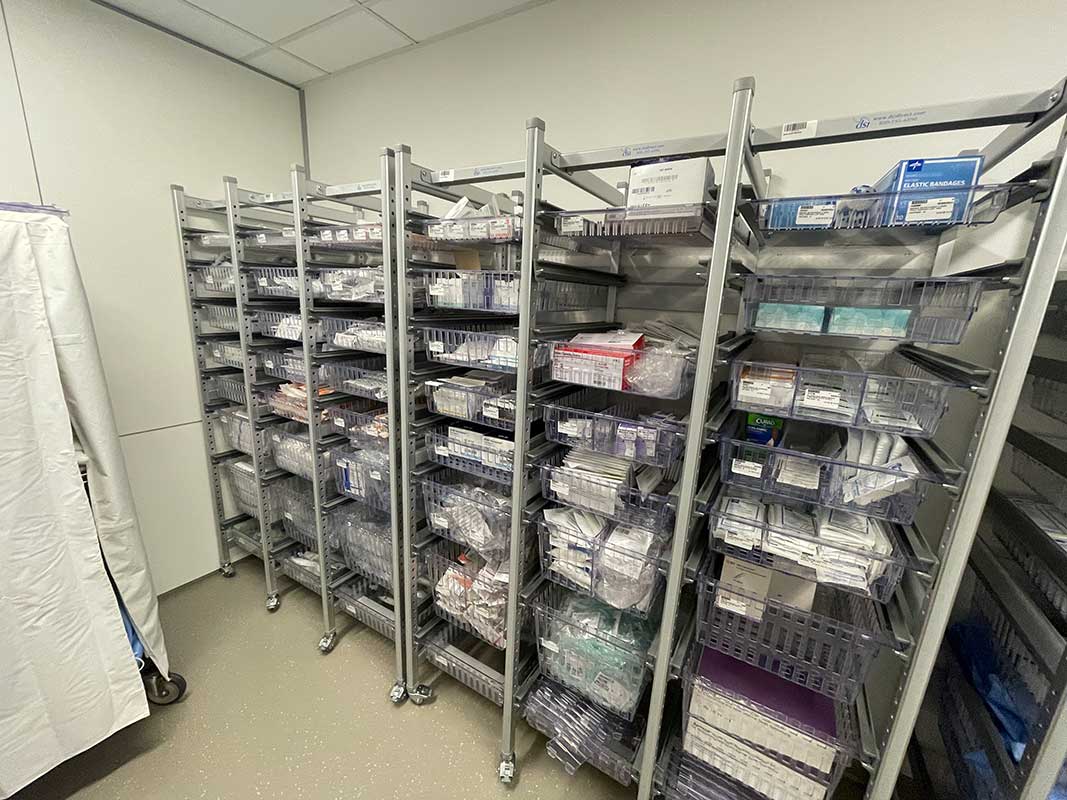
Facilities using modular storage systems report fewer stacking violations because dedicated slots eliminate the need for vertical compression. Handling damage from stacking increases reprocessing workload, extends instrument turnaround time, and creates supply chain waste. Dedicated tray positions provide immediate visual confirmation of proper storage configuration and reduce touch points during retrieval.
Excess traffic in sterile storage areas creates environmental contamination risk through airflow disruption and particle introduction. AAMI ST79 and CDC guidance both emphasize limited-access storage zones to reduce door openings and personnel movement frequency. High-traffic environments increase event-related contamination likelihood even when packages remain physically intact.
Food and drink in sterile areas create additional contamination risk and frequently result in survey citations. The 2024 VA OIG case documented staff eating, drinking, and storing food in sterile storage areas as part of a broader pattern of storage compliance failures. These violations reflect weak environmental discipline and insufficient leadership accountability for maintaining controlled-access zones.
Poor environmental monitoring leads to temperature and humidity noncompliance that may not be discovered until a survey inspection. Many facilities rely on periodic spot checks rather than continuous monitoring systems with automated alerts. This approach fails to capture transient excursions that compromise sterility maintenance during overnight or weekend periods.
Inadequate IFU documentation causes survey deficiencies and allows unsafe practice drift. Facilities must maintain current manufacturer instructions at the point of use and verify that staff competency assessments reflect actual IFU requirements. Missing or outdated documentation strongly indicates that infection control and quality assurance processes are not effectively integrated into daily operations.
The sterile storage systems market includes open racks, closed cabinets, modular storage, and mobile storage configurations. The global sterile storage systems market reached USD 2.1 billion in 2024 and is projected to grow to USD 4.3 billion by 2033, representing an 8.2% compound annual growth rate driven by procedural volume growth and compliance pressure.
North America accounted for more than 35% of the global market in 2024. Investment in premium storage systems is concentrated in urban and academic medical centers where procedural throughput and space constraints create strong demand for high-density and compliance-oriented solutions.
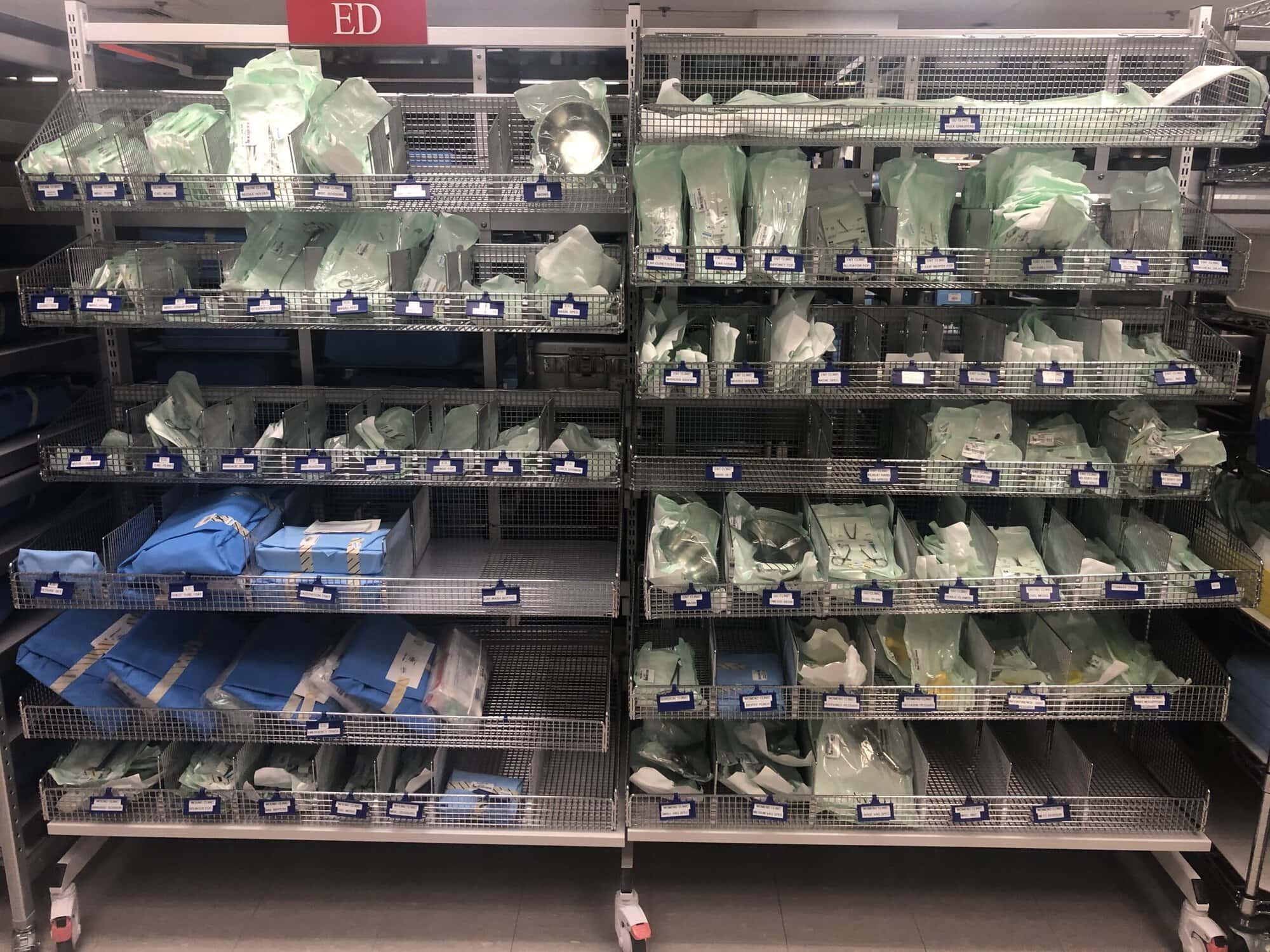
Chrome wire shelving represents the budget tier, with basic kits priced at $599 to $629. Wire shelving with integrated bins ranges from $1,229 to $1,619, offering greater organizational flexibility. However, Metro explicitly states that it does not recommend open wire shelving for wrapped instrument packs due to snag risk.
Polymer shelving starts at approximately $519 for basic kits and offers better wrap protection than chrome wire. Smooth-surface polymer systems reduce the likelihood of tears during retrieval and are easier to clean than wire configurations. Wire shelving can snag sterile wraps during handling, creating micro-tears that compromise package integrity and trigger unnecessary reprocessing.
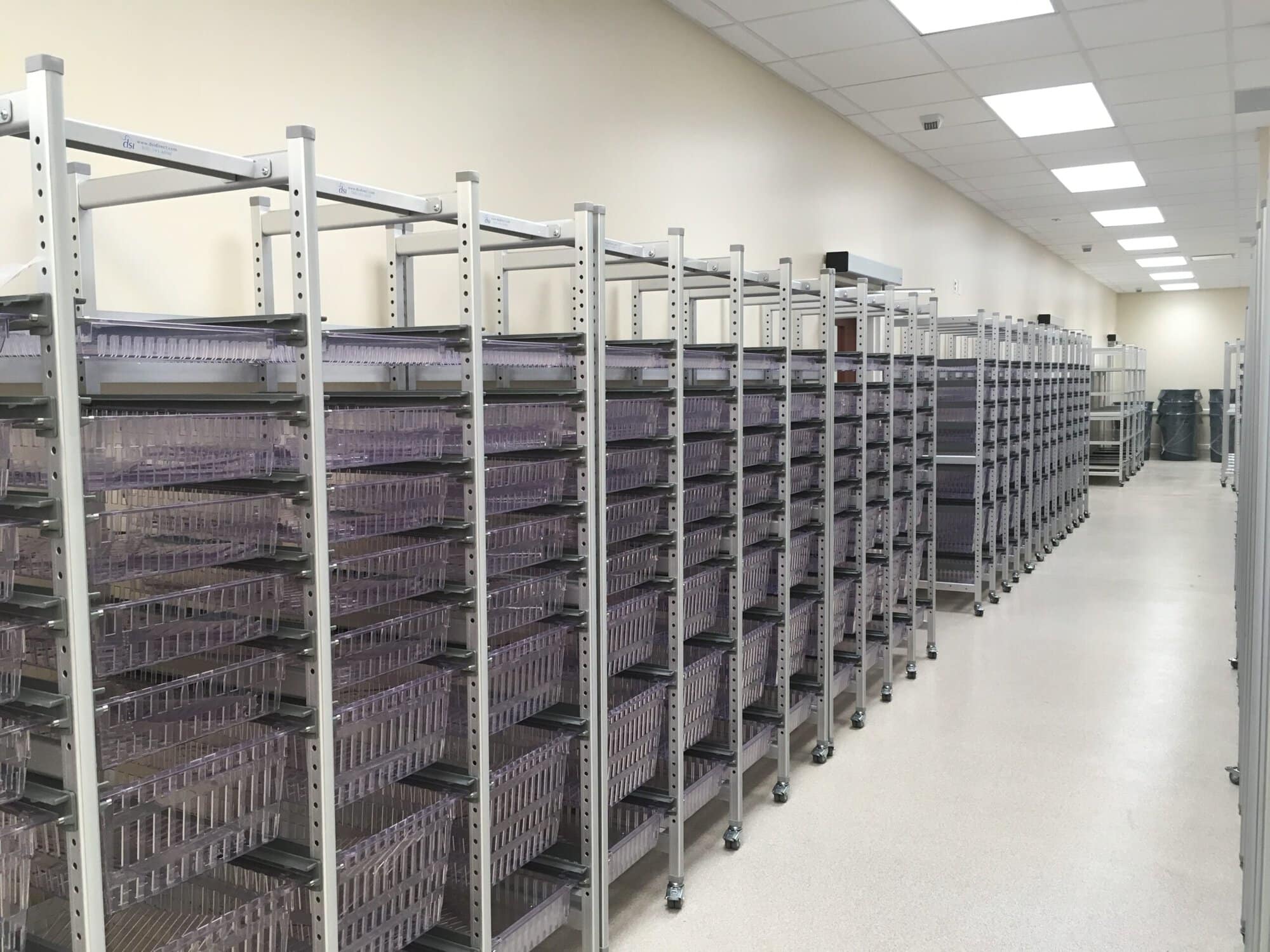
Premium modular tray systems, such as SterileShelf can save 30 to 40 percent of storage space compared to open shelving. These systems use dedicated pull-out trays with individual slots for each wrapped or containerized instrument set. Polymer construction provides better wrap protection than chrome wire and eliminates stacking violations common in space-constrained departments.
SPD-specific systems are designed around AAMI ST79 compliance rather than adapted from general-purpose storage. Dedicated slots prevent compression damage, reduce handling touch points, and improve retrieval ergonomics. The initial investment is higher than commodity wire shelving, but the total cost of ownership over ten years is significantly lower.
Premium triple-column cabinets cost approximately $14,440.95 and provide secure, enclosed storage for high-value or controlled-access inventory. Enclosed cabinets offer security advantages over open shelving but may slow retrieval workflows in high-throughput environments. These systems are ideal for procedural areas requiring organized tray storage with visual access control.
High-density mobile track shelving ranges from approximately $937.80 to $2,482.00 for basic configurations before customization. These systems maximize storage capacity per square foot by eliminating fixed aisles between shelving units. High-density systems are most valuable where existing storage footprint cannot be expanded, and density optimization can defer costly renovation projects.
Effective diagnosis begins with a structured assessment of current storage practices against AAMI ST79 and CDC environmental requirements. Facilities should conduct a gap analysis examining physical storage configuration, environmental controls, traffic patterns, documentation completeness, and staff competency verification. This assessment identifies both obvious violations and systemic weaknesses contributing to practice drift.
Prioritization should focus on violations creating the highest patient safety risk and most frequent survey citations. High-risk violations include stacking or compressing wrapped trays, inadequate environmental monitoring, and unrestricted traffic in sterile areas. Lower-risk issues can be addressed through planned capital cycles.
Reprocessing rates due to package damage provide a direct measure of handling and storage effectiveness. Facilities experiencing frequent reprocessing for tears, punctures, or seal compromise should investigate storage configuration and retrieval practices. Elevated reprocessing rates indicate that current storage systems are not adequately protecting sterile packages.
Environmental excursion frequency reveals whether monitoring systems and alarm protocols function properly. Facilities should track the number of temperature or humidity violations per month and the time elapsed between excursion onset and corrective action. Frequent excursions suggest equipment failure, inadequate HVAC capacity, or insufficient monitoring discipline.
Competency verification ensures that staff understand proper storage configurations and handling techniques. Annual competency assessments should include practical demonstrations of retrieval, package inspection, and recognition of conditions requiring reprocessing. Facilities relying solely on classroom training without hands-on verification experience have higher deficiency rates during inspections.
SOP updates must reflect current IFU requirements and manufacturer recommendations for specific packaging systems. Outdated SOPs create confusion about acceptable practices and undermine staff confidence in compliance expectations. Regular document review and version control prevent the accumulation of obsolete guidance conflicting with current standards.
Continuous environmental monitoring with automated alerts prevents undetected excursions that compromise sterility maintenance. Manual logging systems are inadequate because they cannot capture transient events or provide real-time notification. Facilities must implement 24/7 monitoring with documented review protocols and clear escalation pathways for out-of-range conditions.
Traffic control requires physical barriers, access restrictions, and clear signage designating sterile storage zones. Limited-access areas should minimize through-traffic and prevent casual entry by non-SPD personnel. Effective traffic control reduces airflow disruption, limits particle introduction, and reinforces environmental discipline necessary for sustained storage compliance.
Fixing violations requires a combination of infrastructure upgrades, process redesign, and behavioral accountability. The most effective remediation strategies address root causes rather than implementing superficial workarounds that fail under operational pressure. Sustainable compliance integrates physical storage design, environmental controls, and staff discipline into a cohesive system.
Practical fixes should be prioritized based on patient safety impact, regulatory exposure, and ease of implementation. Quick wins such as de-stacking policies and access signage can be implemented immediately while longer-term infrastructure projects are planned. A phased approach maintains momentum and demonstrates leadership commitment to storage compliance.
Dedicated storage slots eliminate the physical possibility of stacking violations by providing individual positions for each wrapped tray or container. This design change removes reliance on staff judgment and creates a visible compliance checkpoint during retrieval. Facilities implementing dedicated slots report immediate reductions in package damage and reprocessing rates.
De-stacking policies formalize the prohibition against vertical compression and establish accountability for violations. Written policies should specify acceptable storage configurations, provide visual examples of compliant layouts, and define consequences for non-compliance. Policies without enforcement mechanisms fail to change behavior, particularly during high-volume periods.
Controlled-access signage clearly identifies sterile storage zones and restricts entry to authorized personnel. Signage should include specific prohibitions against food, drink, and non-essential traffic to reinforce environmental discipline. Visual cues help prevent casual violations by visitors or support staff unfamiliar with sterile processing requirements.
Electronic access controls provide an additional layer of accountability by creating audit trails of entry events. Badge-access systems allow facilities to restrict access during low-staffing periods and monitor traffic patterns over time. High-traffic periods can be analyzed to identify workflow inefficiencies or layout problems driving unnecessary movement through sterile areas.
Comprehensive training programs must include IFU-specific handling requirements, environmental monitoring procedures, and recognition of contamination events. Training should be delivered at hire, annually, and whenever procedures or equipment change. Documentation of training completion provides evidence of due diligence during survey inspections.
Monitoring gaps are typically addressed through automated systems with continuous data logging and alarm notification. Manual inventory processes still dominate in 78 percent of hospitals, creating opportunities for documentation failures and visibility gaps. Facilities should evaluate inventory management solutions that integrate environmental monitoring, stock rotation, and compliance tracking into unified platforms.
Storage choices affect compliance sustainability through their impact on package protection, staff behavior, maintenance burden, and lifecycle replacement costs. Systems causing frequent package damage or requiring constant repair create ongoing compliance risk and operational disruption. Sustainable storage infrastructure reduces compliance friction and allows staff to focus on core sterilization functions.
Long-term cost analysis must account for acquisition price, installation complexity, maintenance requirements, expected service life, and the cost of compliance failures. Budget-tier systems often appear attractive during initial procurement but generate hidden costs through damage, labor inefficiency, and premature replacement. Total cost of ownership provides a more accurate framework for storage investment decisions.
Chrome wire shelving carries a reported ten-year total cost of approximately USD 14,500 per unit. SterileShelf systems have a claimed ten-year cost of USD 8,500 per unit, representing a 41% lower total cost of ownership. This comparison accounts for acquisition, installation, maintenance, and replacement across a full decade of service.
Annual maintenance costs reveal significant operational differences between storage types. Chrome wire shelving requires approximately $850 per year for cleaning, repair, and component replacement. SterileShelf systems require approximately $150 annually, reflecting lower corrosion risk and reduced handling damage.
Chrome wire shelving has a typical service life of three to five years before corrosion or structural damage requires replacement. SterileShelf and similar premium polymer systems claim service lives exceeding 15 years under normal SPD operating conditions. Longer replacement cycles reduce capital planning uncertainty and minimize operational disruption from equipment changeouts.
Chrome wire is harder to keep cosmetically pristine because exposed metal surfaces corrode, collect debris, and develop sharp edges over time. Weaker protection for delicate sterile packs with wire shelving increases the frequency of wrap tears and seal compromise. Premium systems maintain smooth, protective surfaces throughout their service life, reducing reprocessing waste.
Budget-tier storage typically costs $500 to $1,000 per unit and provides basic organizational functionality. Mid-range systems range from $1,000 to $5,000 and include features such as mobility, adjustability, and accessory integration. Premium systems cost $5,000 to $15,000 or more but deliver superior density, protection, and compliance alignment.
Rising costs are cited by 60 percent of procurement leaders as their top challenge. Cost efficiency is prioritized by 78 percent of hospital purchasing leaders, creating strong demand for lifecycle value rather than the lowest initial price. Facilities evaluating storage through a total cost of ownership framework make better long-term investments and reduce the frequency of costly do-over projects.
Storage compliance ultimately depends on organizational culture and leadership accountability rather than equipment specifications alone. Facilities with strong compliance cultures maintain discipline even during high-volume periods and staffing shortages. Weak cultures allow gradual erosion of standards through uncorrected violations and inconsistent policy enforcement.
Cultural factors are harder to quantify than physical infrastructure, but have a greater impact on sustained compliance. Leadership must establish clear expectations, provide adequate resources, and hold staff accountable for maintaining storage standards. Without visible leadership commitment, even premium storage systems fail to prevent violations.
Leadership accountability creates the expectation that storage compliance is non-negotiable regardless of operational pressures. Leaders who tolerate stacking violations, environmental excursions, or traffic discipline failures signal that compliance is optional during busy periods. This message undermines staff adherence to protocols and increases the likelihood of survey deficiencies.
Effective leaders conduct regular audits, address violations immediately, and demonstrate personal commitment to maintaining controlled environments. Accountability includes providing adequate staffing, functional equipment, and time for proper storage practices. Leaders who blame staff for violations while failing to address systemic resource constraints create resentment rather than improvement.
Staff behavior determines whether well-designed storage systems are used correctly or subverted through workarounds. Behavioral compliance requires understanding of why standards exist, confidence that violations will be addressed fairly, and belief that leadership supports proper practice. Staff viewing compliance as a bureaucratic burden rather than patient protection are more likely to cut corners.
Positive behavioral cultures emphasize shared responsibility for patient safety and celebrate compliance achievements. Facilities that publicly recognize staff who identify and correct violations build peer accountability and normalize proactive error detection. Punitive cultures that focus solely on blame discourage reporting and allow problems to persist undetected.
The 2024 VA OIG case documented an unused endoscope returned to sterile storage after potential environmental exposure. This incident was part of a broader pattern of deficiencies cited repeatedly between 2019 and 2021 without effective closure. Leadership's failure to implement sustainable corrective actions allowed known violations to persist despite multiple inspection cycles.
The case demonstrates that storage compliance failures are rarely isolated events but reflect systemic weaknesses in oversight and accountability. Facilities must implement closed-loop corrective action systems that verify the effectiveness of remediation efforts rather than simply documenting that violations were acknowledged. Without verification and follow-through, compliance becomes a documentation exercise rather than actual risk reduction.
Effective remediation transforms storage compliance from a reactive inspection response into a proactive patient safety strategy. Facilities that successfully address storage violations integrate physical infrastructure, environmental controls, staff competency, and leadership accountability into comprehensive programs. This integrated approach prevents the recurrence of violations and demonstrates mature infection control and quality assurance capabilities.
Sustained compliance requires ongoing investment in monitoring systems, competency verification, and infrastructure maintenance. Storage systems must be evaluated periodically to ensure they continue to meet capacity demands and support current packaging technologies. Organizations that treat storage as static infrastructure rather than dynamic systems experience a gradual degradation of compliance over time.
DSIDirect specializes in storage solutions designed specifically for acute care sterile processing environments. The company's consultative approach includes on-site analysis, custom design, and turnkey implementation that minimizes operational disruption. Long-term partnerships ensure that storage systems continue to support compliance requirements as procedural volumes and regulatory expectations evolve.
Non-compliant storage doesn't fix itself. Every stacked tray, humidity excursion, and open-shelf configuration is a citation waiting to happen — and a patient safety risk that compounds over time.
Distribution Systems International (DSI) designs and installs AAMI ST79-compliant sterile storage systems built specifically for SPD environments. From modular instrument storage to closed-shelf configurations and high-density solutions, DSI's turnkey process covers everything: on-site analysis, custom CAD layout, and full implementation with staff transition support.
Choose DSI if your department needs dedicated tray positions that eliminate stacking, environmental controls that meet CDC storage requirements, and a storage system your surveyors won't flag. Request a free storage compliance analysis from Distribution Systems International today!

With 21 years of sales management, marketing, P&L responsibility, business development, national account, and channel management responsibilities under his belt, Ian has established himself as a high achiever across multiple business functions. Ian was part of a small team who started a new business unit for Stanley Black & Decker in Asia from Y10’ to Y14’. He lived in Shanghai, China for two years, then continued to commercialize and scale the business throughout the Asia Pacific and Middle East regions for another two years (4 years of International experience). Ian played college football at the University of Colorado from 96’ to 00’. His core skills sets include; drive, strong work ethic, team player, a builder mentality with high energy, motivator with the passion, purpose, and a track record to prove it.