Supply chain represents the second-largest controllable cost in acute care, behind only labor. Medical supply costs consume 15% to 25% of operating expenses, while purchased services account for more than 20% of total expenditures. When disruptions multiply and margins tighten, the operating model and technology stack behind materials management trends become strategic imperatives rather than administrative details.
Here’s what we break down: the operating models, AI and automation tools, and LEAN practices reshaping acute care supply chains. As of early 2025, facilities confronted 270 active drug shortages, tariff pressures threatening 15% cost increases, and 90% of supply chain professionals expecting procurement disruptions. Acute care leaders are responding by rethinking both their operating models and their technology investments, moving toward hybrid arrangements that preserve control while importing specialized expertise, and adopting AI in healthcare storage, automation solutions, and lean manufacturing healthcare methods that shift materials management from reactive ordering to predictive intelligence.
Five distinct operating models now define how acute care facilities manage supply chains. The traditional binary of in-house versus outsourced no longer captures market reality, as health systems increasingly describe hybrid arrangements that balance control with cost efficiency.
In-house self-distribution means the health system owns warehousing or a consolidated service center and acts as its own distributor. Roughly 45% of hospitals that own or lease warehousing engage in some self-distribution, delivering maximum control at maximum capital exposure. Fully outsourced third-party logistics shifts platform ownership and labor to an external partner running distribution under a service contract. More than 25% of facilities operate a consolidated service center today, while another 25% plan to build one within three years.
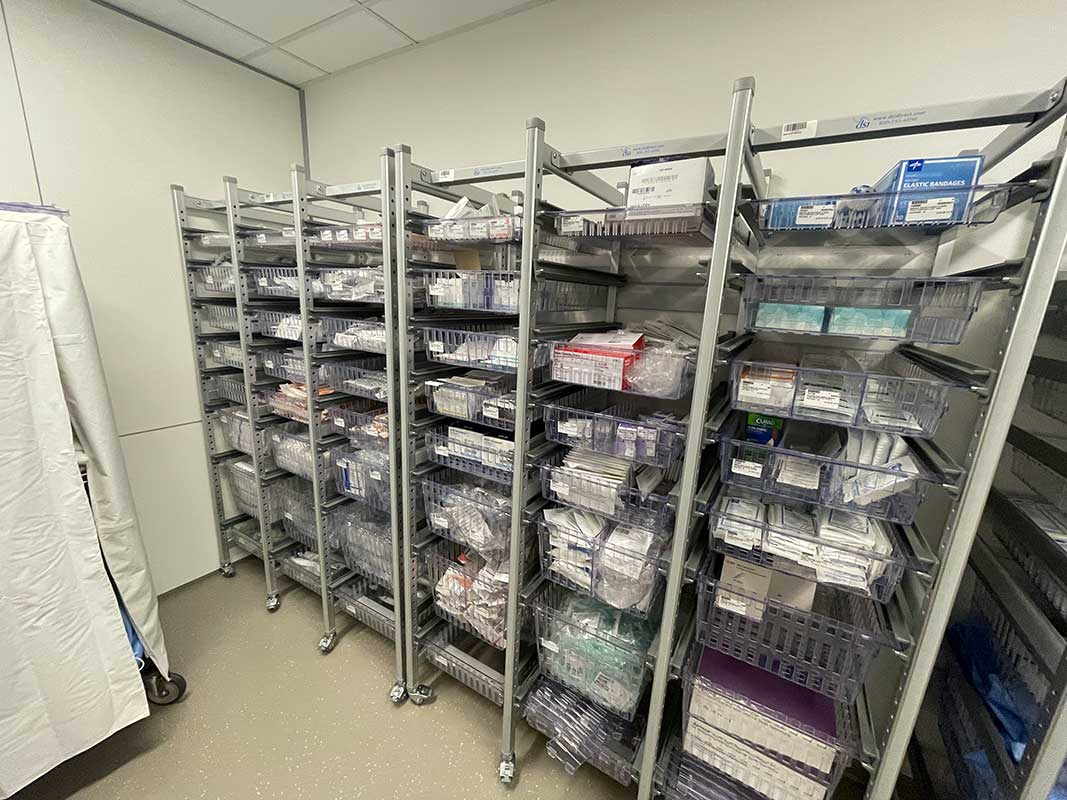
Hybrid oversight plus specialist partner arrangements let facilities keep strategic control and internal staff while engaging specialized partners for LEAN implementation and solutions design. Distribution Systems International operates in this hybrid oversight model, delivering storage optimization without replacing the facility's materials management function. Facilities retain data ownership and decision authority while importing process discipline that produces documented 5% to 7% annual supply expense reductions.
In-house operations with GPO support place internal staff in charge of daily materials management while the GPO supplies contract pricing and analytics. This GPO-supported model dominates the market because major group purchasing organizations save hospitals an estimated 10% to 18% annually through collective negotiating power, according to industry data. Commercial distributor reliance represents the traditional default, where facilities buy through national distributors and hold minimal internal infrastructure.
Operating Models at a Glance
| Operating Model | Control Level | Cost Profile | Ideal For |
| In-house self-distribution | High | High capital exposure | Facilities prioritizing full ownership |
| Fully outsourced 3PL | Low | Service-contract fees | Facilities offloading transactional work |
| Hybrid oversight + specialist partner | High | Moderate, project-based | Facilities wanting control plus process expertise |
| GPO-supported in-house | Moderate | Moderate, GPO savings of 10% to 18% | Facilities leveraging group purchasing power |
| Commercial distributor reliance | Low | Variable, unit-cost driven | Facilities with minimal internal infrastructure |
Operating model choice directly affects cost structure, operational control, and the facility's ability to respond to supply disruptions. Total compensation accounts for roughly 56% of hospital costs, making supply chain the largest controllable expense category where strategic decisions produce measurable financial impact.
Medical supply costs consume 15% to 25% of operating expenses, and purchased services represent more than 20% of annual expenditures. In-house and hybrid arrangements outperform on control, customization, and clinical integration by allowing facilities to set PAR levels and formulary rules internally. Outsourced and GPO-supported arrangements outperform on unit cost and access to expertise, freeing internal resources for clinical priorities while leveraging distributor scale.
In-house and hybrid models allow facilities to set their own PAR levels rather than accepting outsourced standardized templates. Internal teams can improvise substitutions immediately when disruptions occur, while outsourced response speed is governed by service-level agreements. The elevated drug shortages and tariff pressures of early 2025 pushed most supply chain professionals to expect procurement disruptions, making response agility a survival capability rather than a convenience.
In-house models keep procurement and inventory data on facility systems, while outsourcing sends sensitive data to third parties. Loss of oversight is the most cited outsourcing risk, requiring strong governance, clear SLAs, and cybersecurity protocols when sharing data externally. Outsourced staff turnover can erode institutional knowledge, and facilities often undercount in-house costs by missing benefits, infrastructure, and management overhead spread across cost centers.
Automation solutions and AI are shifting materials management from manual, reactive ordering to predictive, data-driven replenishment. Machine learning models now analyze multi-signal data to forecast demand 30 to 90 days ahead, adjusting PAR levels dynamically and eliminating the forecast failures inherent in historical-average methods.
AI demand forecasting delivers roughly 31% improvement in forecast accuracy over traditional methods by training models on consumption patterns and census trends. AI adopters report 15% to 25% inventory cost reductions across early implementations, with systems reducing stockouts by as much as 95% through continuous monitoring. Cleveland Clinic's machine-learning inventory tracking saved $1.5 million in a single year while cutting manual data entry time by 80%. The American Cancer Society cut oncology medication waste by 28% using AI-driven expiry management and demand prediction.
Cleveland Clinic cut manual data entry time by 80% through robotic process automation handling purchase orders and invoice reconciliation. Accounts-payable automation commonly achieves 70% to 85% reduction in manual processing time within six months of deployment. Procurement workload rose 8.0% in 2024 while headcount and budgets stayed flat, opening a 6.6% productivity gap. Weight sensors, RFID, and IoT connectivity detect when stock is drawn down and trigger automatic replenishment alerts without manual counting.
Perpetual inventory systems update records in real time as items move, replacing periodic manual cycle counts with continuous accuracy. An RFID smart shelf can inventory an entire shelf in about 10 seconds, many times faster than manual methods. E-KANBAN systems pair KANBAN bins with RFID or barcode scanning to generate predictive alerts five to seven weeks before potential stockouts. KANBAN empty-bin signals read by RFID or IoT sensors update perpetual inventory records instantly, closing the loop between consumption and digital replenishment.
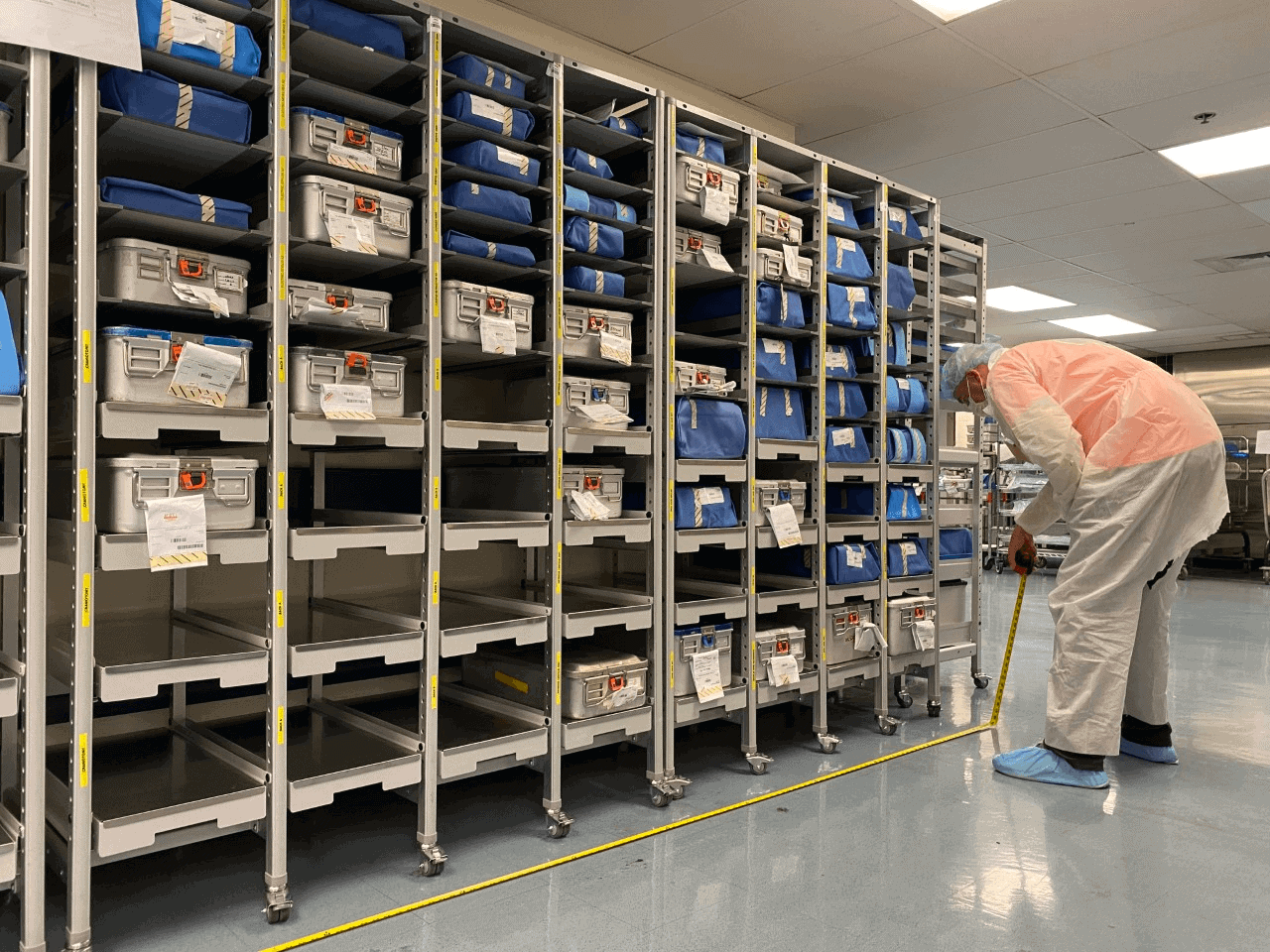
LEAN and KANBAN have crossed from pilot programs into scaled, multi-department implementations producing measurable cost and efficiency gains. The 2-Bin KANBAN method places each item in two bins at the point of use, triggering replenishment when the first empties while staff draws from the second.
Two-Bin KANBAN implementations allow each item to live in two bins at the point of use, with the empty-bin signal triggering replenishment automatically. The table below summarizes the documented cost, efficiency, and workforce outcomes from these deployments.
Documented Outcomes at a Glance
| Metric | Documented Result |
| AI demand forecasting accuracy | +31% improvement |
| Inventory cost reduction (AI adopters) | 15% to 25% |
| Stockout reduction (AI-driven monitoring) | Up to 95% |
| LEAN/KANBAN annual supply expense reduction | 5% to 7% |
| Clinical hours returned (multi-site KANBAN program) | 14,000+ hours per year |
| Clinical FTEs saved per site | 7 to 8 |
| Supply chain efficiency improvement (KANBAN) | 30% |
| Supply holding space reduction (KANBAN) | 25% |
E-KANBAN systems fire predictive alerts 5 to 7 weeks before potential stockouts by integrating RFID and IoT sensors with forecasting algorithms. AI reconciles the empty-bin signal against forecasted demand and adjusts PAR levels dynamically based on consumption trends. Robotic process automation generates the purchase order automatically and reconciles the invoice against goods receipt, eliminating manual three-way matching.
LEAN storeroom redesigns delivered 80% to 90% staff satisfaction in multi-year study data by removing the frustration of stockouts and improving workflow efficiency, on top of the clinical hours already returned through KANBAN adoption.
Sustainability has shifted from a side initiative to a procurement criterion because environmental performance now aligns with cost control. More than two-thirds of health systems included environmental performance in supplier selection by late 2025, driven by both regulatory pressure and the recognition that waste reduction lowers total cost of ownership.
Global healthcare emissions exceeded 4% of the world total in 2025, while some hospitals generated 12% to 18% more hazardous waste than in 2019. Packaging waste, emissions, and cost could grow 35% to 40% by 2040 without changes. Sustainability investments typically pay back within about four years through energy and waste-disposal savings.
Thirty-six percent of leaders now prioritize supply chain reliability over lowest unit cost when selecting partners. Facilities are strengthening resilience by tightening internal operations through better forecasting, analytics, and inventory discipline rather than relying solely on supplier diversification. Strategic buffer stock, pre-qualified alternative suppliers, and AI-driven monitoring of supplier financial health now form the core resilience framework.
One manufacturer cut packaging raw material by 417,000 pounds annually through a single packaging change, demonstrating how circular-economy practices reduce waste and cost simultaneously. One health system cut bed-rental costs by 20% by switching from rental to ownership, illustrating how asset management supports both financial and environmental goals. Reusable totes, reprocessed devices, and SKU rationalization serve as both resilience levers and sustainability investments.
Technology adoption for the future supply chain follows a maturity curve, with some capabilities established and others still in pilot phase. Understanding where each technology sits on the curve helps leaders sequence investments for maximum return and minimal disruption.
Nearly 70% of hospitals and health systems are likely to adopt cloud-based supply chain management by 2026, forming the digital foundation for AI and automation. Seventy percent of large organizations are projected to adopt AI-based supply chain forecasting by 2030, according to Gartner market research. Two-Bin KANBAN and LEAN storeroom redesigns sit in the approaching-mainstream stage, with documented multi-site deployments and standardized vendor programs. RFID smart cabinets, IoT bin sensors, and robotic process automation for purchase orders are scaling now, moving rapidly from pilot to enterprise rollout.
AI trains machine learning models on multi-signal data including consumption by department and procedure, census trends, and EHR-derived prescription patterns. AI predicts consumption 30 to 90 days ahead and adjusts PAR levels dynamically based on real-time signals from IoT sensors and RFID tags. Robotic process automation handles purchase order generation, three-way matching of PO to goods receipt to invoice, vendor onboarding, and data reconciliation automatically. In this converged ecosystem, an RFID or IoT sensor triggers the empty-bin signal, AI reconciles it against forecasted demand, and RPA generates the purchase order automatically.
The AI hospital inventory market is projected to grow from roughly $571 million in 2026 to about $1.77 billion by 2036, reflecting accelerating adoption. Intermountain saved $32 million in inventory through AI-driven demand forecasting and automated replenishment, demonstrating enterprise-scale impact. A three-year peer-reviewed KANBAN study recorded 40% to 50% cost reduction and a 50% decrease in stockouts at the storeroom level.
Model selection depends on facility size, internal expertise, capital availability, and strategic priorities around control versus cost efficiency. Facilities under acute margin pressure or lacking internal expertise skew toward outsourced and GPO models, while those prioritizing control and customization favor in-house and hybrid arrangements.
Facilities under acute margin pressure or lacking internal expertise skew toward outsourced and GPO models that offload transactional work. Leaders reassess models annually against cost, quality, and resilience benchmarks as volumes, budgets, and strategic priorities shift. Health systems running different models across sites increasingly standardize to reduce variation in cost and quality, consolidating around hybrid or GPO-supported arrangements. Significant volume changes, rising costs with falling service quality, and post-pandemic resilience concerns drive most model switches.
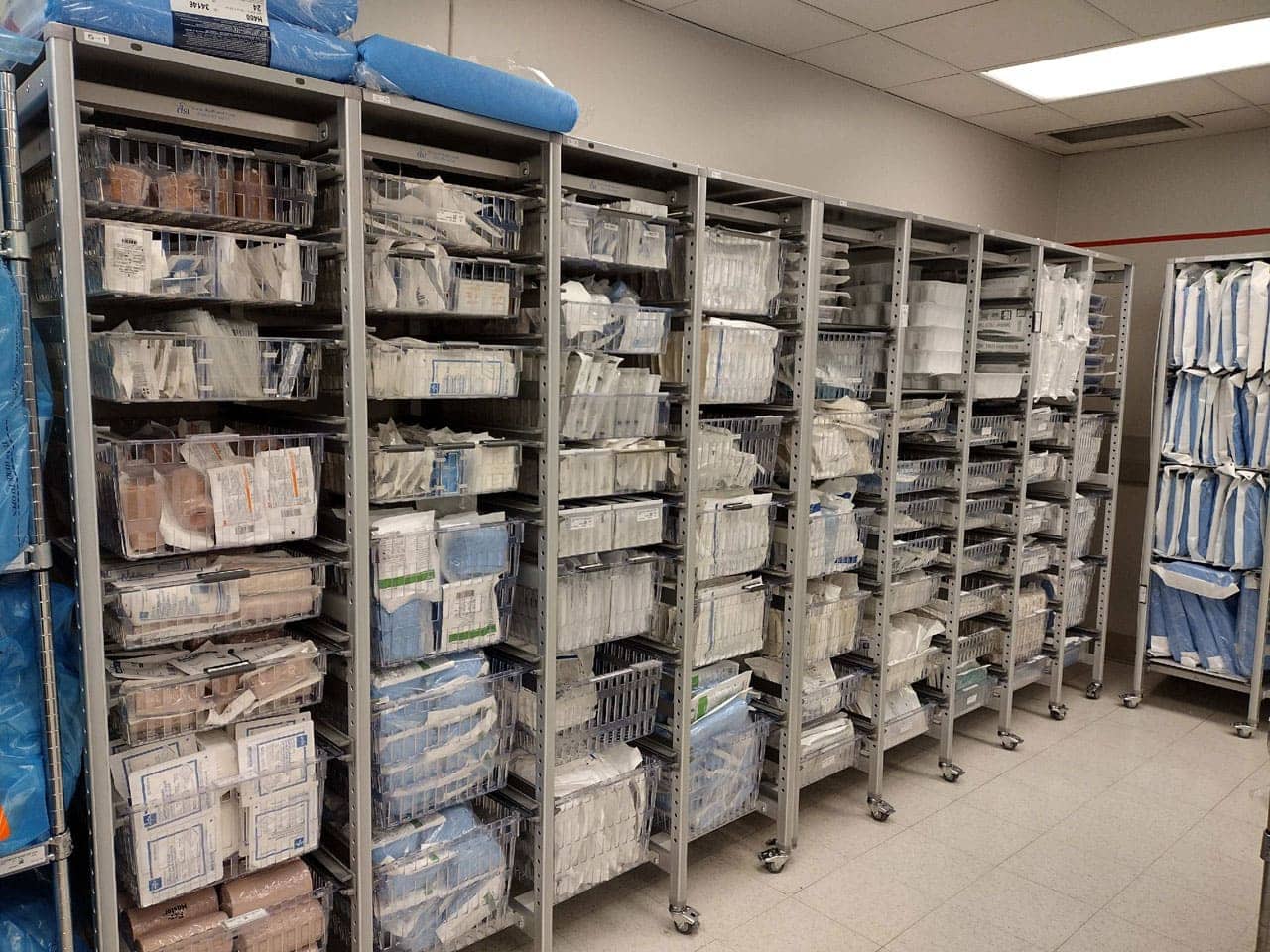
The hybrid specialist model begins with on-site analysis of PAR levels, usage patterns, and workflow bottlenecks conducted by services teams. Custom-configured storage design follows, including architectural CAD drawings, application gallery references, and ROI calculations projecting supply expense and inventory reductions. Full turnkey implementation covers delivery, assembly using Modu-Stor CTS shelving and plastic bins, inventory transfer, and after-sales support, allowing facilities to retain strategic control while importing LEAN expertise. Distribution Systems International operates precisely in this hybrid lane, delivering track systems and workstations that form the physical foundation for sensor integration and perpetual inventory systems.
Full self-distribution sits in the high-control, high-cost corner and remains rare because capital and staffing burdens outweigh benefits for most facilities. Standardized outsourcer templates trade customization for scale, delivering unit-cost efficiency at the expense of formulary flexibility and departmental adaptation. In-house and hybrid models provide lower access to specialized expertise unless a specialist partner is engaged for LEAN implementation and storage optimization. The right model matches the facility's internal capabilities, risk tolerance, and strategic priorities, with annual reassessment ensuring the choice adapts as conditions change.
The convergence of AI forecasting, IoT sensing, RFID accuracy, and LEAN methodology is creating a unified intelligent materials management ecosystem. Facilities that have already standardized storage and adopted 2-Bin KANBAN are well positioned to layer predictive technology on top, because the physical foundation and clean data are already in place. The result is near-zero stockouts, lower inventory and waste, clinical hours returned to patient care, real-time resilience visibility, and workforce evolution from counting to analytics and strategy.
For acute care leaders, the model question and the technology question resolve into one coherent direction: hybrid arrangements that preserve internal strategic control while importing scale and specialized expertise capture the control facilities value most without the capital burden of full self-distribution.
Distribution Systems International has operated at this intersection for over 30 years, delivering the storage foundation and LEAN process discipline that let facilities keep control, cut supply and inventory costs, and stand ready for the predictive, sensor-driven future of materials management.
Materials management trends for 2026 point toward hybrid models, AI forecasting, and LEAN-based storage design as the path to lower costs and stronger patient care. Distribution Systems International has delivered turnkey storage optimization for acute care facilities since 1990, combining on-site analysis, custom CAD design, and full implementation support. Request a complimentary storage consultation at dsidirect.com/contact-us or call (800) 393-6090 to start your assessment.
The most significant shift is toward hybrid operating models that pair internal control with a specialist storage partner. Facilities keep PAR-level authority and data ownership while importing LEAN process discipline from an outside team. This approach produces documented 5% to 7% annual supply expense reductions without the capital burden of full self-distribution.
AI-driven demand forecasting improves accuracy by roughly 31% over traditional methods, and early adopters report inventory cost reductions of 15% to 25%. Stockouts can drop by as much as 95% through continuous monitoring and dynamic PAR adjustment. Cleveland Clinic's machine-learning inventory tracking saved $1.5 million in a single year while cutting manual data entry time by 80%.
Two-Bin KANBAN places each item in two bins at the point of use. Staff draw from the active bin while the second stays in reserve, and an empty-bin signal triggers automatic replenishment. Hospital deployments report 5% to 7% annual supply expense reductions and up to 25% lower overall inventory.
The right choice depends on internal expertise, capital availability, and desired control. In-house and hybrid models let facilities set their own PAR levels and respond immediately to disruptions, while outsourced and GPO-supported models trade some customization for unit-cost efficiency.
Facilities benefit most from sequencing investments by maturity. Two-Bin KANBAN and LEAN storeroom redesign are approaching mainstream adoption with standardized, documented outcomes, making them a practical starting point. RFID smart shelving, IoT bin sensors, and robotic process automation are scaling quickly and layer well on top of an established physical storage foundation. AI-based forecasting delivers the strongest return once consumption data and storage infrastructure are already standardized.
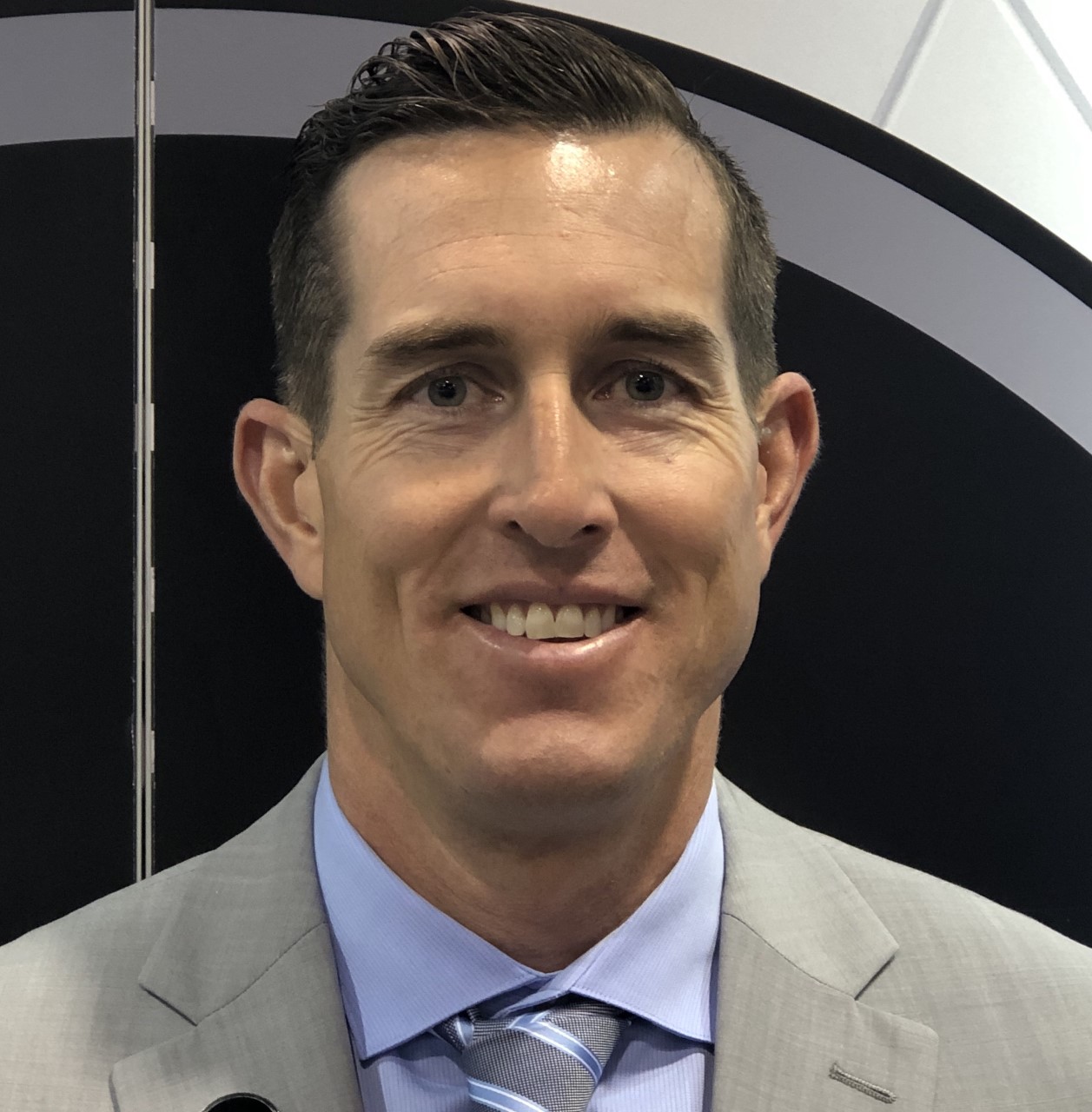
With 21 years of sales management, marketing, P&L responsibility, business development, national account, and channel management responsibilities under his belt, Ian has established himself as a high achiever across multiple business functions. Ian was part of a small team who started a new business unit for Stanley Black & Decker in Asia from Y10’ to Y14’. He lived in Shanghai, China for two years, then continued to commercialize and scale the business throughout the Asia Pacific and Middle East regions for another two years (4 years of International experience). Ian played college football at the University of Colorado from 96’ to 00’. His core skills sets include; drive, strong work ethic, team player, a builder mentality with high energy, motivator with the passion, purpose, and a track record to prove it.