Healthcare facilities face critical decisions when selecting storage infrastructure for sterile processing departments. The choice between modular and fixed systems directly impacts infection control outcomes, regulatory compliance, and operational costs. Understanding the functional differences, clinical implications, and financial models enables administrators to align storage investments with patient safety priorities and budgeting constraints.
Key Takeaways
Modular and fixed systems represent two distinct architectural approaches to organizing sterilized medical instruments and supplies. The Sterile Processing Department (SPD) is where medical instruments are cleaned, sterilized, and stored before distribution. PAR level management ensures adequate supply without overstocking, reducing carrying costs, and minimizing waste.
Modular systems feature reconfigurable components that adapt to changing inventory requirements, functioning as dynamic storage platforms that evolve with departmental needs. Fixed systems consist of permanent installations designed for specific spatial layouts and long-term use. Event-related shelf-life means packages remain sterile indefinitely unless compromised by specific events like tears or water damage, shifting focus from time-based expiration to protective storage design.
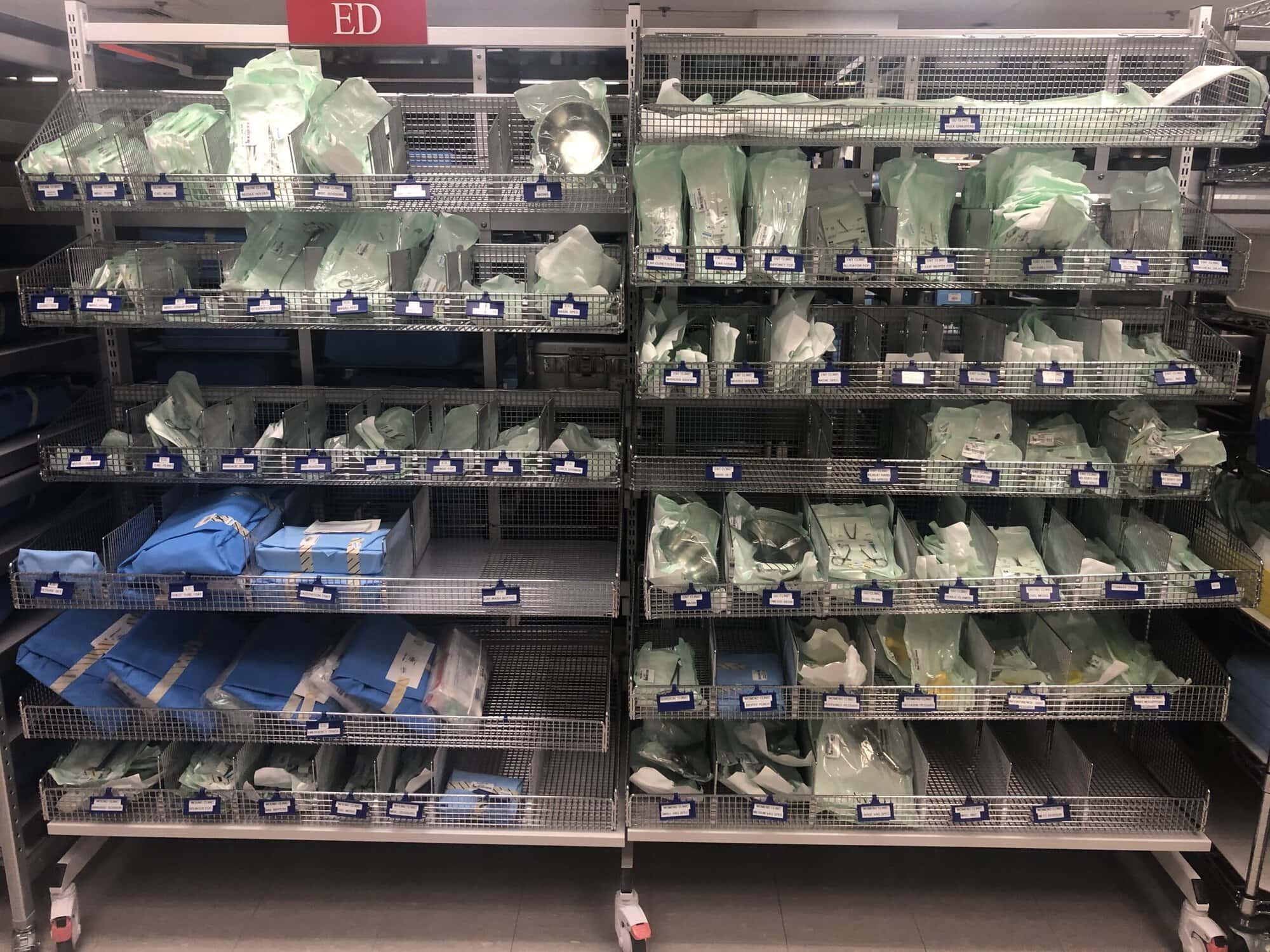
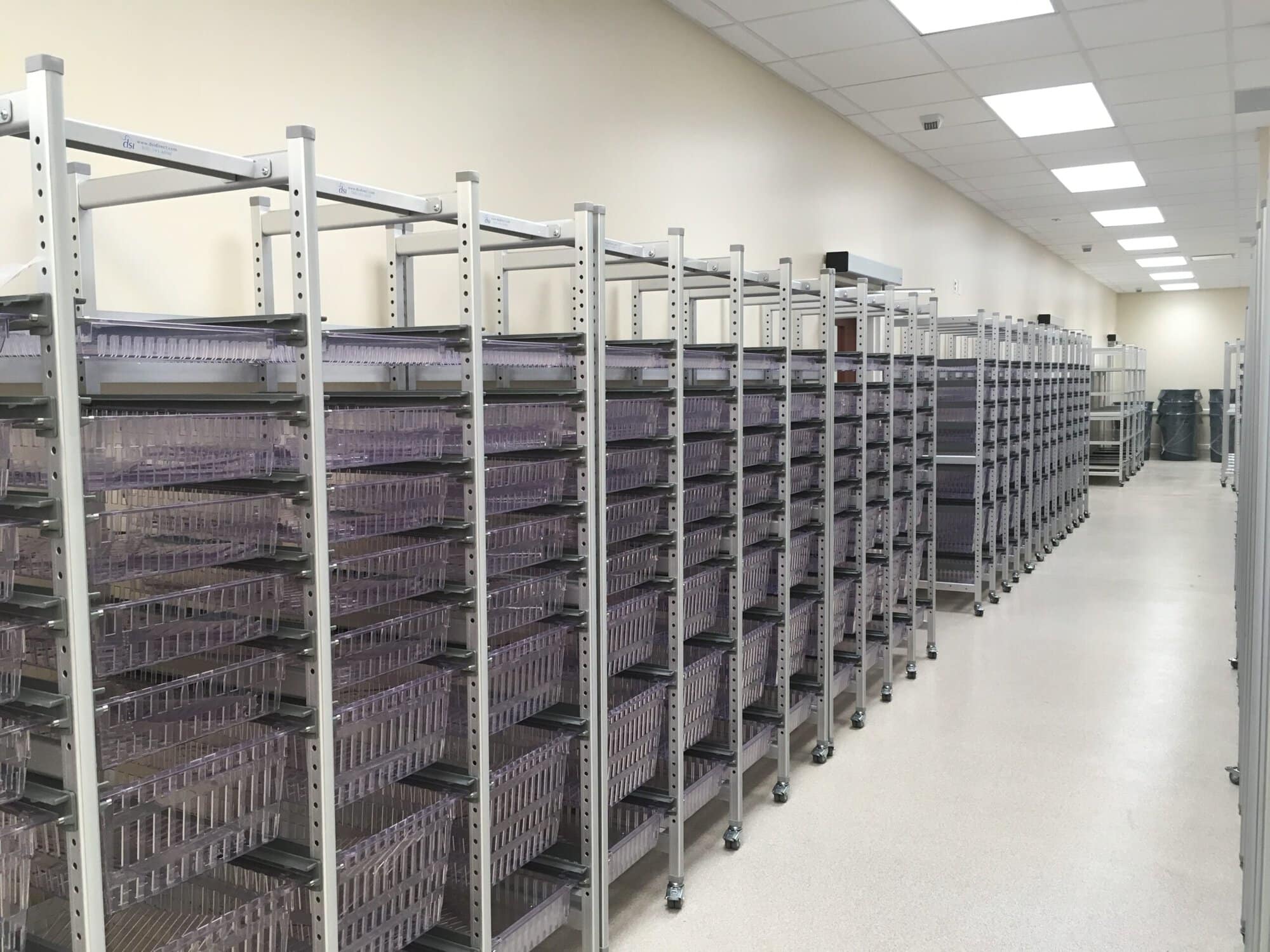
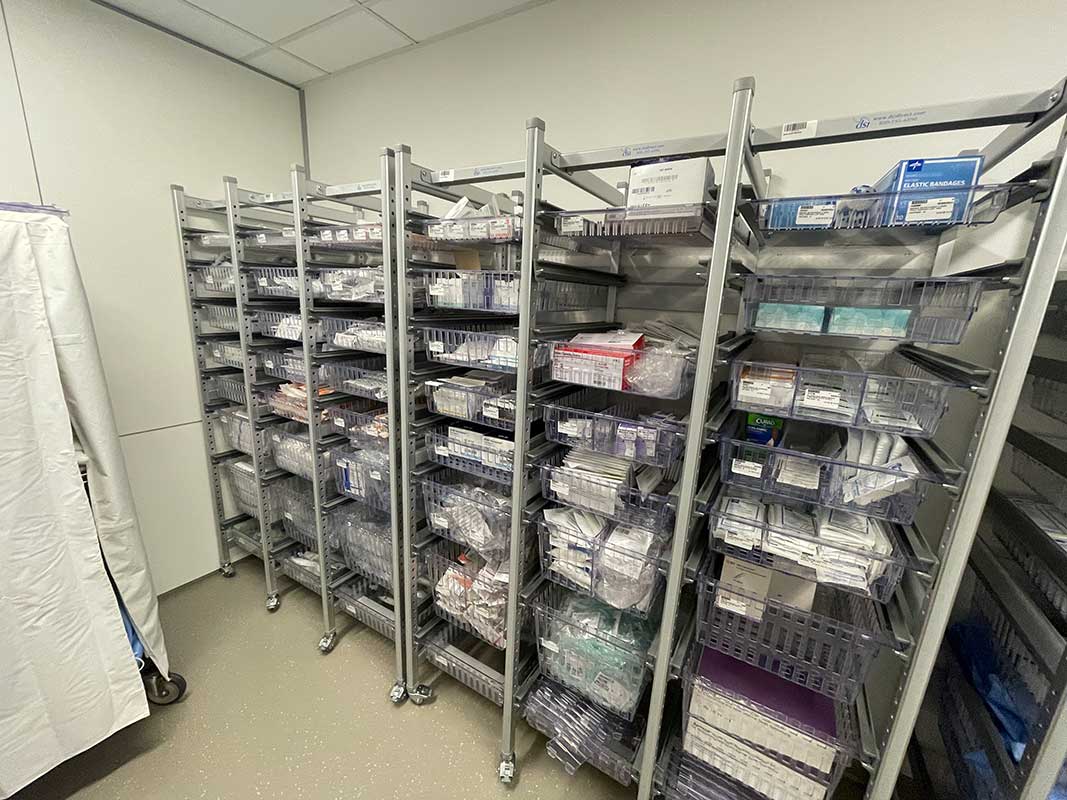
Advanced modular storage solutions incorporate interchangeable inserts and adjustable shelving to accommodate varying instrument sizes. DSI SterileShelf exemplifies polymer system design with seamless construction that eliminates crevices where contaminants accumulate. AireCore represents an engineered polymer material that resists chemical degradation from hospital-grade disinfectants while maintaining structural integrity.
Storage systems must protect sterile packages from physical damage and environmental contamination throughout the supply chain. Primary functions include maintaining package integrity, facilitating efficient inventory rotation, and supporting visual verification of contents. Properly designed systems reduce the time clinicians spend locating supplies, directly increasing time available for patient care.
Secondary functions address space optimization and workflow integration within materials management ecosystems. Designated storage locations for each supply category reduce retrieval errors and improve inventory accuracy. Systems must support first-in-first-out (FIFO) rotation to minimize waste from expired items. Integration with hospital information systems enables real-time tracking of inventory levels and automated reorder triggers.
Joint Commission citation EC.02.06.01 identifies non-cleanable surfaces as a primary compliance failure in sterile storage areas. VA Directive 1116(2) establishes minimum environmental and design standards for facilities serving veteran populations. ANSI/AAMI ST79 defines comprehensive sterilization and sterile storage protocols recognized across acute care settings.
ASHRAE 170-2017 specifies ventilation and environmental control parameters for healthcare facilities, including sterile storage zones. Compliance and Regulatory Standards receive 98% importance ratings from procurement professionals evaluating storage investments. Non-compliance exposes facilities to survey citations, financial penalties, and elevated healthcare-associated infection rates.
The structural and functional distinctions between modular and fixed storage directly influence clinical workflow and capital planning. Closed cabinets hold 35% market share due to superior contamination protection in high-traffic environments. Modular systems hold 28% market share, driven by facilities prioritizing adaptability and scalability.
Fixed systems require permanent mounting to walls or floors, limiting future reconfiguration. Modular systems utilize freestanding or minimally anchored units that allow repositioning as departmental needs evolve. Open shelving holds 18% market share, primarily in non-clinical storage where environmental protection is less critical.
Fixed systems hold 12% market share, concentrated in facilities with stable surgical programs and predictable instrument inventories. Temperature/humidity-controlled cabinets hold 7% market share but represent the premium segment where environmental precision is non-negotiable. Installation complexity and lead times vary significantly, with fixed configurations requiring detailed spatial planning and extended downtime during implementation.
Flexibility enables storage systems to accommodate new surgical specialties and evolving procedural volumes without capital reinvestment. Modular platforms incorporate adjustable components like removable dividers and reconfigurable shelf heights to match changing PAR levels. This adaptability proves essential for facilities experiencing growth or implementing new service lines.
Fixed systems excel in maximizing storage capacity within defined footprints but sacrifice future modification capability. Facilities with established surgical programs benefit from custom-fitted fixed installations that optimize every cubic foot of available space. The choice between flexibility and density optimization depends on projected departmental growth and budgetary constraints.
Chrome wire systems have a lifespan of 3-5 years before corrosion compromises cleanability and structural integrity. Polymer systems deliver 15+ years of service with minimal maintenance beyond routine cleaning. Open wire shelving lasts 3-10 years compared to closed cabinets, achieving 10-15+ years, reflecting superior protection from environmental exposure.
Modular systems provide 10-15+ years of service while fixed systems extend to 15-20 years due to heavier construction and permanent installation. Durability and lifespan receive 82% importance ratings from facility managers evaluating long-term value. Replacement cycles directly impact the total cost of ownership, making initial material selection a critical financial decision.
Infection control capabilities represent the most critical performance metric when evaluating sterile processing storage solutions. Chrome wire shelving shows an 85% contamination rate due to surface pitting and corrosion that harbors bacterial colonies. Polymer systems reduce contamination rates to 12%, delivering an 86% improvement over chrome wire through seamless, non-porous construction.
Chrome wire shelving proves extremely susceptible to rust and corrosion when exposed to moisture and chemical disinfectants. Surface degradation creates microscopic pits where biofilm accumulates beyond the reach of standard cleaning protocols. These compromised surfaces directly contribute to elevated healthcare-associated infection rates and regulatory citations.
Advanced polymer materials maintain smooth, cleanable surfaces throughout their operational lifespan. Infection Control and Contamination Risk receives 95% importance ratings from sterile processing managers prioritizing patient safety. Material selection determines whether storage infrastructure supports or undermines facility-wide infection prevention protocols.
Temperature must remain at or below 75°F (24°C) for sterile storage to prevent accelerated microbial growth. Relative humidity must stay between 20% and 60% to inhibit bacterial multiplication and spore germination. Temperature increases of 5°C (from 20°C to 25°C) double bacterial multiplication rates, emphasizing the importance of environmental precision.
Higher humidity creates ideal breeding conditions for bacteria and mold on package exteriors and exposed surfaces. Premium temperature-controlled cabinets integrate HEPA filtration and active environmental monitoring to maintain compliance with stringent protocols. These systems prove essential in climates with extreme seasonal variation or facilities lacking centralized environmental controls.
Advanced storage systems contribute to a 55.7% reduction in HAI incidence through improved contamination barriers and environmental protection. ISO 4 cleanliness standards for HEPA filtration ensure airborne particulate concentrations remain below critical thresholds. Sterile processing departments implementing comprehensive system upgrades report measurable improvements in regulatory compliance scores.
Event-related shelf-life protocols require storage systems that minimize physical contact and environmental exposure throughout the supply chain. Properly designed infrastructure extends the practical lifespan of sterile packages by preventing the specific events that compromise package integrity. This approach shifts quality focus from arbitrary time limits to protective design and handling protocols.
Modular platforms deliver quantifiable improvements in workflow efficiency and inventory accuracy compared to traditional fixed installations. Staff experience 25% reduction in manual workload when retrieving and restocking supplies using well-organized modular systems. Ease of Use and Efficiency receives 78% importance ratings from department managers, balancing clinical demands with limited staffing resources.
Optimized storage layouts reduce the distance traveled and time spent locating specific instruments during case preparation. Color-coded zones and adjustable shelving heights improve visual identification and minimize search times during high-pressure situations. These efficiency gains translate directly into increased OR readiness and reduced procedure delays.
Modular cell configurations enable customization of compartment sizes to match specific instrument dimensions and utilization patterns. Each storage bin is clearly labeled to support rapid identification and accurate restocking. Front-facing accessibility eliminates the need to remove multiple items when accessing supplies stored in rear positions. Workflow optimization through intelligent storage design allows highly trained technicians to focus on complex sterilization tasks rather than on inventory management.
Accurate PAR level management prevents both stockouts that delay procedures and overstocking that increases carrying costs. Modular systems with clear labeling and dedicated fixed locations for each item simplify cycle counting and reorder point identification. Visual management principles derived from LEAN methodologies reduce reliance on digital systems for routine inventory verification.
Integration with KANBAN replenishment systems enables automated reordering when supplies reach predetermined minimum levels. Adjustable compartments accommodate changes in PAR levels as procedural volumes fluctuate seasonally or following service line additions. This flexibility prevents capital reinvestment when inventory requirements evolve.
Digital tracking systems require physical storage infrastructure that supports barcode scanning and RFID technology integration. Modular platforms accommodate mounting hardware for readers and display screens without compromising structural integrity or accessibility. Real-time inventory visibility enables materials management teams to optimize purchasing contracts and minimize emergency orders.
Comprehensive healthcare storage services increasingly incorporate data analytics and automated replenishment algorithms that rely on accurate physical inventory data. Storage system design must facilitate rapid, accurate counting during routine audits and physical inventory cycles. Integration between physical and digital infrastructure eliminates discrepancies that erode confidence in automated systems.
Financial considerations extend beyond initial purchase price to encompass installation complexity, maintenance requirements, and replacement cycles. Chrome wire shelving costs $100-$390 per unit, while stainless steel wire ranges from $300-$800 per unit. Polymer systems require $500-$1,200 per unit but deliver superior long-term value through extended lifespans.
Closed cabinets range from $2,000 to $15,000+ per storage unit, depending on size, material specification, and environmental control features. Temperature-controlled cabinets represent the premium tier at $8,000-$25,000+ per unit, incorporating HEPA filtration and active monitoring systems. Installation labor costs vary significantly based on system complexity and facility infrastructure requirements.
Budget constraints often drive initial selection toward lower-cost open shelving despite the superior performance of enclosed systems. Decision frameworks must account for regulatory compliance risks and infection control implications when evaluating budget options. True cost comparison requires total cost of ownership analysis rather than simple purchase price evaluation.
Ten-year TCO for chrome wire units reaches approximately $14,500 when accounting for replacement cycles and increased cleaning requirements. Ten-year TCO for polymer units totals approximately $8,500, delivering $6,000 savings per unit through extended lifespan and reduced maintenance. Polymer systems provide 41% reduction in total costs over a decade compared to budget alternatives.
Total Cost of Ownership (TCO) includes initial purchase price plus long-term maintenance and replacement costs over the system's operational life. Facilities replacing 100 chrome units with polymer alternatives can realize approximately $600,000 in savings over ten years. This analysis transforms apparent premium pricing into demonstrable long-term value.
Payback period of 5.6 months makes premium polymer systems financially viable even for facilities with limited capital budgets. Hard savings from eliminated replacement cycles and reduced maintenance expenditures provide quantifiable returns for budget justification. Soft savings from improved staff productivity and reduced HAI incidence contribute additional value that enhances patient outcomes.
Cost and Total Cost of Ownership receives 88% importance ratings from procurement professionals evaluating storage investments. Capital budgeting strategies must balance immediate financial constraints against long-term operational efficiency and patient safety priorities. Data-driven ROI calculations enable evidence-based decision-making that aligns storage infrastructure with organizational goals.
Market penetration of advanced storage systems varies significantly based on facility size, geographic location, and management demographics. Large hospitals (500+ beds) show 78% adoption rate of advanced systems, driven by high procedural volumes and substantial capital budgets. Medium hospitals (100-500 beds) show 62% adoption rates, balancing compliance requirements with moderate financial resources.
Small hospitals (<100 beds) show 38% adoption rates, frequently relying on basic enclosed cabinetry due to limited budgets and space constraints. Clinics and urgent care facilities show 25% adoption rates, primarily utilizing entry-level closed systems for basic sterile storage needs. Facility size directly correlates with system sophistication, reflecting both financial capacity and clinical complexity.
Large academic medical centers prioritize integration with hospital information systems and automated inventory management platforms. Small rural facilities emphasize durability and low maintenance requirements over technological sophistication. The adoption gap between large and small facilities continues to widen as advanced systems incorporate increasingly complex features.
Rural facilities face limited capital budgets that restrict access to premium storage solutions. Geographic isolation from service providers complicates maintenance and repair of complex systems requiring specialized technical support. These challenges perpetuate reliance on basic, proven technologies despite inferior performance metrics.
Northeast and West Coast regions demonstrate the highest penetration of temperature-controlled and modular systems driven by stringent state regulations. Southeast and Midwest facilities favor mid-range solutions that satisfy essential compliance requirements without premium pricing. Urban facilities rapidly adopt advanced technologies to manage high patient volumes while rural hospitals prioritize fundamental functionality.
Baby Boomer administrators prioritize proven technologies and focus heavily on initial capital expenditure when evaluating storage investments. Generation X managers balance cost considerations with operational efficiency improvements and staff workload reduction. Millennial leaders increasingly advocate for data-driven, technologically integrated solutions that provide real-time monitoring and environmental analytics.
Generational shifts in healthcare leadership accelerate the adoption of systems incorporating digital integration and sustainability features. Younger decision-makers demonstrate greater willingness to invest in premium solutions when supported by a comprehensive ROI analysis. These demographic trends suggest continued market growth for technologically sophisticated storage platforms.
Systematic evaluation frameworks prevent rushed decisions that compromise patient safety or exceed budgetary constraints. Compliance with CDC, AAMI, and Joint Commission standards establishes the non-negotiable baseline for any storage solution. Selection criteria must prioritize infection control performance before considering secondary factors like workflow efficiency or cost.
CDC guidelines establish environmental parameters and cleaning protocols for sterile storage areas in healthcare facilities. AAMI standards define comprehensive sterilization processes and storage requirements recognized throughout the acute care industry. Joint Commission survey protocols specifically target non-cleanable surfaces and equipment disrepair as high-risk compliance failures.
Regulatory compliance functions as a qualifying criterion rather than a differentiating factor when comparing acceptable storage options. Systems failing to meet baseline standards expose facilities to citations, financial penalties, and elevated infection risks. Documentation requirements demand clear evidence that selected systems satisfy all applicable regulatory requirements.
Storage infrastructure must support facility-wide infection prevention protocols and cleaning schedules. Surface materials require compatibility with hospital-grade disinfectants without degradation that compromises cleanability over time. Environmental protection features prevent airborne and contact contamination during routine storage and retrieval activities.
Separation of clean and dirty workflows requires physical barriers and designated pathways that prevent cross-contamination. Storage system placement within the SPD layout must support unidirectional flow from decontamination through sterilization to storage. These spatial relationships prove as important as individual component specifications when optimizing infection control outcomes.
EIPAC framework step 1 requires facilities to identify the issue by documenting current compliance gaps and infection risks. EIPAC framework step 2 involves gathering information through TCO analysis, clinical efficacy evaluation, and regulatory requirement verification. EIPAC framework step 3 demands analyzing alternatives based on patient safety impact, operational efficiency, and financial constraints.
EIPAC framework step 4 guides making decisions that prioritize patient protection while delivering measurable long-term value. This structured approach prevents emotionally-driven purchases and ensures selections align with organizational mission and values. Documentation throughout the EIPAC process provides justification for capital requests and supports evidence-based decision-making.
Strategic storage system selection requires balancing immediate budgetary constraints against long-term operational efficiency and patient safety priorities. The global Sterile Storage Cabinet Market was valued at $3.46 billion in 2024 and is projected to reach $3.60 billion in 2025. Market expansion to $5.50 billion by 2035 reflects growing recognition of storage infrastructure's critical role in infection prevention.
The broader Medical Cabinetry market is projected to reach $11.71 billion by 2027 with a CAGR of 4.3% during the forecast period. This sustained growth demonstrates healthcare's commitment to modernizing physical infrastructure to support evolving clinical and regulatory demands. Facilities investing in advanced storage systems position themselves for long-term success through improved compliance scores, reduced infection rates, and enhanced operational efficiency.
Healthcare decision-makers must evaluate storage options using comprehensive frameworks that account for the total cost of ownership and clinical outcomes rather than purchase price alone. Modular storage delivers superior flexibility for growing facilities while fixed storage maximizes density in stable environments with predictable needs. The optimal choice depends on facility-specific factors, including surgical program complexity, space utilization requirements, and projected growth trajectories.
Organizations like DSIDirect provide specialized expertise in healthcare storage solutions, helping facilities navigate complex decisions through data-driven analysis and department-specific recommendations. Their comprehensive approach addresses sterile processing challenges from initial assessment through post-installation support, ensuring selected systems deliver promised clinical and financial outcomes.
Ready to optimize your sterile processing storage infrastructure? Explore proven healthcare storage solutions designed to reduce contamination risk, improve workflow efficiency, and deliver measurable return on investment.
Distribution Systems International has helped acute care facilities across the country move from disorganized, high-cost storage to compliant, efficient systems built for sterile processing demands. Whether your department needs modular configurations that adapt to growing surgical volumes or fixed installations that maximize storage capacity in a defined footprint, DSI delivers a complete solution—from initial workflow analysis and custom CAD design to full turnkey implementation and post-installation support.
Our LEAN-based approach assigns each item clear storage locations and fixed locations within a structured system, improving inventory accuracy, reducing staff retrieval time, and supporting compliance with AAMI ST79 and Joint Commission standards. Contact Distribution Systems International today for a complimentary storage analysis and discover how the right system improves space utilization, reduces total cost of ownership, and strengthens patient safety outcomes.

With 21 years of sales management, marketing, P&L responsibility, business development, national account, and channel management responsibilities under his belt, Ian has established himself as a high achiever across multiple business functions. Ian was part of a small team who started a new business unit for Stanley Black & Decker in Asia from Y10’ to Y14’. He lived in Shanghai, China for two years, then continued to commercialize and scale the business throughout the Asia Pacific and Middle East regions for another two years (4 years of International experience). Ian played college football at the University of Colorado from 96’ to 00’. His core skills sets include; drive, strong work ethic, team player, a builder mentality with high energy, motivator with the passion, purpose, and a track record to prove it.