Key Takeaways
Every surgical procedure depends on one assumption: the instruments are sterile. Yet that sterility can be lost long before an instrument reaches the operating room. Temperature fluctuations, humidity spikes, improper shelving, and disorganized inventory all compromise sterile barriers, often invisibly.
The consequences are measurable. Surgical site infections affect 2–4% of surgical patients in the United States, adding $10,000–$25,000 per case in treatment costs. Beyond finances, SSIs increase patient morbidity, extend hospital stays, and in severe cases, contribute to mortality.
Storage is the last line of defense. This guide examines how facility design, environmental controls, organization systems, and healthcare storage compliance work together to protect sterile integrity and patient safety. From Joint Commission requirements to emerging AI-powered inventory systems, we cover what healthcare facilities need to know to turn their storage rooms from potential vulnerabilities into reliable safety assets.
Breaches in sterile barriers cause surgical site infections. SSIs significantly increase patient morbidity, mortality, and healthcare costs. A single compromised package can introduce pathogens into a surgical wound.
Compliance with sterile storage standards is mandatory for accreditation and safe patient care. Facilities cannot separate patient safety and storage practices from patient outcomes. The two are directly linked.
Patient safety in storage rests on maintaining sterile integrity from processing to the point of use. Regulatory bodies establish clear requirements. Staff must understand both the standards and the reasoning behind them.
The Joint Commission requires a safe and functional environment that minimizes risk to patients and staff. This includes the integrity of the sterile process, storage conditions, and documentation. Every element of the medical supply storage environment must support sterility maintenance.
Infection control specialists describe the storage room as "the last line of defense." Once an instrument leaves sterilization, storage is the final opportunity to protect its integrity before patient contact.
Accreditation surveys focus on the "why" behind storage practices. Surveyors look for a culture of safety, not just a checklist. Staff must articulate the purpose of each protocol.
Poor storage management creates preventable risks. Compromised sterility, workflow disruptions, and emergency reprocessing all trace back to storage failures. Understanding the chain of risk helps facilities target prevention efforts.
Storage related safety risks progress through a predictable chain:
| Risk Stage | Description |
| Compromised Sterility | Improper handling, high humidity, or non-compliant shelving damages the sterile barrier through tears, punctures, or moisture |
| Microbial Ingress | A compromised barrier allows microorganisms to enter the package, rendering the instrument non-sterile |
| Infection Risk | Using a non-sterile instrument during surgery directly exposes the patient to pathogens, causing an SSI |
| Operational Impact | Poor organization, mislabeling, or lost instruments cause surgical delays or force Immediate Use Steam Sterilization (IUSS) |
Environmental conditions directly affect packaging integrity and sterility. Temperature and humidity deviations compromise packaging materials, enabling microbial penetration.
| Environmental Factor | Effect on Storage |
| High Humidity | Promotes bacterial growth on packaging surfaces |
| Extreme Temperatures | Degrades packaging materials |
| Environmental Deviations | Compromises packaging integrity, allowing microbial penetration |
Strict environmental parameters protect sterility integrity. The CDC recommends that sterile storage areas maintain temperatures of 68°F to 73°F (20°C to 23°C) and relative humidity of 30% to 60%.
AAMI ST79 specifies the same controlled environment and requires continuous monitoring and documentation. Facilities must track conditions consistently to demonstrate compliance and catch deviations before they compromise inventory.
Effective storage practices combine environmental control, proper organization, and staff training. Regulatory bodies provide specific guidelines, but successful implementation requires a systematic approach across all storage operations. Achieving safe medical supply storage demands attention to every detail, from shelving height to labeling systems.
Four primary organizations govern sterile storage requirements. Each focuses on different aspects of compliance.
| Organization | Key Storage Guidelines | Temperature & Humidity Control | Handling & Contamination Prevention |
| Joint Commission | Safe, functional environment minimizing risk; sterile process integrity, including storage conditions and documentation | Monitoring and control of environmental conditions; parameters align with AAMI standards | Proper handling to prevent damage; defined process for identifying compromised sterile items |
| CDC | Storage areas must be clean, dry, protected from temperature/humidity extremes; packaging integritymust be maintained | 68°F–73°F (20°C–23°C); 30%–60% relative humidity (or per manufacturer instructions) | FIFO inventory management; staff inspection of packages for integrity before use |
| AAMI | Detailed technical guidance (AAMI ST79); sterile items in designated areas, away from traffic, protected from environmental contaminants | 68°F–73°F (20°C–23°C); 30%–60% relative humidity; continuous monitoring and documentation required | Specifies shelving requirements; mandates proper hand hygiene and minimal handling |
| OSHA | Healthcare worker safety in handling and storing instruments | General workplace safety standards apply to storage area design | Appropriate PPE for staff handling contaminated items; training on safe handling/disposal of sharps and biohazardous materials |
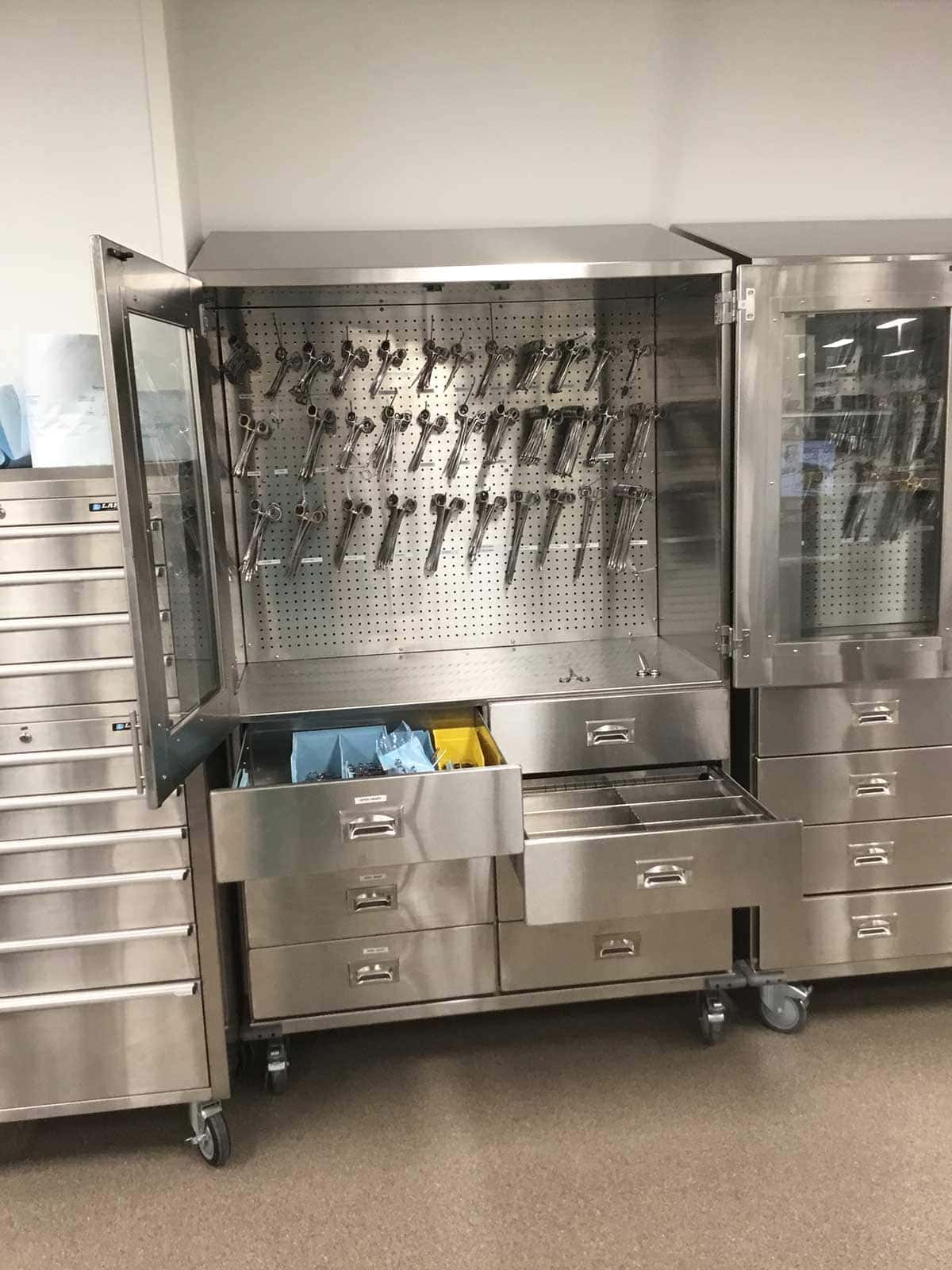
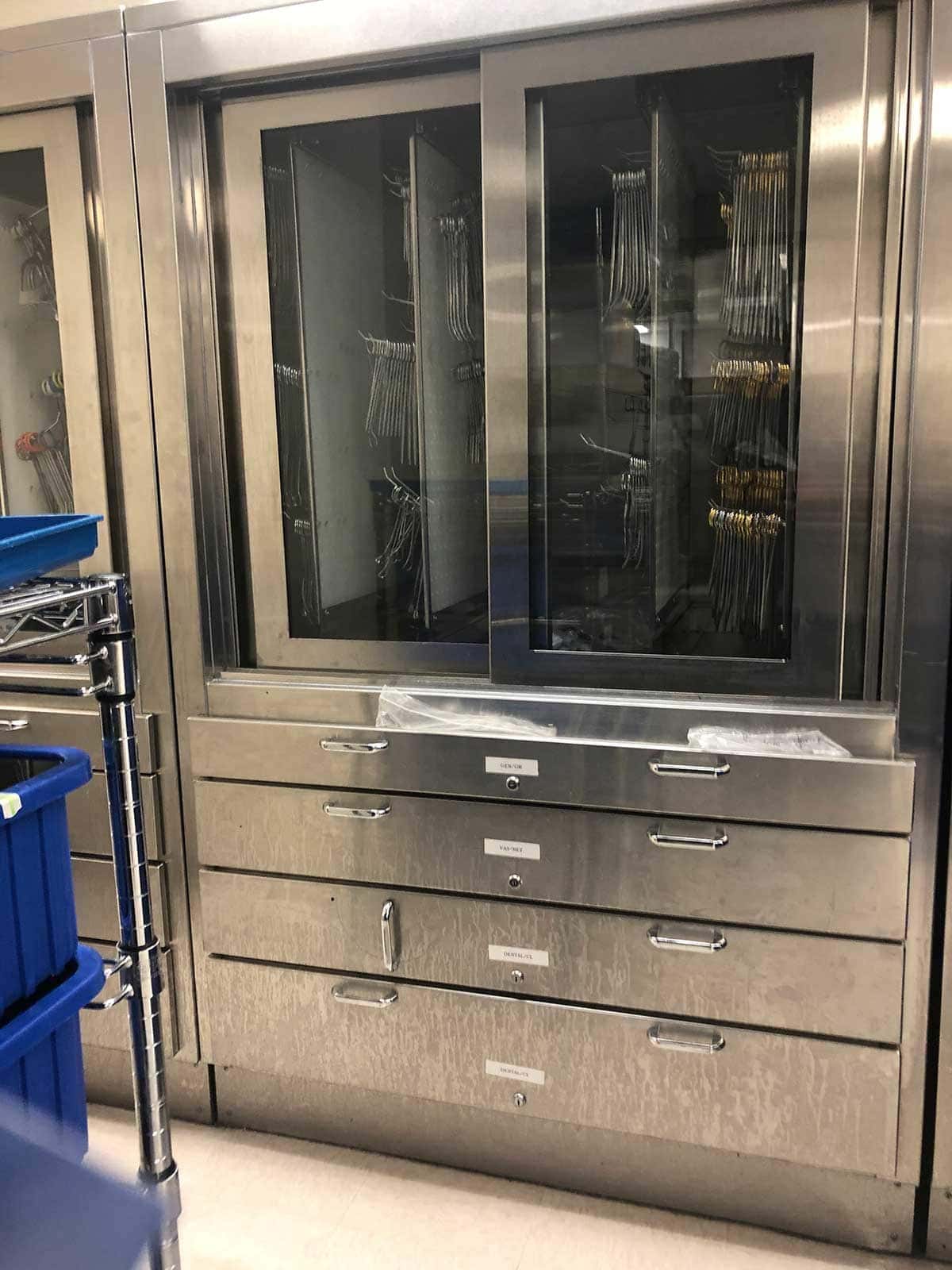
AAMI provides the most detailed physical requirements for sterile storage. Shelving must be non-porous and easy to clean. Items must be stored on solid-bottom shelves at least 8–10 inches off the floor to protect against splashes and cleaning chemicals.
Additional clearance requirements protect sterile packages from environmental threats. Items must be stored at least 18 inches from the ceiling and 2 inches from outside walls. Shelving must be designed to prevent package compression, which can compromise sterile barriers. Proper shelving design also supports nurse safety and ergonomics by reducing reaching, bending, and lifting strain.
Clear, standardized labeling prevents the use of expired items and supports inventory management. FIFO (first-in, first-out) rotation must be strictly enforced. Color-coded or date-based labeling systems facilitate compliance.
Accreditation reviewers assess whether staff can articulate the FIFO process. Understanding the "why" behind labeling protocols demonstrates a culture of safety, not just procedural compliance.
Technology transforms storage from a passive function to an active safety system. Data analytics, automated monitoring, and environmental controls reduce human error and enable proactive intervention.
Data analytics platforms identify root causes of storage and processing failures. High IUSS (Immediate Use Steam Sterilization) rates often signal underlying issues in instrument inventory, processing, or storage. IUSS is discouraged due to its higher risk profile and potential for workflow disruption.
A large health system implemented a data analytics platform to monitor and address the root causes of high IUSS rates. The system identified workflow issues and inventory gaps that manual tracking missed, enabling targeted interventions.
Continuous environmental monitoring catches deviations before they compromise inventory. AAMI standards require continuous monitoring and documentation of temperature and humidity conditions. Real-time systems alert staff to environmental excursions immediately.
Proper air circulation also requires monitoring. Storage areas should maintain positive air pressure relative to adjacent areas. A minimum of four air exchanges per hour (ACH) prevents the influx of contaminated air from surrounding spaces.
Multiple regulatory frameworks govern storage practices in healthcare. Requirements vary based on what is being stored, protected health information, pharmaceuticals, or sterile instruments, each of which has distinct compliance obligations.
HIPAA governs the storage of protected health information (PHI), not sterile instruments. The Privacy Rule and Security Rule require physical safeguards for any records containing PHI. This includes locked file cabinets, restricted access to storage areas, and controlled facility entry.
Medical records and PHI must be stored and used to minimize incidental disclosure. PHI should be stored out of sight of unauthorized individuals and locked in a cabinet, room, or building when not supervised or in use. HIPAA-related documentation must be retained for six years after the document is last in force.
The FDA and USP provide pharmaceutical storage requirements that complement sterile instrument standards.
| Storage Type | Temperature Range | Additional Requirements |
| Room Temperature | 68°F–77°F (20°C–25°C) | Excursions permitted between 59°F–86°F (15°C–30°C) |
| Cool Storage | 46°F–59°F (8°C–15°C) | Per manufacturer specifications |
| Refrigerated/Cold | 36°F–46°F (2°C–8°C) | Medical-grade refrigerators recommended |
| Freezer | Below 32°F (0°C) | Per product labeling |
All prescription drugs must be stored at appropriate temperatures and under appropriate conditions in accordance with the requirements in the labeling of such drugs. Appropriate manual, electromechanical, or electronic temperature and humidity recording equipment, devices, and/or logs shall be utilized to document proper storage of prescription drugs.
The Joint Commission mandates a defined process for identifying and managing compromised sterile items. Temperature logs must show consistent adherence to AAMI standards for accreditation compliance.
Non-compliance costs far exceed compliance investments. As one infection control specialist noted, "Compliance is not a cost; it's an investment in preventing a multi-million dollar SSI."
In the United States, surgical site infections cost about $10 billion in direct and indirect costs each year. Attributable costs for SSI vary between $10,443 and $25,546 per infection. SSIs contribute to patients spending more than 400,000 extra days in hospital at an additional cost of $900 million per year.
Non-compliance most often occurs with the 8-inch rule off the floor and the 18-inch rule from the ceiling. These are not arbitrary numbers. They are based on preventing contamination from floor cleaning chemicals and fire suppression systems.
Storage failures create both immediate and long-term financial consequences. Direct costs include emergency reprocessing and surgical delays. Indirect costs accumulate through increased infection rates, extended hospital stays, and regulatory penalties.
Storage failures translate directly to operational costs:
Data-driven storage optimization delivers measurable returns. One health system achieved a 94.8% reduction in IUSS rates over an 18-month period through a data analytics platform that identified root causes of storage-related failures.
This reduction significantly minimized infection risks and enhanced both patient safety and operational efficiency. As one clinical operations manager noted, "When sterile storage is disorganized, it directly impacts the OR schedule. Standardized shelving and clear labeling systems are essential tools for efficiency, turning the storage room from a bottleneck into a reliable asset."
Emerging technologies are transforming storage from passive inventory holding to active safety management. AI, machine learning, and real-time monitoring systems enable predictive intervention rather than reactive correction.
AI and machine learning enable predictive inventory management and automated compliance monitoring. Data analytics platforms can identify root causes of storage-related issues before they impact patient care, as demonstrated in IUSS reduction initiatives.
AI and ML can be utilized to improve a variety of healthcare inventory management tasks. AI data interpretation helps healthcare providers to gain an understanding of future inventory needs. It can be used to forecast stock levels by analyzing historical data and making predictions about future demand.
Continuous environmental monitoring technology supports compliance with AAMI standards through automated alerts and documentation. AI-assisted systems help guide technicians in reprocessing workflows and can verify that instruments belong in specific trays. Blockchain technology could be used to create tamper-proof records of inventory movements, enhancing traceability and reducing fraud.
Technology adoption introduces new risk categories that facilities must address. While AI offers significant benefits, implementation challenges require careful management.
Many of today's cutting-edge AI technologies, particularly machine learning systems, have opaque algorithms, making it difficult or impossible to determine how they produce results. This "black-box reasoning" presents concerns for patient safety and clinical judgment.
When AI is incorporated into clinical practice, healthcare providers might be susceptible to a type of cognitive error known as "automation bias." The use of AI in patient care must be accompanied by human oversight; overreliance on AI tools in patient care can lead to critical errors.
Additional implementation challenges include:
Storage practices form a direct causal link to patient outcomes. The evidence demonstrates a clear pathway: proper storage design, organization systems like FIFO, and regulatory compliance with Joint Commission, CDC, AAMI, and OSHA standards collectively reduce risk, preventing sterile barrier breaches, lowering IUSS rates, and minimizing SSIs. Healthcare providers must prioritize regular staff training on spatial requirements and inventory protocols, invest in automated tracking and real-time environmental monitoring, and ensure facility design supports both compliance and efficiency.
Data-driven approaches have proven their value, with one health system achieving a 94.8% reduction in IUSS rates over 18 months. Compliance is not a cost, it is an investment in preventing infections that cost healthcare systems billions annually. The storage room is the last line of defense before instruments reach patients, and facilities that treat it as a critical safety function protect both patients and their operational viability.
Ready to optimize your sterile storage systems? DSI Direct provides healthcare facilities with compliant storage solutions designed for patient safety and operational efficiency. Contact our team to discuss your facility's needs.
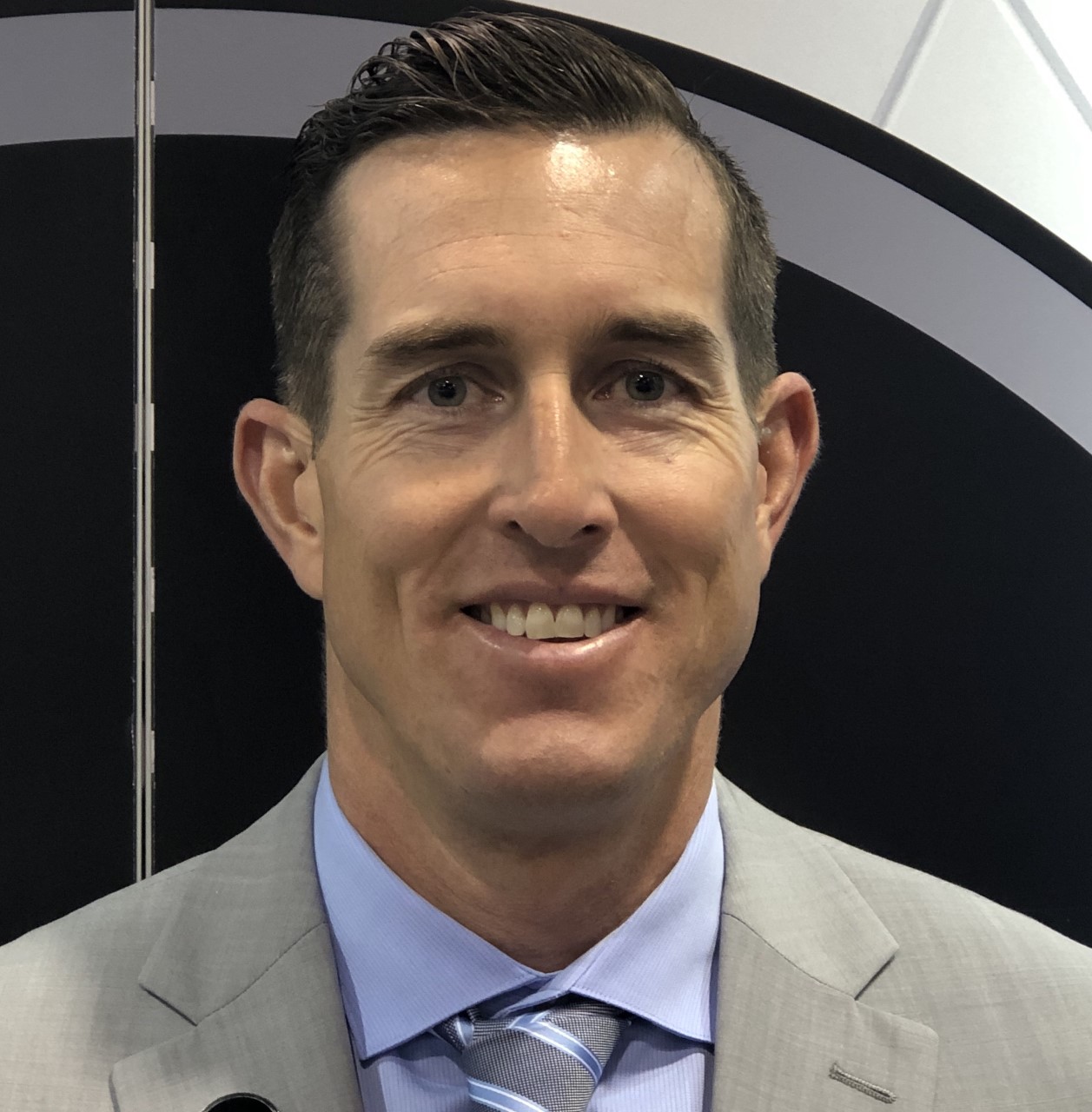
With 21 years of sales management, marketing, P&L responsibility, business development, national account, and channel management responsibilities under his belt, Ian has established himself as a high achiever across multiple business functions. Ian was part of a small team who started a new business unit for Stanley Black & Decker in Asia from Y10’ to Y14’. He lived in Shanghai, China for two years, then continued to commercialize and scale the business throughout the Asia Pacific and Middle East regions for another two years (4 years of International experience). Ian played college football at the University of Colorado from 96’ to 00’. His core skills sets include; drive, strong work ethic, team player, a builder mentality with high energy, motivator with the passion, purpose, and a track record to prove it.