Hospitals and healthcare facilities face mounting pressure to store more inventory without expanding footprints or sacrificing clinical workflow efficiency. Vertical storage and high-density mobile shelving represent two fundamentally different approaches to space optimization, each with distinct cost structures, installation requirements, and operational implications.
Understanding how these systems differ in density gains, retrieval speed, and total cost of ownership enables directors of materials management and sterile processing departments to make evidence-based decisions that align with departmental priorities and budgetary constraints.
Vertical storage and high-density mobile shelving systems address space constraints through different geometric strategies. Vertical storage uses automated height to compress inventory into smaller floor areas, while mobile shelving eliminates fixed aisles by mounting shelves on movable carriages.
Vertical lift modules consist of enclosed steel towers that house automated trays accessed through ergonomic delivery windows. Software-controlled extractors retrieve trays on demand and deliver them to operators at a comfortable working height. The towers typically range from 8 to 45 feet tall, allowing facilities to exploit unused ceiling space. Single-level delivery systems held 63.4% of the VLM market share in 2023, reflecting preference for simpler operator interfaces. Non-refrigerated vertical storage configurations accounted for 56.1% of installations, indicating that most deployments serve general-purpose industrial and healthcare applications rather than specialized cold-chain requirements.
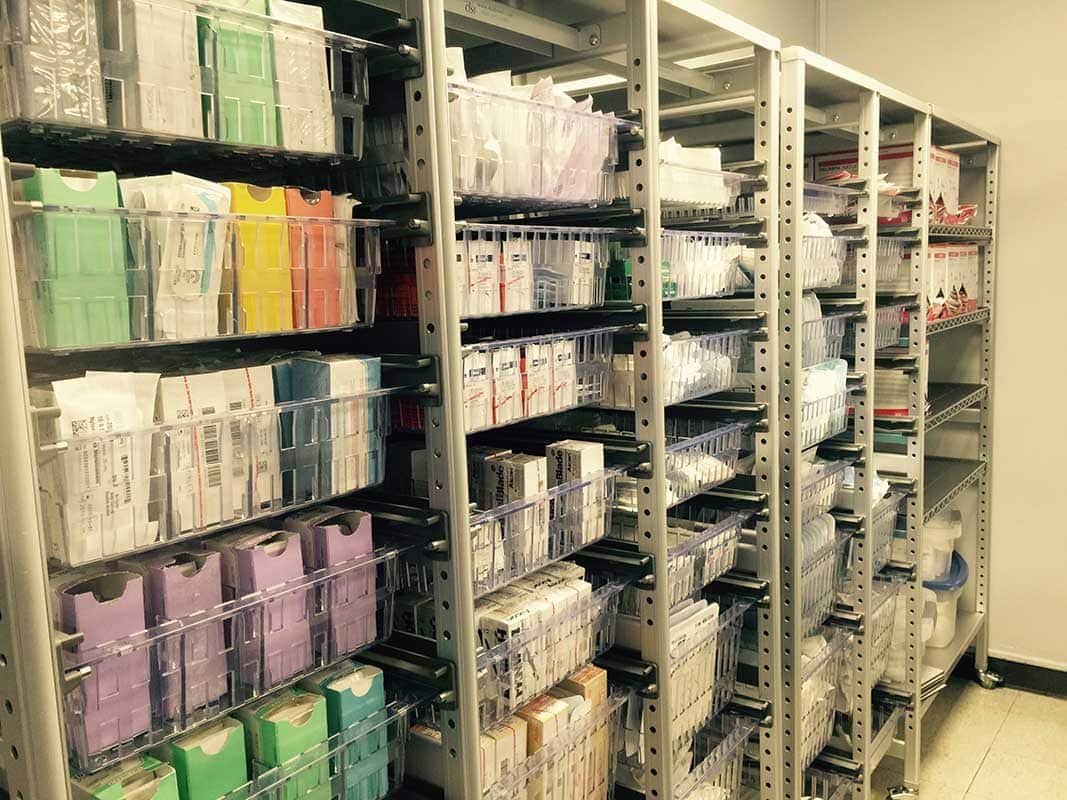
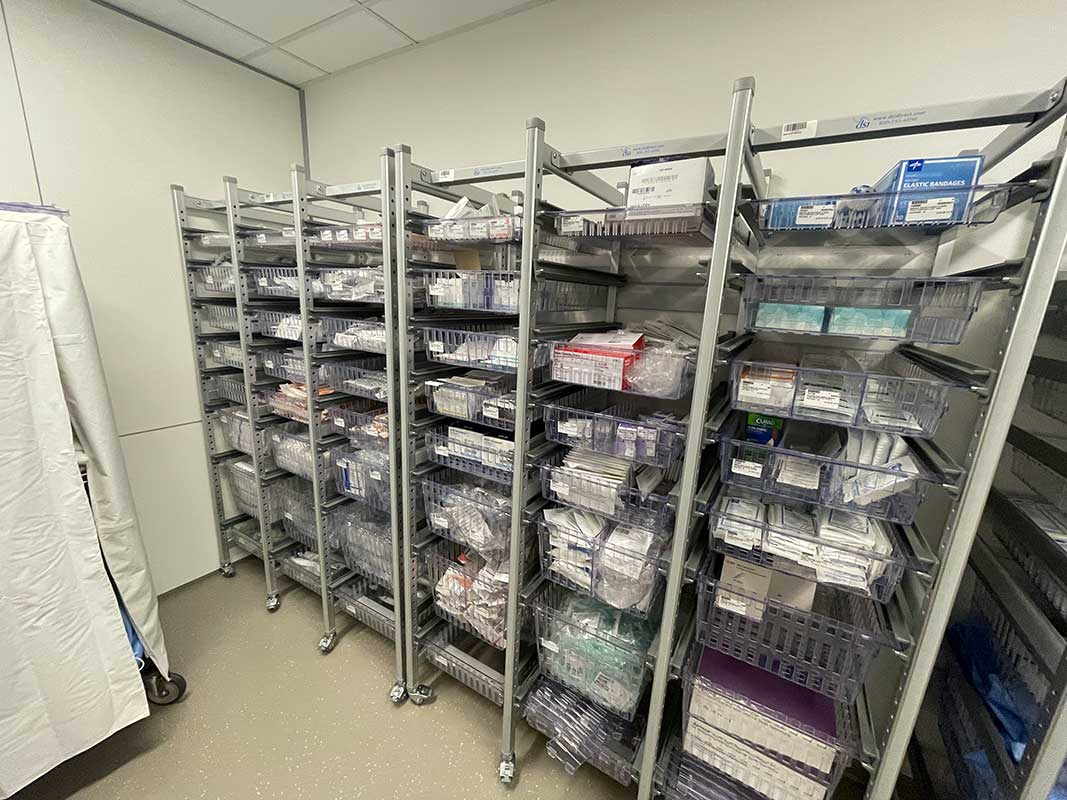
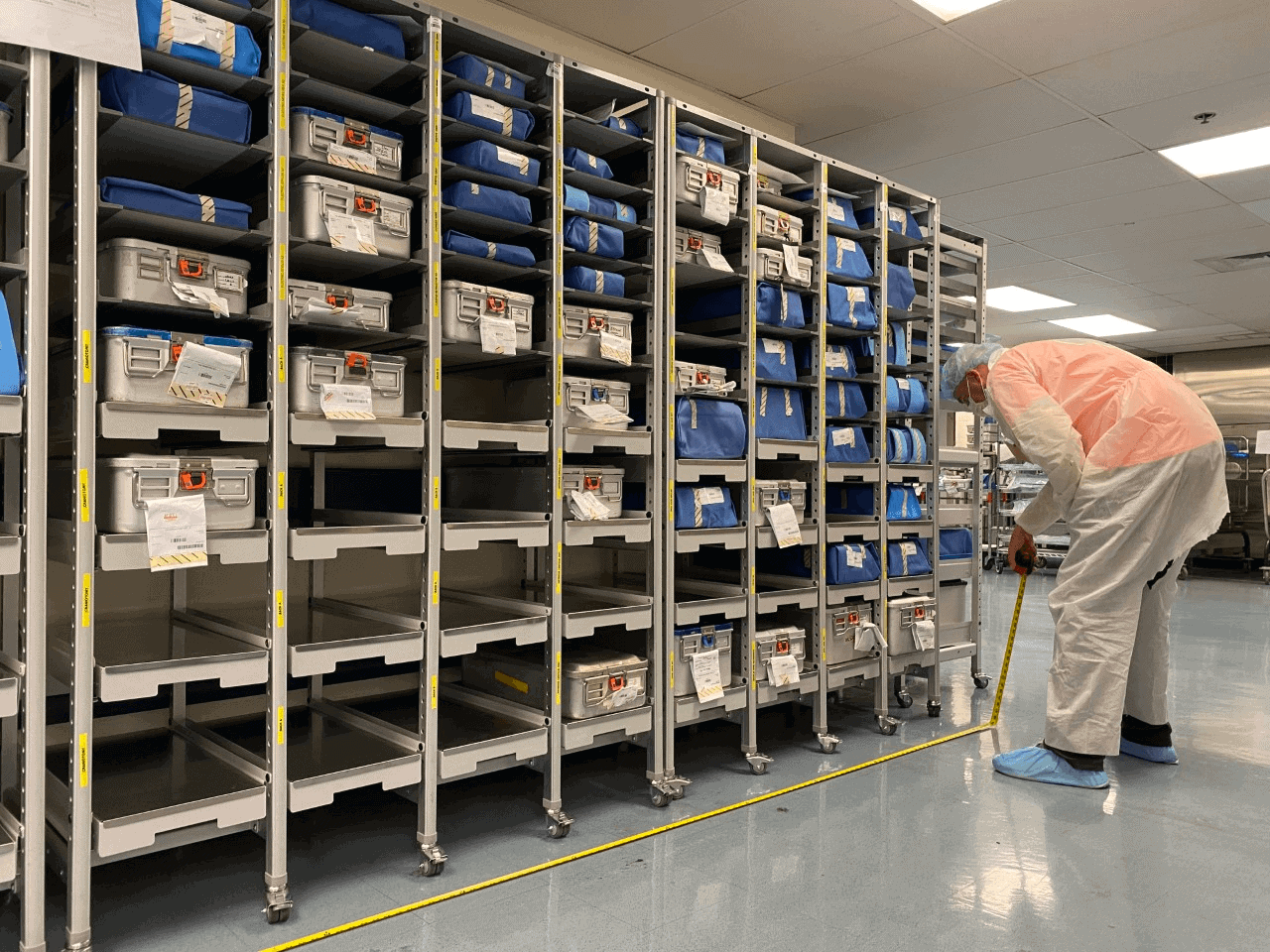
High-density mobile shelving mounts standard shelving units on wheeled carriages that ride along floor-mounted tracks. Operators open aisles on demand using hand-crank or powered movement systems, then close them to eliminate wasted space. Lockable bays provide security for controlled substances and high-value inventory while maintaining density advantages over fixed shelving. The mobile shelving systems eliminate multiple permanent aisles, recovering 40% to 50% more usable storage capacity within the same footprint. High-density mobile shelving reached USD 1.89 billion in 2026 and is projected to grow to USD 3.78 billion by 2035 at an 8.0% CAGR.
Static warehouse racking uses fixed uprights and shelves in open-wire or pallet-rack layouts without tracks or automation. Adjustable shelves accommodate varying product heights, and simple bolt-together construction keeps installation costs low. The static racking market stood at USD 9.71 billion in 2024 with a projected 4.2% CAGR through 2030. Medical carts feature casters, modular drawers, locks, and wipe-clean surfaces designed for point-of-care delivery.
Optional computing integration and MRI-safe variants address specialized clinical environments, with mobile computing carts holding 72.38% of the medical carts market share in 2024. Medical cabinetry includes operatory, sterilization, and secure storage configurations built for material-specific requirements and integrated counters, valued at USD 9.31 billion in 2022.
Space optimization performance depends on whether the limiting constraint is floor area or ceiling height. Mobile systems excel in retrofit applications with standard ceiling heights, while vertical systems recover the most floor space when tall ceilings are available.
Mobile systems compress horizontal aisles by eliminating permanent walkways between shelving units. Vertical systems exploit unused building height by stacking inventory in automated towers. Density increases correspond directly with capital cost: static shelving offers the lowest purchase price but consumes the most aisle space, mobile shelving provides intermediate density at moderate cost, and VLMs deliver the highest floor-space recovery at premium prices. Static shelving requires minimal installation complexity and maintenance but sacrifices density in high-rent environments. Mobile shelving maximizes floor density and delivers strong retrofit value, though track installation and floor preparation add upfront costs. VLMs achieve the highest floor-space recovery and generate labor and accuracy gains, but implementation complexity and software integration needs represent barriers for smaller facilities.
Facilities with ceiling heights below 12 feet typically favor mobile shelving because vertical systems cannot justify their cost premium without a sufficient height advantage. Buildings with 16-foot or taller ceilings enable VLMs to compress inventory into vertical footprints that reclaim entire rooms for alternative uses. Structural loading capacity matters more for vertical storage because concentrated tower weight requires floor reinforcement in older buildings. Track systems for mobile shelving demand level concrete floors with sufficient load ratings to support carriage movement. Retrofits in existing sterile processing or central supply rooms often favor mobile solutions because they work within current ceiling envelopes without structural modifications.
Hackensack University Medical Center improved retrieval times by implementing a Storage Wall system that reduced staff walking distance and consolidated inventory visibility. Retrieval speed depends on whether clinical staff can access multiple storage locations simultaneously or must wait for automated delivery cycles. Mobile shelving permits simultaneous aisle opening when powered systems are installed, though hand-crank models limit concurrent access. Vertical lift modules deliver trays to operators at waist height, eliminating ladder use and reducing ergonomic strain, but single-operator access points create potential bottlenecks during peak demand periods. Space optimization operating rooms require balancing density with surgical case turnover speed, making retrieval performance a critical selection factor alongside pure storage capacity.
Total cost of ownership extends beyond purchase price to include installation complexity, maintenance requirements, and operational labor savings. Budget constraints often dictate whether facilities can justify automation or must optimize within manual system categories.
Budget mobile wire units range from $220 to $465, providing entry-level density improvement without powered movement. Mid-range mobile shelving spans $553 to $3,000 for standard departmental applications with manual or assisted opening mechanisms. Premium mobile systems with full electronic controls and integrated locking can exceed $25,000 for large installations. Used VLM systems cost approximately $35,000 to $75,000, offering depreciated entry points for facilities testing automation. New VLM systems range from $75,000 to $140,000 for single towers, with premium multi-tower configurations frequently exceeding $250,000 when software integration and custom tray designs are included.
Mobile shelving installation costs exceed fixed shelving because track preparation, floor leveling, and carriage assembly require specialized labor. Track systems must be anchored into structural concrete, and older buildings may need floor reinforcement to support carriage loads. Slower simultaneous access represents an operational trade-off because only one aisle can be opened at a time in hand-crank configurations. VLMs carry the highest capital cost and implementation complexity due to software integration needs, electrical requirements, and operator training programs. Wire shelving systems require minimal installation labor and can be reconfigured without professional assistance, making them suitable for departments with frequently changing inventory profiles.
Facilities operating under strict capital constraints typically deploy static shelving initially and migrate to mobile systems during renovation cycles. Mid-range budgets favor mobile shelving because it delivers measurable density gains without automation complexity or software dependencies. High-density mobile shelving benefits include 40% to 50% space recovery, improved inventory control, and security enhancements at price points accessible to most hospital departments. Organizations facing severe floor-space limitations or planning to avoid building expansions can justify VLM investments by calculating the cost of additional real estate against automation capital expense. ROI calculations must include labor savings, accuracy improvements, and inventory carrying cost reductions alongside pure space recovery metrics.
Medical carts bring supplies directly to point-of-care locations, supporting nursing workflow and flexible deployment across clinical areas. Carts provide lower storage density compared with built-in systems but eliminate centralized stocking bottlenecks. Emergency carts held 40.53% of the medical carts market by type in 2024, reflecting clinical prioritization of rapid-response readiness. Medical cabinetry delivers excellent hygiene and permanent organization for sterile and treatment areas, but offers less flexibility once installed. Hospitals held 35.94% of the end-use share for medical carts, underscoring the institutional preference for mobile supply delivery in acute care settings.
Morristown Medical Center processes approximately 100 surgical cases per day and is considering expansion from 28 to 30 operating rooms. The hospital required a storage solution flexible enough to accommodate changing surgical tray sizes and stackability requirements while supporting increased case volume. Morristown's upgraded system holds 40% more inventory than the legacy arrangement without expanding the physical footprint of the central supply department. The case demonstrates how high-density storage preserves room for future throughput growth without proportional increases in floor area, a critical consideration for facilities operating under space constraints.
Demographic demand patterns and regional market dynamics shape purchasing behavior across both consumer self-storage and institutional healthcare storage categories. Understanding these trends helps predict future adoption rates and system preference shifts.
Gen X respondents reported 54% self-storage usage or intent, Boomers 51%, and Millennials 40% in 2022 surveys. Adults aged 24 to 39 accounted for approximately 25% of current storage users in 2024. Almost 24% of Millennials not currently renting storage expect to do so later, indicating strong latent demand. Self-storage participation reached 38% of Americans in 2021, with 18% actively renting in 2024. These figures reflect broader space-scarcity trends that also drive institutional demand for vertical storage and mobile shelving in healthcare and commercial environments.
Operators in the Northeast reported that 87.8% expected long-term demand to remain stable or increase, suggesting mature but resilient market conditions. Economic downturn concerns dominated the Southeast at 66.4% and the West Coast at 69.8% of operator responses. Urban growth markets in Texas, Nevada, and Florida showed strong search intensity for storage solutions, reflecting migration-driven demand. Vertical versus horizontal storage selection often correlates with urban density because high land costs justify premium systems. Rural facilities with lower real-estate expenses typically favor static or basic mobile shelving over automated vertical systems.
High-density mobile shelving is projected to grow from USD 1.89 billion in 2026 to USD 3.78 billion by 2035 at an 8.0% CAGR. Vertical lift modules reached USD 1.56 billion in 2023 and are forecast to grow to USD 2.78 billion by 2030 at a 9.1% CAGR. The global shelving units and shelves market stood at USD 26.03 billion in 2024 and is expected to reach USD 41.07 billion by 2035 at a 4.23% CAGR. Static warehouse racking accounted for USD 9.71 billion in 2024 with a projected increase to USD 12.41 billion by 2030 at a 4.2% CAGR. Faster growth rates in mobile and vertical categories indicate buyer preference is shifting from fixed shelving toward space-efficient and workflow-oriented systems.
System selection requires evaluating multiple factors simultaneously rather than optimizing for a single attribute. Directors of materials management must balance competing priorities, including density, speed, flexibility, cost, and compliance.
Space efficiency represents the dominant justification for investing in mobile or vertical systems over static shelving. Facilities facing expansion constraints or high real-estate costs prioritize density gains because adding square footage is often impossible or prohibitively expensive. Mobile shelving eliminates fixed aisles and recovers 40% to 50% of floor area for additional storage or alternative uses. Vertical systems compress inventory into smaller footprints by exploiting unused ceiling height, with some installations reclaiming entire rooms for clinical or administrative functions. Healthcare storage solutions must quantify space recovery in relation to departmental throughput needs and future case-volume projections.
Flexibility matters when demand patterns, tray sizes, or clinical workflows change frequently over time. Mobile shelving allows reconfiguration without permanent structural modifications, making it suitable for departments that anticipate inventory evolution. Vertical systems require tray redesigns and software updates when storage needs shift, adding complexity to adaptation. Safety considerations include ergonomic access, ladder elimination, and contamination risk reduction in sterile environments. Compliance requirements such as Joint Commission standards for secure medication storage and infection control protocols often dictate system features, including lockable bays, cleanable surfaces, and access logging.
Retrieval speed directly impacts surgical case turnover times and clinical staff productivity. Departments with high-frequency access requirements favor systems that permit simultaneous retrieval by multiple operators. Mobile shelving with powered aisle opening supports concurrent access when properly configured, while manual systems introduce sequential bottlenecks. Vertical lift modules deliver trays to operators quickly but limit simultaneous access to single delivery windows. Healthcare facilities must map storage system performance against actual workflow patterns, including peak demand periods and emergency access scenarios, to avoid selecting systems that maximize density at the expense of operational throughput.
Automation introduces labor savings, accuracy improvements, and inventory control enhancements that extend beyond pure storage density. Evaluating automation requires comparing operational benefits against capital cost and implementation complexity.
Single-level delivery configurations held 63.4% of the VLM market share in 2023, reflecting demand for ergonomic operator interfaces. Non-refrigerated systems accounted for 56.1% of installations, indicating mainstream industrial and healthcare applications dominate current deployments. Vertical lift modules eliminate ladder use, reduce search time, and deliver consistent accuracy through software-controlled inventory tracking. Facilities gain labor productivity through faster retrieval cycles and reduced physical strain on central supply staff. Software integration enables real-time inventory visibility, automated reorder triggers, and usage analytics that support LEAN inventory management methodologies.
Mobile shelving occupies the middle ground between fully manual static systems and fully automated vertical storage. Powered mobile systems offer push-button aisle opening while maintaining manual inventory selection and restocking processes. This hybrid approach preserves operator familiarity and reduces training requirements compared with full automation. Product gallery resources demonstrate how mobile configurations support departmental workflows by consolidating inventory into accessible zones without requiring software management. Facilities implementing KANBAN or two-bin replenishment systems often pair mobile shelving with visual management tools to achieve semi-automated inventory control.
Static shelving requires the most staff time for inventory location, retrieval, and restocking because fixed aisles increase walking distance. Mobile shelving reduces travel time by compressing inventory into smaller zones, but still demands manual search and selection. Vertical lift modules minimize labor through automated retrieval and delivery, with some installations reporting 60% to 70% reductions in picking time. Productivity gains must be measured against capital investment and operational complexity to determine whether automation justifies its cost premium. Healthcare facilities with limited budgets often achieve measurable efficiency improvements through mobile shelving before pursuing vertical storage in later phases.
Vertical storage and high-density mobile shelving each address space constraints through fundamentally different geometric strategies, and optimal selection depends on ceiling height, budget capacity, workflow speed requirements, and departmental flexibility needs. Facilities with standard ceiling heights and moderate budgets typically achieve the best value through mobile shelving, while organizations facing severe floor-space limitations and possessing tall ceilings justify vertical systems through combined space recovery and labor productivity gains. Healthcare environments add complexity because clinical workflow, infection control, and regulatory compliance must be balanced against pure storage density, requiring directors of materials management to evaluate systems in relation to case throughput, sterilization workflows, and point-of-care supply delivery rather than shelving price alone.
Organizations like Distribution Systems International support hospital directors and department managers through turnkey consultation, design, and implementation services that align storage system selection with measurable operational outcomes. Whether addressing central supply consolidation, sterile processing efficiency, or operating room inventory optimization, the right storage solution integrates departmental priorities with facility constraints to deliver sustainable space utilization and workflow improvements.
Selecting between vertical storage and high-density mobile shelving comes down to your facility's ceiling height, workflow demands, and capital budget — and the wrong choice is expensive to reverse. Trust Distribution Systems International to guide the decision with a complimentary on-site storage analysis, CAD layout, and ROI calculation built around your department. With 30+ years of serving acute care facilities and full turnkey implementation, DSI helps you maximize density without disrupting clinical operations. Schedule your free storage consultation today.

With 21 years of sales management, marketing, P&L responsibility, business development, national account, and channel management responsibilities under his belt, Ian has established himself as a high achiever across multiple business functions. Ian was part of a small team who started a new business unit for Stanley Black & Decker in Asia from Y10’ to Y14’. He lived in Shanghai, China for two years, then continued to commercialize and scale the business throughout the Asia Pacific and Middle East regions for another two years (4 years of International experience). Ian played college football at the University of Colorado from 96’ to 00’. His core skills sets include; drive, strong work ethic, team player, a builder mentality with high energy, motivator with the passion, purpose, and a track record to prove it.