Key Takeaways
Sterile storage is one of the most consequential environments in a hospital. It is also one of the least scrutinized. Moisture damage, the silent, slow compromise of packaging integrity, builds undetected until it becomes a survey finding, an infection event, or a canceled case. It is not a cosmetic problem. It is a patient-safety problem.
This guide covers how moisture enters, why teams miss it, and what to do about it.
Moisture does not attack all packaging the same way. Wraps, peel pouches, and rigid containers each have a single barrier function. Moisture targets that function directly. Knowing the packaging type tells you exactly where to look for failure.
Wrap. Signs: dampness, softened paper, label bleed, indicator smearing. Moisture wicks through fabric layers via capillary action. Once it penetrates, the barrier against microbial ingress is compromised. No visible tearing required.
Peel Pouch. Signs: condensation inside the pouch, loosened or peeled seal edges, spotting. The adhesive or heat-sealed bond is the only sterility barrier. Moisture degrades that bond, often invisibly. The seal may look intact, but no longer holds.
Rigid Container. Signs: water droplets on lid or tray interior, fogging, dampness on filter membranes, gasket swelling. Damp filters increase flow resistance and can allow particulates through. Swollen gaskets prevent proper resealing.
The harm mechanism changes at each level of moisture exposure. The response must match.
A wet pack means liquid water contacted the packaging barrier. Wicking may have already occurred. The load is suspect. A damp pack requires investigation: how long was it exposed, and did moisture reach the barrier? Humidity exposure without visible moisture on packaging triggers an environmental review, not an immediate quarantine.
Decision-making depends on packaging integrity, traceability, and facility policy. Once any pathway is breached, the item must be treated as non-sterile.
Moisture damage accumulates invisibly. Teams dismiss it, misroute it, or never see it at all. Three patterns keep it hidden.
Steam sterilization uses water, so leftover moisture feels harmless. It is not. Residual moisture is no longer sterilizing; it is exposed to airborne bacteria during cooling and storage, and it enables those microorganisms to transfer through packaging via wicking. The packaging was designed to stay dry. Moisture defeats that design.
Moisture risk spans departments. No one department controls the full chain.
| Activity / Risk Point | Primary Owner | Typical Failure Mode | What Good Looks Like |
| Post-sterilization cooling | SPD | Condensation forms on packs cooled in uncontrolled areas | Dedicated cooling area; cooling time documented per load |
| Sterile storage conditions | SPD + Facilities | RH or temperature excursions go undetected | Continuous monitoring with alarms; weekly data review |
| Transport to OR | OR Charge + SPD | Packs move through temperature transitions without arrival inspection | Route guidelines documented; arrival checkpoint at each destination |
| Incident detection | Infection Prevention + Quality | Events categorized inconsistently; not trended | Standard definition; mandatory documentation; leadership visibility |
Gaps exist at every handoff. The Carl Vinson VA Medical Center case illustrates the worst outcome: sterile processing deficiencies led to notification of over 6,600 veterans. Remediation costs exceeded $1.5 million.
Without a shared definition of "moisture damage," the same physical event gets described differently across teams. "Minor dampness" gets dismissed. "Wet pack" may or may not trigger quarantine. "Condensation event" gets routed to Facilities instead of Infection Prevention. Events accumulate untracked until a survey or patient safety incident forces visibility.
Moisture damage is not random. It follows physics. Temperature transitions, building design, and process shortcuts create moisture risk in repeatable, identifiable patterns.
A surface temperature drops below the local dew point, and water vapor condenses. This happens when warm packs move into cooler corridors or when cold items enter a warmer room. Choosing the right medical cart for your transport workflow reduces handling time and exposure to temperature shifts.
Localized moisture zones form around specific building elements, often invisible to routine inspection.
| Building Feature | Why It Causes Moisture | Where It Shows Up |
| Supply air vents | Cold discharge cools nearby surfaces below the dew point | Shelving near vent discharge; top shelves |
| Outside walls | Thermal bridging from exterior temperatures | Corners; shelving against exterior walls |
| Sprinkler pipes | Cold water cools the surrounding air and pipe surfaces | Shelving directly below sprinkler lines |
| Poorly sealed penetrations | Allow humid air from less-controlled spaces to enter | Areas near pipe penetrations or conduits |
One critical threshold: metal corrosion accelerates significantly above 45% RH. That is below the 60% regulatory maximum. A compliant room average can mask localized zones that are actively degrading materials.
Process shortcuts between cycle completion and storage are the most common driver of wet packs.
| Shortcut | Most Likely Symptom |
| Insufficient dry time after cycle | Wet wrap corners; damp filters |
| Premature sterilizer door opening | Condensation across all pack surfaces |
| Hot packs covered or bagged immediately | Condensation pooling inside the bag |
| Rushed cooling before transport | Sweating on surfaces during transit |
Each shortcut is a time-pressure decision that creates a moisture event with a predictable signature.
Tight shelving kills airflow, residual moisture cannot dissipate, humidity accumulates, and microclimates develop between packs.
Shelf spacing, bin depth, and case-cart staging location determine whether air circulates freely enough to dry packs after cooling. Overcrowding does not just slow drying; it creates conditions where drying cannot occur. When inventory volume outpaces your current layout, high-density storage may be the answer, but only if the design preserves airflow between items.
A damp pack isn’t “slightly imperfect”—it’s non-sterile. Moisture creates a direct pathway for contamination to reach sterile contents, so once a pack is wet, sterility is lost.
Moisture drives wicking, pulling microorganisms through paper and fabric via capillary action. It also weakens seals, degrading adhesives and creating invisible micro-gaps where particulates can pass. As packaging materials soften, barriers become more permeable than they would be when dry.
The risk worsens when storage surfaces degrade. Research has found heavy microbial colonization on corroded surfaces (up to 4.3 × 10⁶ CFU/cm²), with corrosion pits that can shelter bacteria from routine disinfection—turning storage areas into active contamination sources.
Moisture-damaged items must be reprocessed or discarded, consuming unplanned SPD capacity and causing delays or cancellations when discovered at point of use. Hospitals have reported mold remediation costs reaching $5 million, and SSIs tied to compromised sterile supplies can cost $7,493 per day per patient.
Regulators treat material degradation as a patient-safety issue: the FDA issued a Class II recall of Stryker V40 components in 2017 due to corrosion debris. If packaging integrity can’t be confirmed, AAMI ST79 and Joint Commission guidance is clear—treat the item as non-sterile.
Moisture damage is visible before it becomes dangerous, if you know what to look for.
On the packaging: Surface dampness or water droplets. Softened or limp paper. Loosened seal edges. Fogging inside containers. Dampness on filter membranes.
On labels and indicators: Illegible lot numbers or barcodes. Indicator color that does not clearly match "pass." Any smearing or distortion on chemical indicators.
On carts and transport: Damp surfaces inside case carts. Fogging on covers or protective wraps.
Stop-use trigger: any item showing visible moisture, a compromised seal, or an illegible indicator goes to quarantine immediately. Do not dry it. Do not repackage it.
If moisture keeps recurring, look at the room, not just the item. Fogging on glass doors, sweating on metal posts, recurring damp spots in the same corners, musty odor, or condensation on overhead pipes all signal a humidity condition that will keep producing damaged items until addressed.
The rule is simple. The application requires discipline.
Treat an item as non-sterile when moisture is visible on the packaging, the barrier shows degradation, labeling or indicators are unreadable, or exposure history cannot be reconstructed. Drying does not restore sterility, it removes water but does not reverse what the water enabled. The sequence is fixed: isolate → document → trace the lot, load, and storage location → apply the facility's decision rule → reprocess or dispose → trend the event.
Meeting the regulatory numbers is necessary. It is not sufficient. Moisture damage happens inside compliant rooms when humidity control is inadequate or response plans are absent.
| Parameter | Target / Limit | Why It Matters | Common Pitfall |
| Temperature | 22–26°C (AAMI ST79); ≤24°C (ASHRAE 170) | Controls condensation risk; keeps packaging stable | Relying on spot checks; ignoring seasonal drift |
| Relative Humidity | ≤60% | Limits wicking, mold growth, and material degradation | Assuming room-average reading reflects all zones |
| Air Changes / Hour | ≥4 ACH | Prevents humidity stratification; removes airborne contaminants | Relying on original design spec without re-verification |
Set alarm thresholds below regulatory limits, for example, RH alarm at 55%. That buffer buys correction time before a limit is breached.
Continuous loggers beat spot checks. Brief humidity spikes are invisible to once-daily readings, and a single undetected spike can produce a wave of moisture events. Define a response playbook before an alarm triggers: who is notified, what is checked, and what must be true before clearance. Temperature, humidity, and airflow interact, areas behind shelving and near blocked vents retain moisture longest. Monitor all three together.
A moisture problem is one finding. Without policy, logs, and staff awareness, it is multiple findings. Surveyors evaluate the system, not just the event.
Written policy defining storage conditions and the moisture damage response. Environmental evidence, logs, alarm records, and monitoring data prove that conditions were tracked. Incident records showing investigation and corrective action, not just acknowledgment. Staff knowledge, the ability to describe what moisture damage looks like, and what to do.
In 2018, 73% of facilities were cited for environment-of-care deficiencies. OSHA general violations for unsafe storage reach $7,000 per violation. The average healthcare regulatory penalty is $1.5 million.
If your policy says you monitor, you must prove it. Gaps, blanks, or copied entries are findings on their own. Surveyors measure you against the standards your own policies reference; referencing a standard you do not follow is worse than not referencing it.
The two categories require different responses. Conflating them delays correction and produces findings.
Was moisture observed immediately after the cycle or during storage? Is it clustered in one zone or scattered across items? Did multiple items share the same load? Was the item transported through a temperature transition? Were there recent HVAC changes or nearby construction?
Each answer points to a specific failure category, sterilizer, cooling, transport, or environment, with a different correction path.
The chain must be unbroken: load record → cycle record → cart status at removal → transport route → storage zone and shelf → discovery point → scope of affected items. Any gap is the investigation target. If a link is missing, quarantine everything in the affected scope until the gap is closed. BMS data shows intended conditions; shelf-level loggers show actual conditions. Both are required.
A moisture problem requires a structured response. It does not require an operational halt.
Post a decision tree at quarantine and point of use: moisture visible? → seal intact? → indicator readable? → traceability confirmed? Any "no" triggers quarantine. Map hot spots with portable probes across the room, not just at the monitor, and set alarm thresholds below regulatory limits. Define minimum cooling times, specify transport routes that minimize temperature transitions, and prohibit covering hot packs.
| Event Type | Immediate Action | Who to Notify | Root Cause Path |
| Single wet pack | Quarantine; reprocess or dispose per decision rule | SPD Lead | Check sterilizer and storage records |
| Condensation zone, multiple items | Quarantine all items in zone | SPD Lead + Facilities + IP | Identify environmental source; submit work order |
| Repeated zone events | Escalate to full investigation | SPD + Facilities + Quality + IP | Full root cause: HVAC, layout, process, seasonal factors |
Share trend data in leadership reviews. CAPA must address root causes, not symptoms.
Moisture vulnerability is not fixed by the room alone. How items are stored, moved, and packaged determines whether moisture finds a path to sterile contents.
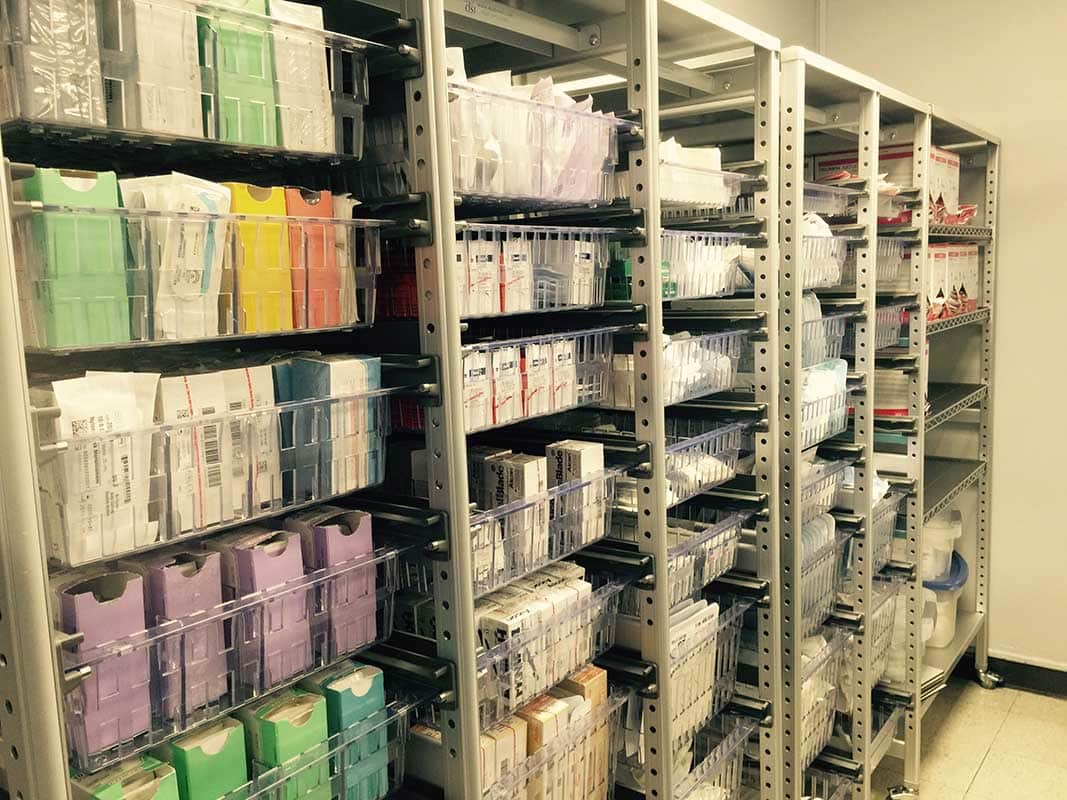
Maintain spacing between shelf levels and between items. Use open or vented shelving, keep clearance from walls, vents, and pipes, and never store on the floor. Do not over-bin, packed bins block airflow and trap humidity.
| Format | Moisture Sensitivity | Common Failure | Storage Cautions |
| Wrap | High | Wicking through fabric layers | Keep away from moisture sources; do not store in deep bins |
| Peel Pouch | Moderate–High | Seal loosening | Store flat; avoid stacking that stresses seals |
| Rigid Container | Moderate | Filter dampness; gasket swelling | Store upright; check filter and gasket before use |
Know the format and its failure mode. Store accordingly.
Chrome wire shelving fails within 1–2 years in high-moisture environments. It carries an 85% contamination risk. It is typically certified only for NSF Dry Storage. Regular shelf maintenance cannot compensate for a material that is fundamentally incompatible with the environment.
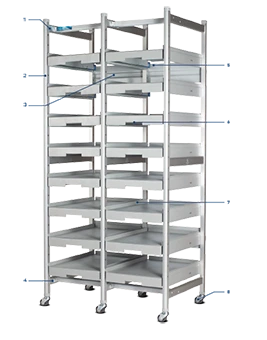
Moisture-proof storage materials eliminate mold, warping, and the contamination risk that chrome wire creates. Polymer shelving lasts 15–25+ years under the same conditions. Contamination risk drops to 12%, an 86% reduction. It qualifies for NSF Wet/Damp certification. The shelving under your sterile items is not a neutral surface. It is either protecting the environment or degrading it.
Speed matters. Every hour a compromised item stays on the shelf, it can be picked, transported, and used. The response must be faster than the next pick cycle.
Damp or wet packs, any packaging showing visible moisture. All items in the same shelf zone if the cause appears environmental. Items from the same sterilizer load if a process issue is suspected. Affected case carts.
Do not sort first. Do not dry and re-evaluate. Quarantine, then investigate.
| Condition | Notify | Timeline |
| Single isolated event | SPD Lead | Immediate |
| Multiple items or repeat zone | SPD Lead + Facilities + IP | Immediate |
| Discovered at point of use, OR, bedside | SPD Lead + OR Charge + IP + Quality | Immediate |
Point-of-use discovery means the item reached the patient or procedure environment. Notification must happen before the next step in that procedure.
Record: date and time, discoverer role, location (zone and shelf), packaging type, photos, environmental readings if available, load and lot identifiers, disposition, suspected cause, and actions completed.
Moisture damage stays invisible when it stays off the dashboard. The right metrics make it impossible to ignore.
| Metric | Why It Matters | Owner |
| Moisture incidents per 1,000 items processed | Shows whether the rate is rising or falling relative to volume | SPD Lead |
| Reprocessing volume due to moisture | Quantifies direct operational and supply cost | SPD Lead |
| Repeat zone incidents within 90 days | Identifies persistent environmental issues not yet corrected | Facilities + SPD Lead |
Rate matters more than count. A facility processing 50,000 items and seeing 10 moisture events is in a different position than one processing 5,000 and seeing 10.
Leading indicators, RH excursions, seasonal shifts, HVAC work orders, precede moisture events. Track them to enable prevention. Make roles explicit and share data openly.
Prevention does not require a capital project. Risk reduction comes from definition, detection, and discipline.
Define "moisture damage" and post it at every handling location. Create a quarantine rule with a designated location and release authority. Map the two or three worst hot spots with a portable probe. Brief staff on signs and response.
Install continuous temperature and humidity loggers with alarms set below regulatory limits. Work with Facilities on HVAC adjustments based on hot-spot data. Implement written cooling and transport rules. Activate the incident workflow so every event is captured, actioned, and trended.
Address structural moisture sources through capital planning, wall insulation, sealed penetrations, HVAC upgrades, and integrate monitoring into the building management system. Where chronic issues persist, plan for purpose-built storage designed to AAMI and ASHRAE standards from the outset.
Moisture damage is preventable, and one of the least addressed risks in sterile storage. If you're ready to close that gap, contact our team to discuss your storage environment.

With 21 years of sales management, marketing, P&L responsibility, business development, national account, and channel management responsibilities under his belt, Ian has established himself as a high achiever across multiple business functions. Ian was part of a small team who started a new business unit for Stanley Black & Decker in Asia from Y10’ to Y14’. He lived in Shanghai, China for two years, then continued to commercialize and scale the business throughout the Asia Pacific and Middle East regions for another two years (4 years of International experience). Ian played college football at the University of Colorado from 96’ to 00’. His core skills sets include; drive, strong work ethic, team player, a builder mentality with high energy, motivator with the passion, purpose, and a track record to prove it.