Key Takeaways
Selecting the right sterile instrument storage system directly impacts infection control, regulatory compliance, and operational efficiency in healthcare facilities. Storage decisions affect contamination rates, staff productivity, and long-term financial performance across sterile processing departments.
Healthcare administrators face increasing pressure to balance patient safety with cost control while meeting evolving regulatory standards. Advanced storage systems reduce healthcare-associated infections by up to 55.7% while delivering measurable return on investment through reduced replacement cycles.
Sterile instrument storage systems are specialized cabinets, shelving units, and containment solutions designed to protect sterilized medical instruments from contamination until use. These systems maintain sterility by controlling environmental factors, including dust exposure, humidity levels, temperature fluctuations, and physical damage to packaging integrity.
Storage systems serve as the final barrier between successful sterilization and potential recontamination before surgical procedures. Properly designed storage protects the substantial investment in instrument reprocessing while ensuring patient safety and regulatory compliance.
Closed cabinets currently hold 35% market share and provide maximum protection from environmental contaminants through solid doors and sealed construction. Modular systems account for 28% market share, offering flexible configurations that adapt to changing inventory needs and departmental workflows.
Open shelving represents 18% market share despite declining use in critical clinical areas due to contamination concerns. Fixed systems comprise 12% market share for permanent installations, while temperature and humidity-controlled cabinets make up 7% market share for specialized applications.
Sterile storage systems reduce healthcare-associated infections by protecting instruments from airborne contaminants, moisture damage, and physical packaging breaches. Advanced systems achieve a 55.7% reduction in HAI incidence compared to facilities using basic open shelving configurations.
Chrome wire shelving demonstrates an 85% contamination rate because corroded surfaces harbor bacteria in pitted areas that defeat standard cleaning protocols. Polymer systems reduce contamination risk to just 12%, representing an 86% improvement over traditional wire shelvings through seamless, non-porous surfaces.
The Joint Commission issues citations under standard EC.02.06.01 for non-cleanable surfaces that cannot be properly disinfected or maintained in a sanitary condition. Healthcare facilities must demonstrate that storage surfaces resist corrosion, allow thorough cleaning, and prevent microbial harboring through smooth, intact construction.
Event-related shelf-life practices have replaced time-based expiration, meaning packages remain sterile indefinitely unless compromised by specific events, including tears or moisture exposure. This standard emphasizes physical protection provided by storage systems rather than arbitrary time limits.
Selection of sterile storage systems depends on six primary factors: regulatory compliance requirements, infection control efficacy, total cost of ownership, durability, ease of use, and compatibility with existing workflows. Healthcare facilities must prioritize these factors based on patient volume, case complexity, budget constraints, and departmental space limitations.
Decision-makers evaluate both clinical outcomes and financial performance when comparing storage options across different technology categories. The selection process requires collaboration between sterile processing managers, infection preventionists, facilities directors, and materials management leadership.
Compliance and regulatory standards receive a 98% importance rating because non-compliant storage systems risk Joint Commission citations and CMS penalties. Infection control and contamination risk earn a 95% importance rating as facilities recognize the direct connection between storage quality and patient safety outcomes.
These two factors function as non-negotiable baseline requirements that eliminate certain storage categories from consideration regardless of cost advantages. Facilities prioritize systems that demonstrate verifiable contamination reduction and meet or exceed CDC, AAMI, and state health department guidelines.
Total Cost of Ownership encompasses purchase price, maintenance expenses, cleaning labor, and replacement costs over the expected equipment lifespan. Cost and TCO receive an 88% importance rating as administrators recognize that the initial purchase price alone misrepresents true financial impact.
Chrome wire shelving costs $150 to $390 per unit but carries a 10-year TCO of $14,500 due to corrosion and frequent replacement cycles. Polymer units require higher upfront investment but deliver a 10-year TCO of just $8,500, generating $6,000 savings per unit, representing a 41% cost reduction.
Durability and lifespan receive an 82% importance rating because frequent replacement disrupts departmental operations and compounds long-term expenses. Polymer systems demonstrate 15-plus-year operational life compared to the 3-to-5-year replacement cycle typical of chrome wire shelving in clinical environments.
Ease of use and efficiency earn a 78% importance rating by directly affecting staff productivity and workflow bottlenecks during high-volume periods. Modular storage systems reduce manual workload by 25% through organized layouts, clear visibility, and adjustable configurations that minimize search time.
Storage system categories differ substantially in material composition, contamination risk, cleaning requirements, load capacity, environmental resistance, and long-term durability. Open wire shelving offers low initial cost but high contamination risk, while closed cabinets provide superior protection at higher price points.
Polymer and scratch-resistant systems occupy the mid-range segment with excellent infection control performance and extended lifespan. Temperature-controlled cabinets represent premium solutions for facilities requiring strict environmental parameters and ISO-level air quality.
Chrome wire shelving consists of carbon steel coated with a thin 12.7-micrometer layer of decorative chromium plating that corrodes rapidly in healthcare environments. Load capacity ranges from 600 to 800 pounds per shelf, making wire shelving suitable for heavy instrument trays and supply containers.
Plating becomes easily breached by micro-scratches from bins or chemical degradation from hospital-grade disinfectants used during routine cleaning. Corroded surfaces create pitting that harbors bacteria and renders the shelving non-compliant with Joint Commission cleanability standards.
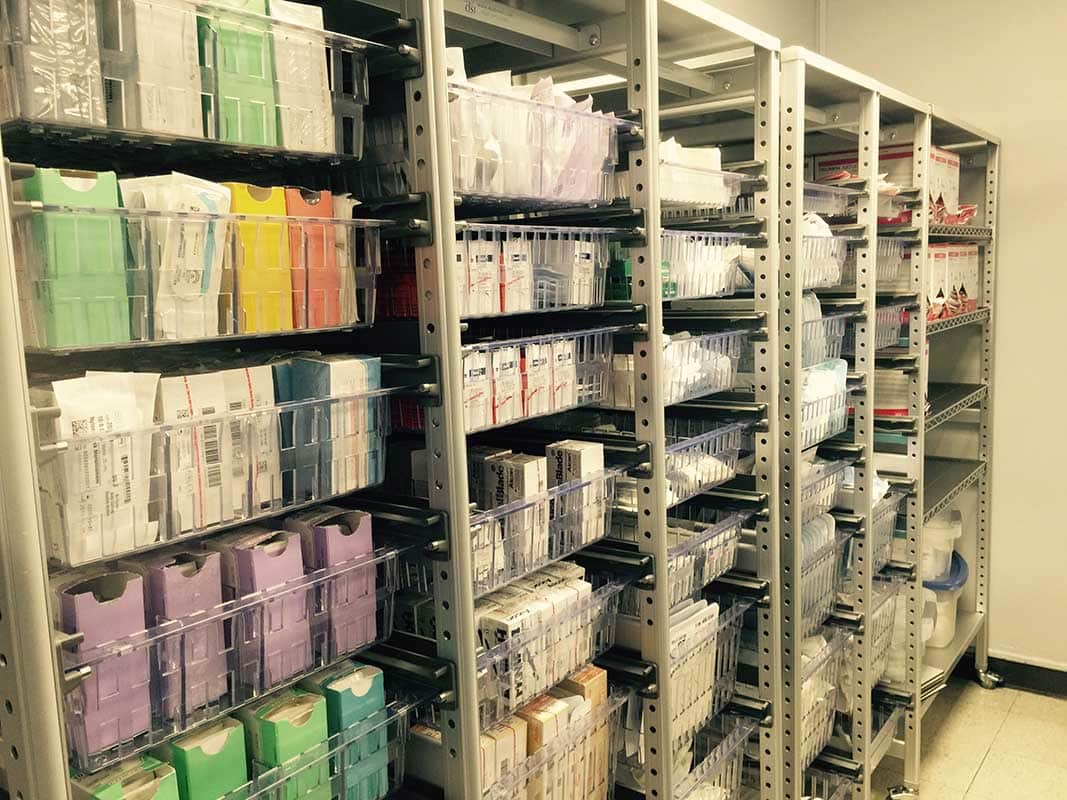
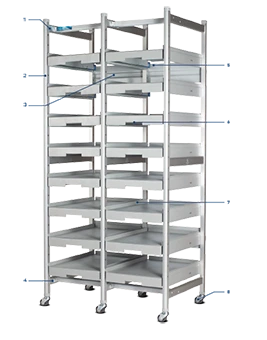
DSI SterileShelf and similar engineered polymer storage systems utilize AireCore material that resists chemical degradation and prevents surface pitting throughout extended service life. Polymer systems reduce contamination risk to 12% compared to the 85% contamination rate documented with chrome wire alternatives.
Scratch-resistant construction eliminates bacterial harboring points through seamless surfaces that withstand repeated cleaning with aggressive disinfectants. These systems maintain structural integrity for 15-plus years without surface degradation, eliminating replacement cycles that disrupt departmental operations.
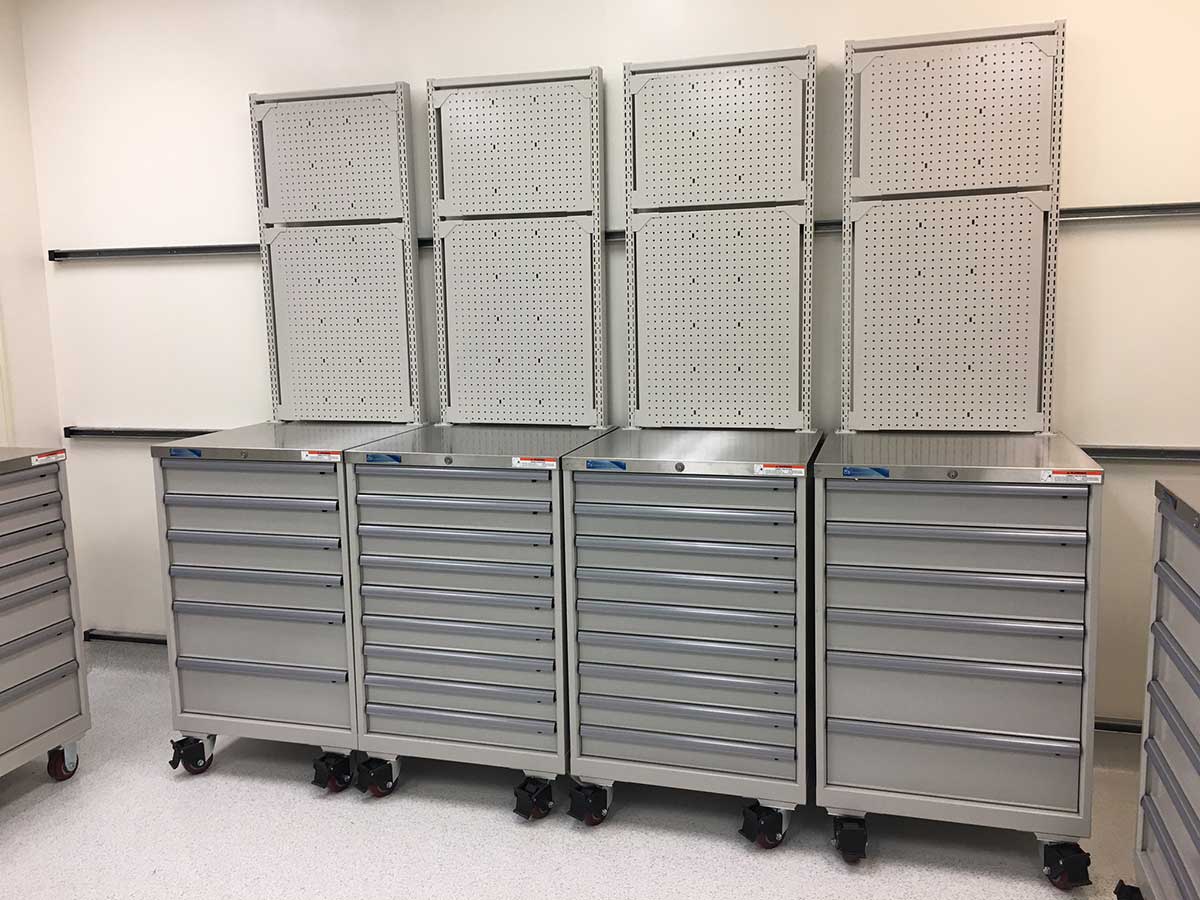
Closed cabinets provide physical barriers against dust, moisture, and airborne contaminants through solid or tempered glass doors with positive-seal gaskets. Basic closed units start at $2,000 while advanced configurations with high-density modular interiors reach $10,000 based on size and features.
Modular systems incorporate FlexCell technology, allowing interior reconfiguration as inventory requirements change without replacing entire cabinet structures. These systems reduce manual workload by 25% through organized compartments, adjustable shelving, and clear visibility that streamlines supply location.
Large hospitals with 500-plus beds demonstrate the highest adoption rate at 78% due to greater capital budgets, complex surgical volumes, and regulatory scrutiny. Medium hospitals ranging from 100 to 500 beds show 62% adoption, balancing compliance needs against moderate budget constraints through selective system deployment.
Small hospitals with fewer than 100 beds achieve only 38% adoption, while clinics and urgent care facilities lag at 25% adoption rates. Rural facilities face limited capital budgets and geographic isolation from service providers, creating barriers to implementing advanced storage infrastructure.
Facility type and size determine available capital budgets, space constraints, case volumes, and regulatory exposure that shape SPD selection criteria. Large academic medical centers prioritize scalable, automated systems with hospital information system integration, while smaller facilities focus on basic compliance solutions.
High-volume surgical departments require specialized scope cabinets and compartmentalized storage that protect delicate instruments and maintain strict organization protocols. Ambulatory surgery centers emphasize mobile solutions and compact footprints that maximize limited storage space without sacrificing infection control standards.
Northeast and West Coast regions demonstrate the highest penetration of premium temperature-controlled and modular systems, driven by stringent state regulations and concentrated academic centers. Southeast and Midwest facilities favor mid-range solutions, balancing essential compliance requirements with regional cost expectations and competitive healthcare markets.
Urban medical centers rapidly adopt advanced technologies to manage high patient volumes and complex surgical caseloads requiring extensive instrument inventories. Rural healthcare systems prioritize durable, low-maintenance designs that ensure basic compliance without requiring extensive technical support or frequent service visits.
Baby Boomer healthcare leaders prioritize proven technologies with established track records, focusing heavily on initial capital expenditure and immediate regulatory compliance. Generation X managers balance cost against operational efficiency, preferring systems that demonstrably improve workflow and reduce staff burden through ergonomic design.
Millennial administrators advocate for data-driven, technologically integrated solutions offering real-time environmental monitoring, inventory analytics, and long-term sustainability performance. This generational shift accelerates the adoption of smart cabinets with embedded sensors, automated alerts, and digital integration with materials management platforms.
Financial implications extend beyond purchase price to encompass total cost of ownership, return on investment timelines, operational efficiency gains, and avoided costs from infection prevention. Chrome wire shelving appears economical at $100 to $390 per unit but delivers poor long-term value compared to polymer or closed systems.
Stainless steel wire ranges from $300 to $800 per unit, while closed cabinets span $2,000 to $10,000, and controlled cabinets require $8,000 to $25,000 investments. Comprehensive financial analysis must account for maintenance frequency, replacement cycles, cleaning labor, and contamination-related costs over the projected equipment lifespan.
Chrome wire shelving demonstrates deceptively low initial costs but accumulates $14,500 in 10-year TCO through replacement expenses, increased cleaning labor, and maintenance requirements. Budget-tier chrome units cost $150 while heavy-duty versions reach $390, yet both corrode similarly under healthcare disinfection protocols.
Controlled cabinets range from $8,000 for basic temperature monitoring to $25,000 for full ISO 4 cleanroom standards with integrated HEPA filtration. While initial investment appears substantial, these systems eliminate replacement cycles, reduce infection-related costs, and maintain consistent performance throughout 10-to-15-year operational lifespans.
Facilities replacing 100 chrome wire units with polymer alternatives achieve payback periods of just 5.6 months through eliminated replacement costs and reduced labor. This same upgrade generates $600,000 in savings over 10 years when factoring in avoided equipment purchases, reduced cleaning time, and prevented infection costs.
Advanced systems reduce HAI incidence by 55.7%, preventing infections that cost healthcare facilities $28,400 to $33,800 per occurrence in treatment expenses and penalties. Each prevented infection delivers measurable ROI beyond equipment savings, protecting both patient outcomes and facility financial performance.
Modular systems reduce manual workload by 25% through organized layouts that minimize time spent locating instruments and supplies during procedure preparation. Efficient storage designs allow sterile processing technicians to focus on instrument reprocessing rather than inventory management, improving departmental throughput and reducing overtime expenses.
Advanced systems achieve 55.7% reduction in HAI incidence by maintaining sterile packaging integrity and preventing environmental contamination throughout storage periods. This dual improvement in workflow efficiency and patient safety demonstrates how equipment investments generate both operational and clinical value.
SPD workflow optimization requires strategic placement of closed systems in high-traffic areas, strict separation of clean and dirty pathways, and organized storage utilizing plastic bins for small components. Best practices emphasize event-related sterility maintenance, PAR level management, and regular environmental monitoring to ensure storage conditions remain within acceptable parameters.
Effective storage design integrates with departmental workflow patterns, instrument processing sequences, and supply chain replenishment cycles. Facilities must implement standardized protocols for package handling, environmental controls, and routine compliance auditing to maximize storage system performance.
High-traffic corridors experience constant air disturbance that promotes bacterial settlement on exposed surfaces and sterile packages stored on open shelving. Closed systems provide essential physical barriers against airborne contamination, dust accumulation, and inadvertent contact during staff movement through busy departmental areas.
Open shelving designs allow particulate matter to settle directly on stored items, increasing contamination risk despite proper sterilization and packaging procedures. Enclosed cabinets maintain protective environments that preserve sterile integrity regardless of external traffic patterns and environmental conditions.
Cross-contamination occurs when clean and dirty items share pathways, storage areas, or handling procedures within sterile processing departments. Strict separation protocols require dedicated storage zones, distinct traffic patterns, and physical barriers preventing contact between contaminated and sterilized instruments.
PAR level management maintains adequate supply without overstocking, reducing inventory carrying costs while ensuring procedure readiness. Organized separation systems enable rapid visual inventory assessment, streamlined restocking procedures, and clear accountability for sterile instrument tracking.
The EIPAC framework provides structured decision-making for infection prevention and control equipment investments requiring ethical consideration of patient safety priorities. This approach begins with identifying compliance gaps or infection risks in the current storage infrastructure that threaten patient outcomes.
Decision-makers gather information assessing TCO, clinical efficacy data, and regulatory compliance documentation for alternative storage systems under evaluation. Teams analyze alternatives based on patient safety impact, then select systems delivering the highest patient protection combined with demonstrated long-term financial value.
Premium sterile storage incorporates active temperature control, maintaining conditions at or below 75°F, humidity regulation between 20% and 60%, and HEPA filtration, achieving ISO 4 air cleanliness. These systems prevent packaging degradation, inhibit microbial growth, and maintain optimal conditions for extended sterile storage periods.
Advanced cabinets feature real-time environmental monitoring, automated alerts for parameter deviations, and digital integration with facility management systems. Technical specifications must align with VA Directive 1116(2), ANSI/AAMI ST79, and ASHRAE 170-2017 standards governing sterile storage environments.
Temperature-controlled cabinets utilize active cooling systems, maintaining internal conditions at or below 75°F to inhibit bacterial multiplication and spore germination. A temperature increase of just 5°C from 20°C to 25°C doubles bacterial multiplication rates, making precise control essential for infection prevention.
Humidity regulation prevents moisture accumulation that compromises packaging integrity and creates environments conducive to microbial growth. Controlled cabinets cost $8,000 for basic temperature monitoring, rising to $25,000 for full ISO 4 environmental specifications with integrated filtration.
Premium storage systems must satisfy VA Directive 1116(2) requirements for sterile medical device storage in federal healthcare facilities and military installations. ANSI/AAMI ST79 establishes comprehensive guidelines for instrument processing, including environmental parameters for storage areas and maintaining sterilized instruments until use.
ASHRAE 170-2017 specifies ventilation, temperature, and humidity requirements for healthcare facilities, including sterile storage and processing departments. Compliance with these overlapping standards ensures storage systems meet federal, professional association, and engineering society requirements simultaneously.
HEPA filtration removes 99.97% of airborne particles 0.3 micrometers or larger, achieving ISO 4 air cleanliness that prevents contamination from environmental sources. This level of filtration exceeds requirements for most sterile storage applications but becomes essential for highly sensitive instruments or biological materials.
Premium cabinets integrate HEPA systems with active air circulation, maintaining positive pressure that prevents unfiltered air infiltration during door openings. Combined environmental controls create protective microenvironments preserving sterile integrity regardless of surrounding conditions in larger storage rooms.
The global sterile storage cabinet market reached $3.46 billion in 2024 and projects growth to $5.50 billion by 2035 at 4.3% CAGR. Medical supply storage cabinets achieved $2.82 billion in 2024, while the broader medical cabinetry market targets $11.71 billion by 2027 at 4.7% annual growth.
Market expansion reflects increasing regulatory requirements, healthcare infrastructure investment, and heightened focus on infection prevention following pandemic awareness. Facilities transitioning from traditional open wire shelving to advanced enclosed and modular systems drive sustained market growth across all healthcare segments.
Strategic storage selection requires balancing compliance mandates, infection control efficacy, total cost of ownership, and operational workflow optimization. Healthcare administrators must evaluate complete facility needs rather than focusing narrowly on individual unit costs that obscure long-term financial and clinical implications.
Polymer systems, closed cabinets, and temperature-controlled units deliver superior patient safety outcomes while generating measurable return on investment through reduced replacement cycles and prevented infections. Organizations like DSIDirect provide specialized expertise in healthcare storage solutions, helping facilities implement custom configurations that address specific departmental requirements and budget parameters.
Selecting appropriate sterile instrument storage represents a strategic investment in patient safety, regulatory compliance, and operational efficiency that impacts clinical outcomes for years. Facilities should conduct comprehensive assessments evaluating current storage performance, identifying compliance gaps, and projecting long-term costs before making procurement decisions.
Choosing the right sterile instrument storage system is one of the highest-stakes decisions your SPD team will make. Distribution Systems International brings over 30 years of acute care expertise to every project — from on-site workflow analysis and CAD-based design to full turnkey implementation and after-sales support.
Our SterileShelf polymer systems and MODU-MAX modular configurations are engineered for compliance, durability, and long-term cost performance. We don't sell off the shelf; we build the right system for your department's exact needs.
Schedule your complimentary SPD storage consultation with DSI today and get a clear ROI projection before you commit.

With 21 years of sales management, marketing, P&L responsibility, business development, national account, and channel management responsibilities under his belt, Ian has established himself as a high achiever across multiple business functions. Ian was part of a small team who started a new business unit for Stanley Black & Decker in Asia from Y10’ to Y14’. He lived in Shanghai, China for two years, then continued to commercialize and scale the business throughout the Asia Pacific and Middle East regions for another two years (4 years of International experience). Ian played college football at the University of Colorado from 96’ to 00’. His core skills sets include; drive, strong work ethic, team player, a builder mentality with high energy, motivator with the passion, purpose, and a track record to prove it.