Hospital operating room storage assessment drives capital allocation, workflow efficiency, and patient safety across surgical departments. Storage decisions about medical supplies, instruments, and capital equipment influence throughput, labor productivity, inventory control, and cybersecurity governance. The operating room equipment market reached USD 48.61 billion in 2024 and is projected to reach USD 75.39 billion by 2030 at 7.8% CAGR, reflecting sustained demand for storage integration, automation, and modular renovation systems that expand storage capacity, recover floor space, and reduce downtime while improving supply visibility.
Operating room storage comprises systems designed to organize, secure, and track medical supplies and surgical instruments within sterile environments. These systems directly impact case readiness, infection control, inventory accuracy, and staff efficiency across the operating suite and the sterile processing department. Insufficient or malfunctioning instruments account for 18.8% of surgery interruptions, while equipment failure causes 55.2% to 57.9% of OR delays. Proper storage design reduces search time, prevents stock-outs, expands usable storage space, and supports regulatory compliance.
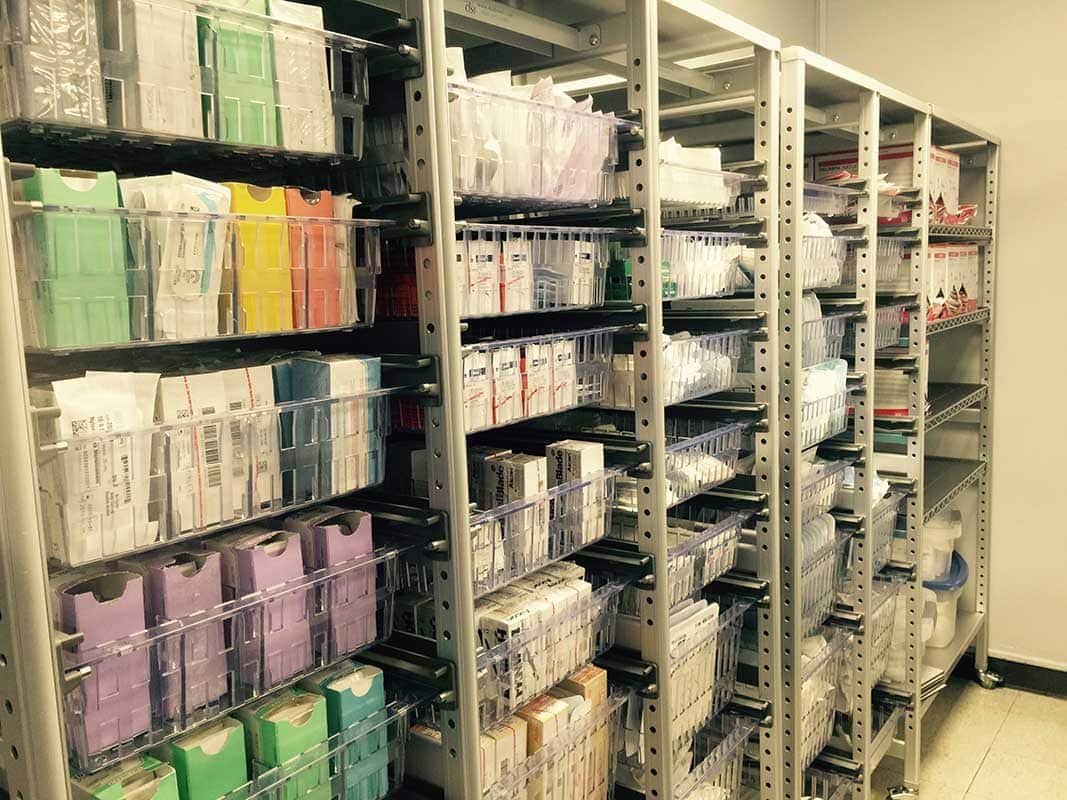
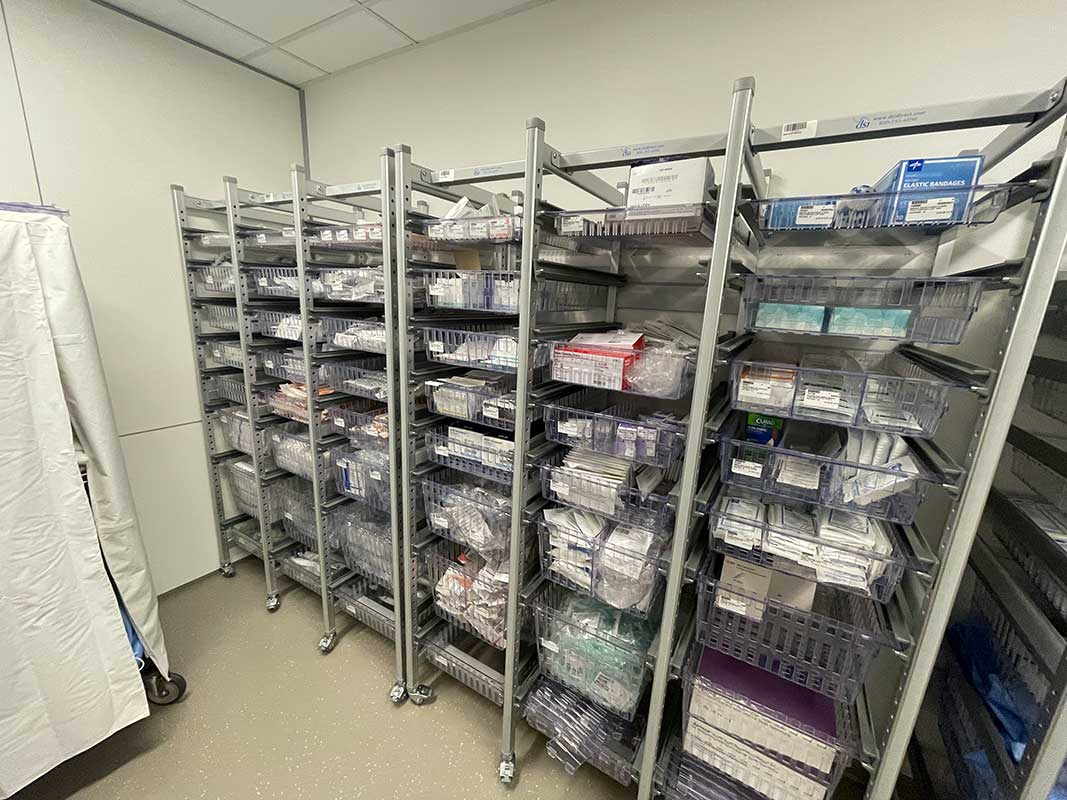
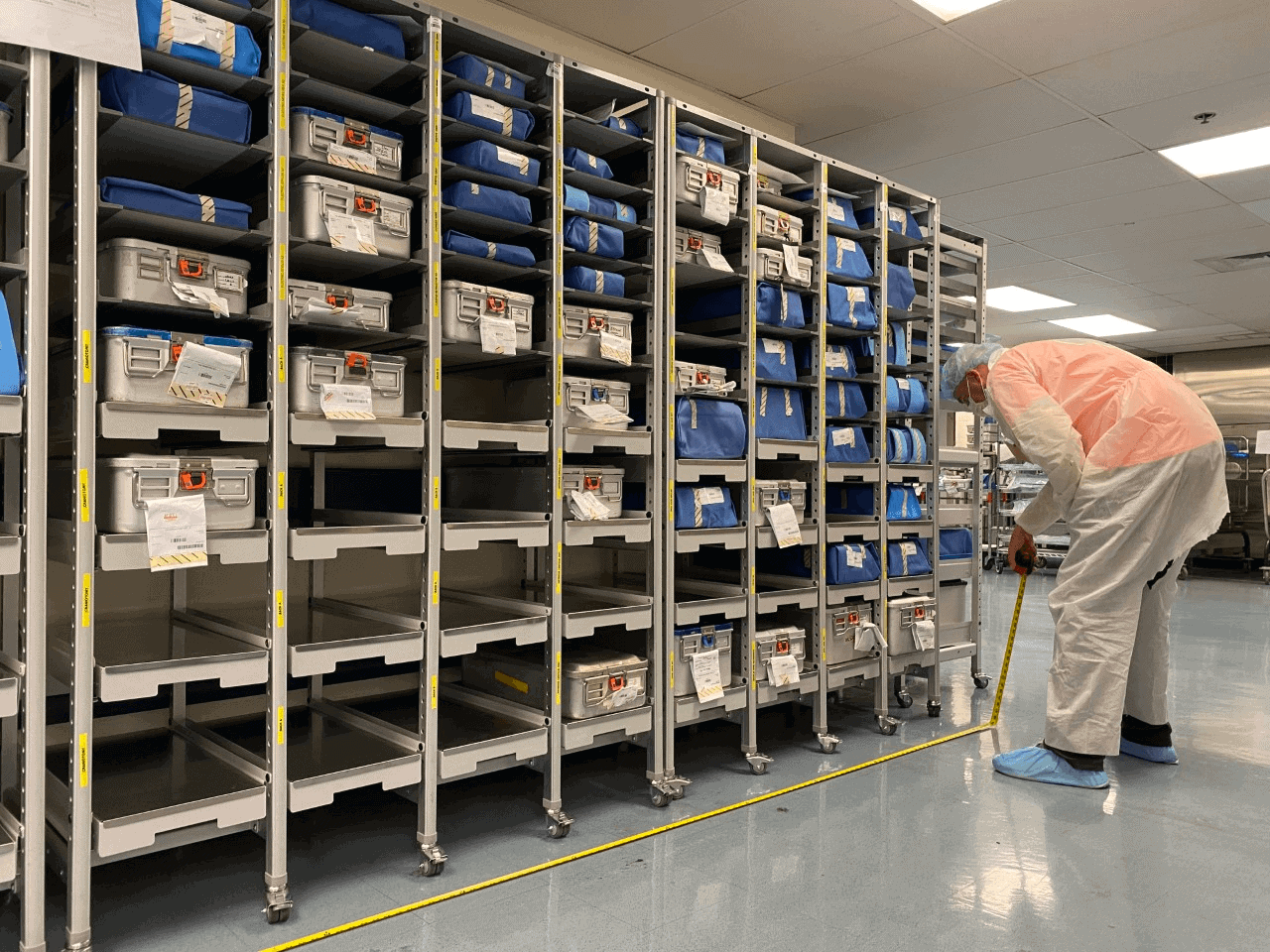
OR storage spans traditional medical cabinetry, modular casework, stainless and wire shelving units, RFID-enabled smart cabinets, mobile storage racks, and robotic accessory storage. Traditional OR storage uses welded stainless steel with tempered glass doors, sloped tops, adjustable shelving, and locking hardware. Modular casework consists of factory-built components using aluminum-clad, laminate, or stainless elements assembled on site. Smart storage deploys RFID-enabled cabinets with software dashboards and automated replenishment workflows to improve inventory visibility. High-density shelving and mobile storage systems consolidate floor space by replacing static aisles with compacting units that travel along an overhead guide track or floor-mounted rail.
Robotic-assisted storage provides secure storage for robotic accessories, filtered cabinets, and closed-loop transport between the sterile processing department and surgical suites. The medical cabinetry market is projected to rise from USD 9.308 billion in 2022 to USD 11.711 billion in 2027 at 4.7% CAGR.
Traditional storage holds the largest installed share while smart and modular categories capture a disproportionate share of new renovation budgets. Traditional cabinets and fixed wire shelving are harder to reconfigure and deliver lower data visibility than integrated systems. Smart storage provides better supply visibility but carries higher software and integration costs, requiring workflow-change management. Modular casework offers seven-year depreciation versus 31 years for fixed casework, creating financial advantage in renovation-focused budgets and improving overall space utilization.
Traditional systems remain preferred where budgets are tight, digital maturity is low, and fast payback is required. Smart and modular systems gain adoption when hospitals prioritize throughput, inventory control, and labor efficiency. The RFID smart cabinets market was valued at USD 1.19 billion in 2024 and is projected to reach USD 2.21 billion by 2030 at 10.8% CAGR.
The OR integration market was valued at USD 2.35 billion in 2025 and is projected to reach USD 5.67 billion by 2033 at 11.67% CAGR, reflecting accelerated demand for digital inventory management. Automation reduces manual counting, provides real-time replenishment alerts, and generates audit trails supporting compliance, particularly when paired with multilevel storage configurations that maximize vertical capacity within the existing floor space. Integration enables seamless data flow between storage systems, supply chain platforms, and electronic health records.
Hospitals prioritizing AI and automation represent 45% of executive decision-makers surveyed in 2025. Automated storage cuts labor-intensive supply handling while improving visibility over high-value items and controlled substances, aligning with perioperative efficiency goals, including reduced case delays and better inventory accuracy.
Market forces influence OR storage renovation through accelerating growth in automation, modular construction, and enterprise standardization. Renovation budgets are rising from 30% of hospital capital spending to an expected 37% in 2025, driving demand for modular, reconfigurable storage that minimizes downtime, recovers floor space, and supports phased implementation. Security and privacy risk now rank as top priority for 50% of hospital executives, reinforcing demand for access-controlled and trackable storage.
The global operating room equipment market was valued at USD 48.61 billion in 2024 and is projected to reach USD 75.39 billion by 2030 at 7.8% CAGR. The medical cabinetry market is projected to rise from USD 9.308 billion in 2022 to USD 11.711 billion in 2027 at 4.7% CAGR. Traditional cabinetry and basic wire shelving remain the largest segment by installed base, but growth rates lag automation and modular categories.
The RFID smart cabinets market was valued at USD 1.19 billion in 2024 and is projected to reach USD 2.21 billion by 2030 at 10.8% CAGR. The modular operating room market reached USD 1.50 billion in 2023 and is projected to reach USD 3.20 billion by 2032 at 8.2% CAGR, confirming hospitals are allocating capital toward systems that improve flexibility, storage capacity, visibility, and workflow integration.
Traditional cabinetry and fixed casework account for 66.2% share of current OR storage spending. Integrated and robotic-enabled storage systems represent 15.6%, while modular storage accounts for 10.5%. Smart or automated storage captures 7.7% of the market, making it the fastest-growing category despite a smaller installed base. Hospital renovation rising from 30% to 35% in 2024 and expected 37% in 2025 reflects growing preference for phased upgrades that prioritize space utilization and reconfigurable shelving units.
Quality patient care ranks as a priority for 39% of hospital executives, favoring storage designs that reduce missing-item risk and improve first-case readiness. Workforce costs influence 34% of executive decisions, strengthening the case for automation, cutting labor-intensive supply handling. OR efficiency is identified as a priority by 26% of executives, confirming that storage layout is evaluated as a throughput issue.
Urban hospitals demonstrate 81% digital readiness proxy, indicating strong capacity for integrated smart storage platforms. Rural hospitals show 56% digital readiness, suggesting greater reliance on traditional and hybrid modular approaches. Large hospitals with more than 400 beds achieve 96% digital readiness proxy, making them the most attractive market for enterprise OR storage automation. Medium hospitals with 100 to 399 beds reach 80% digital readiness, while small hospitals with fewer than 100 beds demonstrate 59% readiness.
System-affiliated hospitals demonstrate 86% digital readiness proxy compared to 37% for independent hospitals, reflecting greater governance capacity, IT infrastructure, and capital access within multi-site health systems. Non-critical-access hospitals reach 80% digital readiness, while critical-access hospitals demonstrate 50%.
Hospitals evaluate OR storage investments using cost discipline, operational efficiency, space optimization, and technology enablement. Security and privacy risk ranks as the top priority for 50% of hospital executives surveyed in 2025. Quality patient care influences 39% of executives, while AI and automation drive 45% of decision-making. These priorities reflect a shift from cost-first purchasing to multidimensional ROI assessments, including labor savings, inventory reduction, throughput improvement, and recovered floor space.
Security and privacy risk represent the highest priority for 50% of hospital executives in 2025, driving demand for access-controlled storage, audit trails, and policy-compliant inventory management. Quality patient care influences 39% of executives, favoring storage designs that reduce missing-item risk. Smart storage delivers better visibility but introduces cybersecurity and governance burdens requiring IT coordination and staff training.
Infrastructure modernization influences 36% of hospital executives, supporting phased storage renovation as part of larger OR modernization programs. Capacity constraints affect 30% of executives, making space utilization and storage capacity expansion strategically valuable. OR efficiency ranks as a priority for 26% of executives, confirming storage layout influences throughput metrics.
AI and automation represent a priority for 45% of hospital executives surveyed in 2025, supporting investment in RFID-enabled cabinets, analytics platforms, and integrated replenishment workflows, reducing manual counting. Technology-enabled storage generates real-time alerts, expiration control, and demand-planning data, aligning with enterprise supply chain goals. Hospitals with higher digital readiness demonstrate stronger adoption of smart storage, particularly in urban and large-facility segments.
Workforce burnout influences 26% of hospital executives, encouraging designs that reduce supply hunts during case preparation. Supply costs affect 24% of executives, supporting RFID visibility and tighter par management. OR efficiency as a cost driver influences 21% of executives, confirming that throughput problems are monetized in capital budgeting decisions.
Workforce costs influence 34% of hospital executives, strengthening the case for automation, cutting labor-intensive supply handling. Staff satisfaction in one perioperative inventory optimization study rose from 1.7% to 80% after redesigning inventory management and storage workflows, demonstrating workforce impact. Workforce burnout affects 26% of executives, supporting storage layouts, reducing physical searching, and improving ergonomic access to medical supplies.
Supply costs drive 24% of executive decisions, favoring RFID visibility and expiration control, reducing waste. OR efficiency influences 26% of executives, while OR efficiency as a cost driver affects 21%, together confirming storage-related delays are recognized as revenue risks. Hospitals increasingly evaluate storage through the combined lenses of labor savings, inventory reduction, and throughput improvement.
OR storage categories range from traditional stainless steel cabinetry to modular casework, wire shelving, high-density mobile shelving systems, smart RFID systems, and robotic-assisted storage platforms. Each category serves distinct facility types, budgets, and workflow requirements. Traditional cabinetry delivers the lowest upfront cost and strongest durability, but limits reconfiguration flexibility and data visibility. Modular systems reduce installation complexity and support phased expansion, while smart storage automates inventory tracking and replenishment.
Traditional OR storage uses welded stainless steel construction with tempered glass doors, sloped tops, adjustable shelving, and locking hardware. These shelving units range from USD 3,000 to USD 9,000+ per cabinet, depending on size and features. Budget traditional cabinets cost USD 3,000 to USD 4,500, mid-market units range from USD 4,500 to USD 7,000, and premium cabinets exceed USD 7,000. One pass-through cabinet is priced at USD 3,017.65.
Traditional cabinetry remains dominant where budgets are tight, digital maturity is low, and fast payback is required. These systems deliver strong durability and low training burden but are harder to reconfigure when workflows change or when teams need to recover floor space.
Modular casework offers lower installation costs versus fixed casework using factory-built components assembled on site. The modular operating room market reached USD 1.50 billion in 2023 and is projected to reach USD 3.20 billion by 2032 at 8.2% CAGR. Modular systems provide reconfigurable interiors, interchangeable components, and phased expansion capabilities, reducing downtime during renovation. These systems support standardization across multi-site health systems, improving repeatability and procurement leverage.
Modular casework uses aluminum-clad, laminate, or stainless elements, adapting to changing workflow requirements. Seven-year depreciation rate versus 31 years for fixed casework creates a financial advantage. Modular platforms can be paired with a high-density shelving storage system or high-density mobile wire shelving to nearly double storage capacity inside the sterile processing department without adding floor space. Modular storage solutions deliver faster installation and easier future changes, making them attractive for hospitals prioritizing flexibility and speed.
Smart storage systems use RFID readers, automatic inventory counts, replenishment alerts, audit trails, and cloud dashboards to improve supply visibility and reduce stock-outs. The RFID smart cabinets market was valued at USD 1.19 billion in 2024 and is projected to reach USD 2.21 billion by 2030 at 10.8% CAGR. These systems provide better visibility than traditional storage but require software integration and workflow-change management. Standalone hardware begins around USD 3,500 to USD 4,500, but enterprise installed systems commonly exceed mid-five-figure costs after software and implementation.
Robotic-assisted storage provides filtered, secure storage for robotic accessories, protected equipment cabinets, and closed-loop transport between sterile processing and surgical suites. Higher complexity limits adoption to facilities with strong robotic case volumes.
OR storage renovation costs vary by scope, from limited cabinet refreshes under USD 75,000 to full robotics-enabled programs exceeding USD 500,000. New healthcare construction costs range from USD 700 to USD 730 per square foot, while moderate renovation costs USD 245 to USD 256 per square foot. Gut-and-rebuild renovation runs USD 385 to USD 402 per square foot, with demolition adding USD 20 to USD 50 per square foot. Construction typically represents 60% to 65% of total project cost, requiring additional budgeting for owner costs, contingencies, and commissioning.
New healthcare construction costs range from USD 700 to USD 730 per square foot. Moderate renovation costs USD 245 to USD 256 per square foot, while gut-and-rebuild renovation ranges from USD 385 to USD 402 per square foot. Demolition adds USD 20 to USD 50 per square foot when existing millwork must be removed. Construction typically represents 60% to 65% of total project cost, meaning owner costs, contingencies, planning, and commissioning add substantial expense.
Cabinet price is not project price due to installation sequencing, infection-prevention controls, night or weekend work, utilities relocation, validation, and inventory migration. Limited cabinet refreshes range from USD 15,000 to USD 75,000. Hybrid storage upgrades cost USD 75,000 to USD 250,000, including modular casework, mobile storage systems, and localized smart cabinet deployment. Full-room storage-led renovations often exceed USD 250,000 when demolition, infection control, and downtime mitigation are included.
Traditional cabinet price ranges span USD 3,000 to USD 9,000+, depending on size, materials, and features. Budget traditional cabinets cost USD 3,000 to USD 4,500. Mid-market traditional cabinets range from USD 4,500 to USD 7,000. Premium traditional cabinets exceed USD 7,000 and may include pass-through configurations or specialized shelving.
A pass-through cabinet is priced at USD 3,017.65. Modular systems begin around USD 5,000 for budget configurations, reach USD 9,000 in mid-market segments, and exceed USD 15,000 for complex installations. High-density mobile wire shelving and overhead guide track systems are typically priced per run based on linear feet and carriage count, with pricing scaling against the storage capacity recovered. Smart storage hardware starts at USD 3,500 to USD 4,500 for standalone units, but enterprise systems commonly exceed mid-five-figure costs after software and implementation.
Cabinet price is not project price due to installation, infection control, and downtime costs often exceeding hardware expense. Limited cabinet refreshes cost USD 15,000 to USD 75,000. Hybrid storage upgrades range from USD 75,000 to USD 250,000. Robotics-enabled storage programs cost USD 100,000 to USD 500,000+, depending on infrastructure scope.
Perioperative downtime during installation creates revenue risk and staff scheduling complexity. Facilities should plan installation sequencing, infection-prevention protocols, and night or weekend work to minimize disruption. Inventory migration of medical supplies from old shelving units to new storage requires coordination among perioperative, sterile processing department, supply chain, and facilities teams.
Storage efficiency depends on workflow design, inventory policy, and clinical coordination between perioperative teams and the sterile processing department as much as cabinet selection. Effective storage optimization reduces search time, improves space utilization, prevents stock-outs, controls expiration waste, and improves case readiness. Inventory reduction of 37.7% was achieved in one perioperative optimization study, combined with average tray size cuts of 18%. Annual labor savings reached USD 39,995 while depreciation savings totaled USD 64,320.
Inventory reduction of 37.7% was achieved in a perioperative optimization study that redesigned storage and inventory workflows across four high-volume services. Average tray size was cut by 18%, reducing reprocessing burden. The program saved 1,333 reprocessing hours annually. Annual labor savings reached USD 39,995, while annual depreciation savings totaled USD 64,320.
Case cancellation reduction from 3.9% to 0.2% demonstrates the clinical impact of better inventory and storage design. Staff satisfaction rose from 1.7% to 80% after implementing redesigned workflows, supporting burnout reduction and workforce retention. These results confirm storage renovation delivers measurable ROI through combined labor, inventory, and throughput improvements.
Case cancellation reduction from 3.9% to 0.2% was achieved through perioperative inventory optimization and improved storage design, preserving revenue and reducing schedule disruption. Staff satisfaction rose from 1.7% to 80%. Insufficient or malfunctioning instruments account for 18.8% of surgery interruptions, while equipment failure causes 55.2% to 57.9% of OR delays.
Faulty or missing equipment delayed nearly 16% of scheduled surgeries in one teaching hospital study. These delays stem from weak visibility, poor zoning, and disorganized point-of-use storage. High-density supply storage reduces search time and improves case readiness by organizing medical supplies near the point of use while expanding effective storage capacity inside the same floor space.
Zone supplies by case criticality and frequency of use to reduce search time. Avoid mixed-use storage rooms for IT or nonclinical functions that compromise sterile separation. Plan storage with perioperative, sterile processing department, supply chain, facilities, IT, and security teams at the concept stage. Audit missing-item causes, pass-through bottlenecks, and equipment search time before locking layout decisions.
Place high-value RFID or robotics storage near procedure flow while preserving sterile separation. Compact track systems support efficient medical supply organization in constrained spaces. Mobile storage track systems with an overhead guide track or floor-mounted rail improve density and flexibility, allowing staff to access supplies without excessive walking. Multilevel storage configurations stack capacity vertically so teams recover floor space without sacrificing accessibility.
Storage strategy selection depends on facility type, digital readiness, robotics utilization, and enterprise standardization goals. Small or rural hospitals with tight capital budgets benefit from traditional plus selective modular approaches. Medium hospitals renovating existing OR cores gain best value from modular plus selective smart cabinets, balancing downtime reduction with ROI. Large urban health systems with high case volumes achieve the strongest results with modular, high-density mobile shelving systems, RFID, and integration layers aligning with digital maturity and labor-efficiency goals.
Large urban health systems are most attractive for smart storage versus rural hospitals, which more likely adopt hybrid approaches combining traditional wire shelving and modular elements. System-affiliated hospitals demonstrate 86% digital readiness proxy compared to 37% for independent hospitals. Large hospitals with more than 400 beds achieve 96% digital readiness proxy, making them primary targets for integrated OR storage automation.
Medium hospitals with 100 to 399 beds reach 80% digital readiness, supporting modular casework plus targeted RFID for implants and expensive consumables. Small hospitals with fewer than 100 beds demonstrate 59% digital readiness and are more price-sensitive, likely prioritizing standardization and lower-capex improvements such as mobile storage racks that maximize space utilization in tight rooms. Scope cabinets address specialized storage requirements for endoscopy and surgical instruments.
Complete hospital robotic delivery implementations cost USD 100,000 to USD 500,000 per hospital, depending on infrastructure scope. These systems support closed-loop transport, accessory storage, and workflow integration for robotic surgery programs. Robotic-assisted storage provides filtered, secure storage for robotic arms and adapters, reducing handling damage. The OR integration market, valued at USD 2.35 billion in 2025, is projected to reach USD 5.67 billion by 2033.
Robotics-heavy service lines benefit from robotic-assisted storage plus controlled-access smart tracking. Facilities with low robotic case volume achieve a weaker ROI from robotic storage. Plastic bins support flexible medical supply organization within larger shelving units and high-density shelving storage system layouts.
STERIS EVOLVE Modular Casework provides template-based designs supporting repeatability across multi-site health systems. Cardinal Health's automatic hands-free counting systems deliver enterprise analytics and replenishment workflows. Oracle RFID replenishment systems reduce manual counting and generate demand-planning data. System-wide standardization programs benefit from template-based modular casework paired with enterprise analytics and high-density mobile shelving systems, maximizing procurement leverage and storage capacity across sites.
Multi-site health systems demonstrate 86% digital readiness proxy, making them the strongest candidates for integrated smart storage and analytics platforms. Workstations support point-of-use workflow organization and improve staff efficiency during case preparation. Independent hospitals with 37% digital readiness are more likely to favor budget-conscious traditional wire shelving or hybrid modular options.
Successful OR storage renovation integrates assessment, planning, and installation into a coordinated program addressing facility type, workflow requirements, and technology readiness. Assessment begins with auditing missing-item causes, pass-through bottlenecks, equipment search time, and current storage space utilization across the operating suite and sterile processing department. Planning coordinates perioperative, supply chain, facilities, IT, and security teams at the concept stage. Installation sequencing minimizes downtime through infection-prevention protocols and phased migration.
The strongest ROI cases combine labor savings, cancellation reduction, expiration control, depreciation savings, and recovered floor space. Inventory reduction of 37.7%, annual labor savings of USD 39,995, and annual depreciation savings of USD 64,320 demonstrate a measurable impact. Case cancellation reduction from 3.9% to 0.2% and staff satisfaction improvement from 1.7% to 80% confirm that storage design directly influences clinical continuity and workforce retention. DSI supports healthcare facilities through consultative assessment, custom design, and turnkey implementation, aligning storage renovation with operational efficiency and patient safety goals.
Distribution Systems International designs and installs the full range of OR storage solutions covered in this guide, from modular casework and shelving units to high-density mobile wire shelving, overhead guide track configurations, and multilevel storage that expands storage capacity without consuming additional floor space.
Our team partners with perioperative leaders, sterile processing department managers, and facilities planners to assess current space utilization, recommend the right mix of traditional cabinetry and high-density mobile shelving systems, and deliver a turnkey installation that protects case volume during the renovation. Contact Distribution Systems International today to schedule an on-site storage assessment and unlock measurable improvements in inventory control, workflow efficiency, and staff satisfaction.
Is your facility ready to optimize OR storage through data-driven operating room storage assessment and LEAN methodology? Explore our services to discover how consultative planning and turnkey implementation can deliver measurable improvements in inventory control, workflow efficiency, and staff satisfaction.

With 21 years of sales management, marketing, P&L responsibility, business development, national account, and channel management responsibilities under his belt, Ian has established himself as a high achiever across multiple business functions. Ian was part of a small team who started a new business unit for Stanley Black & Decker in Asia from Y10’ to Y14’. He lived in Shanghai, China for two years, then continued to commercialize and scale the business throughout the Asia Pacific and Middle East regions for another two years (4 years of International experience). Ian played college football at the University of Colorado from 96’ to 00’. His core skills sets include; drive, strong work ethic, team player, a builder mentality with high energy, motivator with the passion, purpose, and a track record to prove it.