Sterile processing departments face mounting pressure to reduce costs while maintaining regulatory compliance and protecting packaged instruments. Storage decisions affect capital budgets, maintenance labor, replacement frequency, packaging damage rates, and inspection readiness. Evaluating shelving systems solely on purchase price ignores the majority of expenses incurred over a system's productive lifespan.
Total cost of ownership analysis provides a more accurate framework for comparing sterile storage options. Direct comparisons show chrome wire shelving costs approximately $14,500 per unit over ten years, while SterileShelf systems cost $8,500 over the same period. This $6,000 difference per unit reflects variations in maintenance demands, durability, and damage prevention rather than initial acquisition expense alone.
SterileShelf and chrome wire represent two distinct approaches to organizing sterile instruments and wrapped packages in healthcare facilities. Chrome wire shelving uses open metal construction for flexibility and airflow, while SterileShelf systems employ dedicated slots and smooth surfaces designed specifically for sterile processing requirements.
Both categories serve the primary function of holding sterilized instruments and supplies between processing and use. Construction methods, materials, and design priorities differ significantly, creating trade-offs between initial cost, long-term durability, and package protection.
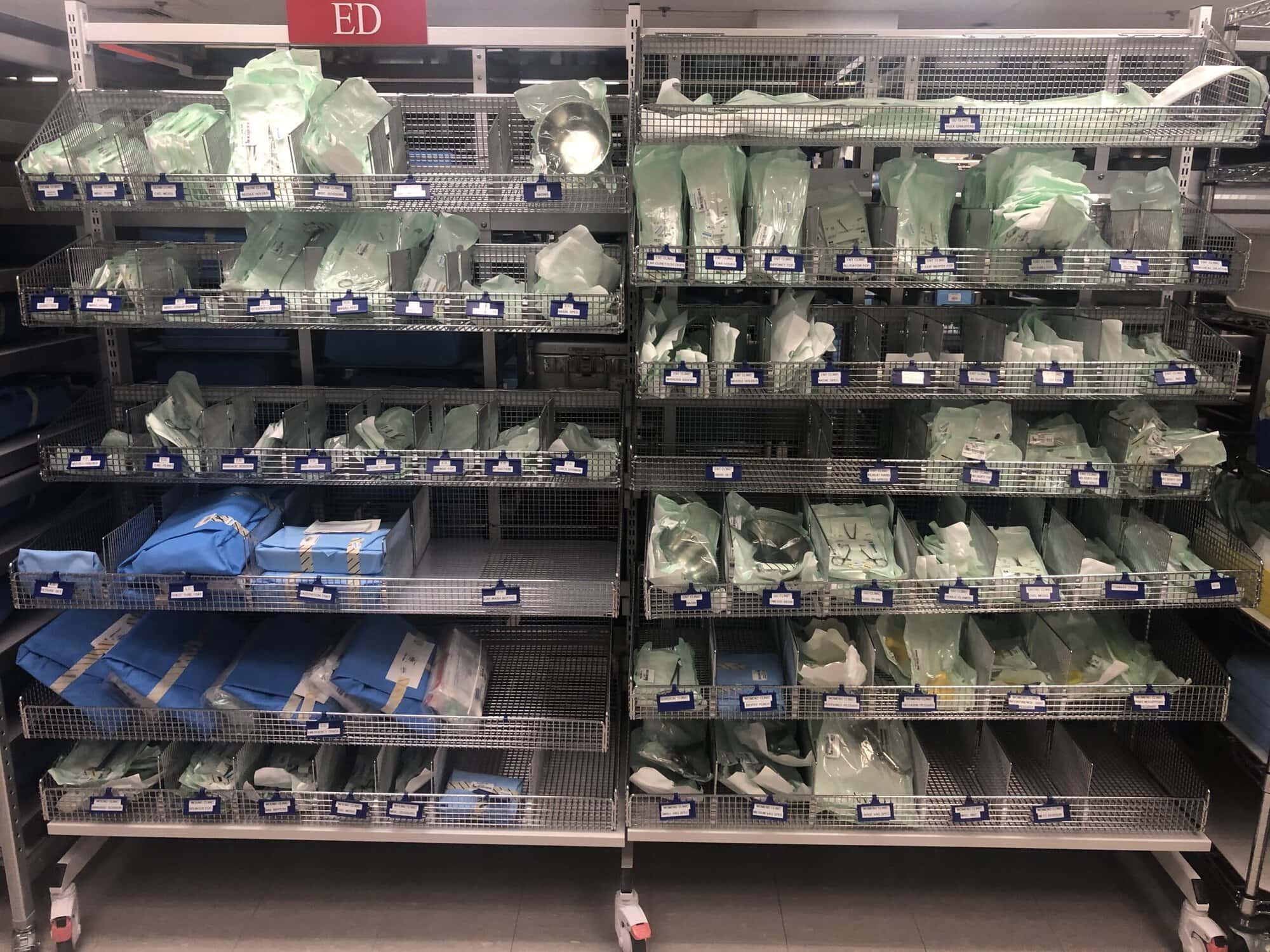
Chrome wire shelving consists of open metal wire grids that allow airflow and accommodate bins or baskets. The exposed wire geometry typically features chrome plating or a similar metal coating for corrosion resistance. This design provides low upfront cost, flexible configuration, and fast reconfiguration when departmental needs change.
However, chrome wire surfaces can snag sterile wraps during placement or retrieval, creating package integrity concerns. The open construction offers weaker protection for delicately wrapped packages, particularly when wire shelvings support stacked items that compress lower trays.
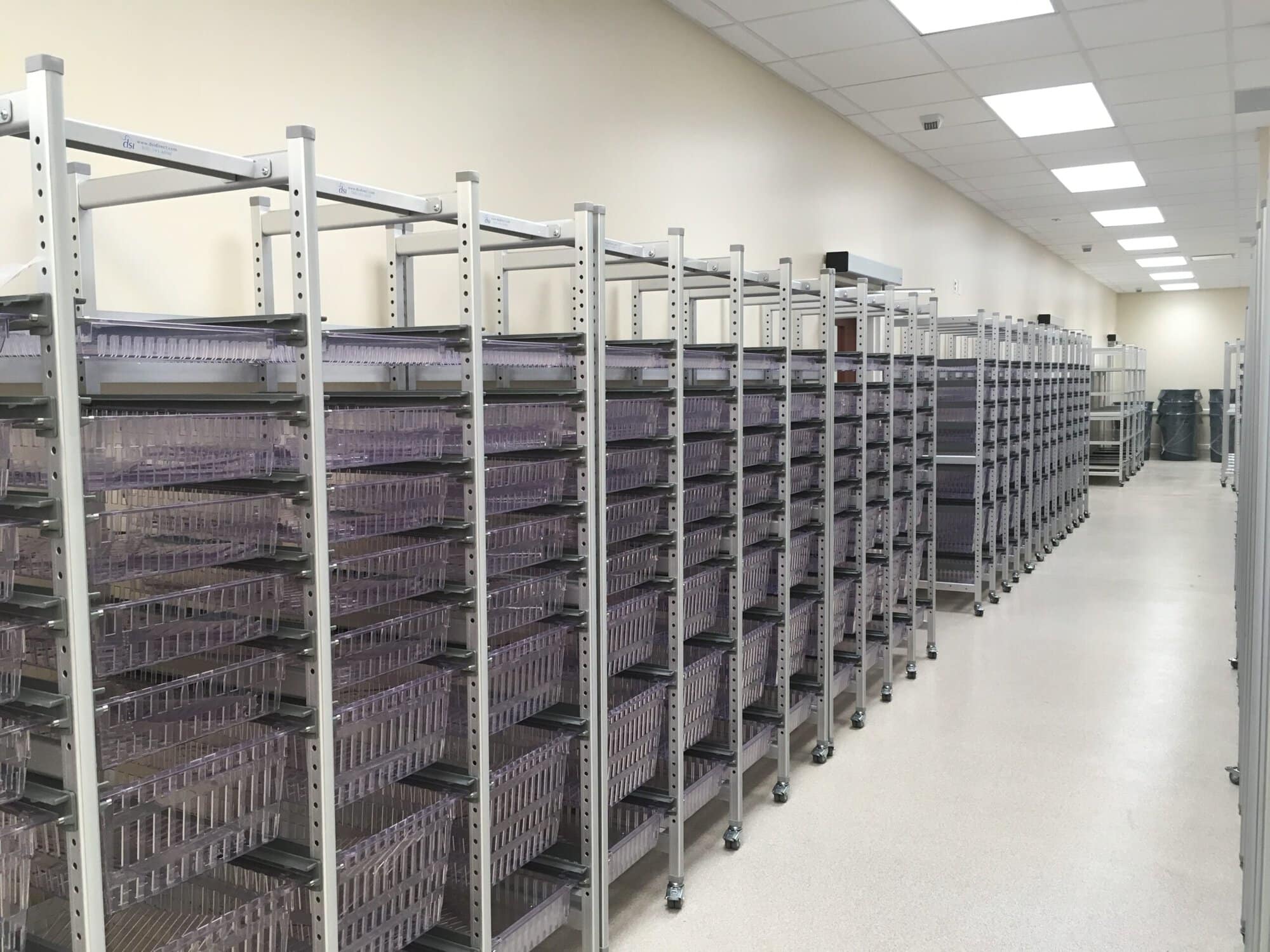
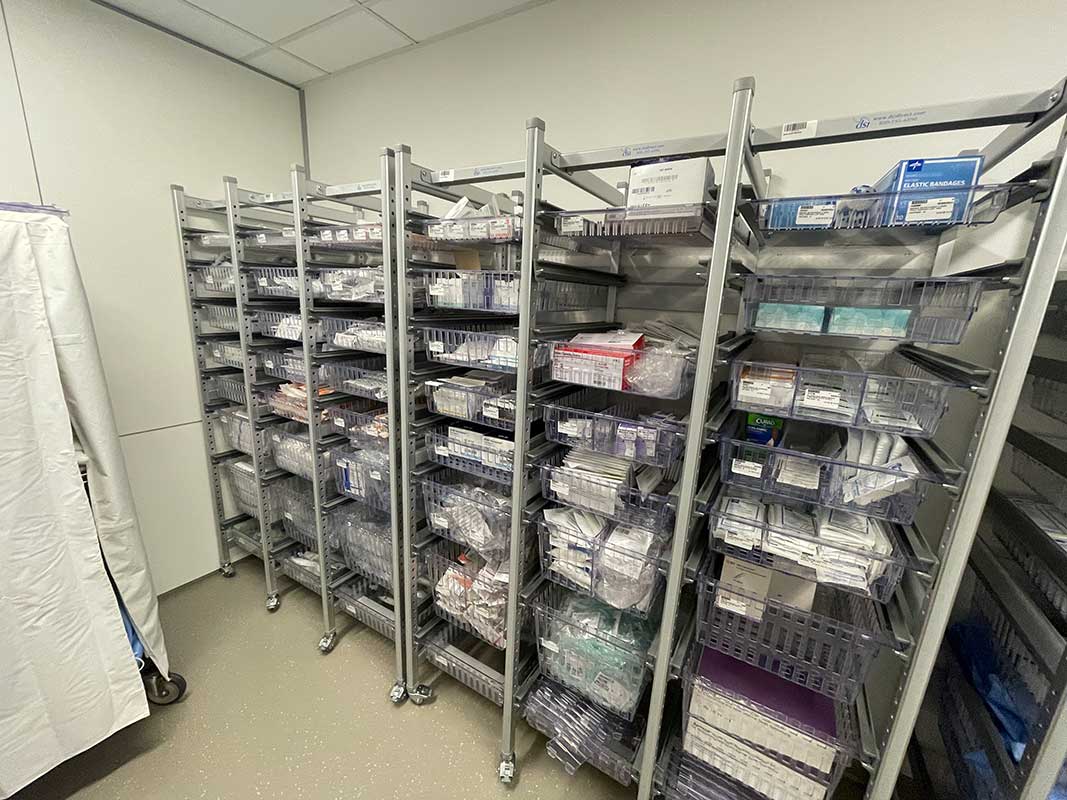
SterileShelf and similar SPD-specific modular tray storage use dedicated slots, pull-out drawers, and blue-wrap protection features. These systems employ anodized aluminum frames combined with powder-coated solid galvanized tray surfaces to minimize snag points. The design reduces stacking by providing individual compartments for wrapped sets, improving access ergonomics, and protecting packages from compression damage.
Space savings of 30–40% are achievable compared to traditional open shelving when vertical organization replaces stacked storage. Pull-out access reduces touch points and handling motions required to retrieve instruments.
Chrome wire shelving manufacturing emphasizes cost efficiency through standardized wire-forming processes and modular post assemblies. Wire grids attach to adjustable posts using clips or sleeves, enabling height changes without tools. Volume production keeps unit costs low, making wire shelving accessible for budget-conscious facilities.
SterileShelf construction uses welded aluminum frames and individually powder-coated steel tray surfaces engineered for long service life. Heavy-duty glides enable smooth drawer operation under repeated daily use, while solid surfaces eliminate wire-grid geometry that can catch blue wrap or peel labels.
Total cost of ownership extends analysis beyond purchase price to capture maintenance labor, replacement frequency, and compliance risk. Sterile processing departments operate under regulatory scrutiny where storage-related packaging damage creates reprocessing costs and potential patient safety exposure. Evaluating lifecycle economics prevents decisions based solely on initial capital outlay that ignore predictable downstream expenses.
Storage systems requiring frequent replacement or generating high maintenance burdens shift costs from capital budgets to operational expenses. These ongoing costs accumulate over the years and often exceed initial savings from lower purchase prices.
Chrome wire systems generate approximately $850 in annual maintenance, cleaning, and repair expenses per unit. Surface corrosion, bent wires, and damaged plating require periodic replacement of shelves or entire units. Cleaning labor increases when wire grids accumulate visible contamination or when environmental inspections identify cosmetic deficiencies requiring attention.
SterileShelf systems require approximately $150 in annual maintenance burden due to smooth surfaces and durable construction. Powder-coated finishes resist scratching and maintain appearance with routine cleaning protocols, reducing touch-up or replacement frequency.
Chrome wire shelving typically delivers 3–5 years of service life before corrosion or structural wear necessitates replacement. Frequent replacement cycles multiply capital expenditures over a decade and create recurring installation labor and workflow disruption. Facilities purchasing wire shelving for budget analysis reasons often replace units two or three times during the service life of premium alternatives.
SterileShelf systems claim 15+ years of service life based on construction materials and design durability. Extended replacement intervals reduce capital churn and minimize operational disruptions from equipment swaps. The difference between replacing a system twice versus not replacing it at all substantially alters decade-level budget analysis.
Compliance failures related to packaging damage, environmental contamination, or storage conditions create reprocessing costs and inspection citations. Wire surfaces that snag blue wrap or storage methods that compress packages increase the risk of barrier breaches. These failures require instruments to be rewrapped and resterilized, consuming labor and extending instrument unavailability.
Inspection deficiencies tied to storage conditions can delay accreditation or trigger corrective action requirements. Facilities facing compliance citations often implement emergency upgrades at higher costs and shorter timelines than planned capital projects.
Cost and performance comparisons require examining upfront acquisition, annual operating expenses, and longevity differences together. Chrome wire systems offer lower entry costs but higher ongoing maintenance and shorter service lives. SterileShelf systems require greater initial investment but demonstrate lower operating costs and extended replacement intervals, creating economic crossover points within multi-year planning horizons.
Performance metrics include packaging damage rates, retrieval efficiency, cleanability, and space utilization. Systems that reduce handling steps, prevent wrap snags, and optimize vertical space improve workflow productivity.
Chrome wire shelving costs roughly $14,500 per unit over ten years when acquisition, maintenance, and replacement expenses are combined. Upfront purchase prices remain low, but repeated replacement cycles and annual maintenance burdens accumulate substantially. Budget analysis must account for these recurring costs rather than treating the purchase price as the total expense.
SterileShelf costs $8,500 over ten years based on vendor-published total cost of ownership comparisons. This represents a claimed 41% lower total cost of ownership and approximately $6,000 lower decade cost per unit.
Durability differences stem from material selection and construction methods rather than surface appearance or marketing claims. Chrome plating on wire shelving eventually corrodes in sterile processing environments where humidity and frequent cleaning create harsh conditions. Wire grids bend under heavy loads or impact, requiring shelf replacement even when posts remain serviceable.
Anodized aluminum frames and powder-coated steel surfaces resist corrosion and maintain structural integrity under daily use. Heavy-duty drawer glides and solid construction methods extend functional life beyond typical capital equipment depreciation periods.
Stacked blue wrap or compressed trays cause tears, punctures, and handling damage that compromise package integrity. Wire shelving can snag sterile packs or sealed supplies during placement and retrieval, creating barrier breaches. These failures necessitate reprocessing and extend instrument turnaround time, affecting OR readiness and procedure scheduling.
Multiple handling before use increases contamination risk and creates additional touch points where packaging damage may occur. Dedicated slots and pull-out access reduce the number of handling motions required to retrieve specific instrument sets.
Compliance challenges stem from CDC guidelines, AAMI ST79 requirements, and accreditation survey standards that govern sterile storage environments. Facilities must maintain temperature and humidity within specified ranges while controlling traffic and minimizing contamination risks. Storage systems affect compliance through their impact on package integrity, cleanability, environmental control, and handling discipline.
Survey deficiencies related to storage often reveal systemic problems rather than isolated equipment failures. Addressing these challenges requires integrated solutions that combine appropriate infrastructure with operational discipline and leadership accountability.
Sterile storage humidity should not exceed 70% according to CDC environmental control guidance. Temperature may be as high as 75°F, but consistent monitoring and documentation are required. Storage and transport practices must preserve package integrity per AAMI ST79, which specifically warns that stacking should be avoided unless supported by packaging instructions for use.
These requirements favor storage systems that minimize stacking, reduce handling, and support environmental monitoring. Smooth surfaces facilitate cleaning and inspection, while dedicated compartments eliminate the need to stack wrapped sets. Facilities using track systems or high-density configurations can often meet space requirements while maintaining IFU-compliant storage methods.
A 2024 VA OIG case study documented sterile processing deficiencies, including environmental contamination and procedural failures. An unused endoscope returned to sterile storage after potential environmental exposure demonstrated inadequate handling protocols. Staff eating, drinking, or storing food in sterile storage areas created direct contamination risks that persisted despite repeated citations between 2019 and 2021 without effective closure.
These violations highlight how storage infrastructure alone cannot ensure compliance without operational discipline. Traffic control failures, weak oversight, and absent standard operating procedures undermine even properly designed storage environments.
Excess traffic in sterile storage creates environmental contamination risk by increasing air movement and particulate introduction. Air movement, traffic, location, humidity, and storage space affect sterility maintenance according to CDC guidance. Open shelving versus closed systems influences environmental exposure, with enclosed storage providing additional protection in high-traffic areas.
Facilities should limit sterile storage access to authorized personnel and minimize unnecessary movement through sterile areas. Using plastic bins or enclosed containers adds secondary protection for items subject to extended storage or multiple handling events before use.
Facility demography influences storage adoption through patient volume concentration, procedural infrastructure availability, and geographic market characteristics. Urban facilities with high surgical throughput face different space and efficiency pressures than rural hospitals with lower volumes. Age demographics affect procedure rates, which drive sterile processing workload and storage capacity requirements.
Premium storage system adoption concentrates in metropolitan markets where procedural volumes, space constraints, and competitive pressures justify capital investment. Rural facilities face budget constraints and infrastructure gaps that often favor lower-cost solutions.
More than 90% of ASCs are in urban areas where patient volume and procedural complexity support investment in specialized infrastructure. Nearly 90% of major ambulatory surgery encounters occurred in facilities owned by urban hospitals. High throughput creates space pressure, and efficiency demands that premium storage systems address through density optimization and workflow improvement.
Urban facilities also face stricter competitive environments where operational efficiency directly affects financial performance. Space constraints in expensive metropolitan real estate make vertical storage and high-density solutions particularly attractive.
Ambulatory surgery rates reach 72.3 to 75.6 per 1,000 population among adults aged 65 and older. Older patient populations consume disproportionately high procedural volumes compared to younger demographics. This creates sustained demand for sterile instruments and drives storage system capacity requirements in regions with aging populations.
Facilities serving older populations must maintain larger instrument inventories and faster turnover cycles to support procedural scheduling. Age-driven demand growth explains why facilities in retirement-heavy regions often prioritize storage upgrades despite budget constraints.
Rural counties were 5.32 times more likely to lack both ASCs and hospital outpatient departments compared to urban areas. Infrastructure gaps limit procedural volume and reduce the economic justification for premium storage investments. Rural facilities often operate with constrained budgets and lower case volumes that favor simpler, less expensive storage solutions.
Limited access to capital and smaller staff sizes create additional barriers to complex system implementation. These structural constraints explain why premium system adoption concentrates in metropolitan and academic medical centers.
Buyer priorities center on cost efficiency, operational reliability, and workflow productivity. Hospital purchasing surveys show that 78% of leaders prioritize cost efficiency as their top concern. Supplier reliability ranks second at 76%, while operational efficiency appears at 75%, demonstrating that buyers seek proven solutions rather than experimental innovations.
These priorities reflect operational pressures from rising costs, demand unpredictability, and compliance complexity. Buyers evaluate storage systems through the lens of quantifiable returns rather than theoretical benefits.
Cost efficiency priority at 78% of hospital purchasing leaders, reflecting budget pressures and administrative scrutiny of capital expenditures. Buyers require clear documentation of lifecycle costs, replacement intervals, and maintenance requirements. Supplier reliability at 76% indicates that consistent product availability and responsive service matter nearly as much as initial price.
Reliability encompasses both product durability and vendor responsiveness when problems arise. Facilities cannot afford storage failures that disrupt sterile processing workflows or create compliance exposure.
Operational efficiency rated at 75% encompasses workflow productivity, space utilization, and labor requirements. Efficient storage systems reduce time spent locating instruments, minimize unnecessary handling, and optimize vertical space utilization. These improvements directly affect staff productivity and departmental throughput.
Ease of cleaning relates to both labor efficiency and compliance risk management. Smooth surfaces require less cleaning time than complex wire geometries while maintaining appearance under frequent use. Systems incorporating stainless steel products offer superior cleanability and corrosion resistance, reducing long-term maintenance burdens and supporting infection control protocols.
Space optimization becomes critical when facilities face capacity constraints without expansion budgets. Vertical storage and high-density configurations can increase capacity by 30–40% within existing footprints. This capability defers expensive renovation projects while accommodating procedural volume growth.
Facilities evaluating space optimization should assess current utilization patterns and identify wasted vertical space. Comprehensive solutions that integrate storage design with workflow analysis deliver better results than equipment purchases without operational planning.
Alternative storage categories include polymer shelving, enclosed medical cabinets, and high-density mobile systems. Each category addresses specific operational priorities such as cleanability, security, or space maximization. Understanding these alternatives helps facilities match storage solutions to actual requirements.
Market diversification reflects varying facility needs and budget constraints across healthcare segments. Buyers should evaluate multiple categories against documented needs rather than restricting analysis to familiar product types.
Polymer shelving features smooth shelf mats, rust resistance, easy cleaning, and mobile cart options. Advanced polymer shelf mats and posts provide removable components and rust-proof surfaces at moderate cost. Basic wire shelving kits range from $599–$629, while polymer shelving starts from $519 for basic configurations.
Enclosed medical storage cabinets incorporate doors, locks, trays, baskets, and modular inserts for dense organization. Premium triple-column examples reach approximately $14,440.95, targeting facilities requiring controlled access and high-value inventory protection.
High-density mobile and track shelving use mobile carriages on the floor or overhead track to maximize storage density. These systems can double or triple capacity per square foot compared to static shelving. Public pricing examples range from $937.80–$2,482.00 before customization.
Mobile systems excel where floor space limitations prevent capacity expansion through conventional means. Facilities considering Modu-Stor CTS-HD or similar high-density configurations should conduct workflow simulations to validate that density gains do not compromise retrieval efficiency during peak periods.
Metro generally does not recommend open wire shelving for wrapped instrument packs due to snag risk. However, wire remains popular in lower-risk supply settings because of flexibility, airflow, adjustability, and bin compatibility. General clean supply areas, central supply receiving, and non-sterile storage applications often benefit from the wire's economy and reconfigurability.
Wire shelving makes sense when budget constraints preclude premium alternatives and stored items tolerate open-grid surfaces. Facilities should segment storage by risk level rather than applying uniform solutions across all areas.
Comprehensive evaluation requires balancing the total cost of ownership, compliance requirements, and operational workflow impact. The $6,000 per-unit decade cost difference between chrome wire and SterileShelf reflects durability, maintenance, and damage prevention rather than initial price alone. Facilities must assess whether premium system benefits justify a higher upfront investment based on volume, space constraints, and compliance exposure.
Operational context determines optimal storage selection more than generic product specifications. High-volume urban facilities with space constraints realize greater value from premium systems than low-volume rural sites. Budget analysis should incorporate packaging damage costs, reprocessing labor, and potential compliance citations rather than focusing exclusively on capital expenditure.
Decision frameworks should evaluate current failure modes, including wrap damage, stacking violations, retrieval inefficiency, and environmental control gaps. Storage upgrades address these problems most effectively when combined with updated standard operating procedures, staff competency verification, and environmental monitoring protocols. Leadership commitment to operational discipline matters as much as equipment selection in achieving sustainable compliance improvement.
Distribution Systems International supports healthcare facilities in optimizing sterile processing infrastructure through comprehensive consultation and turnkey implementation. Our team conducts a complimentary on-site storage analysis and workflow assessment to identify improvement opportunities. Established in 1990, we specialize in acute care facilities requiring measurable ROI and proven LEAN methodology application.
Chrome wire shelving costs $6,000 more per unit over ten years than SterileShelf — and that's before accounting for compliance risk, reprocessing labor, and packaging damage. Distribution Systems International provides a complimentary on-site storage analysis that calculates your facility's actual cost exposure and projects your return on investment before any purchase decision is made. Contact Distribution Systems International today to schedule your free SPD storage consultation.

With 21 years of sales management, marketing, P&L responsibility, business development, national account, and channel management responsibilities under his belt, Ian has established himself as a high achiever across multiple business functions. Ian was part of a small team who started a new business unit for Stanley Black & Decker in Asia from Y10’ to Y14’. He lived in Shanghai, China for two years, then continued to commercialize and scale the business throughout the Asia Pacific and Middle East regions for another two years (4 years of International experience). Ian played college football at the University of Colorado from 96’ to 00’. His core skills sets include; drive, strong work ethic, team player, a builder mentality with high energy, motivator with the passion, purpose, and a track record to prove it.