Hospitals face mounting pressure to store more supplies without expanding their physical footprint. Choosing high-density storage systems that align with clinical workflows and regulatory requirements determines whether facilities achieve measurable efficiency gains or simply add shelves. Healthcare storage selection requires balancing space recovery, staff access speed, infection control standards, and total cost of ownership across departments from central supply to operating rooms.
The global shelving units and shelves market reached USD 26.03 billion in 2024 and is projected to grow to USD 41.07 billion by 2035. Healthcare represents one of the fastest-growing segments because hospitals are replacing passive storage with systems that support LEAN inventory management, faster case turnover, and better sterile processing workflows. This guide explains how to evaluate high-density storage options and select systems that deliver quantifiable returns.
High-density storage systems compress inventory into smaller footprints by eliminating unnecessary aisles, exploiting vertical height, or integrating mobility and automation. Three primary categories dominate healthcare: mobile shelving that condenses horizontal space, vertical lift modules that use building height, and specialized carts and cabinetry designed for clinical workflows.
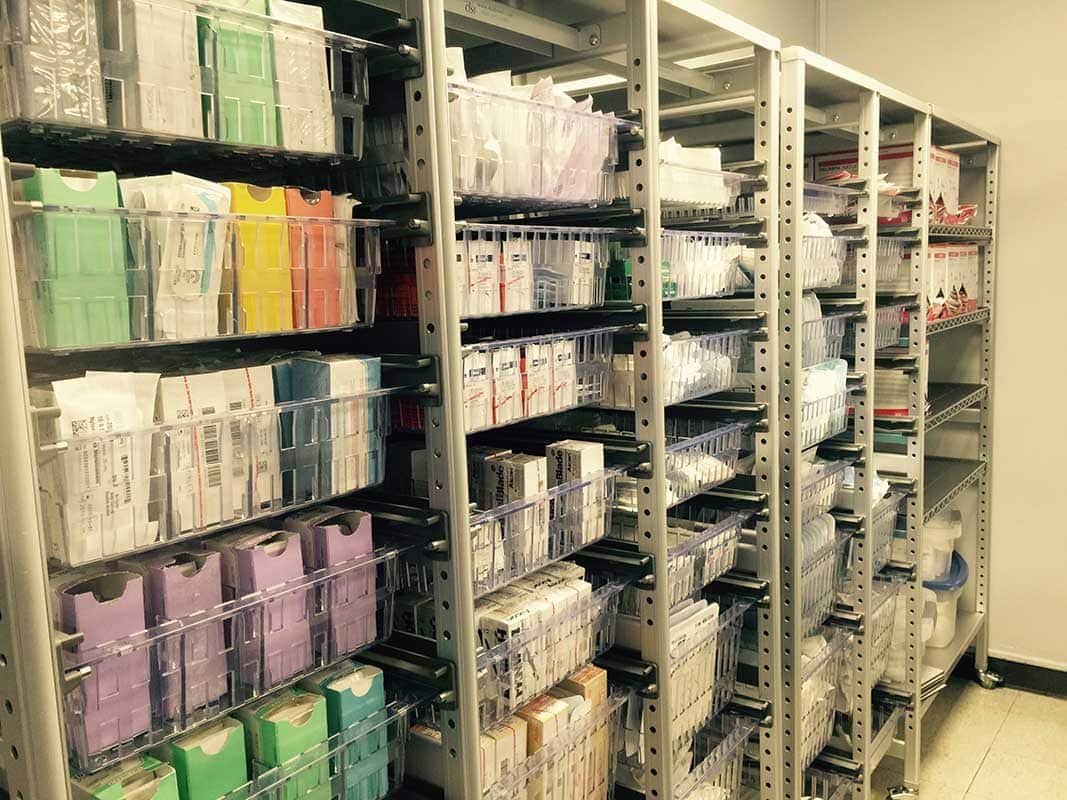
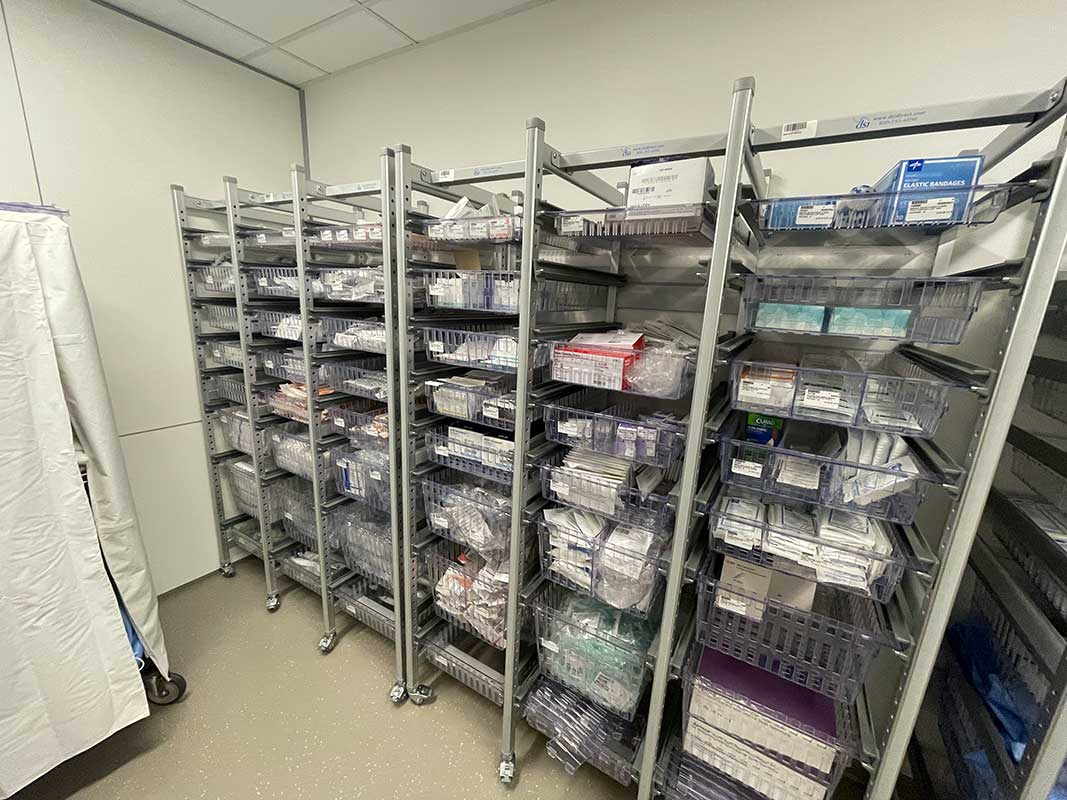
Mobile shelving systems mount shelves on wheeled carriages that travel along floor tracks, allowing users to compress multiple aisles into a single access point. Hand-crank or powered movement enables staff to open only the needed aisles while keeping others closed. Lockable bays provide security for controlled substances and high-value inventory while eliminating wasted floor area.
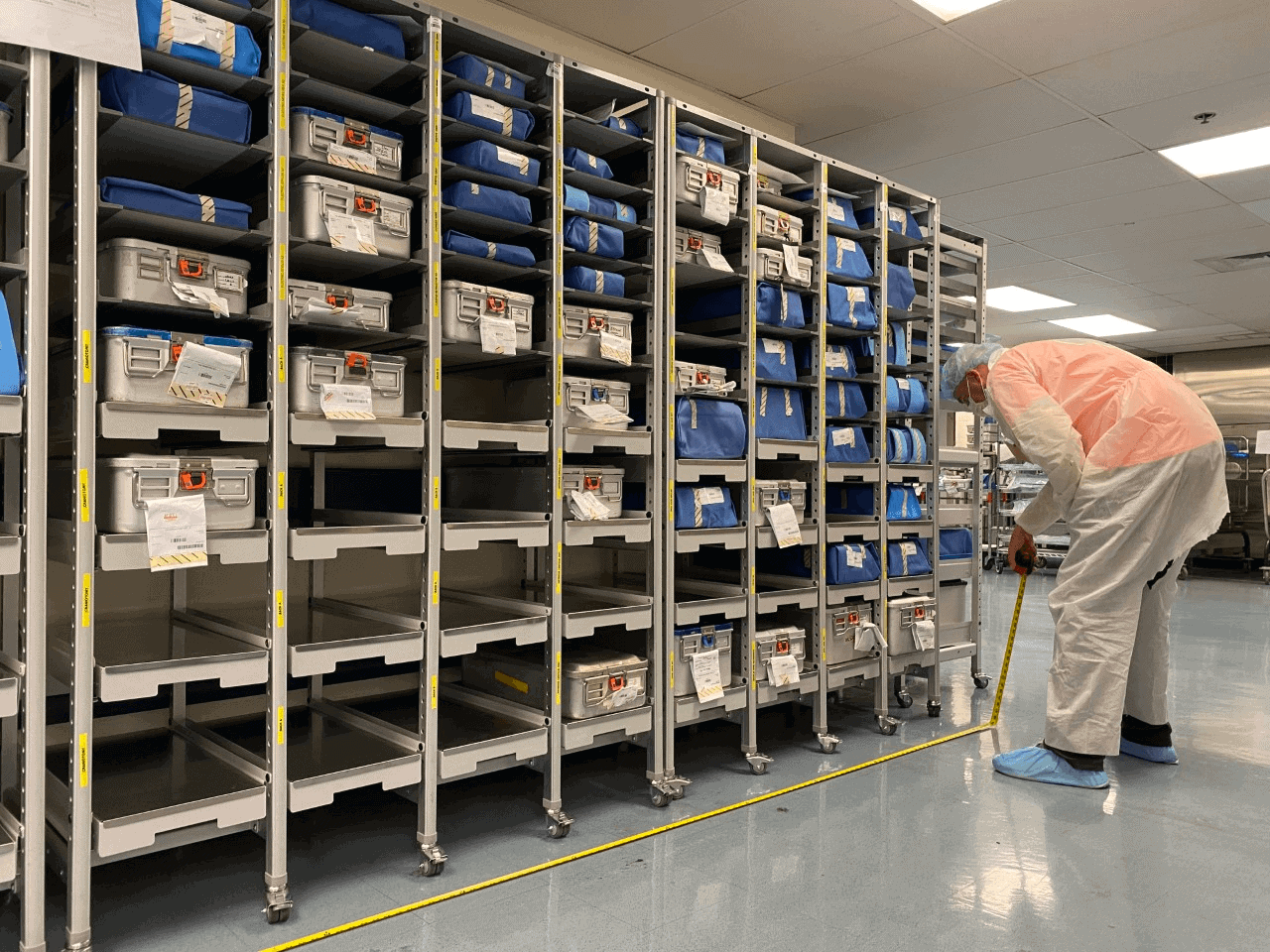
The high-density mobile shelving market was valued at USD 1.89 billion in 2026 and is forecast to reach USD 3.78 billion by 2035 at an 8.0% CAGR. Budget mobile wire shelvings units start around $220 to $465, mid-range systems range from $553 to $3,000, and premium installations exceed $25,000. Morristown Medical Center installed a high-density mobile system that holds 40% more inventory than its previous arrangement while supporting 100 surgical cases per day.
Vertical lift modules enclose automated trays inside a tower structure and use software-controlled extractors to deliver requested items to an ergonomic access window. These systems optimize unused ceiling height rather than floor area, making them ideal for high ceilings and limited square footage. Operators input requests through a touchscreen, and the VLM retrieves the correct tray in seconds.
The vertical lift module market reached USD 1.56 billion in 2023 and is expected to grow to USD 2.78 billion by 2030 at a 9.1% CAGR. Used VLMs cost $35,000 to $75,000, new systems range from $75,000 to $140,000, and premium configurations exceed $250,000. Single-level delivery systems held 63.4% of the market share in 2023, while non-refrigerated systems accounted for 56.1%.
Medical carts feature casters, lockable drawers, wipe-clean surfaces, and optional computing integration to bring supplies directly to patient care areas. MRI-safe variants use non-ferrous materials, while modular bin systems allow nurses to customize drawer configurations for specific procedures. Medical carts eliminate trips to central supply and reduce staff search time at the point of care.
The medical carts market was valued at USD 2.60 billion in 2024 and is projected to reach USD 6.63 billion by 2030 at a 16.95% CAGR. Visible cart products range from $1,199 to $4,579, with premium specialized units exceeding $3,000. Mobile computing carts held 72.38% of market share in 2024, reflecting hospitals' emphasis on digital workflow integration.
Medical cabinetry includes operatory cabinets, sterilization casework, and secure storage units designed for department-specific workflows. Integrated counters and material-specific construction support infection control and regulatory compliance in sterile processing and OR environments. The medical cabinetry market reached USD 9.31 billion in 2022 and is expected to grow to USD 11.71 billion by 2027 at a 4.7% CAGR.
Space constraints, workflow bottlenecks, and compliance mandates drive hospitals to replace traditional shelving with high-density systems. Fixed shelving consumes excessive floor area with permanent aisles that remain empty most of the time. High-density alternatives compress inventory, reduce staff walking distances, and improve supply visibility.
Facilities that delay storage optimization face rising real estate costs, slower case turnover, and higher labor expenses. Early adopters recover floor space for clinical expansion, reduce expired product waste, and improve OR readiness.
Morristown Medical Center processes 100 surgical cases per day and is considering growth from 28 to 30 operating rooms. Its upgraded high-density system holds 40% more inventory than the legacy arrangement without expanding the central supply footprint. Improved organization reduced staff search time, and supported flexible tray configurations.
Hackensack University Medical Center improved retrieval times by installing a Storage Wall system that condensed back-room inventory into movable bays. Faster access eliminated delays during procedure setup and allowed technicians to focus on sterilization workflows instead of searching for supplies. Both case studies demonstrate that OR storage system evaluation must account for throughput, tray variability, and staff movement patterns.
Healthcare storage must meet infection control protocols, secure storage mandates for controlled substances, and sterile processing standards. Wipe-clean surfaces, lockable compartments, and material compatibility with disinfectants are non-negotiable in clinical environments. Stainless steel products resist corrosion and support rigorous cleaning schedules required in operating rooms and sterile core areas.
Cabinetry in sterile processing departments must segregate contaminated instruments from clean inventory and support one-way workflows that prevent cross-contamination. Specialized scope cabinets provide drying channels and secure hanging systems that comply with manufacturer guidelines for flexible endoscope storage.
Hospitals operate in fixed building footprints where expansion is prohibitively expensive or physically impossible. High-density storage recovers floor area by eliminating redundant aisles or exploiting vertical height, allowing facilities to defer construction projects. Mobile shelving and vertical lift modules convert underutilized storage rooms into high-capacity inventory hubs.
Facilities facing space constraints must compare the cost of high-density systems against the cost of leasing off-site storage or building new square footage. In urban markets where real estate costs are high, ROI for mobile shelving or VLMs typically occurs within two to four years.
Mobile versus static shelving decisions hinge on floor area constraints, budget limits, and workflow priorities. Static shelving uses fixed uprights and adjustable shelves with open-wire or pallet-rack layouts that require permanent aisles. Mobile shelving mounts those same shelves on wheeled carriages that travel along track systems, allowing users to compress multiple aisles into a single access point.
Vertical lift modules replace horizontal shelving entirely by storing trays in an enclosed tower structure. Automation adds cost but eliminates manual searching and reduces retrieval errors.
Static warehouse racking features fixed uprights and shelves with adjustable heights and no floor tracks. Open-wire or pallet-rack layouts provide universal compatibility with bins, trays, and bulk supplies. Fixed shelving wins on purchase price and simplicity, but consumes more floor area.
Mobile systems compress horizontal aisles by eliminating fixed access lanes, while vertical systems exploit unused building height. Mobile shelving performs best in lower-ceiling or retrofit spaces where floor area is expensive. VLMs perform best with high ceilings, software readiness, and inventory discipline.
Static warehouse racking reached USD 9.71 billion in 2024 and is expected to grow to USD 12.41 billion by 2030 at a 4.2% CAGR. Budget wire shelving costs $81 to $500, mid-range systems run $500 to $1,500, and premium heavy-duty units move into the low thousands.
Mobile shelving requires higher installation costs than fixed shelves due to track and floor preparation requirements. Track systems must be anchored to reinforced concrete slabs capable of supporting concentrated loads. Slower simultaneous access limits mobile shelving where multiple staff members need concurrent access to different aisles.
Automation transforms storage from a passive inventory holder into an active workflow tool that tracks usage, reduces errors, and improves ergonomics. Vertical lift modules use software-controlled extractors that deliver requested trays to an ergonomic access window without requiring staff to climb ladders or search shelves. Automated systems log every retrieval transaction, enabling inventory tracking and reorder triggers.
Powered mobile shelving uses electric motors instead of hand cranks to move carriage bays. Software integration allows VLMs to connect with hospital enterprise resource planning systems for real-time inventory management. Automation increases capital cost but reduces labor expenses and improves accuracy in high-throughput departments.
Budget mobile wire units cost $220 to $465, mid-range systems range from $553 to $3,000, and premium installations exceed $25,000. Used VLMs cost $35,000 to $75,000, new systems range from $75,000 to $140,000, and premium configurations frequently exceed $140,000 and can approach $250,000. Medical cart pricing spans $1,199 to $4,579 for visible products, with premium specialized carts trending above $3,000.
Fixed wire shelving provides the lowest entry cost at $81 to $500 for budget units. The large price jump to VLMs reflects enclosed tower construction, automation components, and software integration requirements. Facilities must compare purchase cost against floor space recovery, labor savings, and avoided expansion expenses to calculate the true total cost of ownership.
Hospital directors must rank competing priorities before comparing storage technologies. The five most important decision criteria are space efficiency, retrieval speed, flexibility, total cost of ownership, and compliance with safety and hygiene standards. Each criterion carries a different weight depending on department needs and facility constraints.
Facilities that prioritize density over access speed favor mobile shelving or VLMs. Departments that prioritize speed and simultaneous access favor static shelving or medical carts.
Buyers must determine how much density improvement justifies slower or restricted access. Mobile shelving eliminates fixed aisles but requires staff to open and close bays, adding seconds to each retrieval. VLMs deliver exceptional density but restrict access to one user at a time per tower.
Facilities must assess how quickly supplies must be retrieved during normal operations versus emergency scenarios. Central supply departments processing scheduled surgical cases tolerate slightly longer retrieval times for greater inventory capacity. OR satellite storage requires instant access to emergency supplies, making mobile carts and open shelving more appropriate than automated towers.
Healthcare workflows change as case volumes grow, new procedures launch, and sterile processing standards evolve. Storage systems that accommodate changing tray sizes, stackability requirements, and supply packaging reduce costly renovations. Morristown Medical Center required a system flexible enough to adapt to changing surgical instrument configurations without rebuilding the central supply.
Modular shelving with adjustable heights and removable dividers supports reconfiguration without replacing entire units. Modu-Stor CTS-HD systems provide tool-free shelf adjustment and interchangeable accessories that adapt to evolving department needs.
Infection-control protocols, secure storage mandates, and sterile processing standards eliminate certain system types from consideration in regulated departments. Wipe-clean polymer materials and sealed drawer systems prevent contamination in clinical environments. Lockable compartments secure controlled substances and high-value inventory while maintaining audit trails.
Ergonomic access windows in VLMs reduce injury risk by eliminating ladder climbing and overhead reaching. Automated retrieval systems reduce human error in pharmacy and central supply, where accuracy directly affects patient safety.
Different hospital departments require different storage architectures based on throughput rates, staff access patterns, and inventory characteristics. Central supply and sterile processing benefit from high-density systems that maximize floor space and support batch workflows. Point-of-care areas benefit from mobile carts that bring supplies to patients and reduce nursing travel time.
Central supply departments process large volumes of surgical trays and medical devices in batch workflows that tolerate slightly longer retrieval times. High-density mobile shelving or vertical lift modules maximize inventory capacity while maintaining organized storage for kits, implants, and instrumentation. Automated systems reduce search time and support inventory tracking requirements.
Sterile processing departments require segregated storage zones for contaminated instruments, clean supplies, and sterile case carts. Cabinetry with integrated counters supports one-way workflows that prevent cross-contamination between decontamination and sterile packing areas. Material-specific construction using stainless steel or wipe-clean polymer surfaces meets infection control standards.
Nursing units and procedure rooms require immediate access to frequently used supplies without sending staff to central storage. Medical carts with lockable drawers and modular bins bring medications, wound care supplies, and IV materials directly to patient bedsides. Mobile computing carts integrate digital charting with supply management at the point of care.
Point-of-care storage prioritizes mobility and accessibility over maximum density. Carts must maneuver through corridors and fit into crowded patient rooms without blocking workflows.
High-volume surgical centers processing 100 or more cases per day require storage systems that support rapid tray turnover and accommodate varying instrument configurations. Morristown Medical Center needed flexible storage that adapted to changing surgical packaging and stackability requirements as case volumes grew.
Facilities with highly standardized procedures benefit from automated retrieval systems that enforce first-in-first-out rotation and reduce picking errors. Departments with variable case mixes require modular shelving that accommodates different tray dimensions without wasting vertical space.
System selection represents only the first phase of achieving measurable storage improvements. Installation quality, software integration, and total cost of ownership calculations determine whether facilities achieve projected returns.
Successful implementations address floor load capacity, electrical requirements, staff training, and inventory transfer logistics before installation begins.
Mobile shelving requires floor track installation and structural reinforcement to support concentrated loads from compressed inventory bays. Track and floor preparation add installation cost compared to fixed shelves that simply anchor to walls. Facilities with aging infrastructure may require additional engineering evaluations.
Vertical lift modules require adequate ceiling height, electrical capacity for automation components, and climate control to protect sensitive inventory. Narrow doorways and elevator weight limits complicate tower delivery and installation.
VLMs deliver maximum value when integrated with hospital enterprise resource planning systems for real-time inventory tracking. Software links enable automatic reorder triggers, usage reporting, and audit trails that support compliance requirements.
Mobile shelving automation using powered carriage movement improves ergonomics but adds electrical requirements and maintenance complexity. Manual systems remain viable when budgets or technical capabilities limit automation investments.
Purchase price represents only one component of the total cost of ownership. Floor space recovery, labor savings, reduced product expiration, and avoided expansion expenses often exceed initial system costs within three to five years. Facilities should calculate the cost per square foot of recovered floor area and compare that figure to local real estate costs.
Quantifiable returns include reduced staff search time, improved inventory accuracy, and faster case turnover in operating rooms. Morristown Medical Center justified its high-density investment by demonstrating that 40% additional inventory capacity supported OR expansion without constructing new square footage. Buyers should demand vendor-supported ROI projections based on facility-specific workflows before finalizing solutions.
Storage demand patterns vary by age group, geographic location, and market maturity. Understanding these trends helps healthcare facilities anticipate future needs and select systems with appropriate capacity and flexibility.
Gen X respondents reported 54% self-storage usage or intent, followed by Boomers at 51% and Millennials at 40%. Adults aged 24 to 39 account for about 25% of current storage users. Almost 24% of Millennials not currently renting storage are expected to do so later.
These demographic patterns suggest that younger hospital administrators may prioritize mobile and modular storage solutions that support flexible workflows.
Texas, Nevada, and Florida cities showed strong storage search intensity, reflecting population growth and real estate pressure in urban markets. Northeast operators reported that 87.8% expected long-term storage demand to remain stable or increase. Southeast and West Coast markets cited economic concerns but maintained strong baseline demand.
Urban hospitals face higher real estate costs that justify premium investments in high-density systems. Rural facilities benefit from lower construction costs but may still choose compact storage to preserve limited square footage for clinical expansion.
The global shelving units and shelves market reached USD 26.03 billion in 2024 and is growing to USD 41.07 billion by 2035 at a 4.23% CAGR. Medical cabinetry is expanding from USD 9.31 billion in 2022 to USD 11.71 billion by 2027 at 4.7% CAGR. U.S. self-storage inventory surpassed 2.1 billion square feet, and one in three Americans used self-storage.
These growth trends indicate sustained demand for space optimization across all sectors. Healthcare facilities should anticipate continued pressure to maximize storage density as supply inventories grow and building footprints remain fixed.
Healthcare facilities achieve the best storage outcomes when they align system capabilities with department workflows, compliance requirements, and long-term growth plans. Mobile shelving delivers the best balance between density improvement and affordability for central supply and back-room applications. Vertical lift modules provide maximum floor space recovery and automation benefits when ceiling height and IT infrastructure support their implementation.
Specialized medical carts and cabinetry serve distinct roles that high-density shelving cannot replace. Point-of-care carts bring supplies directly to patients and reduce nursing travel time. Sterile processing cabinetry supports infection control protocols and workflow segregation requirements that mobile shelving cannot address.
The most successful implementations begin with detailed workflow analysis rather than product selection. Facilities should map current case volumes, growth projections, staff movement patterns, and compliance requirements before evaluating system options. Total cost of ownership calculations must include floor space recovery, labor savings, and avoided expansion costs to justify premium system investments.
Distribution Systems International has specialized in healthcare storage optimization since 1990, helping acute care facilities nationwide implement LEAN inventory management and high-density storage systems. The company's consultative approach includes on-site workflow analysis, custom CAD drawings, and turnkey implementation that minimizes operational disruption.
Selecting the right high-density system shapes your facility's workflow, compliance posture, and capital plan for years. Distribution Systems International has helped acute care facilities make that choice since 1990, pairing LEAN inventory expertise with on-site analysis, custom CAD drawings, and full turnkey installation. Trust a partner that owns the project from assessment through after-sales support. Schedule your complimentary storage analysis and receive ROI projections built around your central supply, SPD, and OR workflows.

With 21 years of sales management, marketing, P&L responsibility, business development, national account, and channel management responsibilities under his belt, Ian has established himself as a high achiever across multiple business functions. Ian was part of a small team who started a new business unit for Stanley Black & Decker in Asia from Y10’ to Y14’. He lived in Shanghai, China for two years, then continued to commercialize and scale the business throughout the Asia Pacific and Middle East regions for another two years (4 years of International experience). Ian played college football at the University of Colorado from 96’ to 00’. His core skills sets include; drive, strong work ethic, team player, a builder mentality with high energy, motivator with the passion, purpose, and a track record to prove it.