Sterile processing storage decisions impact patient safety, regulatory compliance, and operational costs for years after installation. An SPD storage upgrade must address real failure modes in your current system while aligning with budget considerations and long-term efficiency goals. The questions to ask before purchasing should focus on lifecycle value, compliance risk reduction, and measurable workflow improvements rather than upfront price alone.
Most hospitals rely on manual inventory processes and face rising procedural volumes that strain existing storage capacity. The right storage solutions must protect sterile packages from contamination, support efficient retrieval workflows, and withstand the environmental demands of sterile processing environments. Decision-makers should evaluate storage options through a framework connecting physical design choices to compliance outcomes, total cost of ownership, and process efficiency gains.
SPD storage refers to physical systems used to organize, protect, and retrieve sterilized surgical instruments and supplies within sterile processing departments. These systems directly affect sterility maintenance, workflow efficiency, and compliance with infection control standards. Proper storage design prevents package damage, reduces contamination risk, and supports fast, accurate retrieval during high-volume procedural periods.
Storage failures create measurable consequences, including torn sterile wraps, stacking violations, and environmental exposure. Poor storage design contributes to excess handling, inefficient space use, and increased labor costs. The global sterile storage systems market reached USD 2.1 billion in 2024 and is projected to grow at 8.2% annually through 2033, reflecting rising demand for compliance-ready storage infrastructure.
Sterile processing storage serves three primary functions: protecting package integrity, organizing inventory for efficient retrieval, and maintaining controlled environmental conditions. Storage systems must prevent physical damage to sterile barriers while supporting workflow speed and accuracy. Additional functions include maximizing space utilization, enabling inventory visibility, and providing access controls where security matters.
Modern storage systems support compliance documentation by reducing stacking, limiting contamination exposure, and enabling environmental monitoring. Facilities handling higher case volumes require storage that scales without compromising retrieval times or operating room readiness, or sterility assurance.
Event-related contamination risks include air movement, traffic, location, humidity, storage space, open versus closed shelving, temperature, and wrapper properties. Each factor influences the likelihood that a sterile package will maintain its barrier integrity until use. CDC guidance emphasizes that sterile storage should be in a limited-access area with controlled temperature and humidity, with storage humidity not exceeding 70% and temperature reaching as high as 75°F.
Sterility maintenance covers (dust covers) are protective packaging that are not substitutes for sterile barrier systems. AAMI ST79 permits these covers when items face environmental challenges or multiple handling events, but they must only be applied when items are cool and dry. Poor storage design increases handling frequency, traffic exposure, and physical compression, all of which elevate contamination risk.
The sterile storage systems market includes open racks, closed cabinets, modular storage, and mobile storage, representing distinct approaches to balancing cost, protection, density, and workflow.
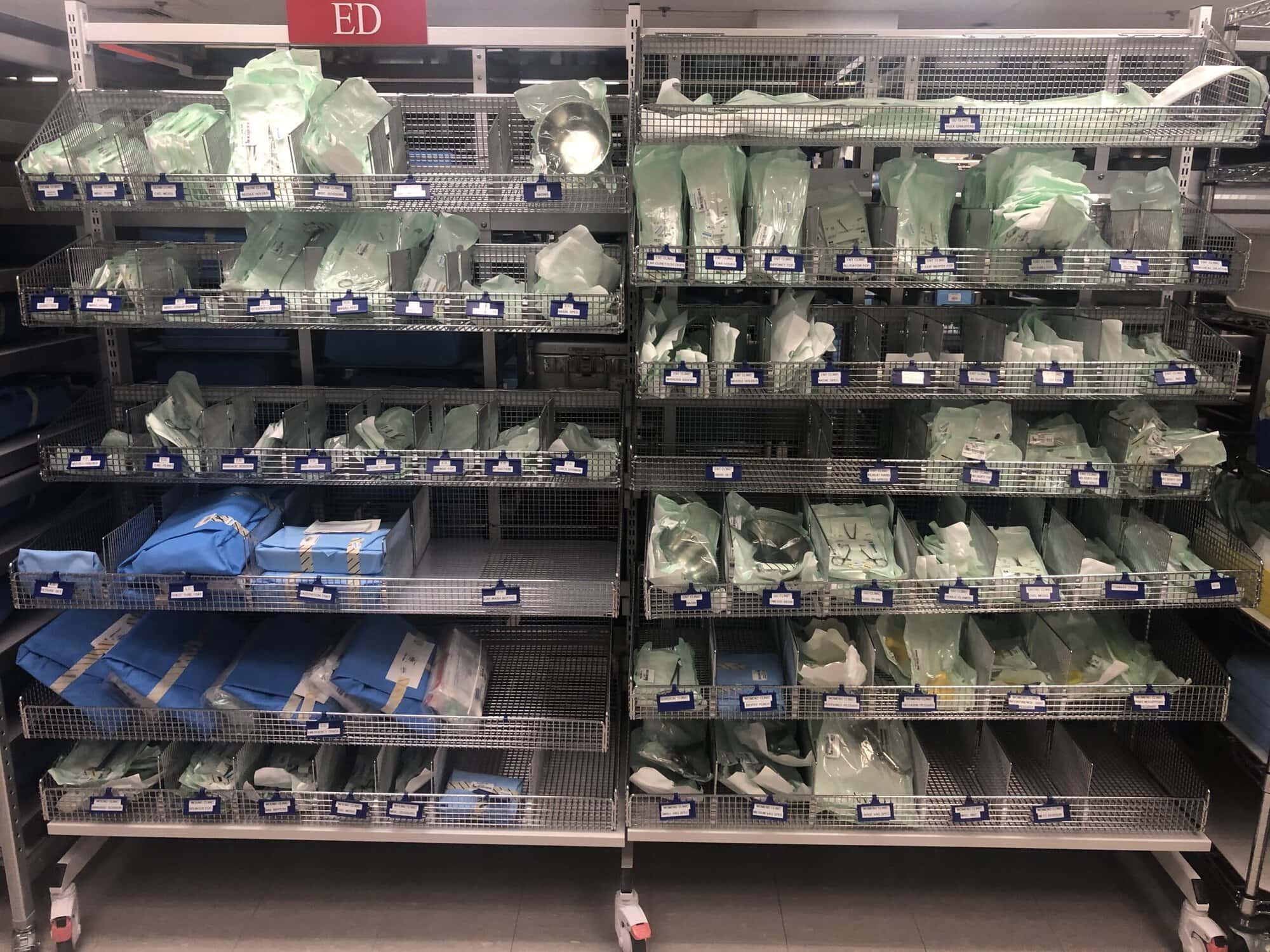
Chrome wire shelving dominates budget-conscious installations due to low acquisition cost and configurability. Polymer and SPD-specific modular tray systems provide smoother surfaces that reduce wrap damage and improve cleanability. Enclosed cabinets offer security and controlled access for high-value inventory, while high-density mobile systems maximize capacity per square foot in space-constrained facilities.
Cost efficiency is a priority among 78% of hospital purchasing leaders, making total cost of ownership a critical evaluation framework. Supplier reliability matters to 76% of purchasing teams, while operational efficiency ranks as a priority for 75%. SPD storage decisions must balance upfront investment against long-term performance, compliance continuity, and workflow impact.
Facilities also face rising procedural volumes, with ASC procedures per Medicare beneficiary increasing 5.7% year over year. This growth creates storage pressure that cannot be solved by purchasing the cheapest available option. Decision-makers must evaluate how storage design affects space productivity, retrieval speed, package protection, and compliance risk over a full replacement cycle.
Chrome wire shelving costs roughly USD 14,500 per unit over ten years, while premium SPD-specific systems cost USD 8,500 over the same period, according to vendor lifecycle comparisons. This USD 6,000 lower decade cost per unit for premium systems represents a 41% lower total cost of ownership. The difference stems from longer service life, reduced maintenance burden, and lower replacement frequency.
Chrome wire systems typically require USD 850 annually in maintenance, cleaning, and repair costs compared to USD 150 for premium modular tray systems. Service life expectations also differ significantly, with chrome wire lasting 3-5 years versus 15+ years for engineered SPD-specific storage.
Supplier reliability is a priority for 76% of purchasing leaders because consistent product performance supports compliance continuity and reduces emergency procurement. Operational efficiency matters to 75% of purchasing teams because workflow bottlenecks create measurable labor costs and procedure delays. Regulatory compliance and reporting burden affects 24% of procurement leaders, particularly in facilities facing recent survey deficiencies or environmental control challenges.
Storage systems that reduce handling steps, eliminate stacking, and support fast retrieval directly improve process efficiency. Facilities with high turnover demand storage that enables staff to locate and retrieve items without unnecessary movement. Compliance-ready storage reduces the administrative burden of documenting corrective actions and responding to survey findings.
How Does Space Optimization Affect Storage Selection?
Space constraints force many facilities to choose between expanding footprint or increasing storage density within existing square footage. High-density mobile systems and modular tray storage can deliver 30-40% capacity improvements without renovation. This space optimization often functions as a capital-avoidance strategy, deferring construction costs while supporting volume growth.
Urban facilities face disproportionate space pressure because more than 90% of ASCs operate in metropolitan areas where real estate costs are highest. Rural facilities may have more space but often lack the procedural volume to justify premium storage investments. Decision-makers should evaluate whether space constraints or workflow efficiency drives the stronger business case for upgrading storage infrastructure.
Five distinct storage categories serve the sterile processing market: chrome wire shelving, polymer shelving, SPD-specific modular tray systems, enclosed cabinets, and high-density mobile systems. Each category addresses different combinations of cost, protection, density, and workflow requirements.
Chrome wire shelving appeals to budget-conscious buyers but can snag sterile wraps and requires more frequent replacement. Polymer shelving offers smoother surfaces and rust resistance at a moderate cost. SPD-specific modular tray systems provide dedicated slots that eliminate stacking and protect packages during retrieval. Enclosed cabinets deliver security and visual control for high-value inventory, while high-density mobile systems maximize capacity in constrained spaces.
Chrome wire shelving features exposed metal wire geometry, commonly chrome-plated or metal-coated to resist corrosion. Basic wire shelving kits range from USD 599 to 629, making them the most affordable initial investment. Wire shelving allows airflow and flexibility but can snag wraps and is harder to keep pristine.
Chrome wire has a claimed service life of 3-5 years and requires an annual maintenance burden of USD 850. The open wire design permits dust accumulation and makes thorough cleaning more labor-intensive.
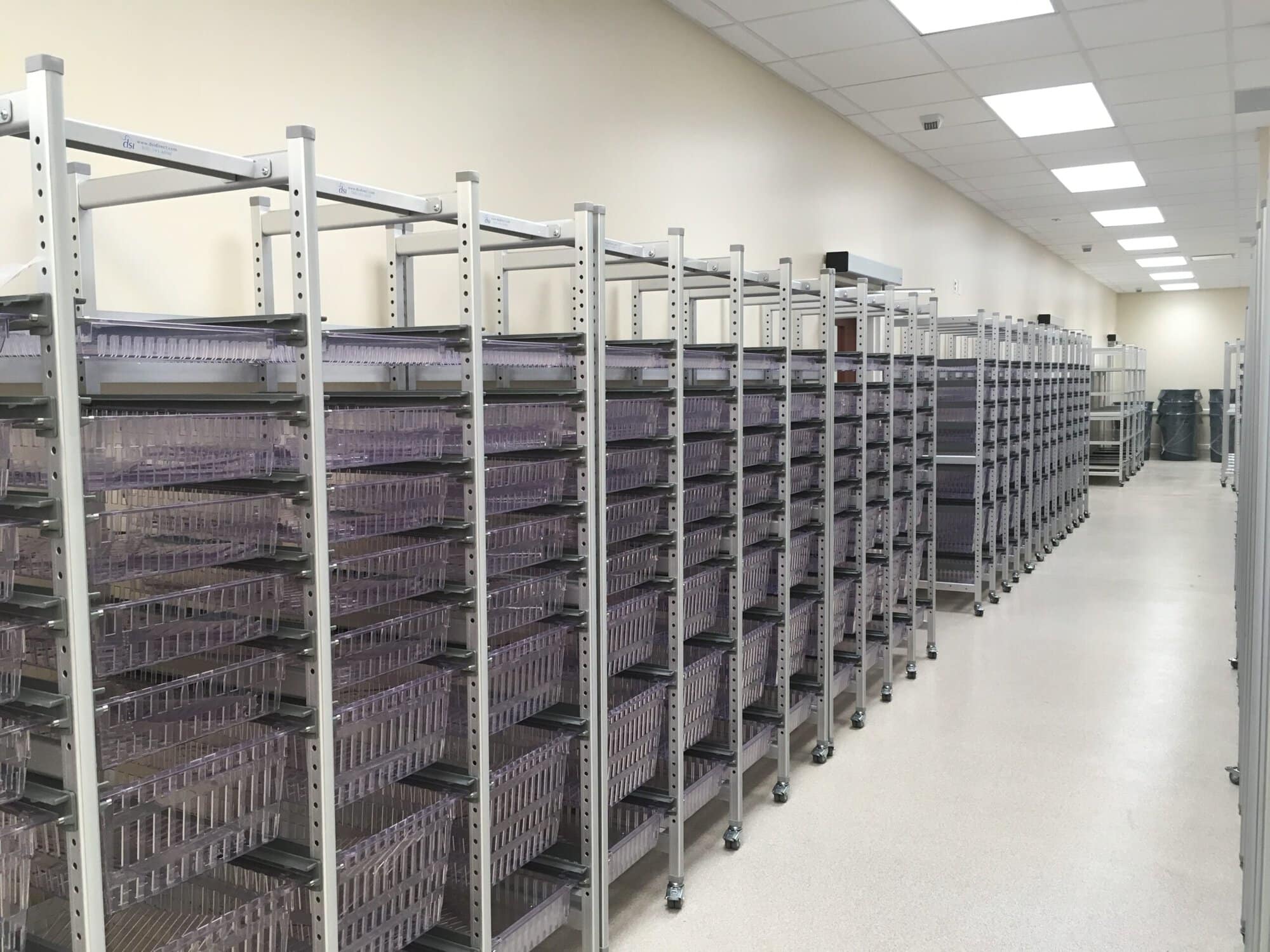
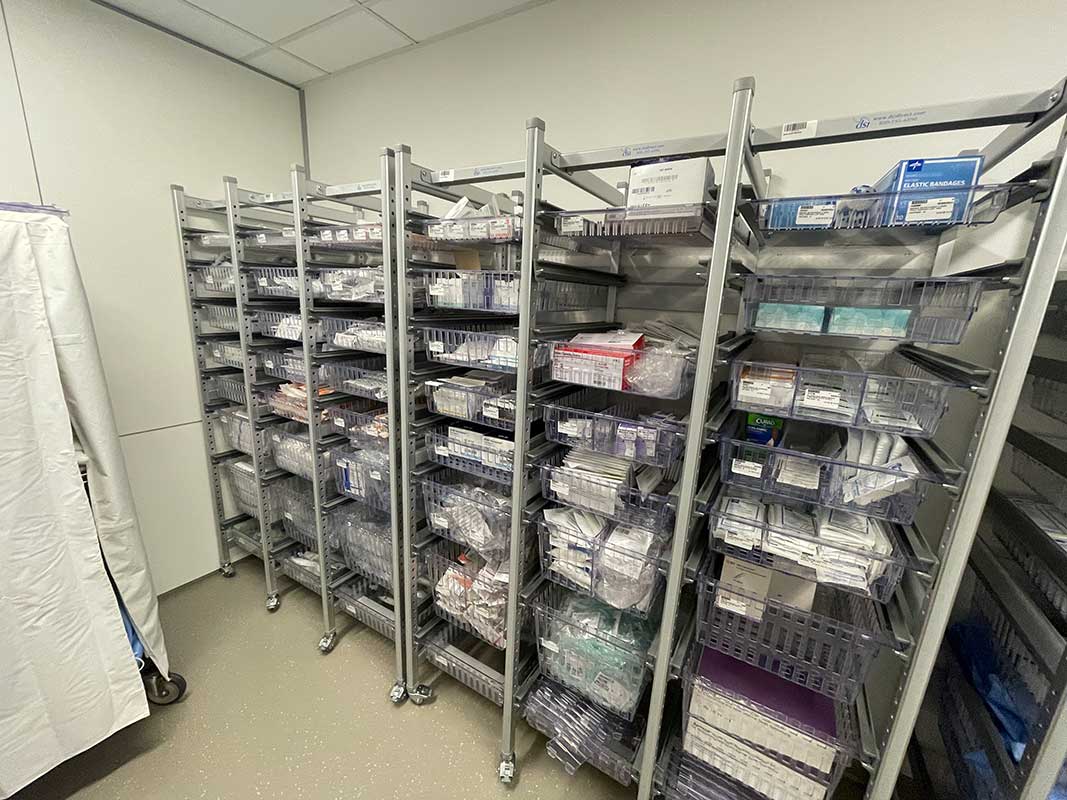
Polymer shelving provides better sterile-pack protection and less snag risk but costs more than basic wire systems. Advanced modular storage systems use anodized aluminum frames with powder-coated solid galvanized tray surfaces and heavy-duty glides. These SPD-specific designs eliminate stacking by providing dedicated slots for each wrapped tray or container.
Premium modular tray systems cost USD 8,500 over ten years with a claimed service life of 15+ years. Annual maintenance burden drops to USD 150 because smooth surfaces are easier to clean and resist corrosion. Facilities experiencing wrap damage, overcrowding, or compliance citations typically achieve measurable ROI from upgrading to dedicated tray storage that protects packages and improves retrieval ergonomics.
Enclosed medical storage cabinets are ideal when facilities require controlled access, security, or protection for high-value specialty instruments. Premium triple-column cabinet examples cost approximately USD 14,440.95 and feature modular trays, locks, and glass or solid doors. These systems excel in procedural areas where inventory organization and visual control reduce searching time.
High-density mobile systems range from USD 937.80 to USD 2,482.00 and deliver the highest capacity per square foot. Track systems use mobile carriages on the floor or overhead rails to compress aisles and expand storage density. These solutions work best where space constraints create immediate operational pressure and where renovation costs exceed the investment in mobile infrastructure.
Compliance risks in SPD storage stem from environmental control failures, traffic management weaknesses, and handling practices that compromise package integrity. CDC and AAMI ST79 guidelines establish specific requirements for temperature, humidity, stacking, and traffic control. Facilities that fail to align storage design with these industry standards face survey deficiencies, corrective action plans, and potential patient safety exposure.
Recent case studies demonstrate that compliance failures often persist through multiple survey cycles when leadership does not establish effective oversight and follow-through. Poor storage creates structural barriers to maintaining sterility assurance. Common violations involve stacking, environmental monitoring gaps, traffic control failures, and inadequate documentation of handling practices.
Sterile storage should be in a limited-access area with controlled temperature and humidity according to CDC guidance. Sterile storage humidity should not exceed 70%, and storage temperature may be as high as 75°F. These thresholds require continuous environmental monitoring and alarm systems to detect excursions before they compromise sterile package integrity.
AAMI ST79 specifies that stacking should be avoided unless supported by packaging instructions for use (IFU). Most blue wrap and sterile barrier systems are not IFU-approved for stacking, making dedicated slots or pull-out trays necessary to maintain compliance. Facilities using open shelving with compressed or stacked packages create unnecessary contamination risk and survey exposure.
A 2024 VA OIG case documented an unused endoscope returned to sterile storage after potential environmental exposure. The same facility had staff eating, drinking, or storing food in sterile storage areas, creating direct contamination risk. Repeated deficiencies were cited between 2019 and 2021 without effective closure, demonstrating how weak leadership follow-through perpetuates violations.
Poor traffic management allows excess personnel movement through sterile storage, increasing environmental contamination risk. Inadequate environmental monitoring leads to temperature and humidity noncompliance that may not be detected until a survey. Storage design that forces stacking or excess handling creates structural noncompliance that cannot be fixed through policy alone.
Excess traffic in sterile storage creates environmental contamination risk that undermines even well-designed physical storage systems. Food, drink, or non-sterile activity in sterile areas creates contamination risk and survey citations that affect accreditation standing. Effective environmental controls require restricted access, continuous monitoring, documented corrective actions, and leadership accountability for closure.
Storage upgrades should include access controls, room layout changes, and traffic flow redesign where necessary. Facilities should establish cooling areas separate from high-traffic corridors to reduce post-sterilization handling exposure. Environmental monitoring systems with real-time alerts prevent temperature and humidity excursions from becoming compliance events.
Facility location, procedural volume, and patient demographics create distinct storage requirements that cannot be addressed through one-size-fits-all solutions. Urban facilities with higher case volumes and space constraints benefit most from high-density modular storage that maximizes capacity per square foot. Rural facilities with lower throughput may prioritize budget-friendly systems that deliver adequate protection without premium lifecycle costs.
Patient age and procedure mix also influence storage needs because older populations consume more procedural care. Adults aged 65 and older have surgery rates of 72.3 to 75.6 per 1,000 population, far exceeding younger age groups.
More than 90% of ASCs are in urban areas, concentrating procedural infrastructure and premium storage demand in metropolitan markets. Nearly 90% of major ambulatory surgery encounters occurred in urban hospital-owned facilities, reinforcing the geographic concentration of high-volume sterile processing operations. Urban facilities face higher real estate costs, making space optimization through storage density a critical ROI driver.
Rural counties were 5.32 times more likely to lack both ASCs and hospital outpatient departments, according to a 2025 study. This infrastructure gap means rural facilities often operate with lower procedural volumes and less capital availability for premium storage investments.
Approximately 6,300 ASCs treated 3.4 million fee-for-service Medicare beneficiaries in 2023, with procedures per beneficiary rising 5.7% year over year. This volume growth creates storage pressure that cannot be addressed by simply adding more shelving units. Facilities must optimize retrieval workflows, reduce handling steps, and protect packages during high-turnover periods.
Procedure type also matters because complex specialty cases require more instruments and longer sterile storage times. Facilities performing orthopedic, cardiovascular, or neuro procedures maintain larger instrument tray inventories that require dedicated slots to prevent stacking. Storage systems must accommodate both standard case volumes and specialty instrument sets without compromising access or sterility assurance.
Workflow ergonomics directly affect staff efficiency, retrieval accuracy, and physical strain during high-volume shifts. Pull-out trays and dedicated slots reduce bending, reaching, and unnecessary movement compared to stacked storage. Storage systems that position frequently used items at optimal heights improve retrieval speed and reduce musculoskeletal injury risk.
Facilities should evaluate how storage layout affects travel distance, retrieval steps, and visual access to inventory. Poor ergonomics create measurable labor costs through slower turnover times and increased staff fatigue.
Economic evaluation of SPD storage must extend beyond upfront price to include lifecycle costs, space productivity, labor efficiency, and compliance risk. Ten-year comparisons reveal that premium systems often cost less than budget alternatives when replacement cycles, maintenance burden, and handling damage are included.
ROI calculation should include space optimization benefits, labor savings from faster retrieval, reduced wrap damage, and avoided compliance citations. High-density storage that defers renovation costs can generate returns exceeding the system investment. Smart storage features, including RFID and barcode integration, create additional value through inventory visibility and automated replenishment.
Chrome wire versus premium modular systems presents a USD 14,500 versus USD 8,500 ten-year cost comparison. Chrome wire service life of 3-5 years requires multiple replacement cycles compared to 15+ years for engineered SPD-specific storage. Lifecycle value includes hardware longevity, maintenance savings, reduced package damage, and improved compliance continuity.
Buyers should calculate the total cost of ownership by adding acquisition price, annual maintenance costs, replacement frequency, and compliance risk exposure. Premium systems with higher upfront costs often deliver lower decade costs through reduced replacement, simplified cleaning, and better package protection.
Chrome wire versus premium modular storage annual maintenance costs run USD 850 versus USD 150 due to differences in surface design and corrosion resistance. Wire systems require more frequent cleaning labor because exposed wire geometry traps dust and debris.
Replacement cycles create hidden costs through installation labor, inventory transfer, and workflow disruption. Facilities replacing chrome wire every 3-5 years incur repeated capital outlays and operational interruptions. Premium systems with 15+ year service lives avoid these replacement costs and maintain consistent workflow performance.
Approximately 78% of hospitals still use manual inventory processes, creating an opportunity for smart storage integration to improve accuracy and reduce labor. RFID and barcode systems integrated with storage infrastructure enable real-time inventory visibility and automated replenishment. These features reduce overstocking, prevent stockouts, and improve case preparation speed.
High-density storage delivers ROI by maximizing capacity within existing footprint and deferring construction costs. Facilities achieving 30-40% density improvements avoid renovation expenses that often exceed USD 200 per square foot. Smart storage features combined with high-density design create compounding value through space productivity and operational intelligence.
Effective upgrade planning requires evaluating current failure modes, environmental controls, inventory requirements, and workflow constraints. The questions to ask should focus on measurable problems rather than abstract preferences. Facilities should identify specific issues such as wrap damage, stacking violations, retrieval delays, and compliance gaps before selecting storage solutions.
Upgrade decisions should also consider future volume growth, space availability, and integration with existing infrastructure. Storage systems that cannot scale with procedural growth create premature replacement cycles.
Stacked blue wrap or compressed trays can cause tears, punctures, and handling damage that compromise sterility assurance. Wire shelving can snag sterile packs and sealed supplies, creating package integrity failures. Facilities experiencing frequent wrap damage should evaluate whether the current storage design forces staff into non-compliant handling practices.
Stacking violations often result from inadequate storage capacity rather than staff negligence.
Providing dedicated slots through modular tray systems eliminates the need for stacking and reduces handling steps. Plastic bins and accessories can improve organization within existing systems, but structural stacking problems require layout redesign.
Sterility maintenance covers should only be applied when items are cool and dry, requiring controlled cooling areas separate from high-traffic zones. Facilities lacking a dedicated cooling space force staff to move items prematurely, increasing contamination exposure. Environmental controls, including temperature, humidity, and air quality monitoring, must operate continuously with documented review protocols.
Traffic management requires physical barriers, access controls, and staff discipline to prevent unauthorized personnel from entering sterile storage. Facilities with open layouts or shared corridors face structural challenges in maintaining limited-access requirements.
Security requirements vary by facility type and inventory value, with specialty instruments and implants requiring controlled access. Enclosed cabinets with locks provide physical security while maintaining organized storage. Mobility features enable flexible room layouts and support workflow changes without fixed infrastructure modifications.
Inventory visibility through manual systems creates inefficiency and increases stockout risk. Facilities handling high volumes benefit from storage integrated with barcode or RFID tracking. Smart storage features reduce manual counting, improve par-level accuracy, and enable predictive replenishment based on usage patterns.
Strategic storage upgrades align physical infrastructure with compliance requirements, workflow discipline, and long-term capacity needs. Facilities should segment storage decisions by application environment rather than applying one solution everywhere—tailored solutions deliver better compliance outcomes and long-term value. Budget considerations should emphasize the total cost of ownership and measurable operational improvements over the lowest upfront price.
Successful upgrades require leadership commitment to environmental controls, staff training, and continuous compliance monitoring. Storage design creates the physical foundation for sterility maintenance, but sustained compliance depends on behavioral discipline and organizational accountability. The most effective storage systems integrate hardware design, workflow protocols, and environmental controls into a unified approach.
Facilities considering an SPD storage upgrade should begin with a comprehensive assessment of current failure modes, equipment and space constraints, and space constraints, and compliance gaps. DSIDirect specializes in turnkey storage optimization that combines layout analysis, system design, and complete installation support. Explore storage optimization services to evaluate how engineered storage solutions deliver measurable improvements in process efficiency, compliance continuity, and total cost of ownership.
Distribution Systems International has helped acute care facilities across the country optimize their SPD storage for over 30 years. Our team assesses your current equipment and space constraints, designs a system built around your workflow, and handles complete turnkey installation—so your staff can focus on patient care from day one. Contact us today to schedule your complimentary storage analysis and see how DSI delivers measurable improvements in compliance, efficiency, and total cost of ownership.

With 21 years of sales management, marketing, P&L responsibility, business development, national account, and channel management responsibilities under his belt, Ian has established himself as a high achiever across multiple business functions. Ian was part of a small team who started a new business unit for Stanley Black & Decker in Asia from Y10’ to Y14’. He lived in Shanghai, China for two years, then continued to commercialize and scale the business throughout the Asia Pacific and Middle East regions for another two years (4 years of International experience). Ian played college football at the University of Colorado from 96’ to 00’. His core skills sets include; drive, strong work ethic, team player, a builder mentality with high energy, motivator with the passion, purpose, and a track record to prove it.