Key Takeaways
Medical supply management is approaching an inflection point. The methods that sustained healthcare storage for decades, manual counts, static par levels, and paper documentation, can no longer keep pace with today's demands. Supply chain disruptions, staffing pressures, rising costs, and tightening regulations have exposed the limits of traditional approaches.
2026 marks a turning point. AI-powered forecasting, automated dispensing, IoT-enabled visibility, and LEAN waste-elimination principles are moving from pilot programs to standard practice.
This guide examines the healthcare storage trends 2026 will bring to the forefront, compares traditional and modern methodologies, and provides a practical framework for assessment and implementation.
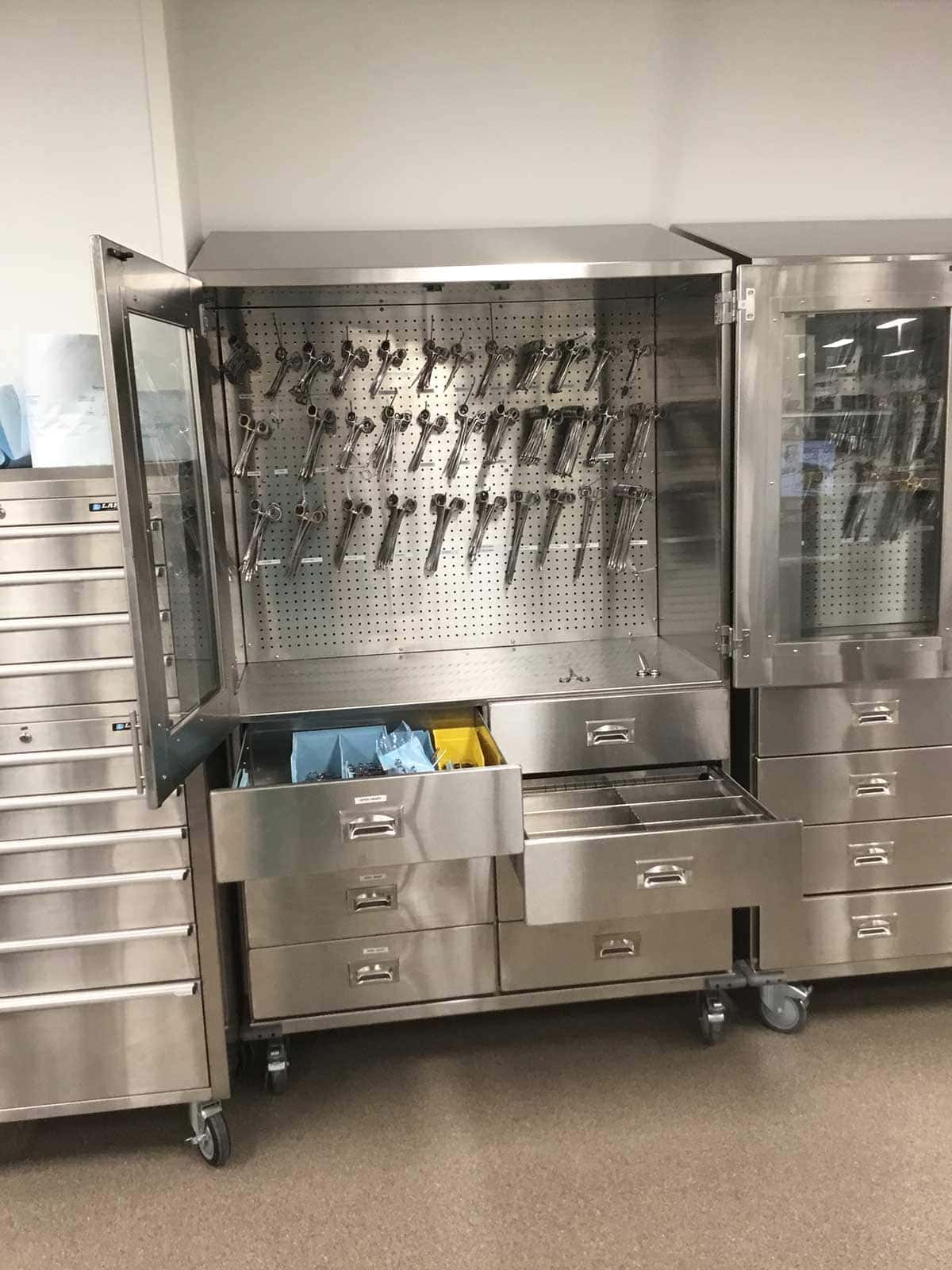
Healthcare storage in 2026 encompasses every location where medical supplies live, central warehouses, pharmacy shelves, unit supply closets, and satellite storage points across the facility. It's a distributed network designed to put the right supplies within reach when clinicians need them.
This isn't retail warehousing. Medical supply storage operates under strict regulatory oversight, including UDI tracking, HIPAA privacy rules, and DSCSA drug supply chain requirements. The stakes are higher: implants, biologics, controlled substances, emergency disposables, and temperature-sensitive medications all demand specialized handling. A stockout doesn't just mean lost revenue; it can mean delayed care.
Healthcare storage systems face converging pressures from multiple directions. Recent global disruptions exposed how quickly supply chains can fracture. Without real-time visibility into inventory levels, facilities can't anticipate shortages or pivot before stockouts hit patient care. Understanding medical supply management trends is essential for navigating this landscape.
The financial toll is mounting. Expired inventory is pure loss. Overstocking ties up capital while increasing expiration risk. Meanwhile, clinical staff spend hours on non-patient activities, counting supplies, hunting for items, and chasing order status. Manual processes invite human error and accelerate burnout. Regulatory exposure compounds the problem: paper-based tracking creates audit gaps and compliance failures under HIPAA and DSCSA requirements.
Traditional storage approaches create predictable failure points:
The downstream effects are concrete: stockouts delay procedures and compromise patient safety. Workflow bottlenecks create chronic stress among clinical teams who shouldn't be managing supply problems. Effective materials management addresses these systemic failures.
Four technology-driven shifts are reshaping how healthcare facilities manage medical supplies. These aren't distant possibilities; they're active deployments gaining momentum as 2026 approaches. The future of medical storage is already taking shape in forward-thinking facilities.
The shift from reactive to predictive inventory management defines the 2026 storage strategy. Healthcare inventory technology powered by AI and machine learning now analyzes seasonal patterns, patient volumes, and historical consumption to enable true just-in-time ordering. Facilities no longer wait for stockouts to trigger reorders.
Beyond replenishment, AI-powered analytics inform strategic decisions, device utilization insights guide vendor selection, and surface savings opportunities. The technology transforms inventory from a cost center managed by gut feel into a data-driven operation.
Automated Dispensing Cabinets (ADCs) are moving from pharmacy-only to facility-wide deployment. The market is projected to reach $6.8 billion by 2033, growing at 8.1% annually from 2026. ADCs tighten access control, automate documentation, and simplify regulatory compliance for controlled substances and high-value items.
Machine learning extends automation upstream. Bill-only order processing for implants and consignment inventory now integrates directly with ERP systems, eliminating manual reconciliation that once consumed hours of staff time.
IoT sensors and RFID tracking form the visibility backbone of smart hospital infrastructure. Facilities gain immediate insight into stock levels, item locations, and environmental conditions across every storage point.
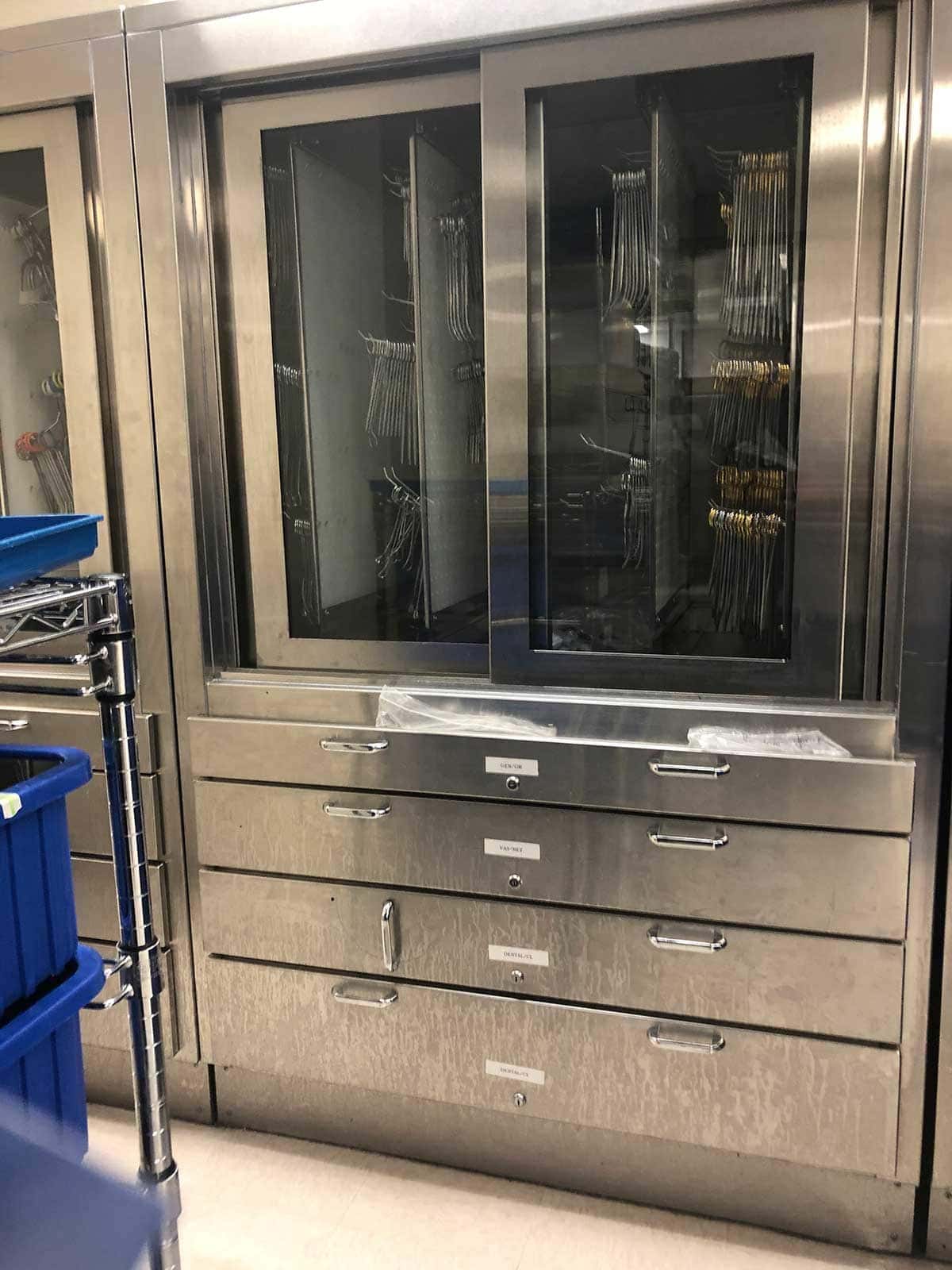
Cold chain integrity becomes verifiable rather than assumed, IoT-monitored temperature tracking protects biologics and temperature-sensitive medications from warehouse to patient. Real-time data enables proactive expiration management and rapid recall response that manual systems simply cannot match. This visibility is especially critical for sterile instrument storage where compliance and patient safety intersect.
Modular construction methods are transforming how facilities build and adapt storage spaces. Prefabricated components reduce construction waste by up to 83%, cut energy consumption by 20%, and lower embodied carbon by 45% compared to traditional builds. Facilities can expand or reconfigure without major disruption. Organizations seeking guidance on sustainable storage practices are finding modular approaches align with broader environmental goals.
Inside storage areas, antimicrobial surfaces on cabinets, shelving, and carts now support infection control as a standard feature rather than an upgrade. High density storage healthcare solutions maximize capacity within existing footprints while maintaining accessibility and organization.
LEAN storage systems built on waste elimination consistently outperform traditional high-volume models. The performance gap is quantifiable across every major metric.
| Metric | Traditional Model | LEAN System | Documented Improvement |
| Space Utilization | Unoptimized, high-volume | Organized, unnecessary items removed | 15.7% space saved |
| Inventory Levels | High stock, poor control | Standardized, visual controls | 56.72% reduction in pharmaceutical stock |
| Inventory Turnover | Low turnover, high holding costs | Increased efficiency | 30% improvement |
| Waste/Expiry | High expiration risk | Systematic elimination | €25,357.98 in savings |
| High-Risk Drugs | Excessive safety stock | Right-sized inventory | 40.73% reduction |
| Staff Productivity | Time spent searching/counting | Reduced search time, streamlined restocking | Improved teamwork and coordination |
The core LEAN toolkit includes 5S methodology (Sort, Set in Order, Shine, Standardize, Sustain), Kanban two-bin replenishment triggers, Point-of-Use Storage with standardized locations, and visual management through color-coding, shadow boards, and clear bins.
One caution: research shows mixed staff impact. Success depends on implementation quality and genuine staff involvement. LEAN deployed purely as cost-cutting, without redesigning underlying work processes, can increase stress rather than reduce it.
Storage optimization follows a predictable path: understand current state, prioritize interventions, and measure results. The timeline varies, but the sequence doesn't.
Start with visibility into how supplies actually flow through your facility:
Quick wins (0–6 months): Implement 5S organization in high-impact areas. Deploy visual management, labels, color-coding, and clear bin systems. Establish expiration monitoring protocols. Standardize par levels using actual consumption data rather than historical guesses.
Major transformations (6–18+ months): RFID-enabled smart cabinet deployment. IoT sensor networks feeding predictive analytics. Distribution hub redesign. Full ERP and inventory system modernization.
| KPI | Why It Matters |
| Stockout rate | Direct patient safety indicator |
| Expiry/waste rate | Measures preventable financial loss |
| Inventory turnover | Shows capital efficiency |
| Fill rate | Measures service reliability |
| Clinician time on supply tasks | Quantifies staff burden |
Storage optimization requires different conversations at different levels. Here's what matters for each audience.
For Supply Chain Leaders:
Start with an honest assessment. Benchmark current performance against industry peers on stockout rates, expiry costs, and inventory turns. Identify high-impact projects that balance quick wins, 5S implementation, visual management, par level standardization, with longer-term technology investments. Pilot new systems in controlled environments before enterprise rollout. Track KPIs continuously; you'll need the data to demonstrate ROI and secure ongoing investment.
For Executives:
Four strategic imperatives connect storage modernization to organizational priorities. Patient safety improves when optimized storage eliminates stockouts and reduces medication errors. Staff efficiency gains free clinician time and addresses burnout, a direct workforce retention lever. Resilience increases as data-driven systems detect and respond to supply disruptions before they reach the bedside. And storage modernization isn't a standalone project; it's foundational infrastructure for broader smart hospital and digital transformation initiatives.
The 2026 trajectory is clear: AI-driven forecasting, automation (ADC market reaching $6.8 billion), IoT-enabled real-time visibility, and LEAN principles with documented results, 15.7% space savings, 56.72% inventory reduction, and 30% turnover improvement. Organizations investing now will operate more resilient, efficient, and patient-safe supply chains. Those waiting will play catch-up.
Healthcare storage is undergoing its most significant shift in decades. The movement from reactive to predictive, manual to automated, and traditional to LEAN isn't a future state; it's happening now. Facilities that embrace AI forecasting, smart dispensing, IoT visibility, and waste-elimination methodologies are already capturing measurable gains in cost, safety, and staff satisfaction.
The competitive window is open but narrowing. Supply chain volatility isn't going away. Staffing pressures continue. Regulatory requirements grow more complex. Organizations that build modern storage infrastructure today create advantages that compound over time. Those who delay face steeper climbs with fewer resources.
The technology is proven. The methodologies are documented. The ROI is quantifiable. What remains is execution.
Ready to modernize your healthcare storage operations? Contact DSI Direct to explore solutions tailored to your facility's needs.
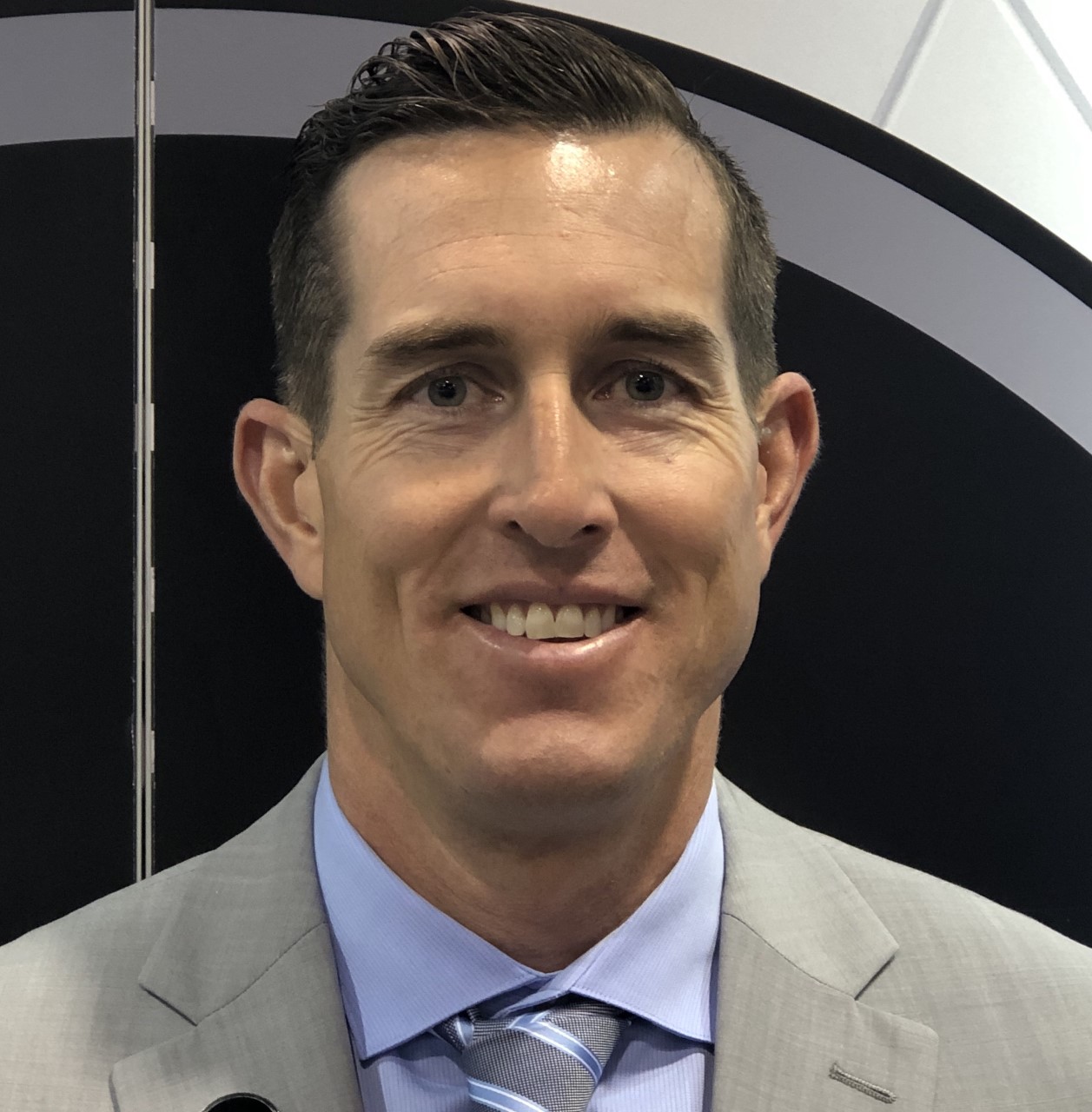
With 21 years of sales management, marketing, P&L responsibility, business development, national account, and channel management responsibilities under his belt, Ian has established himself as a high achiever across multiple business functions. Ian was part of a small team who started a new business unit for Stanley Black & Decker in Asia from Y10’ to Y14’. He lived in Shanghai, China for two years, then continued to commercialize and scale the business throughout the Asia Pacific and Middle East regions for another two years (4 years of International experience). Ian played college football at the University of Colorado from 96’ to 00’. His core skills sets include; drive, strong work ethic, team player, a builder mentality with high energy, motivator with the passion, purpose, and a track record to prove it.