Organizations facing space constraints must choose between high-density mobile shelving and static shelving based on floor-area recovery, budget, and workflow requirements. Mobile systems compress storage by eliminating fixed aisles, while static shelving provides the lowest capital cost and simplest maintenance.
The global shelving market reached $26.03 billion in 2024 and is forecast to grow to $41.07 billion by 2035 at 4.23% CAGR. High-density mobile shelving was valued at $1.89 billion in 2026, with projected growth to $3.78 billion by 2035 at 8.0% CAGR, while static warehouse racking stood at $9.71 billion in 2024 and is expected to reach $12.41 billion by 2030 at 4.2% CAGR.
High-density mobile shelving and static shelving represent different approaches to organizing inventory within fixed floor areas. Mobile systems use carriages mounted on floor tracks to eliminate permanent aisles, while static shelving relies on fixed uprights that consume more horizontal space.
The primary distinction lies in how each system balances accessibility against space efficiency. Static shelving provides simultaneous access to all bays but requires dedicated aisles between every row, whereas mobile shelving sacrifices simultaneous access to recover floor space by condensing storage into movable units.
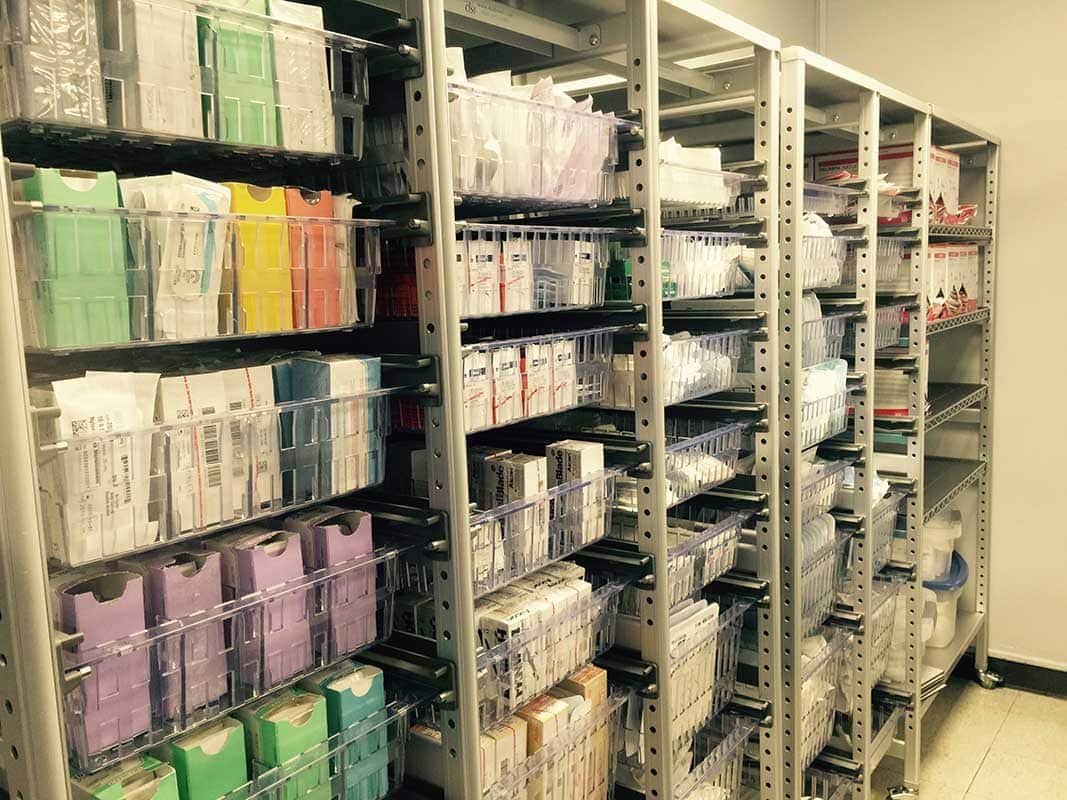
High-density mobile shelving consists of carriage-mounted units installed on floor tracks with hand-crank or powered movement that eliminates aisles between inactive rows. Staff opens only the specific aisle needed for retrieval, allowing remaining units to compress together.
Vertical lift modules represent an automated alternative using trays stored in enclosed towers with software control and ergonomic access windows. These systems reached $1.56 billion in 2023 and are forecast to grow to $2.78 billion by 2030 at 9.1% CAGR.
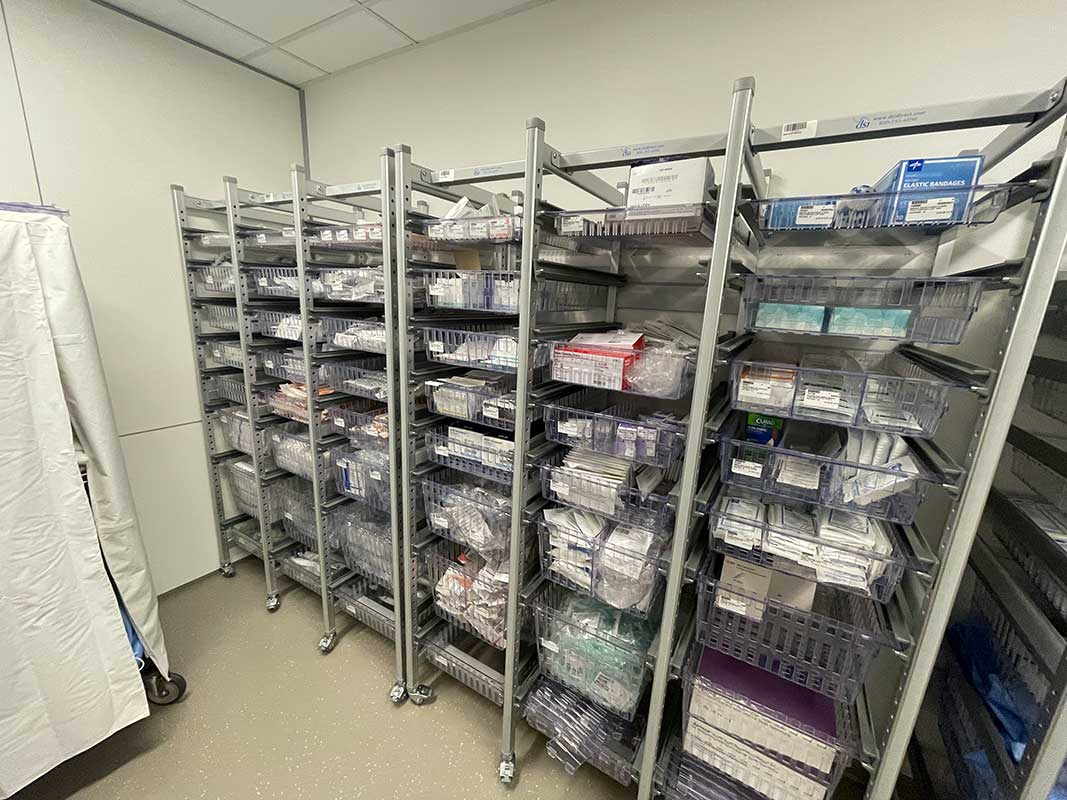
Static warehouse racking consists of fixed uprights and shelves with open-wire or pallet-rack layouts and adjustable shelves that remain in permanent positions. Each bay requires a dedicated aisle, which increases floor area but simplifies installation and reduces capital costs.
Budget wire shelving ranges from $81 to $500, while mid-range static shelving costs $500 to $1,500 per unit. Premium heavy-duty systems move into the low thousands depending on load capacity and configuration.
Mobile shelving eliminates fixed aisles to maximize storage density per square foot, whereas static shelving consumes more aisle space in exchange for lower costs and faster simultaneous access. Mobile systems compress horizontal aisles by moving units on tracks, while vertical systems exploit unused building height through automated retrieval.
Healthcare carts bring supplies directly to the point of care using mobile units with casters and modular bins, whereas cabinetry provides permanent organization with integrated counters and sterilization-specific features. Carts offer flexibility for changing workflows, while built-in cabinetry supports infection control and secure medication storage.
Space efficiency directly impacts operational costs by reducing facility footprint requirements, lowering real estate expenses, and improving inventory accessibility. Organizations that maximize storage density avoid costly building expansions while maintaining or increasing inventory capacity.
Healthcare facilities face acute space pressure because clinical areas command premium square footage values. Efficient storage systems free floor space for patient care while reducing staff time spent searching for supplies.
Vertical lift modules deliver the highest floor-space recovery by storing inventory vertically in automated towers, while static shelving has the lowest acquisition cost but requires the most horizontal area. Morristown Medical Center's upgraded system holds 40% more inventory than its legacy arrangement by implementing high-density storage in central supply.
Fixed shelving wins on purchase price at $81 to $1,500 per unit, whereas mobile and vertical systems win on storage density per square foot. Budget mobile wire units start at $220 to $465, mid-range mobile shelving costs $553 to $3,000, and premium mobile systems exceed $25,000.
U.S. self-storage inventory surpassed 2.1 billion square feet by 2024, reflecting broad national demand for space optimization solutions. One in three Americans used self-storage, demonstrating that space efficiency concerns extend beyond commercial and healthcare facilities.
Eighteen percent of Americans were actively renting storage in 2024, with adults aged 24 to 39 accounting for about 25% of current storage users. This demographic pressure creates demand for both residential and institutional storage solutions that maximize capacity within limited footprints.
Vertical storage exploits ceiling height through automated retrieval systems that deliver items to ergonomic access windows without requiring staff to climb ladders. Horizontal mobile solutions compress aisles by sliding units along floor tracks, creating a single working aisle that moves to the required location.
Used vertical lift modules cost $35,000 to $75,000, while new systems range from $75,000 to $140,000, and premium configurations approach $250,000. The capital cost reflects automation complexity, software integration, and engineering required for multi-story vertical structures.
Each shelving category offers distinct trade-offs between capital cost, space efficiency, installation complexity, and operational accessibility. Static shelving provides the simplest implementation and lowest upfront investment, while mobile and vertical systems require greater capital but deliver superior density.
Decision-makers must evaluate whether their primary constraint is budget, floor area, ceiling height, or workflow speed. Organizations with abundant floor space but limited budgets favor static shelving, whereas facilities facing space scarcity justify higher investments in mobile or vertical systems.
Higher installation cost for mobile shelving reflects floor preparation, track installation, and mechanical components that enable movement. Static wire shelving requires only anchor bolts and minimal assembly, reducing labor expenses and implementation time.
The highest capital cost for vertical lift modules stems from automation hardware, software licensing, and structural engineering for enclosed tower systems. Premium vertical configurations frequently exceed $140,000 due to multi-level delivery mechanisms, refrigeration options, and inventory-management software integration.
Track and floor preparation required for mobile systems includes reinforcing subflooring, installing rail systems, and ensuring level surfaces to prevent binding or uneven carriage movement. Track systems must be precisely aligned to distribute weight evenly and enable smooth operation.
Implementation complexity for vertical systems involves structural analysis to confirm floor-load capacity, electrical work for powered lifts, and software integration with existing warehouse-management platforms. Vertical lift modules also require software integration for inventory tracking, user authentication, and retrieval sequencing.
Slower simultaneous access with mobile shelving occurs because only one aisle can be open at a time when multiple users need items from different rows. Staff must wait for others to complete retrieval before moving carriages to access their target location.
Limited density for mobile carts compared with built-ins restricts total storage capacity in ward or clinic settings. Medical cabinetry offers higher volumetric efficiency but sacrifices the flexibility to relocate supplies as workflows change.
User requirements determine which shelving attributes matter most for specific applications, ranging from retrieval speed in emergency departments to inventory security in pharmacy settings. Healthcare facilities prioritize infection control and workflow support, while warehouses emphasize throughput and load capacity.
Storage demographics, clinical workflows, and regional market conditions shape system selection by defining operational constraints that storage must address. Facilities in urban areas face different space pressures than rural locations, and generational preferences influence how residential users approach storage decisions.
Thirty-eight percent of Americans had used or expected to use self-storage in 2021. Gen X showed the highest participation at 54%, followed by Boomers at 51% and Millennials at 40%.
Generational differences reflect distinct storage drivers: Millennials respond to apartment-size constraints and mobility, Gen X to family overflow and mixed-use needs, and Boomers to downsizing and accessibility requirements. Adults aged 24 to 39 account for about 25% of current storage users.
Medical carts consist of mobile units with casters, drawers, locks, wipe-clean surfaces, optional computing, and modular bins that bring supplies directly to patient bedsides. The medical carts market reached $2.60 billion in 2024 and is rising to $6.63 billion by 2030 at 16.95% CAGR.
Medical cabinetry includes operatory, sterilization, and secure storage systems with integrated counters designed for healthcare facilities that require permanent organization and infection control. The medical cabinetry market stood at $9.31 billion in 2022 and is forecast to reach $11.71 billion by 2027 at 4.7% CAGR.
Texas, Nevada, and Florida cities showed strong search intensity for storage solutions, reflecting migration patterns and urban density pressures that favor space-efficient systems. Urban facilities benefit most from compact mobile configurations that maximize capacity within expensive real estate.
Regional operator surveys show 87.8% of operators in the Northeast expect long-term demand to remain stable or increase, while 66.4% cite economic downturn as the top concern in the Southeast, and 69.8% cite the same concern on the West Coast. Economic sensitivity varies by region, influencing capital-expenditure timing and system-selection priorities.
Decision criteria are ranked by their impact on the total cost of ownership and operational performance, with space efficiency, retrieval speed, and flexibility forming the core evaluation framework. Buyers should quantify the floor area they can recover, how quickly staff must access inventory, and how often layouts will change.
The mobile versus static shelf analysis requires mapping system capabilities against facility-specific constraints such as ceiling height, floor-load capacity, budget limits, and workflow patterns. Healthcare applications add infection control and compliance requirements that elevate certain attributes above cost considerations.
Determining how quickly supplies must be retrieved separates applications where simultaneous access matters from those where sequential retrieval is acceptable. Emergency departments and operating rooms require instant access, making static shelving or strategically placed mobile units preferable to centralized vertical systems.
Central supply and pharmacy environments tolerate slightly longer retrieval times in exchange for higher storage density and better inventory control. Vertical lift modules improve retrieval accuracy and ergonomics even when access takes longer than walking to a static shelf.
Assessing how frequently the layout will change determines whether permanent or reconfigurable systems offer better long-term value. Mobile shelving on tracks can be relocated within a facility as departments expand or contract, whereas static shelving requires complete disassembly.
Healthcare cabinetry becomes less flexible once installed because counters, plumbing, and electrical connections create permanent room configurations. Renovation costs for fixed cabinetry are high, making permanent cabinetry slower to reconfigure when clinical workflows or equipment sizes change.
Evaluating infection-control and security requirements identifies applications where cleanable surfaces, lockable compartments, and ergonomic access windows justify premium system costs. Medical carts emphasize wipe-clean polymer materials and drawer locks that prevent unauthorized access to controlled substances.
Vertical lift modules in pharmacy settings reduce manual handling errors and provide audit trails for regulatory compliance. Automated systems track every retrieval transaction, supporting Joint Commission documentation requirements and reducing medication diversion risk.
Price ranges correlate directly with space recovery, automation level, and operational complexity, creating distinct budget tiers for each system category. Static shelving occupies the entry tier, mobile shelving the mid-tier, and vertical automation the premium tier.
Total cost of ownership includes purchase price, installation labor, floor preparation, ongoing maintenance, and the opportunity cost of floor space consumed. Organizations with expensive real estate justify higher system costs through avoided expansion expenses.
Budget mobile wire units priced from $220 to $465 offer basic manual operation with hand-crank mechanisms suitable for light-duty applications. Mid-range mobile shelving around $553 to $3,000, provides powered assistance, enhanced load capacity, and better track systems for institutional use.
Premium mobile systems can exceed $25,000 when configured with electronic controls, security features, and heavy-duty carriages. Budget wire shelving from $81 to $500 and mid-range static shelving from $500 to $1,500 serve general-purpose storage without floor-preparation requirements.
Used vertical lift module systems cost $35,000 to $75,000, providing an entry point for organizations seeking automation benefits without new-equipment pricing. New vertical lift module systems range from $75,000 to $140,000 and include manufacturer warranties, software updates, and implementation support.
Premium vertical lift module configurations can approach $250,000 when incorporating refrigeration, multi-level delivery, specialized tray sizes, and advanced inventory-management software. Return on investment calculations compare system costs against labor savings, space-recovery value, and avoided building expansion.
Investment in mobile shelving becomes justified when floor-space recovery value exceeds the incremental cost of tracks, carriages, and installation. Facilities paying more than $20 per square foot annually for real estate typically achieve payback within three to five years through avoided expansion.
Organizations facing immediate space shortages without relocation or construction options find mobile shelving the only alternative to operational disruption. The static shelving comparison shows that while fixed systems cost less upfront, they provide no path to increased density without physical expansion.
Case studies demonstrate how real facilities evaluate trade-offs, implement systems, and measure outcomes against space-efficiency and workflow objectives. Hospital implementations provide strong evidence because they document inventory growth, retrieval improvements, and capital-expenditure justifications.
Industry recommendations synthesize patterns across deployments, identifying questions that consistently predict successful system selection and implementation. Expert guidance emphasizes matching system capabilities to specific facility constraints rather than choosing based on product categories alone.
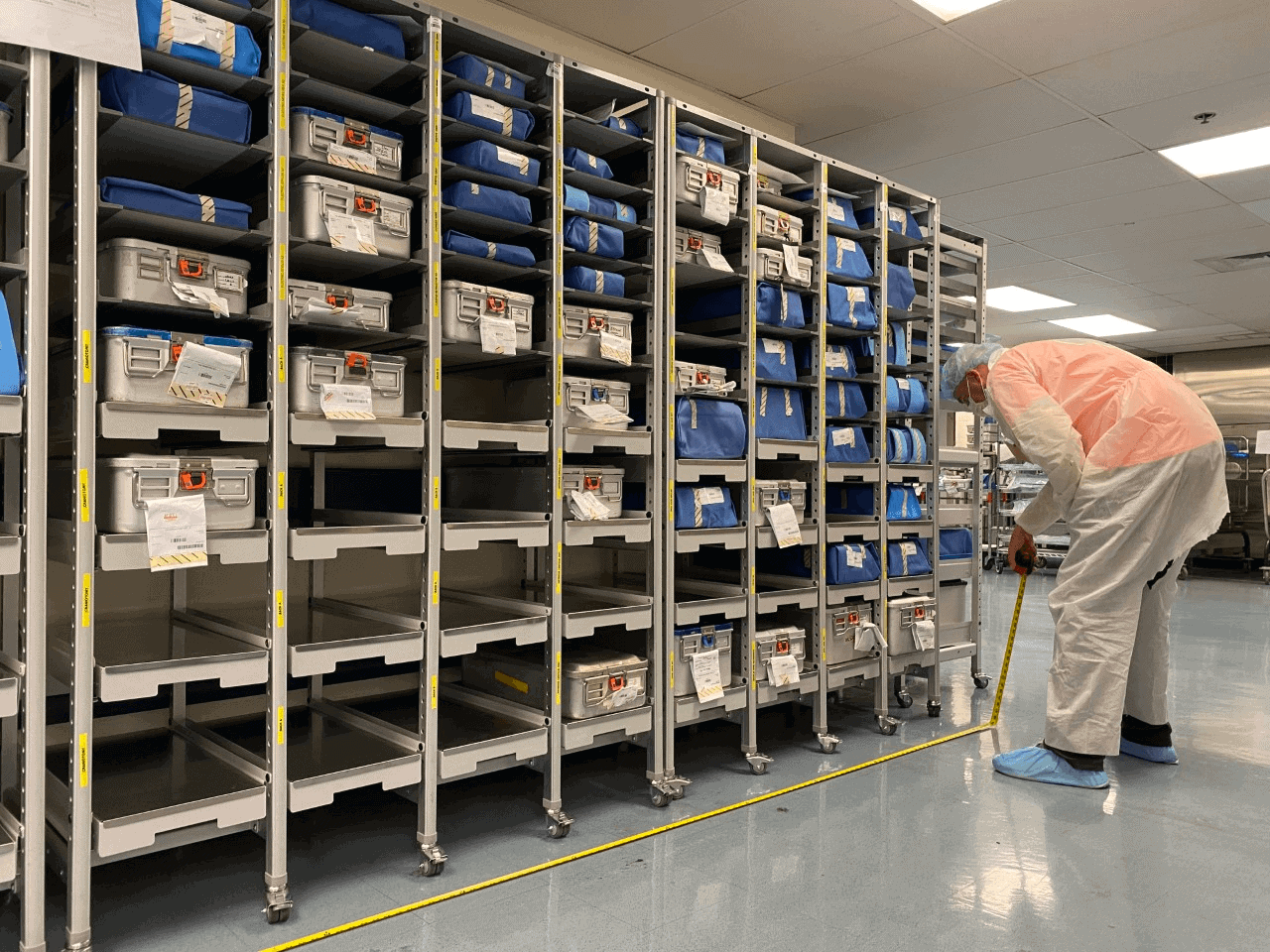
Morristown Medical Center processed 100 surgical cases per day and was considering growth from 28 to 30 operating rooms when it evaluated storage alternatives. The hospital required a system flexible enough to accommodate changing surgical tray sizes and stackability requirements without compromising central-supply floor space.
Morristown's upgraded system holds 40% more inventory than the legacy arrangement by implementing high-density storage and prep/pack workstations in central supply. This capacity increase supported case-volume growth without expanding the department footprint or relocating sterile processing.
The LISTA Storage Wall system improved retrieval times for Hackensack University Medical Center by organizing supplies in modular units with clear sightlines and ergonomic access. Faster retrieval reduces staff time spent searching and improves operating-room turnover between cases.
Central-supply renovations that combine density with workflow optimization deliver dual benefits: more inventory capacity and faster item location. Healthcare case studies consistently show that retrieval speed matters as much as raw storage volume for clinical satisfaction.
Asking how much density is needed establishes whether space recovery justifies the cost premium of mobile or vertical systems over static shelving. Facilities with abundant floor area rarely achieve positive return on investment from high-density solutions.
Deciding if optimizing a room, department, or mobile workflow determines whether fixed cabinetry, stationary shelving, or mobile carts and solutions best serve operational needs. Room-level optimization favors built-ins, departmental optimization favors mobile shelving, and cross-facility workflows favor wheeled carts.
The global shelving units and shelves market reached $26.03 billion in 2024 and is growing to $41.07 billion by 2035 at 4.23% CAGR, driven by demand for space optimization across commercial, healthcare, and residential applications. Static warehouse racking stood at $9.71 billion in 2024 and is forecast to reach $12.41 billion by 2030 at 4.2% CAGR.
High-density mobile shelving reached $1.89 billion in 2026 and is projected to grow to $3.78 billion by 2035 at 8.0% CAGR, reflecting accelerating adoption in space-constrained environments. Vertical lift modules achieved $1.56 billion in 2023 and are forecast to reach $2.78 billion by 2030 at 9.1% CAGR, demonstrating that automation investments concentrate where labor costs and space scarcity converge.
The medical carts market reached $2.60 billion in 2024 and is rising to $6.63 billion by 2030 at 16.95% CAGR, the fastest growth rate among storage categories tracked. This acceleration signals that healthcare buyers increasingly prioritize workflow mobility and point-of-care access over centralized static storage alone.
Growth patterns reveal that space efficiency and storage optimization investments migrate toward systems that solve multiple constraints simultaneously. Mobile shelving addresses floor-area scarcity, vertical systems add labor savings and accuracy gains, and healthcare carts integrate supplies directly into clinical workflows.
Organizations facing space constraints should evaluate systems by quantifying floor-area recovery, retrieval-speed requirements, reconfigurability needs, and total cost of ownership, including avoided expansion. Static shelving remains the cost-efficient baseline, mobile shelving offers the best compromise between density and affordability, and vertical automation delivers premium space recovery when capital budgets and facility infrastructure support implementation.
DSIDirect specializes in helping healthcare facilities optimize storage through LEAN inventory management, 2-Bin KANBAN systems, and department-specific solutions for sterile processing, operating rooms, and materials management. The company's three-step consultation, design, and turnkey implementation process ensures system selection aligns with measurable ROI and operational requirements.
Choosing between high-density mobile and static shelving takes more than a spec sheet. Distribution Systems International has helped acute care facilities recover floor space, cut inventory waste, and standardize SPD and OR workflows since 1990. Our team measures your usage, PAR levels, and layout before recommending a system, so you invest in storage that fits your actual workflow. Schedule a complimentary storage analysis and CAD layout to see your space savings in advance. Contact Distribution Systems International today.

With 21 years of sales management, marketing, P&L responsibility, business development, national account, and channel management responsibilities under his belt, Ian has established himself as a high achiever across multiple business functions. Ian was part of a small team who started a new business unit for Stanley Black & Decker in Asia from Y10’ to Y14’. He lived in Shanghai, China for two years, then continued to commercialize and scale the business throughout the Asia Pacific and Middle East regions for another two years (4 years of International experience). Ian played college football at the University of Colorado from 96’ to 00’. His core skills sets include; drive, strong work ethic, team player, a builder mentality with high energy, motivator with the passion, purpose, and a track record to prove it.