Healthcare facilities require storage solutions that address space constraints, regulatory compliance, and operational efficiency. High-density storage systems offer measurable improvements in capacity utilization and workflow optimization while supporting stringent healthcare standards.
This planning guide provides facility managers and supply chain directors with a structured framework for evaluating, selecting, and implementing healthcare storage solutions. The analysis includes market data, cost comparisons, adoption trends, and proven implementation strategies to support informed decision-making.
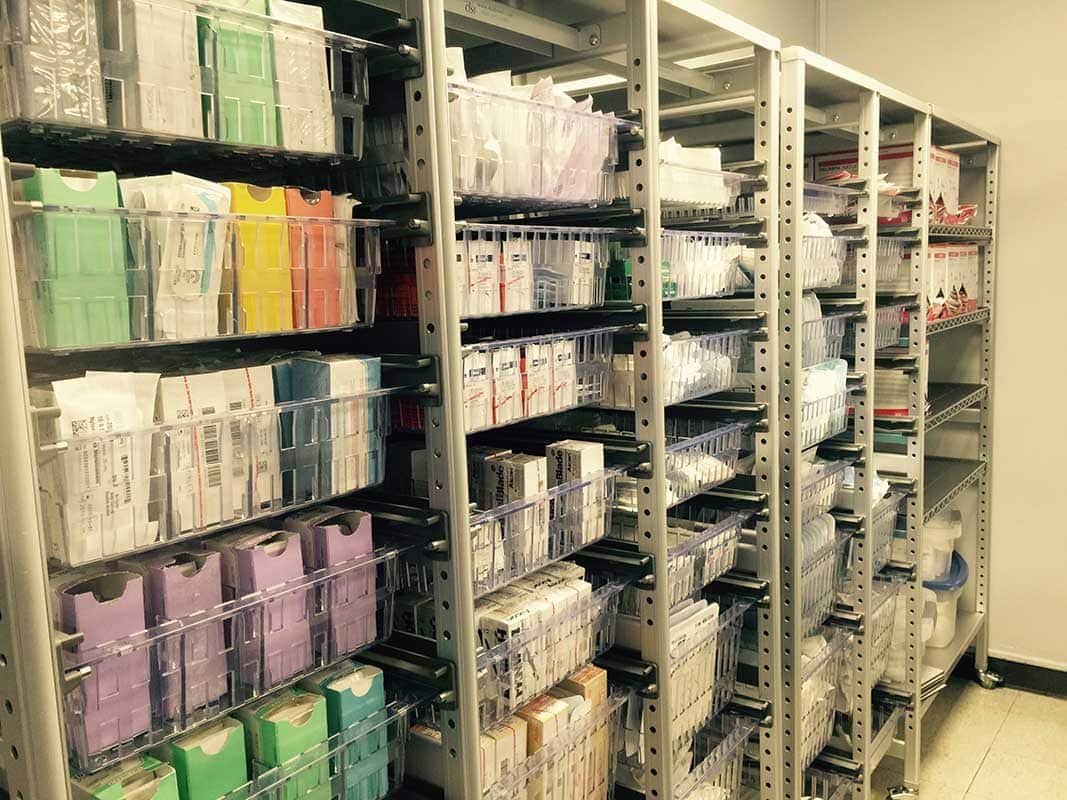
High-density storage maximizes storage capacity within existing footprints by eliminating unnecessary aisles and utilizing vertical space more effectively. These systems address critical challenges, including limited square footage, rising real estate costs, and the need to maintain readily accessible inventory for patient care.
Healthcare facilities face unique storage demands driven by regulatory compliance, infection control protocols, and the requirement for immediate supply availability. High-density storage solutions provide the capacity increases necessary to accommodate growing inventory volumes without facility expansion while ensuring organized systems that support rapid retrieval during emergencies.
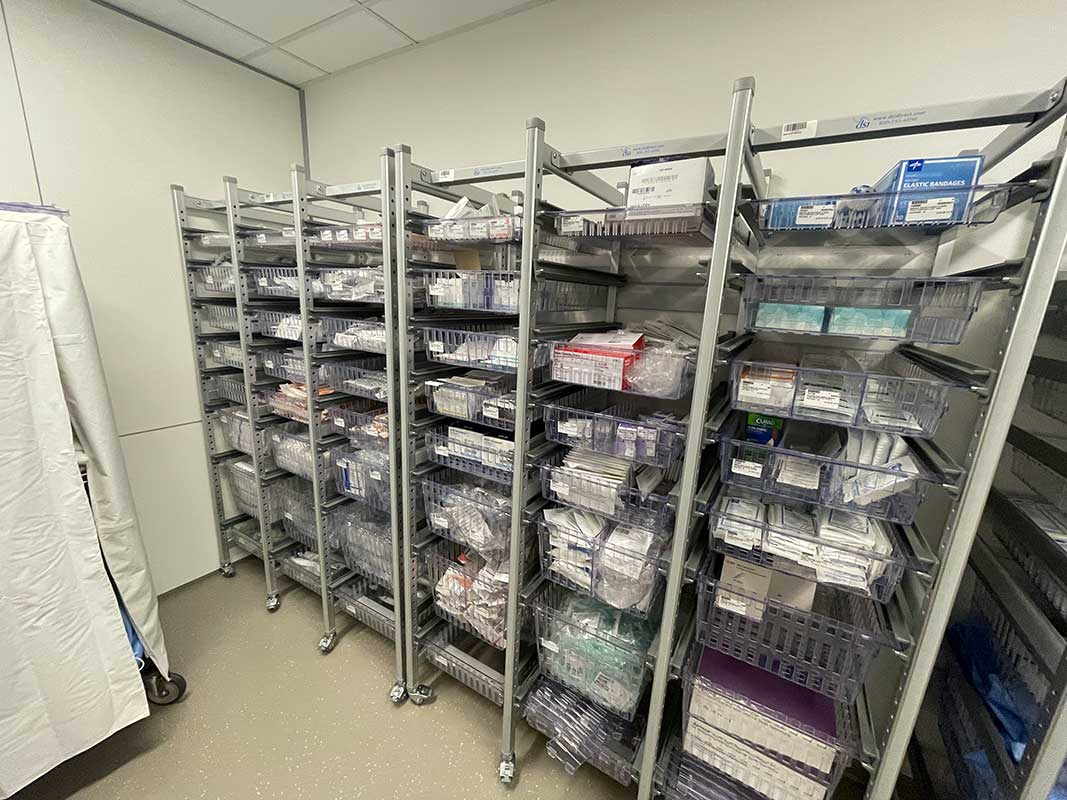
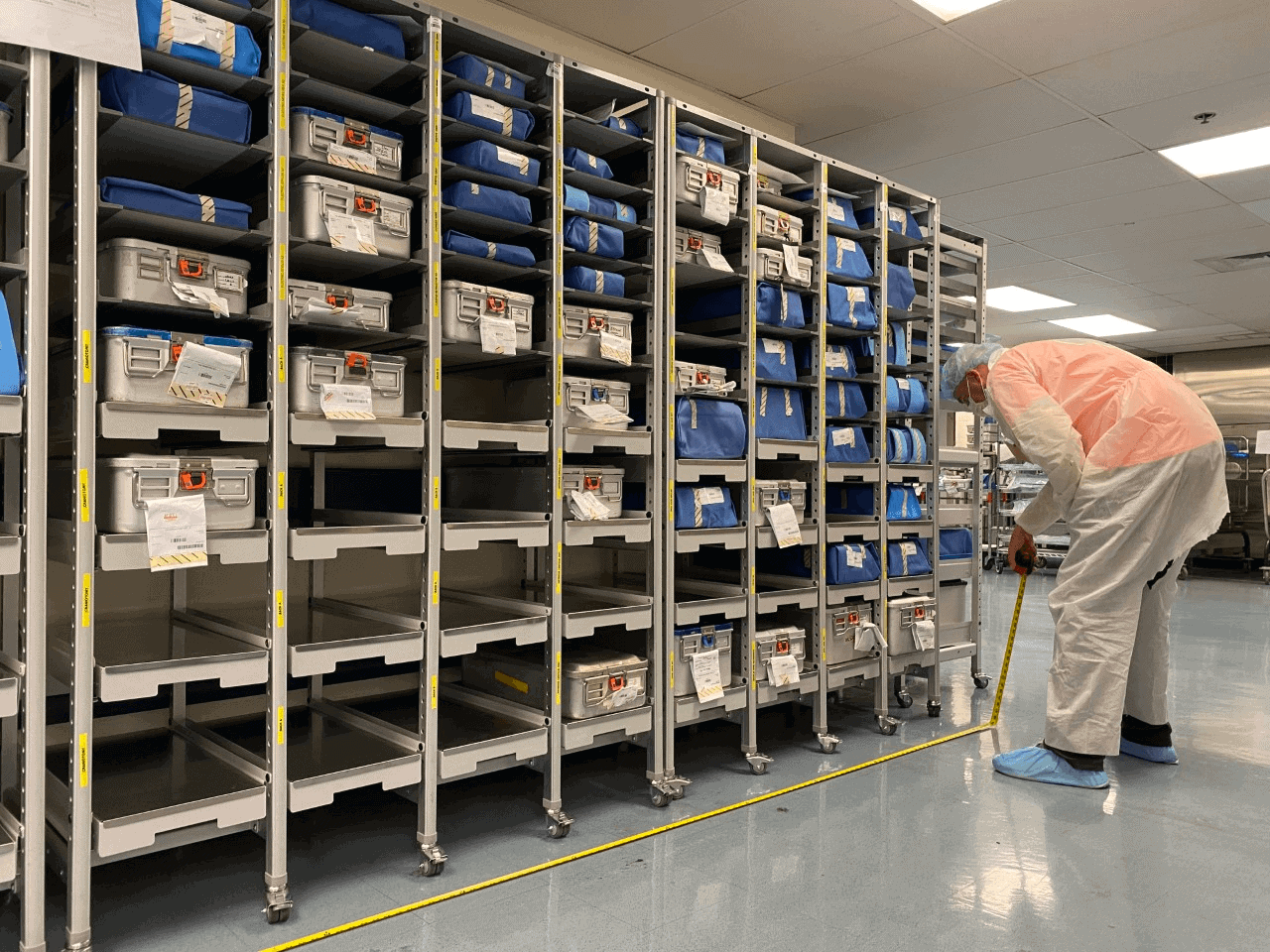
Mobile shelving systems mount traditional shelving units on wheeled carriages that roll along track systems installed in the floor. ASRS (Automated Storage and Retrieval Systems) utilizes robotics and software to automatically place and retrieve items from defined storage locations.
VLMs (Vertical Lift Modules) operate like an internal elevator, extracting trays from two vertical columns and delivering them to an ergonomic picking station. Static shelving represents traditional fixed storage constructed of steel, stainless steel, or wire configurations with adjustable shelves, while ASRS provides the highest density per square foot compared to other systems.
Mobile shelving units provide 50% to 100% increases in storage capacity compared to conventional static systems. Mobile shelving reduces required floor space by nearly half compared to conventional static shelving configurations.
Mobile shelving delivers 2-3x density increases over baseline static systems. Vertical Carousel systems achieve 3-4x density increases, while VLM implementations deliver 4-6x density improvements.
The global mobile shelving market was valued at $1.89 billion in 2026 and is projected to reach $3.78 billion by 2035. The ASRS market was valued at $9.86 billion in 2025 and is projected to reach $14.80 billion by 2030.
The mobile shelving market is growing at 8% CAGR, driven by urbanization and space optimization demands. This growth reflects fundamental shifts in healthcare infrastructure planning, where storage transitions from afterthought to strategic asset.
North America commands approximately 45% of the global market share in healthcare data storage systems. The Asia-Pacific region accounted for 36.6% revenue share in the ASRS sector in 2024.
North American dominance stems from robust regulatory environments, including HIPAA requirements and significant technological advancements. Asia-Pacific growth acceleration results from massive healthcare infrastructure expansion and an increasing operational cost efficiency focus.
Space efficiency accounts for 25% of decision-making weight when healthcare facility managers evaluate storage systems. Cost effectiveness accounts for 20% of decision-making weight, while compliance requirements represent an equal 20% of decision weight.
Accessibility represents 15% of decision weight in system selection processes. Durability represents 10% of decision weight, reflecting the need for systems capable of withstanding 24/7 healthcare environment demands.
Healthcare facilities employ distinct storage categories ranging from static shelving to fully automated systems. Each category offers specific advantages aligned with different operational requirements, space constraints, and budget parameters.
System selection depends on department needs, available floor and vertical space, and long-term capacity projections. Understanding the functional differences between system types enables facilities to match solutions with specific workflow requirements.
Static shelving maintains 60-70% adoption rates across healthcare facilities as the baseline storage approach. Mechanical mobile shelving, also known as roller racking, holds 20-25% market share, offering balanced cost and capacity improvements.
Powered mobile systems represent 5-10% market share, while automated ASRS solutions account for 3-5% of implementations. Mini Load ASRS systems are particularly well-suited for pharmaceutical and medical supply storage applications requiring precise inventory control.
Compactus systems are specialized high-density mobile shelving units designed for space-constrained areas, particularly those with low ceilings or overhead obstructions. These systems maintain high-density capabilities while accommodating challenging architectural constraints common in facility renovations.
Compactus systems may require custom engineering to address specific ceiling heights and structural limitations. These specialized configurations have a higher cost per unit than standard mobile shelving but enable space optimization in otherwise unusable areas.
The initial purchase price represents only one component of the total investment in healthcare storage systems. Comprehensive financial analysis must incorporate installation costs, ongoing maintenance requirements, and operational impacts on labor efficiency. Lower storage costs over time usually come from systems that use space and labor more efficiently, not from the cheapest purchase price.
Lifecycle cost analysis reveals that systems with higher upfront costs often deliver superior total cost of ownership over 10-year periods. Labor efficiency improvements and space optimization benefits frequently offset initial capital expenditures within 3-5 years.
Static shelving demonstrates $170,000 in 10-year total costs for standard implementations. Mechanical mobile shelving achieves $128,000 in 10-year total costs despite a higher initial investment.
Mechanical mobile shelving provides 25% savings compared to static shelving over 10-year analysis periods. Powered mobile systems achieve lower 10-year TCO than static shelving despite higher upfront costs through substantial labor efficiency gains, while static shelving has the lowest initial cost but the highest 10-year labor costs.
Static shelving costs range from $15 to $30 per cubic foot of storage capacity. Mechanical mobile shelving costs range from $35 to $40 per cubic foot.
Powered mobile shelving costs range from $45 to $60 per cubic foot. Vertical Carousel systems cost $80 to $120 per cubic foot, while VLM implementations range from $100 to $150+ per cubic foot.
Adoption rates vary significantly based on facility size, type, and geographic location. Large acute care hospitals demonstrate the highest implementation rates, while smaller facilities and rural locations show more conservative adoption patterns.
Budget availability, space constraints, and operational complexity drive adoption decisions across healthcare segments. Understanding these demographic patterns helps facilities benchmark their storage strategies against comparable organizations.
Large acute care hospitals with 500+ beds show approximately 75% adoption of high-density mobile or automated solutions in critical departments. Medium hospitals with 200-500 beds show 50% adoption rates, typically favoring mechanical mobile shelving.
Long-term care facilities show 40% adoption rates for high-density storage implementations. Long-term care facilities care for over 1.3 million residents daily in the US, and these facilities show 84% adoption rates for HIT and EHR systems, indicating strong technology acceptance.
Rural facilities lag behind urban centers by 23 percentage points in technology implementations, including advanced storage systems. Urban adoption of mobile shelving reaches 65%, while rural adoption remains at 35%.
Urban hospitals have higher capital budgets supporting advanced system investments than rural facilities. Urban facilities face greater space constraints than rural facilities, creating stronger economic drivers for high-density implementations.
Successful implementation requires structured planning processes that incorporate workflow analysis, end-user input, and regulatory compliance verification. Facilities must approach storage as an integrated supply chain component rather than an isolated infrastructure.
Proven implementation strategies emphasize comprehensive needs assessment, accurate future growth projections, and phased deployment approaches. These methodologies minimize operational disruption while maximizing system utilization and staff acceptance.
Organize inventory in a centralized manner to promote efficiency and reduce errors. Establish dedicated storage areas segregated by product type, expiration dates, and usage frequency to maintain organized systems. Sound storage design follows best management practices and a documented standards and quality assurance policy, so staff handle each item the same way on every shift.
Implement First-In, First-Out (FIFO) systems to ensure proper stock rotation and minimize expired inventory waste. Align storage systems with staff workflows, and design systems to support rapid access during emergencies when seconds matter for patient outcomes. Connect these workflows to your inventory management systems so inventory levels stay accurate and the facility avoids both shortages and overstock.
Inadequate Space Assessment represents a critical error where failing to account for 5-10 year growth projections leads to premature system obsolescence. Ignoring Workflow creates problems when implementing without consulting end-users, leading to staff resistance and efficiency losses.
Focusing solely on Initial Cost ignores substantial long-term costs associated with labor inefficiency and maintenance requirements. Insufficient Training occurs when deploying complex systems without comprehensive staff training, resulting in errors, underutilization, and safety risks.
A structured decision framework guides facilities through systematic evaluation of current conditions, future requirements, and available solutions. This methodology ensures a comprehensive analysis of all factors affecting long-term storage performance.
The framework incorporates quantitative metrics, including space utilization, labor efficiency, and regulatory compliance, alongside qualitative factors such as workflow integration. Data-driven analysis produces defensible business cases supporting capital investment decisions.
Assess Current State by evaluating current capacity, workflow bottlenecks, compliance gaps, and space constraints through detailed facility analysis. Define Future Requirements by determining necessary capacity increases, desired workflow improvements, and specific regulatory needs.
Account for 5-10 year growth projections during space assessment to prevent premature obsolescence. Consult end-users, including nurses and technicians, before implementing systems to ensure workflow alignment and staff acceptance. Plan for demand variability and set safety stock for high-use items, since supply usage rarely stays flat across seasons or service lines.
Evaluate Options by comparing systems using a weighted matrix incorporating Space Efficiency at 25%, Cost at 20%, Compliance at 20%, Accessibility at 15%, Durability at 10%, and Customization at 10%. Develop a business case through conducting a 10-year TCO analysis comparing the proposed system against the status quo.
Implement and Optimize by executing installation with minimal disruption and providing thorough staff training. Establish ongoing performance metrics and maintenance schedules to ensure sustained system effectiveness and continuous improvement.
The evolution from traditional static shelving to sophisticated automated systems reflects healthcare's broader transformation toward operational excellence and patient-centered care. Facility managers who understand market dynamics, system capabilities, and implementation best practices position their organizations for sustained competitive advantage through space optimization and workflow efficiency.
Strategic storage planning delivers measurable returns through reduced real estate costs, improved inventory accuracy, and enhanced staff productivity. Organizations implementing comprehensive planning guides and implementation strategies achieve faster ROI realization while minimizing deployment risks and operational disruptions.
Distribution Systems International specializes in consultative healthcare storage solutions designed specifically for acute care facilities seeking measurable operational improvements. Our LEAN methodology approach and turnkey implementation process support Materials Management directors and SPD managers in achieving quantifiable efficiency gains while maintaining full regulatory compliance.
Since 1990, Distribution Systems International has helped acute care facilities turn cluttered storage into space that supports patient care. Our team begins with a complimentary on-site storage analysis, then delivers CAD layouts, LEAN inventory planning, and turnkey installation that keeps your operation running. Schedule your free storage analysis with Distribution Systems International today.

With 21 years of sales management, marketing, P&L responsibility, business development, national account, and channel management responsibilities under his belt, Ian has established himself as a high achiever across multiple business functions. Ian was part of a small team who started a new business unit for Stanley Black & Decker in Asia from Y10’ to Y14’. He lived in Shanghai, China for two years, then continued to commercialize and scale the business throughout the Asia Pacific and Middle East regions for another two years (4 years of International experience). Ian played college football at the University of Colorado from 96’ to 00’. His core skills sets include; drive, strong work ethic, team player, a builder mentality with high energy, motivator with the passion, purpose, and a track record to prove it.