Storage errors account for 30–45% of all robotic instrument damage; a single incident can destroy a $15,000–$30,000 instrument beyond repair or reimbursement.
Tips, wrists, and cables represent 85% of all failures. Custom trays, foam protectors, and proper spacing address the top damage mechanisms directly.
Environmental control isn't optional. Humidity above 60% causes irreversible corrosion within 30–90 days. Continuous monitoring at $500–$5,000 prevents losses exceeding $100,000.
Documentation determines reimbursement. Manufacturers deny 42.1% of failure claims. Environmental logs, inspection records, and photos are the difference between a reimbursed loss and an absorbed one.
The ROI is immediate. Preventing 2–3 instrument losses per year pays for a climate-controlled cabinet. Comprehensive protective storage achieves payback in 12–24 months with ROI exceeding 173%
Robotic surgical instruments are among the most expensive assets in your sterile processing department, and among the most vulnerable. A single advanced energy device or bipolar forceps costs $15,000–$30,000, with a usable lifespan of just 10–20 procedures. Yet research shows that roughly 20% of reusable robotic instruments fail before they reach that limit. Storage-related errors, moisture, stacking, environmental drift, and poor organization account for an estimated 30–45% of all instrument damage.
This guide breaks down exactly where robotic instrument storage failures occur, what they cost, and which preventive measures deliver the fastest return on investment.
What Does "Storage Error" Mean For Robotic Instruments In Sterile Processing?
A storage error is any mishandling, environmental lapse, or organizational failure that damages a robotic surgical instrument after sterilization but before its next use. These errors happen during transport, cooling, shelving, and long-term storage. Because robotic instruments contain precision-engineered tips, cables, and electronics built to sub-millimeter tolerances, even minor storage mistakes can cause thousands of dollars in robotic instrument damage.
What Counts As A Storage Error Between Sterilizer, Transport, And The Sterile Storage Area?
Storage errors fall into six categories spanning the full post-sterilization chain:
Storing instruments wet or before full drying, trapped moisture initiates corrosion and microbial growth, undermining the sterilization you just completed.
Physical damage during transport, drops, vibration, and compression from non-dedicated containers.
Improper stacking or overcrowding on shelves, weight causes misalignment or fracture of delicate tips, wrists, and cable assemblies.
Environmental control failures, temperature or humidity drifting outside 18–23 °C / 30–60% RH accelerates corrosion and risks static damage to electronics.
Improper sterile packaging handling, folding, creasing, or orienting packages in ways that stress seals compromises the sterile barrier.
Storing without restraints or cushioning, unsecured instruments make direct contact, causing scratches, tip deformation, and cable kinking.
Why Do Storage Conditions Matter Even After A "Successful" Sterilization Cycle?
Sterilization only guarantees sterility at the moment the cycle ends. From that point forward, the instrument's environment determines whether it stays sterile and functional or degrades before reaching the patient.
A retrospective analysis of 757 reusable robotic forceps across 1,906 surgeries (2022–2024) found roughly 20% failed prematurely before reaching their 10–20-use lifespan. Every contamination event from poor storage forces an extra reprocessing cycle at $500–$2,000 per run, and each cycle burns one use from the instrument's limited life. A $15,000 instrument rated for 10 uses loses $1,500 in value per unnecessary reprocessing cycle. Proper sterile instrument storage is the only way to protect that investment after the sterilizer door opens.
What Exactly Is Getting Damaged When Robotic Instruments Are Stored Incorrectly?
Which High-Risk Components Fail First From Moisture, Pressure, Or Impact?
Component
Failure Share
Primary Storage Risk
Tips & wrists
46.9% of all failures
Contact damage, drops, stacking without protectors
Cables
30.0%
Kinking from improper positioning; vibration in transport
Disks
8.2%
Compression from overcrowding or heavy items on top
When you damage a $15,000 instrument, and the manufacturer denies reimbursement for mishandling, your facility eats the full cost. That 42.1% denial rate turns storage errors into budget line items fast.
How Does Downtime Create "Hidden Costs" Beyond The Repair Bill?
Case delays cost over $2,000/minute. A 30-minute delay = $60,000. A cancellation = $120,000–$240,000.
One delayed case per month from storage issues = $360,000–$720,000/year.
Unreliable reprocessing forces 50% inventory increases, up to $425,000/year in unnecessary purchases. Soundspare parts management practices eliminate this waste.
Unreimbursed failures totaled $75,950 over three years in one study (~$39.80–$50.60/surgery).
When Does "Repair" Become "Replace," And Why Does That Change the Math?
Tips, wrists, and cables, the three most failure-prone components, generally cannot be repaired. Replacement is the default path.
Sending an instrument for repair can void the manufacturer's warranty, eliminating the 57.9% reimbursement rate. On $100,000 in annual failures, that warranty gap = $57,900. Ineffective reprocessing reduces instrument value by 10–13% per cycle. Every lost use on a $15,000–$30,000 instrument = $750–$3,000 in destroyed value.
Which Storage Errors Most Commonly Damage Robotic Instruments?
What Happens When Instruments Are Stored Wet Or Put Away Before Full Drying?
Moisture in wrist joints and cable channels initiates corrosion and microbial growth.
Humidity above 60% around a wet instrument accelerates fungi/bacteria on surfaces and inside packaging.
Moisture on electronic circuits causes short circuits and component failure.
What Happens When Trays Are Stacked, Or Weight Is Placed On Delicate End Effectors?
Stacking causes tip damage at $15,000–$30,000 per advanced instrument; tips/wrists account for 46.9% of all failures. Crush damage from overcrowding costs $12,000–$28,000 per incident, and the problem compounds as programs grow (market expanding 13.7%/year) without proportional storage expansion.
What Happens When Tips And Jaws Aren't Protected From Contact Damage?
Instruments designed to sub-millimeter tolerances lose calibration from minor contact. Dropped instruments cost $8,000–$30,000 to replace. Foam protectors ($174–$210/50-pack) and protective cases (~$162 each) cost a fraction of one failure.
What Happens When Instruments Are Stored In The Wrong Position Or Without Restraints?
Unrestrained instruments shift during any shelf vibration or adjacent retrieval, causing cable kinking (cables = 30% of all failures), tip-to-tip contact damage, and packaging stress that compromises sterile seals. Best practices for sterile processing department storage eliminate the most common positioning mistakes.
What Happens When Storage Exposes Instruments To Corrosion Risks?
Humidity above 60%: Visible corrosion within 30–90 days, irreversible, $10,000–$25,000/instrument.
Humidity below 30%: Electrostatic discharge risk to electronics.
Environmental control failure across a storage area can damage multiple instruments simultaneously, $100,000+ losses from a single event.
What Happens When Transport-To-Storage Handling Adds Drops, Vibration, Or Compression?
Instruments are most vulnerable in transit. The top transport failures: non-dedicated containers lacking cushioning, rushing that leads to drops ($8,000–$30,000/instrument), and inadequate securing that allows repeated micro-impacts causing cable and disk fatigue.
What Warning Signs Tell You Storage Damage Is Already Happening?
What Visual Cues Should Trigger Concern Before The Next Case?
Spots, discoloration, or pitting on metal surfaces (early corrosion)
Deformation or bending of tips, shafts, or housings
Frayed, kinked, or exposed cable wires
Compromised sterile packaging, moisture marks, creasing, or broken seals
What Functional Cues Suggest Internal Damage?
Binding or rough actuation during articulation testing
Reduced or inconsistent grip strength
Unexpected resistance during wrist movement
IFUs require inspection under 4× magnification, functional testing should accompany every visual check
What Trend Patterns In Tracking Data Point To Storage As The Root Cause?
Pattern
Likely Root Cause
Repeat failures of same instrument type (e.g., fenestrated bipolar at 45.9%)
Inadequate storage accommodation for that design
Failures clustered in same tray or case
Overcrowding, poor cushioning, or tray layout flaw
Failures clustered from same cabinet/shelf location
Localized environmental problem (humidity pocket, temp gradient)
Spike after seasonal change
HVAC can't compensate for ambient shift
Higher failure rate on specific shift
Handling or training gap
What Storage Conditions Are Considered "Safe" For Sterile Packages And Robotic Instruments?
What Temperature And Humidity Targets Are Commonly Used In Sterile Storage Design?
Parameter
Sterile Storage
Tolerance
Temperature
64–73 °F (18–23 °C)
±2 °F
Relative Humidity
30–60%
±5%
Air exchanges (total)
4/hour
—
Air pressure
Positive
—
Monitoring
Continuous 24/7
—
Shelving height from floor
Min. 8 inches, solid bottom shelves
—
What Does "Clean, Dry, And Protected" Mean In Infection Control Terms?
Clean: Free from bioburden. Manual cleaning involves up to 14 steps per device. Automated cleaning cuts time by 25%.
Dry: No residual moisture. Humidity held at 30–60% RH throughout storage.
Protected: Minimum 2-inch spacing. Cushioned. Enclosed cabinets away from contaminants and environmental fluctuations.
What Should Your Team Standardize If AAMI ST79 Doesn't Mandate One Universal Range?
Standardize on 18–23 °C / 30–60% RH with ±2 °F and ±5% tolerance. Log temp and humidity every 5 minutes. Set warning alerts for deviations sustained longer than 15 minutes. Retain data for a minimum of 3 years for compliance, warranty support, and root-cause investigations.
Who Should Own Storage Quality So Errors Don't Slip Between Departments?
What Roles Touch The Instrument Between Sterilizer And Case Cart?
What Accountability Prevents "No One's Job" Storage Mistakes?
Assign a named storage quality owner with authority over placement, tray layout, and environmental escalation, not a committee, a person.
Require sign-off at each handoff: post-sterilizer → transport → shelf → case cart.
Virginia Mason Medical Center cut sterile processing errors from 3% to 1.5% (50% reduction over 37 months) with color-coding and shadow boards.
Barcode or RFID tracking reduces tray assembly time by 50% and prevents up to $425,000/year in unnecessary purchases frominventory control failures.
How Do You Build A Storage Process That Prevents $15,000 Damage Events?
A reliable storage workflow eliminates the gaps where instruments get wet-shelved, stacked, dropped, or exposed to environmental drift, and serves as a core risk mitigation strategy for your robotic program.
What Step-By-Step Storage Workflow Removes The Most Common Failure Points?
Confirm instrument fully dry per IFU drying protocol.
Inspect under 4× magnification, tips, wrists, cables, housings, and electrical connections.
Place in the designated custom tray with foam cushioning per the shadow board.
Transport in a dedicated, cushioned container, secure instruments to prevent movement.
Verify storage area environmental conditions on the monitoring dashboard before shelving.
Shelve with a minimum 2-inch spacing. Never stack trays.
Log placement (barcode/RFID scan or manual sign-off).
What Must Be Documented To Defend Root-Cause Findings And Vendor Conversations?
The 42.1% reimbursement denial rate drops when facilities produce complete records:
What Are The Exact Steps To Eliminate Storage-Driven Damage?
Step 1: Prevent Moisture-Related Damage
Verify complete drying per IFU before tray placement, no exceptions.
Monitor humidity, target 30–60% RH; alert at ±5% deviation sustained >15 min.
Use dehumidification where needed (electronic dry cabinets $699–$9,000; industrial units ~$5,056).
Step 2: Stop Contact And Compression Damage In Tray Layout
Custom robotic instrument trays ($200–$1,000 each) with foam protectors ($174–$210/50-pack).
Maintain 2-inch minimum spacing; allow 30–40% excess capacity for growth.
Never stack; use vertical storage (increases capacity 60%+ without stacking).
Step 3: Prevent Drops And Vibration In Transport-To-Storage
Dedicated transport containers with instrument-specific cushioning.
Secure every instrument; build adequate transport time into workflow.
Minimize transport distance and frequency.
Step 4: Catch Environmental Drift
Install continuous monitoring (24/7), basic systems $500–$1,500; comprehensive $2,000–$5,000.
Warning alert: ±2 °F or ±5% RH sustained >15 min; critical alert: ±5 °F or ±10% RH.
Review trends weekly; report to leadership monthly.
Step 5: Improve Labeling, Mapping, And Chain-Of-Custody
Shadow boards and color-coding for every storage position.
Barcode/RFID scan-in/scan-out at each handoff.
Map every storage zone to its environmental sensor.
Step 6: Make Correct Storage Automatic Through Training
Complete manufacturer training (Intuitive, Medtronic) for all SPD, periop, and biomed staff.
Annual competency assessments; refresher training after any damage incident.
Train every role that touches instruments. Avoiding common inventory management mistakes starts with making sure every team member understands the cost of getting it wrong.
Biomed engineering, if monitoring data suggests an equipment malfunction.
Frequently Asked Questions
Can You Store Robotic Instruments Long-Term Without Reinspection?
No. Inspect under 4× magnification before every use, regardless of storage duration. Extended storage increases exposure to environmental fluctuations and packaging degradation. Follow daily, post-cleaning, weekly, monthly, and annual inspection cadences.
Can You Store Instruments Assembled, Or Should Components Be Separated?
Follow the manufacturer's IFU. Generally, store in the IFU-specified configuration using recommended trays (e.g., InstruSafe Da Vinci Xi). Unnecessary separation adds handling events, and every handling event is a damage opportunity.
Should You Use Desiccants, And When Can They Backfire?
Helpful in chronic high-humidity facilities, especially in the summer months.
Backfire when they pull the cabinet humidity below 30%, creating ESD risk to electronics.
Never substitute for proper HVAC-based control; pair with a humidity sensor and set a 30% low-limit alert.
How Do You Prevent Repeat Failures Tied to One Cabinet, Shelf, Or Transport Route?
Map every failure to its storage location, look for geographic clusters.
Cross-reference with environmental monitoring data for that zone.
Rotate problem locations out of use until the root cause is resolved.
The Storage Fixes That Pay For Themselves First
What Three Storage Changes Most Reliably Prevent High-Cost Damage?
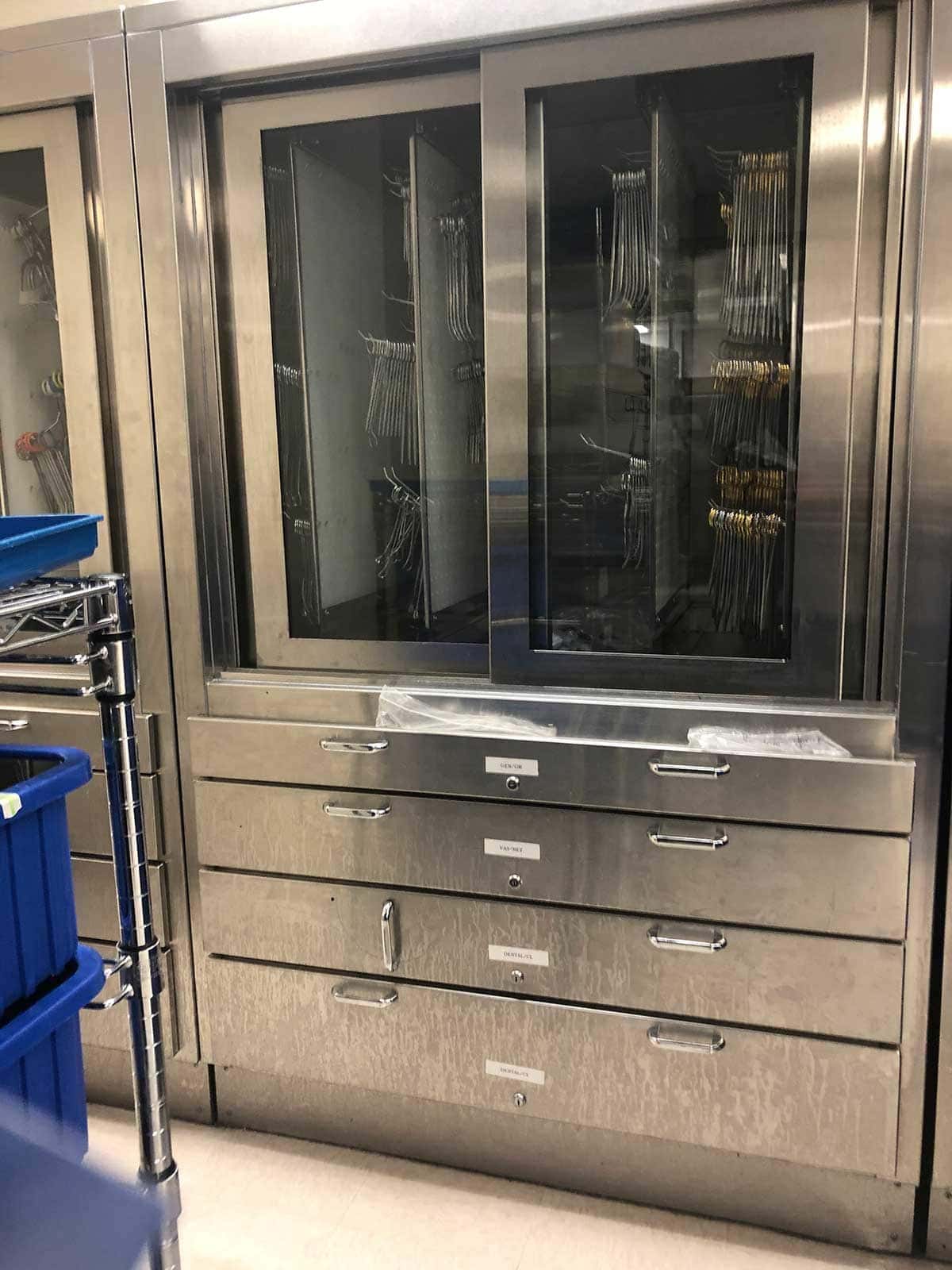
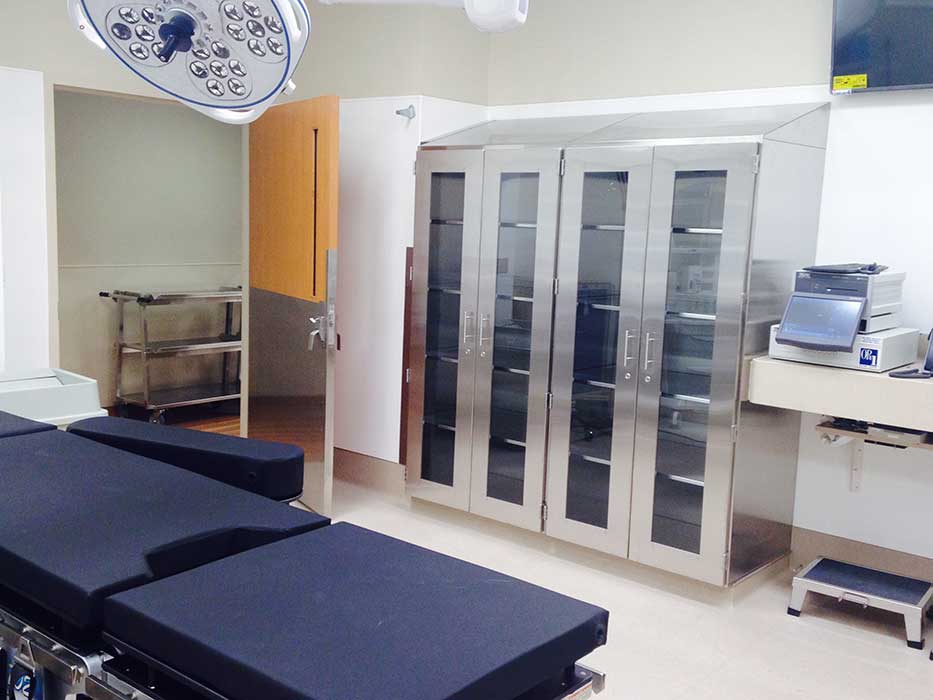
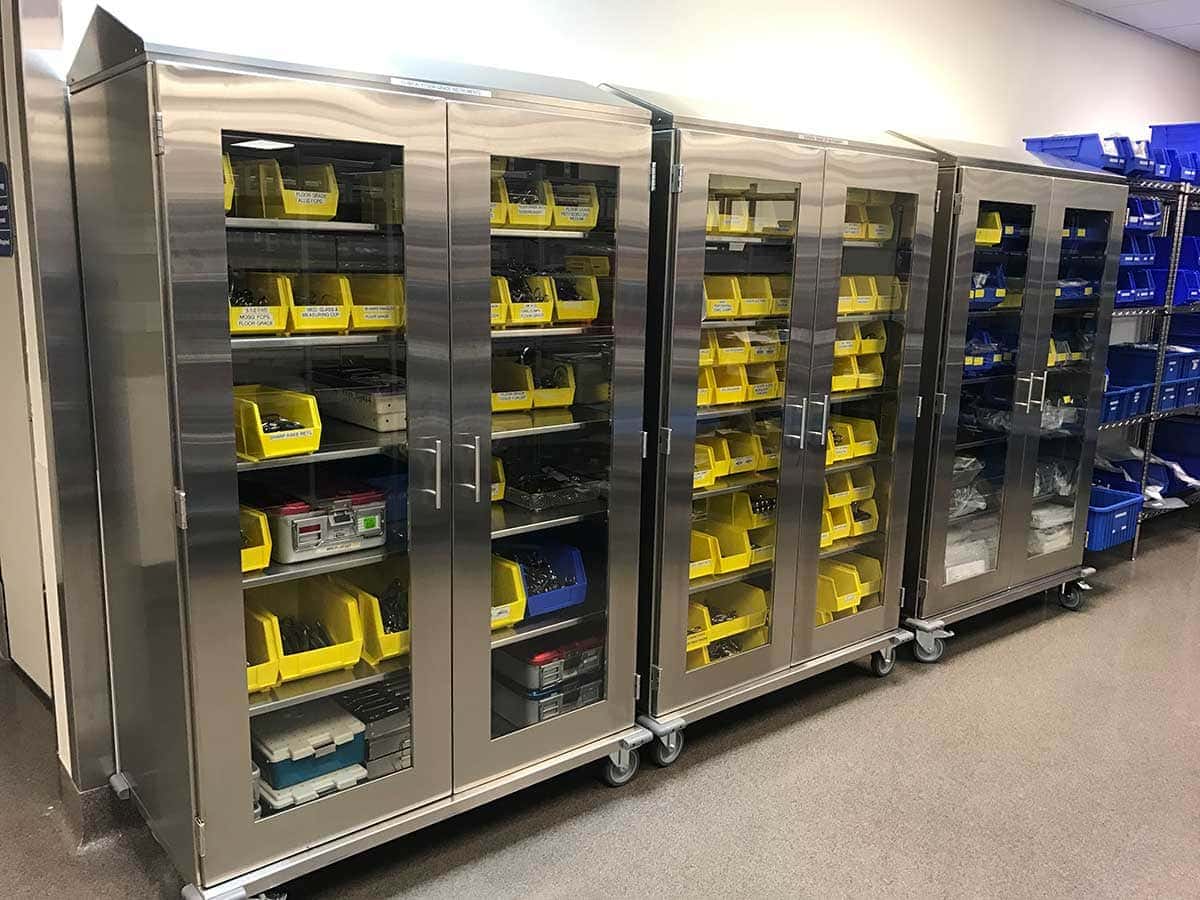
Eliminate moisture, enforce complete drying, and maintain 30–60% RH. Corrosion is irreversible at $10,000–$25,000/instrument. Preventing 2–3 losses/year pays for a climate-controlled cabinet ($1,555–$32,115).
Protect tips and wrists, custom trays, foam protectors, 2-inch spacing. Tips/wrists = 46.9% of all failures and are the most expensive to replace.
Install continuous environmental monitoring, $500–$5,000 catches drift before it becomes a $100,000+ multi-instrument event. Payback on comprehensive protective storage: 12–24 months; conservative ROI: 173%.
What Simple Metric Proves Improvement Month Over Month?
Metric
Baseline
Target
Damage rate (failures ÷ cases)
7.8%/operation
Reduce by 50%
Premature failure rate
~20%
Single digits
Humidity excursion count (>60% or <30%)
Varies
Zero sustained
Unreimbursed failure cost/quarter
42.1% denial rate
Decrease via documentation
Case delays from instrument issues
Varies
Zero ($60,000+ saved per avoided delay)
Storage Errors Are Preventable, And The Cost Of Inaction Isn't
Every dollar lost to a damaged robotic instrument traces back to a gap in the storage process, wet shelving, overcrowded trays, environmental drift, or a missed handoff. These aren't equipment problems. They're workflow problems. The facilities that eliminate storage-related losses don't do it with a single purchase. They do it by enforcing complete drying, protecting high-failure components, monitoring environmental conditions continuously, and building accountability into every handoff between sterilizer and case cart. The investment is modest. The cost of doing nothing is not.
Ready to protect your robotic instrument investment? Contact DSI Direct to discuss storage solutions engineered for your facility's robotic program.
With 21 years of sales management, marketing, P&L responsibility, business development, national account, and channel management responsibilities under his belt, Ian has established himself as a high achiever across multiple business functions. Ian was part of a small team who started a new business unit for Stanley Black & Decker in Asia from Y10’ to Y14’. He lived in Shanghai, China for two years, then continued to commercialize and scale the business throughout the Asia Pacific and Middle East regions for another two years (4 years of International experience). Ian played college football at the University of Colorado from 96’ to 00’. His core skills sets include; drive, strong work ethic, team player, a builder mentality with high energy, motivator with the passion, purpose, and a track record to prove it.