Operating room storage is evolving from static cabinetry into integrated workflow systems that support automation, robotics, and real-time inventory visibility. Hospitals are prioritizing modular designs, RFID-enabled tracking, and specialized robotic surgery storage solutions to address rising labor costs, surgical delays, supply chain constraints, and limited floor space in healthcare facilities. The global operating room equipment market reached USD 48.61 billion in 2024 and is projected to grow to USD 75.39 billion by 2030 at 7.8% CAGR.
This growth reflects a shift in capital allocation, with OR storage trends 2026 emphasizing technology-enabled systems over traditional fixed installations. Renovation budgets now consume 35% of hospital capital spending and are expected to rise to 37% in 2025. Decision-makers increasingly evaluate storage through cost discipline, operational efficiency, storage capacity, and digital integration rather than upfront price alone.
Operating room storage systems are divided into four categories: traditional fixed cabinetry, modular casework, smart automated solutions, and robotic-assisted storage. Traditional cabinetry dominates the installed base with 66.2% market share, while smart and modular categories capture disproportionate shares of new renovation budgets. Each category serves distinct facility types, budget constraints, and operational priorities based on digital maturity and case volume.
Traditional OR storage consists of welded stainless steel storage cabinets with tempered glass doors, sloped tops, drawer cabinets, adjustable components, and locking hardware. These systems remain the most familiar and cost-effective option, with individual cabinets priced between USD 3,000 and USD 9,000. Traditional cabinetry and fixed casework hold 66.2% market share due to lower upfront costs and standardized procurement processes.
Fixed installations provide long-term durability and infection-control compliance through easy-clean surfaces and sealed construction. However, they require longer renovation timelines and offer limited reconfiguration flexibility when surgical programs expand or workflow requirements change.
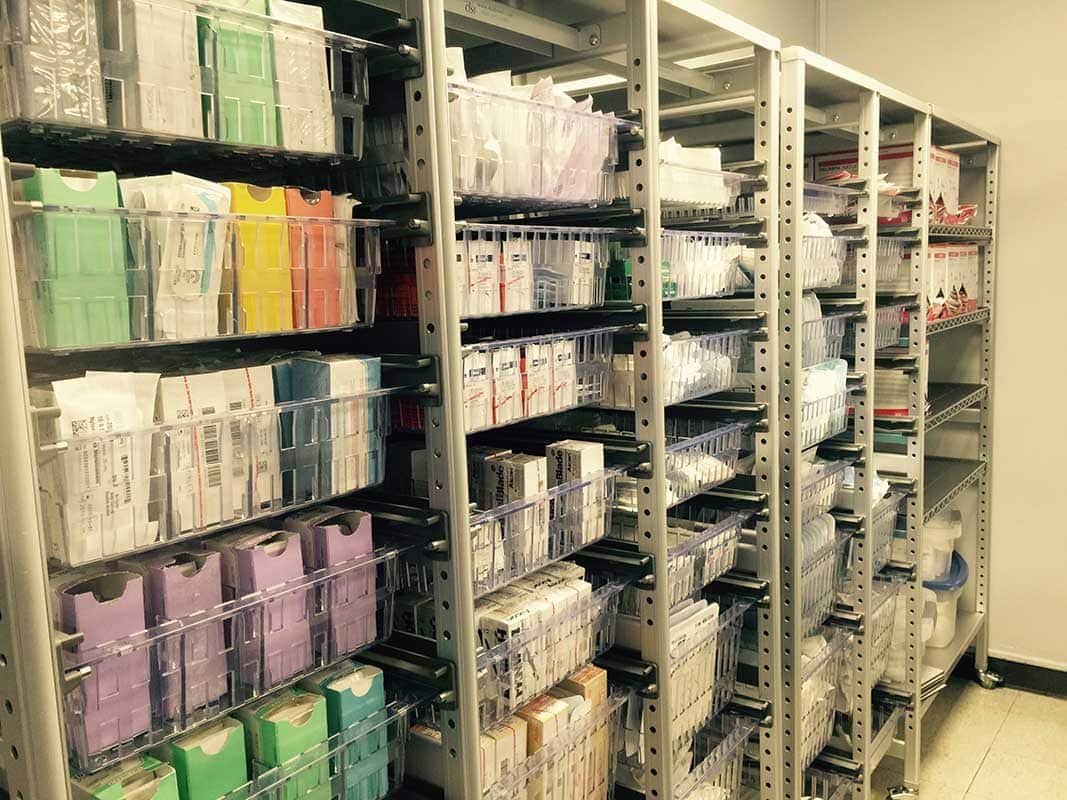
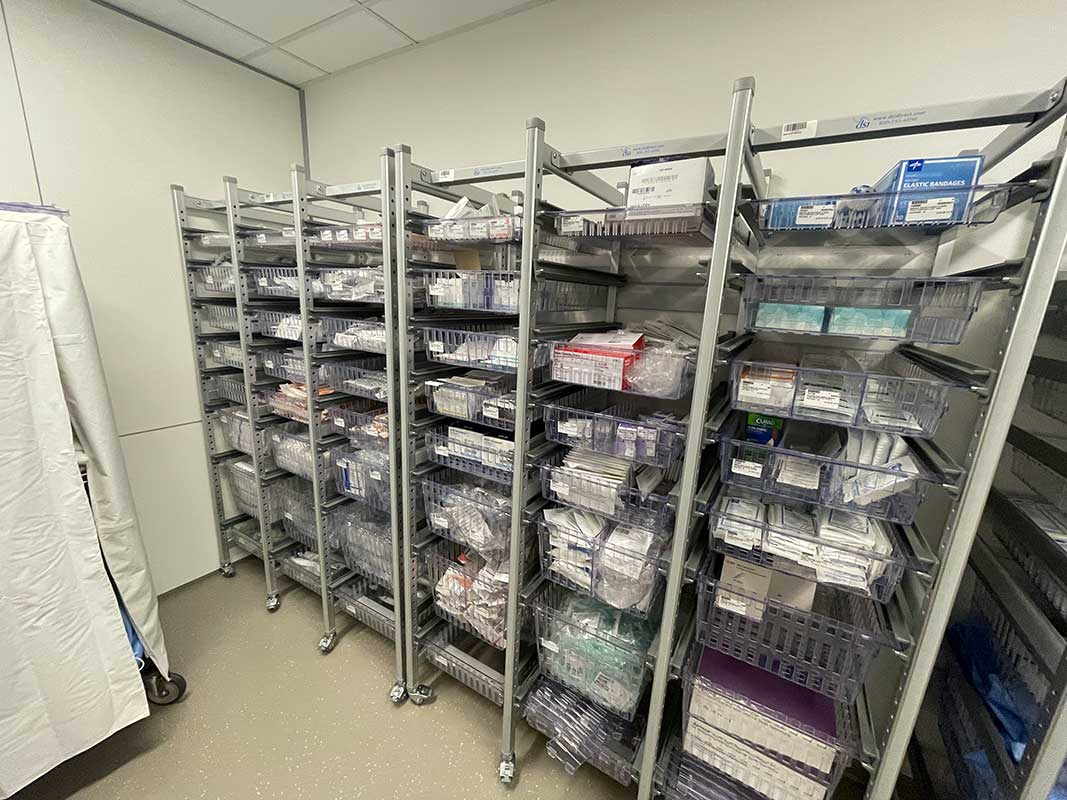
Modular casework offers reconfigurable interiors, modular compartments, interchangeable components, customizable storage solutions, and lower installation burden compared to fixed millwork. Modular storage systems hold 10.5% market share but are gaining adoption in renovation-heavy environments. The seven-year depreciation rate for modular casework versus 31 years for fixed casework creates a compelling financial argument for capital committees.
Modular systems reduce installation disruption and support phased expansion across multi-site health systems using standardized templates. Factory-built components in aluminum-clad, laminate, or stainless finishes, including open shelving and enclosed cabinet variants, enable faster deployment and easier future reconfiguration.
Smart storage centers on RFID-enabled cabinets, software dashboards, and replenishment workflows that provide automatic hands-free inventory counting and tracking. The RFID smart cabinets market valued at USD 1.19 billion in 2024 is projected to reach USD 2.21 billion by 2030 at 10.8% CAGR. Smart or automated storage holds 7.7% market share but represents one of the fastest-growing categories.
These systems deliver better supply visibility, lower stock-out risk, and stronger compliance through audit trails and controlled access. Enterprise implementations using modular cell-based storage commonly reach mid-five-figure costs after software integration and workflow redesign.
Robotics programs require specialized storage for expensive accessories, robotic arms, and sensitive equipment that cannot be adequately protected in standard cabinets. Integrated and robotic-enabled storage holds 15.6% market share and is expanding rapidly in advanced surgical centers. Robotic-assisted solutions improve equipment readiness, reduce handling damage, and support closed-loop transport between sterile processing and operating rooms.
Robotic-assisted storage is specialized secure storage for robotic accessories, robotic arms, filtered cabinets, and closed-loop transport systems. These systems protect high-value robotics equipment through HEPA filtration, locking glass enclosures, and controlled environmental conditions. Specialty cabinets begin around USD 7,500, while complete hospital robotic delivery implementations cost USD 100,000 to USD 500,000 per hospital.
Filtered secure storage combined with high-density storage systems reduces contamination risk and ensures robotic components remain procedure-ready without last-minute cleaning or validation delays. High-capacity storage systems support centralized standardization and improve utilization across multiple robotic service lines.
Integration with surgical workflows reduces missing-item risk and improves first-case readiness through better supply positioning and replenishment visibility. Case cancellation reduction improved from 3.9% to 0.2% after implementing optimized perioperative inventory systems. Staff satisfaction increased from 1.7% to 80% when storage redesign eliminated unnecessary supply searches and workflow bottlenecks.
Workflow-integrated storage using dedicated workstations enables faster case turnover and reduces labor-intensive handling during high-volume surgical schedules. Clinical teams report fewer interruptions and improved procedural focus when supplies are organized by case type and frequency.
Hospital executives prioritize storage investments that address security, automation, quality patient care, and infrastructure modernization over lowest-cost procurement. Security and privacy risk ranks highest at 50% of hospital executives, reflecting growing cybersecurity and access-control concerns. AI and automation follow at 45%, quality patient care at 39%, and infrastructure modernization at 36%.
Security and privacy risk is prioritized by 50% of hospital executives, reinforcing demand for access-controlled and trackable storage environments. AI and automation at 45% supports adoption of RFID analytics and integrated replenishment platforms. Quality patient care at 39% favors storage that reduces missing-item risk, while infrastructure modernization at 36% supports phased OR upgrades.
Workforce costs at 34% and capacity constraints at 30% strengthen the case for automation and space optimization. OR efficiency at 26% and workforce burnout at 26% highlight storage layout as a throughput and retention issue.
Urban hospitals reach 81% adoption readiness proxy, while rural hospitals lag at 56% due to digital infrastructure and budget constraints. Large hospitals exceeding 400 beds achieve 96% adoption readiness, medium hospitals between 100–399 beds reach 80%, and small hospitals below 100 beds remain at 59%. System-affiliated hospitals at 86% readiness outpace independent hospitals at 37%, reflecting enterprise standardization advantages.
Large urban health systems represent the strongest market for smart, automated, and robotic-enabled storage due to existing digital maturity. Rural and critical-access hospitals adopt hybrid approaches using modular track systems combined with selective RFID tracking for high-value items.
OR storage renovation costs vary significantly based on project scope, existing infrastructure, and technology integration requirements. Healthcare construction costs range from USD 700–730 per square foot for new builds, while renovations span USD 245–402 per square foot, depending on complexity. Total project costs exceed cabinet pricing alone because construction typically represents 60–65% of budgets before owner costs, contingencies, planning, and commissioning.
Healthcare construction costs reach USD 700–730 per square foot for new surgical facilities with integrated storage and infrastructure. Moderate renovation costs USD 245–256 per square foot for cabinet replacement and layout optimization without major structural changes. Gut-and-rebuild renovation requires USD 385–402 per square foot when reworking utilities, infection control barriers, and load-bearing elements.
Complete hospital robotic delivery implementations cost USD 100,000 to USD 500,000 per hospital when including automated transport, accessory storage, and workflow integration. Limited cabinet refresh projects range from USD 15,000–75,000, while full-room storage-led renovations commonly exceed USD 250,000 after sequencing and downtime mitigation.
Construction represents 60–65% of total project cost, making installation coordination and phasing critical to budget control. Demolition adds USD 20–50 per square foot before new storage installation begins. Infection-prevention controls, night or weekend work, utilities relocation, validation, and inventory migration determine true renovation costs more than cabinet specifications alone.
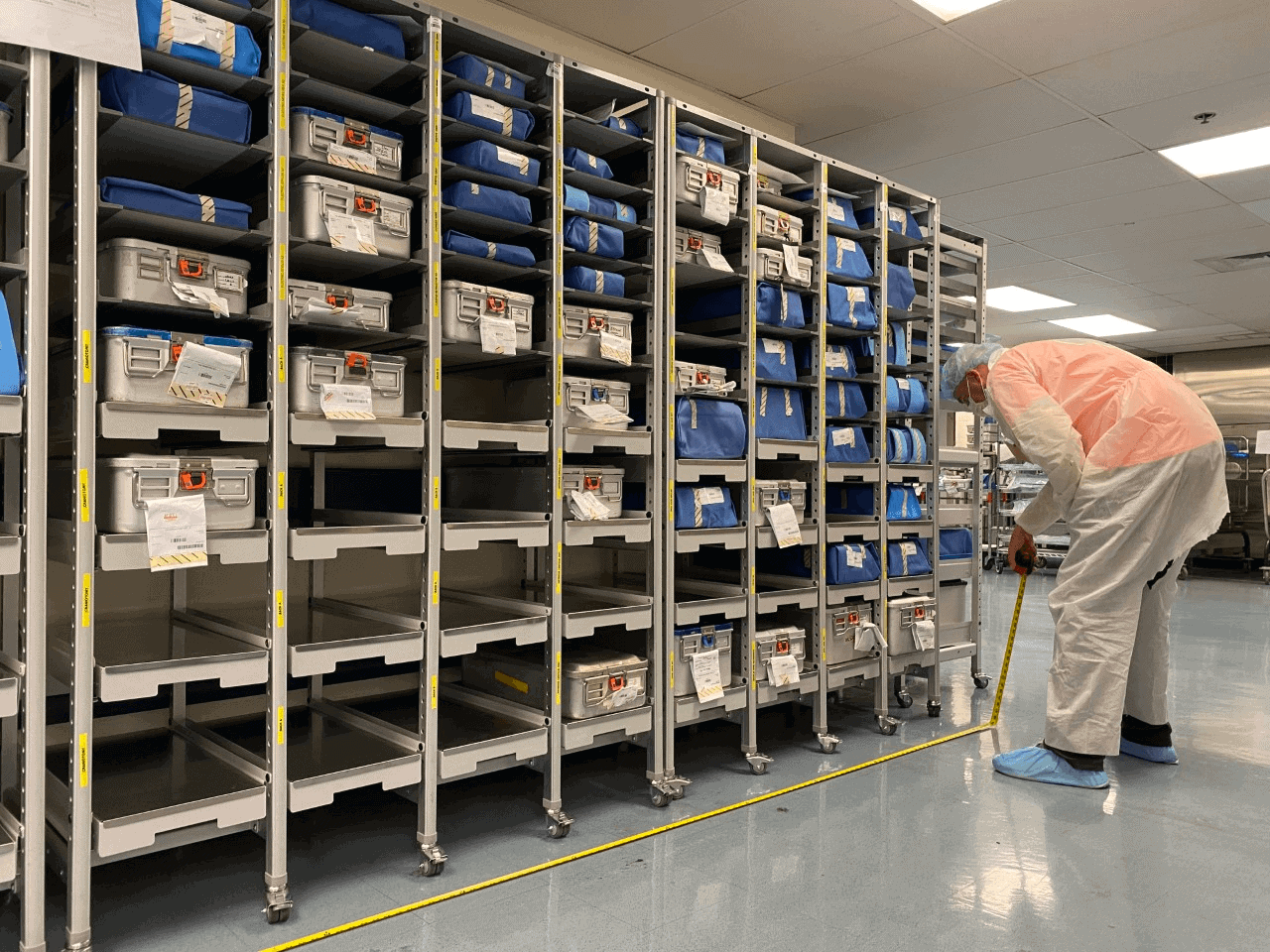
Modular OR shelving reduces installation burden and shortens renovation timelines compared to fixed millwork requiring extensive wall anchoring, wall-attachment devices, and finishing. Phased implementation using case transport systems minimizes perioperative downtime and maintains surgical throughput during upgrades.
Smart layout design zones supplies by case criticality and frequency while maintaining sterile separation and replenishment access. Improved storage organization reduces wasted clinical hours, lowers inventory carrying costs, and minimizes procedure delays caused by missing or misplaced items. Properly designed layouts deliver measurable operational improvements through better visibility, accessibility, and workflow integration.
Zone supplies by case criticality and frequency of use to reduce search time and improve first-case readiness. Place high-value RFID or robotics storage near procedure flow while preserving sterile separation between clean supply and contaminated zones. High-frequency items belong at point-of-use height and proximity, while low-turnover supplies can occupy secondary storage locations.
Specialized scope cabinets maintain proper environmental controls and accessibility for delicate endoscopic instruments without compromising storage capacity. Transparent inventory systems eliminate duplicate ordering and improve expiration-date rotation through better visibility and automated alerts.
Equipment failure causes 55.2%–57.9% of OR delays, while faulty or missing equipment delays 16% of scheduled surgeries. Insufficient or malfunctioning instruments account for 18.8% of surgery interruptions, most of which stem from poor visibility and disorganized storage. Improved layout and inventory management reduce these delays by ensuring supplies are procedure-ready and correctly positioned before the case starts.
Optimized storage using modular central storage systems reduces unnecessary walking, searching, and restocking tasks that contribute to staff burnout. Clinical teams report higher satisfaction when storage design eliminates preventable workflow friction and allows focus on patient care.
Advanced OR storage solutions deliver measurable financial benefits through inventory reduction, labor savings, depreciation optimization, and case cancellation prevention. Healthcare facilities implementing perioperative inventory optimization achieve 37.7% inventory reduction, 18% average tray size reduction, and 1,333 reprocessing hours saved annually. Combined annual labor savings of USD 39,995 and depreciation savings of USD 64,320 total USD 104,315 in documented annual benefits.
Inventory reduction of 37.7% frees working capital and reduces overstocking of expensive surgical supplies and implants. Average tray size reduction of 18% lowers sterilization labor, extends equipment lifespan, and improves turnover efficiency. Annual labor savings reach USD 39,995 through reduced handling, searching, and restocking time across perioperative teams.
Annual depreciation savings total USD 64,320 when optimized inventory systems reduce unnecessary instrument purchases and replacements. Reprocessing hours saved total 1,333 annually, creating labor capacity that can support increased case volume without additional staffing.
Storage innovations address missing-item risk, expiration waste, access-control failures, and supply-chain visibility gaps that compromise patient safety and compliance. Automated tracking systems prevent high-value implant loss and ensure proper documentation for regulatory audits. Controlled-access cabinets reduce diversion risk and maintain chain-of-custody records for controlled substances and expensive devices.
Better visibility prevents expired supplies from reaching sterile fields and reduces last-minute case cancellations from unavailable items. Smart storage solutions mitigate cybersecurity risks through encrypted data transmission and access-controlled inventory management platforms.
Market growth data confirms hospitals are allocating capital toward technology-enabled storage categories despite traditional cabinetry's larger installed base. The global operating room equipment market, valued at USD 48.61 billion in 2024, is projected to reach USD 75.39 billion by 2030 at 7.8% CAGR. The OR integration market, valued at USD 2.35 billion in 2025, will reach USD 5.67 billion by 2033 at 11.67% CAGR.
The global operating room equipment market, valued at USD 48.61 billion in 2024, is projected to reach USD 75.39 billion by 2030 at 7.8% CAGR. The OR integration market, valued at USD 2.35 billion in 2025, is projected to reach USD 5.67 billion by 2033 at 11.67% CAGR. The medical cabinetry market is projected to rise from USD 9.308 billion in 2022 to USD 11.711 billion in 2027 at 4.7% CAGR.
The
RFID smart cabinets market, valued at USD 1.19 billion in 2024, is projected to reach USD 2.21 billion by 2030 at 10.8% CAGR. The modular operating room market, valued at USD 1.50 billion in 2023, is projected to reach USD 3.20 billion by 2032 at 8.2% CAGR.
Hospital renovation budgets rising from 30% to 35% in 2024 are expected to reach 37% in 2025, reflecting infrastructure modernization priorities. Modular operating room market valued at USD 1.50 billion in 2023 is projected to reach USD 3.20 billion by 2032 at 8.2% CAGR. Smart and modular solutions capture disproportionate shares of renovation spending because they reduce installation time, support phased implementation, and deliver faster ROI.
Technology-enabled storage categories grow faster than traditional cabinetry because they address measurable pain points including labor shortages, supply visibility, and throughput optimization. Hospitals increasingly evaluate storage investments through total cost of ownership rather than lowest initial price alone.
Operating room storage in 2026 will prioritize integration over isolation, with systems designed to support robotic workflows, modular reconfiguration, and real-time inventory analytics. Traditional fixed cabinetry remains dominant by installed base but loses ground to solutions that deliver measurable operational improvements and faster renovation timelines. The strongest market growth occurs in RFID smart cabinets, OR integration platforms, and robotics-adjacent storage systems that align with broader hospital priorities around security, automation, and quality patient care.
Successful storage investments combine space planning, inventory policy, clinical workflow, infection prevention, and digital infrastructure into unified programs rather than treating cabinets as standalone purchases. Facilities that adopt this approach achieve documented improvements in case cancellation rates, staff satisfaction, inventory turnover, and labor efficiency. DSIDirect supports healthcare organizations in implementing data-driven storage solutions that optimize space utilization, reduce operational costs, and improve patient safety through proven LEAN and KANBAN methodologies.
Healthcare leaders evaluating OR storage renovations should assess the total cost of ownership, workflow integration requirements, and long-term reconfiguration flexibility before selecting solutions. Comprehensive storage systems deliver the strongest ROI when they align product selection, layout design, and implementation methodology with facility-specific operational priorities.
Distribution Systems International (DSI) helps healthcare facilities upgrade aging operating rooms into efficient, technology-ready environments. Since 1990, our team has designed customizable storage solutions that maximize floor space, expand storage capacity, and align with LEAN inventory practices. From high-density storage systems and drawer cabinets to wall-attachment devices and modular open shelving, we deliver turnkey results. Schedule a complimentary on-site storage analysis with Distribution Systems International today and see how your facility can reduce costs while improving surgical readiness.

With 21 years of sales management, marketing, P&L responsibility, business development, national account, and channel management responsibilities under his belt, Ian has established himself as a high achiever across multiple business functions. Ian was part of a small team who started a new business unit for Stanley Black & Decker in Asia from Y10’ to Y14’. He lived in Shanghai, China for two years, then continued to commercialize and scale the business throughout the Asia Pacific and Middle East regions for another two years (4 years of International experience). Ian played college football at the University of Colorado from 96’ to 00’. His core skills sets include; drive, strong work ethic, team player, a builder mentality with high energy, motivator with the passion, purpose, and a track record to prove it.