Key Takeaways
Healthcare facilities implementing multi-robot surgical programs face a critical logistical challenge: efficiently storing and deploying 36-108 robotic surgical arms representing $5-15 million in equipment while maintaining throughput, safety, and regulatory compliance. As robotic-assisted surgery adoption accelerates across service lines, managing multiple manufacturer platforms simultaneously (da Vinci, Mako, Versius, Hugo) creates unprecedented storage demands. Traditional approaches fail at this scale, resulting in case delays, missing instrument sets, and inefficient use of valuable operating room space.
This guide provides actionable strategies for designing, implementing, and scaling robotic surgery storage solutions that transform storage from a bottleneck into a competitive advantage.
Multi‑robot programs operate multiple robotic surgical platforms across several OR suites to serve diverse service lines. Storage planning determines throughput because every minute spent locating instruments or managing inventory directly subtracts from surgical capacity.
Stored robotic assets include:
Inefficient storage generates cascading delays throughout perioperative processes. When robotic instruments lack proper organization, facilities suffer delayed case starts, extended turnover times, and preventable downtime. Optimized robotic surgery storage reduces instrument retrieval time from 15-20 minutes to 5-8 minutes, directly expanding case volume capacity. Storage within 50-100 feet of SPD reduces transport times by 40-60%.
Common storage-driven constraints: first-case delays due to incomplete staging, turnover times exceeding targets while staff hunt for accessories, missing sets discovered after patient arrival, excessive staff travel time between storage and ORs, emergency borrowing from other service lines.
Accurate sizing starts with demand measurement, not guesswork. Quantify case volume patterns, procedural mix, reprocessing cycles, and staffing workflows before selecting storage systems.
| Service Line | Weekly/Peak Cases | OR Locations | Target Turnover | Staffing |
| General Surgery | 18 / 5 peak | OR 3, 4, 7 | 30 min / 7:30 AM | 2 techs, 1 circulator |
| Urology | 22 / 6 peak | OR 1, 2, 8 | 25 min / 7:15 AM | 2 techs, 1 circulator |
| Procedure | Sets/Case | Reprocessing Time | Minimum Sets | Buffer Sets |
| Prostatectomy | 2-3 | 4-6 hours | 12-18 | +4-6 (25%) |
| Cholecystectomy | 1-2 | 3-4 hours | 8-10 | +3-4 (30%) |
"Hidden demand" factors: maintenance rotation/calibration (plan for 15-25% annual growth), vendor loaners awaiting return, upgrade cycles, multi-site transfers, and new surgeon onboarding.
Regulatory compliance, infection prevention, and equipment protection establish baseline requirements. Violations risk accreditation failures, equipment damage, and patient safety events.
| Storage Type | Environmental Target | Monitoring | Escalation Trigger |
| Sterile instruments | Temp: 18-23°C; Humidity: 30-60% RH | Continuous sensors + daily log | Exceeds range >2 hours |
| Equipment | Temp: 72-78°F per ASHRAE | Sensors + weekly checks | Exceeds range >4 hours |
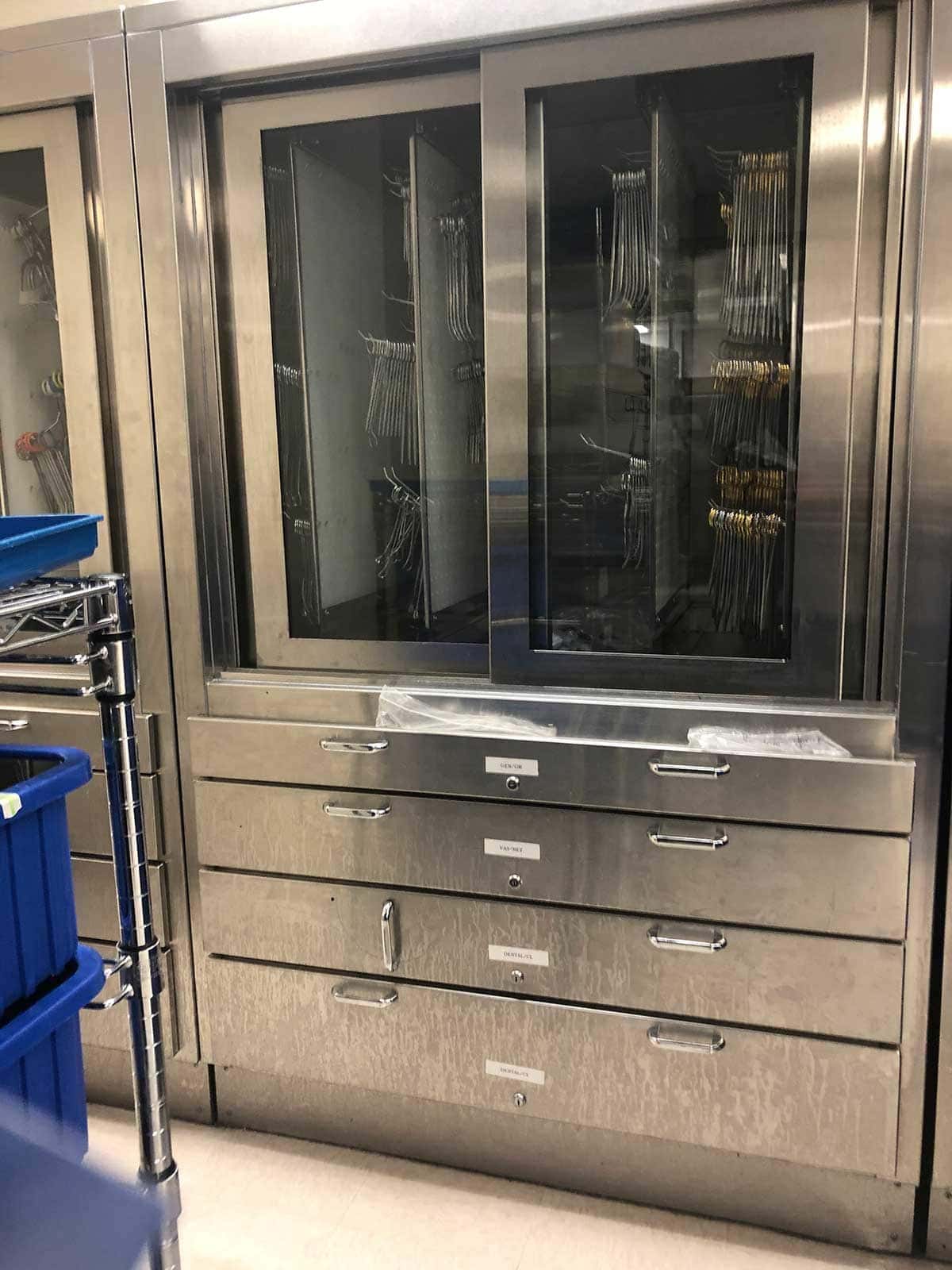
Physical protection requirements: smooth, non-porous shelving positioned ≥8 inches off the floor; dust-free enclosures for electronics; anti-static materials; cushioned supports for robotic arms; detailed storage specifications guide proper configuration.
Access control: badging/locked zones for high-value assets, chain-of-custody handoffs, visitor/vendor escort requirements, after-hours access policy, and audit logging.
Storage location strategy balances accessibility, efficiency, and space constraints based on case volume, facility layout, staffing patterns, and program maturity.
Centralized storage works best for: lower-volume programs (<300 cases annually), compact facilities where SPD-to-OR distance stays within 50-100 feet, limited OR count (≤4 robotic-capable rooms), robust case cart systems.
Near-OR storage works best for: high-volume programs (500+ cases annually requiring 50-80% more accessible storage), multiple platforms running simultaneously, service-line specialization, and documented transport delays.
Common hybrid patterns: central clean hub + near-OR rapid-access zone, service-line pods + shared overflow, multi-site hub-and-spoke with courier protocols, dedicated charging zone + distributed accessory bins.
Storage must mirror the actual workflow. Every step from pick list generation through returns requires specific touchpoints, clear handoffs, and failure prevention.
Staging workflow: pick list creation → pull → stage → verify → transport → post-case returns. "Ready-to-run" criteria include complete instrument sets, verified sterile packaging, valid expiration dates, required accessories, backup instruments accessible, cand art properly labeled.
| Workflow Step | Zone Used | Responsible Role | Common Failure | Prevention Control |
| Pull instruments | Central sterile | SPD tech | Wrong/incomplete set | Color-coded shelving + barcode verification |
| Stage cart | Clean assembly | OR/SPD tech | Missing accessories | Pre-printed checklists + ready kits |
| Verify | Staging area | OR circulator | Missed expirations | Mandatory scan + automated alerts |
Manufacturer Instructions for Use (IFU) are non-negotiable. Violations void warranties, create liability, and compromise safety. Storage behaviors must reflect IFU specifications across the equipment lifecycle.
Each platform has specific requirements. Da Vinci Xi arms (42-54 inches, 12-18 inches diameter, 40-60 lbs) differ from CMR Versius arms (33 lbs, 38 x 38 cm footprint). Stryker Mako (120 x 60 x 60 cm, 150 lbs) and Medtronic Hugo (175 x 60 x 100 cm, 150 kg) introduce additional constraints. Multi-platform storage must accommodate these variations while maintaining manufacturer-specified controls.
Standardize across rooms/shifts: consistent naming conventions/location codes, label format with visual cues implementing custom color coding, minimum par levels, "no exceptions" return rules, quarterly training with monthly audits.
Manual inventory management breaks down beyond 2-3 robots. Automated tracking—barcode or RFID—becomes essential for maintaining accuracy and supporting real-time decisions in multi‑robot programs.
| Factor | Barcode | RFID |
| Setup | Low cost, simple | Higher cost, infrastructure needed |
| Tracking | Line-of-sight, set-level | Real-time, bulk reads, individual instruments |
| Best for | <500 cases/year, stable processes | 500+ cases, multi-site, complex sets |
Minimum tracking fields: item/asset ID, location, status (clean/dirty/quarantine/in-use), quantity/par, expiration, utilization metrics, responsible owner, exception flags.
Key storage KPIs: instrument retrieval time (target: 5-8 minutes), missing item rate (target: <2%), storage utilization (70-85% optimal), par stock accuracy (>95%), transport time variance (<5 minutes).
Storage failures manifest as case delays, losses, contamination, and injuries. Proactive design eliminates failure pathways.
| Failure Mode | Root Cause | Prevention Control | Recovery |
| Incomplete sets at start | Pick/verification failure | Barcode verification + checklists + backup sets | Emergency pull; courier from other site |
| Contamination | Clean/dirty crossover | Physical separation + one-way flow + color-coded carts | Quarantine; reprocessing; root cause analysis |
| Asset loss | Inadequate tracking | RFID on assets >$5K + badge access + audits | Search protocol; insurance claim |
Contamination risks to design against: dirty/clean crossover pathways, dust exposure/uncovered storage, inadequate quarantine separation, uncontrolled vendor handling, poorly defined cleaning checkpoints.
Growth breaking points: adding robots without staging/charging capacity, multi-site sharing without standardization, volume outpacing reprocessing, accessory sprawl, staffing changes losing tribal knowledge—all require building supply chain optimization into planning.
Successful implementation requires structured planning, stakeholder alignment, and iterative validation.
Step 1 - Governance: Define RACI (Responsible: SPD/OR/Biomedical; Accountable: Director Perioperative Services), clarify scope boundaries, set success metrics (retrieval time 5-8 min, missing items <2%, utilization 70-85%), establish timeline phases (Assessment: 4-6 weeks; Design: 6-8 weeks; Build: 8-12 weeks; Pilot: 4 weeks; Deploy: 2-4 weeks).
Step 2 - Current State Mapping: Conduct workflow walkthroughs with time-motion observations, create route maps documenting actual pathways, review 6-12 months failure logs, build photo inventory and location maps.
Step 3 - Forecast Growth: Typical programs grow 15-25% annually. Develop three scenarios (base/expected/surge) accounting for surgeon recruitment, service line expansion, market share. Use modular systems for incremental capacity expansion avoiding overbuilding.
Step 4 - Design Logic: Establish hierarchical location codes (CS-B2-03-L), enforce "same item, same place" rules, define exception handling for overflow/loaners/quarantine.
Step 5 - Pilot: Simulate real cases with timed pulls, test peak day + staffing constraints, conduct failure injection drills, execute revision loop with formal sign-off.
Step 6 - Train and Sustain: Deliver role-based training with quick reference guides, implement audit schedule (daily spot checks, weekly completeness audits, monthly reconciliation), establish escalation rules and continuous improvement loop.
Multi-robot programs require specialized zones beyond standard surgical storage with specific environmental controls, access restrictions, and inventory protocols.
| Item | Near-OR | Central | Par Approach | Restock Owner |
| High-frequency sets | Yes – minimizes retrieval | Yes – backup/overflow | 2-day near; 5-day central | OR tech 2x/day |
| Specialty sets (<1x/week) | No – consumes space | Yes – centralized | All central | SPD on-demand |
| Consumables | Yes – prevents delays | Yes – bulk storage | 3-day near; 30-day central | Materials tech daily |
Charging zone: Charge robotic arm batteries after each use, vision power packs nightly, and backup batteries continuously. Use LED status indicators, color-coded tags (green=ready, yellow=charging, red=failed). Implement "no unplugging" rules with daily verification checklists, backup overflow area with portable chargers.
Repair/quarantine: Tag-out triggers (damage, deviation, failed check, overdue maintenance) require red "DO NOT USE" tags. Physical separation in a locked area. Biomed SLA: emergency <24 hours, routine <5 days, vendor <10 days. Return-to-service requires biomed testing and SPD verification.
Capacity sizing balances operational efficiency against capital investment. Undersizing creates constraints; oversizing wastes resources.
| Procedure | Peak Cases | Sets/Case | Cycle Time | Minimum Sets | Buffer |
| Prostatectomy | 6 | 2-3 | 5 hours | 12-18 | +4-6 (25%) |
| Cholecystectomy | 8 | 1-2 | 4 hours | 8-16 | +3-5 (30%) |
| Buffer Type | Protects Against | Storage Location | Owner |
| Turnover | Reprocessing delays | Near-OR rapid access | OR Manager |
| Peak demand | Schedule surges | Central – dedicated shelf | Materials Manager |
| Maintenance | Calibration/PM | Central – rotation tracking | Biomedical |
| Growth | Volume expansion | Central – expansion zone | Director Perioperative Services |
Utilization thresholds: >90% capacity full triggers immediate mitigation (offsite storage, expedited cycling) and long-term fix (capacity expansion). >85% instrument utilization risks add-on case delays. >5% missing item rate demands daily audits and root cause analysis.
Operational efficiency emerges from disciplined design details: visual management, ergonomic standards, and verification protocols.
Labeling/visual management: 1.5-2 inch font visible from 10 feet, photo labels for high-confusion items, shadowing/outline cues for missing item detection, two-bin kanban restock signals with color-coded cards.
Ergonomic rules: Single-person lifts limited to 35 lbs, team lift 35-50 lbs, mechanical assist >50 lbs (robotic arms range 33 lbs Versius to 60 lbs da Vinci Xi). Most-accessed items at 30-60 inch height, heavy items on lower shelves, 48-inch corridor width for two-way cart traffic.
Ready state checks: inventory completeness verified, packaging integrity confirmed, charge state validated, status correct (clean/dirty/quarantine), case-ready staging sign-off complete.
SOPs prevent storage discipline degradation. Clear permissions, inspection protocols, and escalation pathways maintain operational integrity.
| Role | Can Move | Logging Method | Allowed Destinations |
| SPD Tech | Sterile sets, instruments | Barcode scan/manual log | Central storage, staging, decontam |
| OR Circulator | Case carts, near-OR inventory | Cart checkout sheet | OR suites, near-OR storage only |
| Biomedical | Equipment, charging devices | Asset tracking + work order | Equipment storage, charging, repair, OR |
Escalation protocol: (1) SPD supervisor for missing sets, (2) OR charge nurse for workflow coordination, (3) Director for case delay decision. Provide asset ID, expected vs actual location, case time, patient status. Workarounds include backup inventory, inter-site borrowing, equivalent set substitution with surgeon approval.
Metrics translate design into measurable outcomes validating ROI and identifying degradation early.
Time-based metrics: Instrument retrieval time (baseline: 15-20 min; target: 5-8 min), transport time (<5 min when within 50-100 feet SPD), case start delay rate (baseline: 12-18%; target: <5%), turnover time (baseline: 35-45 min; target: 25-30 min).
Inventory metrics: Missing item rate (↓ toward <2%), par stock accuracy (↑ toward >95%), set availability (maintain >85%), storage utilization (70-85% optimal).
Compliance metrics: Environmental compliance (sterile: 18-23°C, 30-60% RH; equipment: 72-78°F), sterility breach rate (<1% failures), quarantine compliance (zero untagged items), asset loss rate (<0.5% missing).
Adding robots to same OR suite: Each new platform adds 200-500 instruments requiring immediate capacity. Expand staging 30-50%, add 15-20 linear feet shelving per platform, increase charging capacity (4+ positions per platform), create platform-specific accessory bins.
New campus/ambulatory site expansion: Requires identical location coding across sites, unified inventory tracking for real-time visibility, standardized par levels preventing hoarding, documented courier protocols, cross-trained staff.
Vendor tray/packaging changes: Establish 30-day minimum notice requirement, conduct storage impact assessment (dimensional fit, shelf reconfiguration), test SPD workflow with new materials, update labels and staff training, implement parallel inventory transition plan.
30-60 day improvements (no construction): labeling/location logic cleanup, ownership/RACI clarity, charging discipline, missing-item prevention via check-in/out logging, quick KPI tracking with weekly reviews.
6-18 month scaling items:
| Arms | Square Footage | Configuration |
| 36 | 200-400 sq ft | High-density mobile shelving |
| 72 | 400-700 sq ft | Mix mobile/fixed with dedicated zones |
| 108 | 600-1,000 sq ft | Comprehensive strategy including ASRS |
Capacity redesign using high-density systems (40-100% capacity increase; one facility reduced footprint from 2,500 to 375 sq ft using VLMs). Cost: $50,000-$200,000 for 36-arm capacity; $150,000-$500,000 for 108-arm. Tech rollout (barcode/RFID tracking), multi-site standardization, staffing adjustments (dedicated coordinator for 500+ cases annually), and continuous improvement governance.
Multi-robot surgical programs demand storage solutions as sophisticated as the technology they support. Successful programs engineer storage as a strategic enabler of throughput, safety, and scalability through flexible dimensional accommodation, standardized environmental controls, modular zone designs, and workflow-optimized proximity, achieving 40-60% transport time reductions.
Investment in high-density storage delivers measurable ROI: space savings (2,500 to 375 sq ft reductions), efficiency gains (retrieval times dropping from 15-20 to 5-8 minutes), throughput expansion (25% program growth without facility expansion). Whether implementing quick wins or executing capital projects, facilities must anchor decisions in demand forecasting, failure mode prevention, and metrics-driven improvement.
Ready to optimize your robotic surgery storage? Contact our team to design a scalable solution.
With 21 years of sales management, marketing, P&L responsibility, business development, national account, and channel management responsibilities under his belt, Ian has established himself as a high achiever across multiple business functions. Ian was part of a small team who started a new business unit for Stanley Black & Decker in Asia from Y10’ to Y14’. He lived in Shanghai, China for two years, then continued to commercialize and scale the business throughout the Asia Pacific and Middle East regions for another two years (4 years of International experience). Ian played college football at the University of Colorado from 96’ to 00’. His core skills sets include; drive, strong work ethic, team player, a builder mentality with high energy, motivator with the passion, purpose, and a track record to prove it.