Operating room storage systems must support infection control, workflow efficiency, and durability under demanding clinical conditions. Material choice, cabinet construction, and facility layout directly affect cleanability, equipment access, and operational costs in acute care hospitals and ambulatory surgery centers. The global surgical instrument storage cabinets market reached USD 1.42 billion in 2024 and is projected to grow at 6.8% CAGR through 2033, driven by increasing surgical volumes and heightened infection prevention standards. Selection decisions should prioritize contamination control, durability, and adaptability over initial cost.
Stainless steel and aluminum represent the two dominant material platforms for OR cabinets, each offering distinct performance characteristics for sterile environments. Material selection influences corrosion resistance, structural robustness, weight, and maintenance requirements. North America accounts for approximately 42% of the global OR cabinet market, with infection control and durability ranking as the highest facility priorities. Material properties must align with cleaning protocols, equipment loads, and expected service life.
Stainless steel cabinets feature welded body construction with smooth satin finishes, tempered glass options, sloped tops, and corrosion-resistant hinges and latches. Stainless steel accounts for the largest material share due to corrosion resistance, ease of sterilization, and long life compared to aluminum. Welded joinery eliminates crevices that harbor contaminants, while the non-porous surface withstands repeated chemical cleaning. Stainless steel products are especially suited for operating rooms, sterile processing areas, and pharmacy applications where contamination control is paramount.
Aluminum cabinets deliver lighter weight and easier handling compared to stainless steel, making them advantageous in applications requiring frequent reconfiguration. The material offers good corrosion resistance in moisture-exposed environments but provides less impact resistance than welded stainless steel. Aluminum construction is often used in modular casework systems where flexibility and lower installation weight matter more than maximum structural robustness. Lower density reduces transportation costs and simplifies wall mounting in space-constrained procedure rooms.
Infection control priority reaches 75.00% among healthcare facility managers in surgery unit environments, significantly outranking all other criteria. Durability follows at 54.84%, flame resistance at 43.75%, and ease of maintenance at 37.10%, while initial cost ranks lowest at 3.45%. Stainless steel's non-porous surface and chemical resistance make it preferred for high-acuity sterile zones. Aluminum's lighter weight reduces handling strain, but lower impact resistance may require more frequent replacement in heavy-use environments where durability and contamination control outweigh installation flexibility.
Material selection directly affects cleanability, contamination risk, and long-term operational performance in perioperative environments. Stainless steel provides superior corrosion resistance and structural durability under repeated chemical exposure, while aluminum offers lower weight and easier handling during installation. Functional differences between materials shape appropriate use cases across hospital departments, ambulatory surgery centers, and specialty procedure rooms.
Stainless steel supports better cleanability and contamination control due to its non-porous surface, chemical resistance, and ability to withstand high-temperature sterilization protocols. Smooth, welded construction eliminates seams and joints where bacteria and biofilm accumulate. Aluminum provides adequate contamination control for lower-acuity environments but may degrade faster under aggressive chemical cleaning agents used in operating rooms. Stainless steel's rust resistance ensures the cabinet surface remains intact over time, preventing corrosion-related contamination that could compromise sterile instrument storage.
Stainless steel cabinets are significantly heavier than aluminum units, requiring more robust wall anchoring and floor support for larger installations. Aluminum's lower density reduces installation labor and simplifies reconfiguration during facility renovations or workflow changes. Heavy-duty stainless steel construction better withstands impacts from carts, equipment, and daily operational stress in high-volume surgical environments. Aluminum cabinets offer easier repositioning for facilities that prioritize adaptability over maximum structural robustness, making them suitable for modular systems and phased expansion projects.
Stainless steel cabinets dominate operating rooms, sterile processing departments, and central sterile supply areas where infection control and durability are paramount. Aluminum and aluminum-clad systems are used in procedure rooms, clinics, and modular installations where reconfiguration, lighter weight, and lower installation costs align with operational priorities. High-volume robotic surgery programs and teaching hospitals typically specify stainless steel for core surgical storage, reserving aluminum for support areas. Budget-sensitive ambulatory surgery centers may use aluminum for non-critical storage while specifying stainless steel for sterile instrument cabinets adjacent to procedure rooms.
Floor-standing, wall-mounted, mobile, and specialty cabinets represent the primary layout categories for OR storage systems. Each layout type addresses distinct spatial, workflow, and capacity requirements across hospital departments and ambulatory surgery centers. Floor-standing stainless steel cabinets hold an estimated 35% market share, followed by wall-mounted units at 20%, mobile carts at 18%, modular casework at 17%, and dedicated robotic cabinets at 10%. Layout selection depends on case volume, available floor space, cleaning protocols, and need for flexible versus permanent installations.
Floor-standing stainless steel cabinets feature high storage capacity, glazed or solid doors, adjustable shelving,adjustable shelves and shelving units, pegboards, and large-volume enclosed storage suited for central sterile processing and main operating room support areas. Floor-standing units provide the highest capacity per footprint and support heavy equipment loads without requiring structural wall reinforcement. Budget floor-standing cabinets start at $4,044, mid-range units at $5,339, and premium configurations reach $9,809. These cabinets dominate high-volume surgical environments where maximizing storage density and protecting sterile instrument sets are operational priorities.
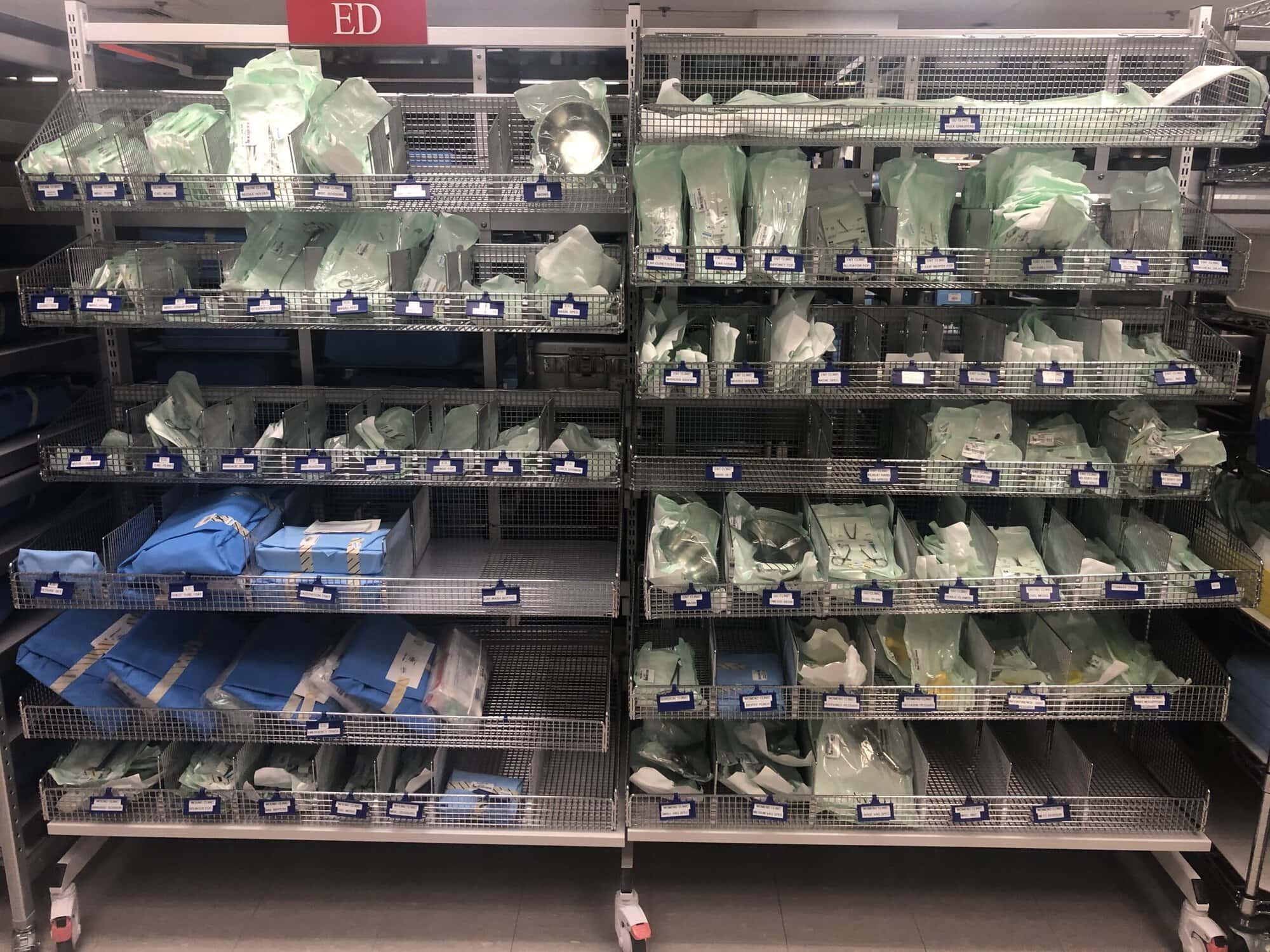
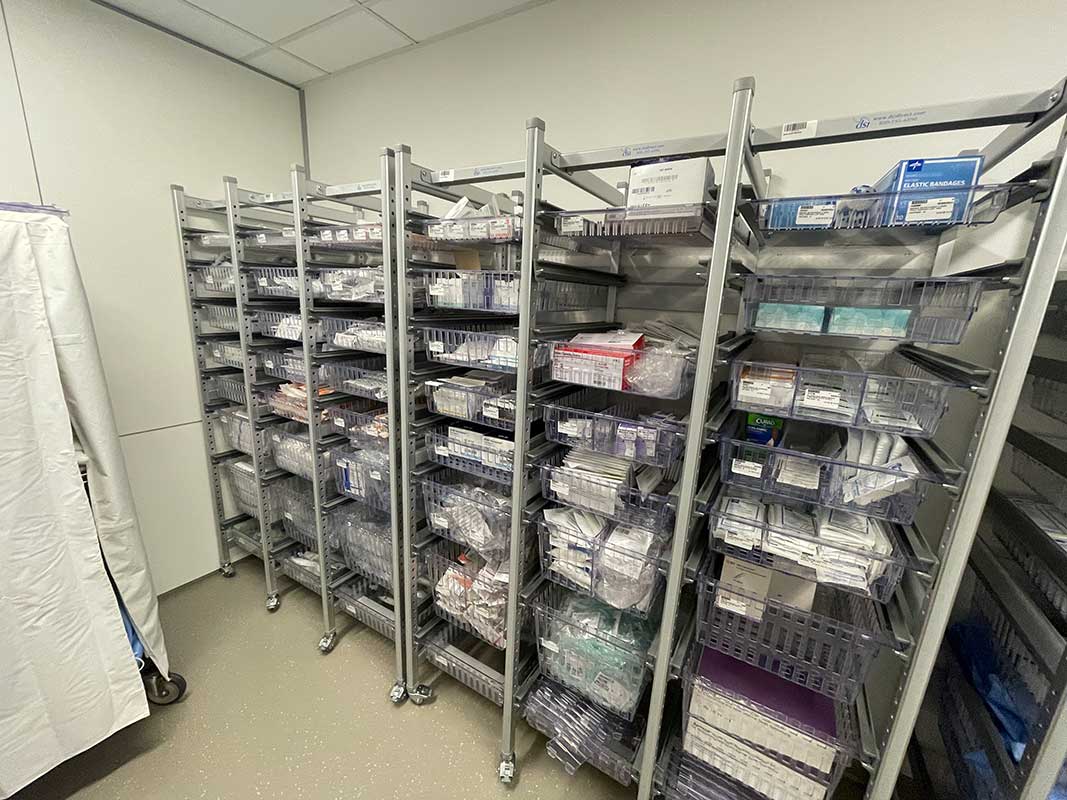
Wall-mounted cabinets provide space-saving, easier floor cleaning, and compact storage close to the point of use in smaller procedure rooms and tight surgical suites. Mobile carts and mobile cabinets include wheels or casters for rapid instrument movement, overflow staging, and flexible deployment during case turnover or facility renovations. Budget wall-mounted cabinets begin at $2,369, mid-range at $3,159, and premium at $4,235, while mobile cart pricing ranges from $349 to $3,219. Scope cabinets and workstations illustrate how targeted storage solutions support specific equipment categories and workflow patterns in perioperative environments.
Dedicated robotic and specialty cabinets provide equipment-specific storage, HEPA-filtered air, hospital-grade power outlets, and robotic accessory capacity designed for advanced surgical platforms. These cabinets feature glass doors, drip trays, internal dividers, and powered features that support contamination control for delicate robotic instruments and accessories. Budget robotic cabinets start at $4,900, mid-range at $5,900, and premium configurations exceed $6,900. HEPA-filtered air and dedicated robotic-adapter capacity address unique storage requirements of high-volume robotic programs where accessory organization and contamination prevention directly impact case start times and instrument availability.
Robotic general surgery use increased from 1.8% in 2012 to 15.1% in 2018, with the share of surgeons performing robotic procedures rising from 8.7% to 35.1% over the same period. Equipment, wires and cords, and lack of space were major contributors to environmental flow disruptions during robotic procedures across 56 observed cases. Room size changes disruption rates in statistically significant ways during robotic pre-docking and docking stages. Hospitals that began robotic surgery during the study period accounted for 31.5% of the cohort, indicating rapid adoption and a corresponding need for storage infrastructure supporting robotic accessory staging, organization, and contamination control.
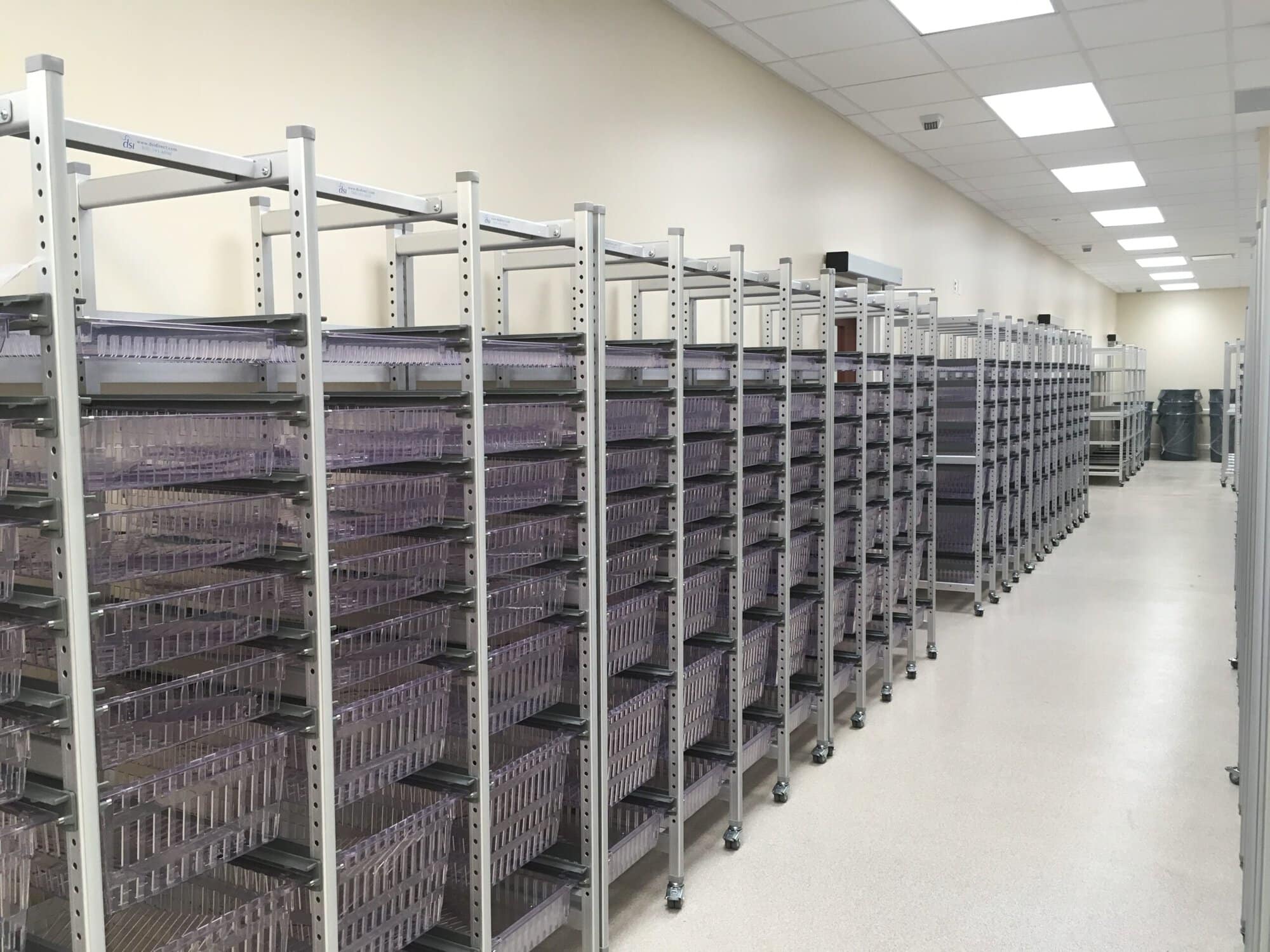
Modular casework systems offer reconfigurability, lower installation cost, multiple cabinet formats, and material options that support phased facility growth and evolving surgical service lines. Modular storage solutions provide seven-year depreciation versus 31 years for fixed casework, reducing long-term capital commitment for facilities with uncertain renovation timelines. Dedicated robotic cabinets deliver equipment-specific interiors, HEPA filtration, powered features, and accessory capacity optimized for mature, high-volume robotic programs. Modular systems favor facilities undergoing expansion or service-line changes, while dedicated cabinets suit established robotic centers with stable case volumes and consistent accessory inventories.
Robotic equipment increases spatial demands due to tower footprints, accessory carts, cable management, and docking clearances that must be accommodated within existing OR footprints. Room size influences flow disruption rates in statistically significant ways, with smaller rooms experiencing more frequent delays during robotic setup and equipment positioning. Equipment clutter and lack of space were major contributors to environmental flow disruptions, highlighting the need for deliberate staging zones and organized storage. Advanced workflow systems that integrate robotic accessory storage with point-of-use instrument access reduce clutter and support efficient case turnover in high-volume robotic surgery environments.
Facilities with mature robotic programs, high case volumes, and multiple robotic platforms benefit most from specialized robotic storage that reduces accessory search time and contamination risk. Hospitals that began robotic surgery during the study period represented 31.5% of the cohort, indicating many institutions are still in early adoption phases. Teaching hospitals, facilities with more than 300 beds, and institutions in competitive markets with neighboring robot adopters show higher adoption rates. Specialized robotic storage becomes cost-justified when accessory inventory complexity, case frequency, and contamination control needs exceed the organizational capacity of general-purpose cabinets and mobile carts.
Material and layout decisions should prioritize infection control, durability, workflow efficiency, and adaptability over initial cost. Infection control ranks as the top priority for 75.00% of healthcare facility managers in surgery unit environments, followed by durability at 54.84% and ease of maintenance at 37.10%. Initial cost ranks lowest at 3.45%, indicating functional performance and long-term value outweigh upfront price considerations. Facility type, case volume, renovation plans, and robotic surgery intensity all influence which material and layout combination delivers the best operational outcomes and return on investment.
Infection control drives 75.00% of facility managers to rank contamination prevention as the most significant selection criterion in surgery unit environments. Non-porous stainless steel surfaces, enclosed storage, sloped tops, and welded construction reduce contamination risk by eliminating seams where bacteria accumulate. Workflow design must ensure unidirectional flow from soiled arrival to sterile distribution, with clean and soiled areas remaining physically separated. Storage systems that support efficient cleaning protocols, chemical resistance, and repeated sterilization cycles protect patient safety and reduce hospital-acquired infection risk.
Durability ranks as the most significant criterion for 54.84% of decision-makers, reflecting the importance of long service life in high-use perioperative environments. Maintenance cost priority reaches 28.33%, while initial cost ranks at only 3.45%, demonstrating total cost of ownership outweighs the upfront price. Welded stainless steel construction withstands impacts, corrosion, and repeated chemical exposure better than lightweight alternatives, reducing replacement frequency and maintenance labor. Facilities should evaluate depreciation schedules, expected service life, and maintenance burden when comparing material and construction options to ensure long-term value.
Adaptability becomes essential for facilities undergoing expansion, service-line changes, or phased renovations where storage configurations must evolve over time. Modular casework offers reconfiguration options and shorter depreciation cycles that align with uncertain renovation timelines and changing surgical case mixes. Fixed installations provide maximum capacity and structural robustness but limit future flexibility. Hospitals with stable case volumes and mature service lines benefit from permanent installations, while growth-oriented institutions and ambulatory surgery centers with evolving case mixes gain more value from modular systems that support incremental changes without full replacement.
Ambulatory surgery centers in urban areas represent 94% of ASC locations, while rural areas account for only 6% of facilities. California holds 896 ASCs, Florida 517, Texas 497, and Georgia 423, with the Southeast region accounting for 32.82% of total ASC capacity. Urban facilities face higher real estate costs and tighter space constraints, favoring wall-mounted and compact storage solutions. Rural facilities prioritize versatility and lower capital investment, often selecting mobile carts and multifunctional units that support diverse case types with smaller inventory footprints.
Urban ASCs in dense metropolitan markets prioritize space efficiency, vertical storage, and premium infection control features to maximize capacity within expensive real estate footprints. Rural facilities emphasize cost comparison, versatility, and mobile storage that supports variable case volumes without requiring dedicated cabinets for every specialty. Urban hospitals typically justify dedicated robotic storage and specialty cabinets due to higher case volumes and competitive service differentiation. Rural facilities favor general-purpose stainless steel cabinets and mobile carts that serve multiple procedure types, reducing capital investment while maintaining infection control standards.
Large hospitals with multiple operating rooms, sterile processing departments, and robotic surgery programs require floor-standing stainless steel cabinets, dedicated robotic storage, and modular casework to support complex case mixes and high-volume instrument turnover. Ambulatory surgery centers prioritize cost-effective solutions, mobile carts, and wall-mounted cabinets that maximize limited floor space while maintaining infection control compliance. Hospitals justify premium systems through higher case volumes and longer planning horizons, while ASCs focus on rapid return on investment and flexible configurations. Integrated facility solutions help both facility types align storage decisions with operational priorities, space constraints, and long-term growth plans.
Millennial representation among decision-makers reaches 50.61%, Gen X accounts for 32.50%, and Boomer-proxy representation stands at 12.14% based on occupation-weighted data for medical managers and registered nurses. Medical managers show 44.01% Millennial representation versus 40.58% Gen X and 13.53% Boomer, while registered nurses demonstrate 52.30% Millennial, 30.43% Gen X, and 11.79% Boomer. Younger decision-makers prioritize workflow efficiency, digital inventory integration, and adaptable systems that support evolving clinical practices. Mid-career leaders balance operational performance with total cost of ownership, while senior professionals emphasize proven durability and compliance with established infection control protocols.
Surgeons and facility managers should define storage needs by procedure family, accessory variability, and case volume rather than generic square footage. Reviewing storage ideas early in planning ensures cabinet selection reflects actual case workflows and infection control requirements. Standardization reduces surgeon preference variation, excess stock, emergency fulfillment costs, and inventory waste that amplify operational complexity. Workflow should be unidirectional from soiled arrival to sterile distribution, with clean and soiled areas remaining physically separated. Planning teams should address workflow, space utilization, infection prevention, current and future equipment needs, workplace safety, and technology expansion before finalizing cabinet specifications.
Category choice should match case volume, robotics intensity, renovation horizon, and available floor space to ensure operational fit and long-term value. High-volume hospitals benefit from floor-standing stainless steel cabinets that maximize capacity and durability, while ambulatory surgery centers with variable case mixes favor mobile carts and wall-mounted units that support flexible workflows. Robotic programs with mature case volumes justify dedicated storage with HEPA filtration and powered features, while emerging programs benefit from modular systems that accommodate evolving accessory inventories. Facility layout should position storage near the point of use to reduce travel distance, minimize contamination risk, and support efficient case turnover.
Surgeon preference variation can create excess stock, emergency fulfillment demands, and waste when preference cards lack standardization across providers performing similar procedures. Poorly standardized storage and picking systems amplify inventory complexity, increase carrying costs, and contribute to expired product waste. Storage systems that support standardized bins,storage bins, clear labeling, and point-of-use visibility reduce search time and improve inventory accuracy. Facilities should implement LEAN principles and standardized instrument sets to reduce preference variation, lower inventory costs, and improve workflow efficiency across perioperative departments.
Workflow should be unidirectional from soiled arrival to sterile distribution, with clean and soiled areas remaining physically separated in sterile processing design. Storage should be selected through a workflow-plus-infection-control lens rather than treated as a late-stage furniture decision. Planning teams should address workflow, space utilization, infection prevention, current and future equipment needs, workplace safety, and technology expansion during the design phase. Sterile-durables storage should be sized based on the number of ORs and procedure rooms served to ensure adequate capacity without overstocking.
Stainless steel cabinets dominate high-acuity surgical environments due to superior infection control, durability, and corrosion resistance, while aluminum offers lighter weight and easier handling for applications where flexibility and lower installation costs outweigh maximum structural robustness. Infection control ranks as the top priority for 75.00% of facility decision-makers, followed by durability at 54.84%, demonstrating that functional performance and long-term value consistently outweigh initial cost considerations. Floor-standing stainless steel units serve high-volume surgical environments, wall-mounted cabinets maximize space efficiency in smaller ORs, and mobile carts support flexible workflows and budget-sensitive applications. Modular casework provides adaptability for facilities undergoing expansion or service-line changes, while dedicated robotic storage suits mature programs with high case volumes and complex accessory inventories. Decision-makers should evaluate material properties, layout configurations, and construction quality through the lens of contamination control, workflow efficiency, and total cost of ownership.
Since 1990, Distribution Systems International has specialized in applying LEAN inventory principles to acute care facilities facing operational efficiency, space optimization, and infection control challenges. Facilities seeking to improve OR turnover times, reduce inventory carrying costs, and ensure regulatory compliance benefit from tailored solutions and consultative approaches that begin with on-site workflow analysis and deliver custom-configured solutions backed by turnkey implementation support.
Discover how comprehensive facility services can help your organization maximize storage capacity, streamline perioperative workflows, and achieve measurable return on investment through data-driven storage system design.
Distribution Systems International helps acute care hospitals and ambulatory surgery centers select, configure, and implement OR cabinet systems that support infection control, workflow efficiency, and long-term operational value. Our team conducts on-site storage analysis, delivers custom-configured cabinet recommendations, and manages full turnkey installation—minimizing disruption to perioperative operations. Contact Distribution Systems International today to schedule a complimentary OR storage consultation and find the right cabinet solution for your facility’s case volume, layout, and compliance requirements.

With 21 years of sales management, marketing, P&L responsibility, business development, national account, and channel management responsibilities under his belt, Ian has established himself as a high achiever across multiple business functions. Ian was part of a small team who started a new business unit for Stanley Black & Decker in Asia from Y10’ to Y14’. He lived in Shanghai, China for two years, then continued to commercialize and scale the business throughout the Asia Pacific and Middle East regions for another two years (4 years of International experience). Ian played college football at the University of Colorado from 96’ to 00’. His core skills sets include; drive, strong work ethic, team player, a builder mentality with high energy, motivator with the passion, purpose, and a track record to prove it.