Key Takeaways
Sterile instrument storage is where reprocessing excellence meets, or fails, patient care. A perfectly sterilized instrument becomes a contamination risk the moment improper storage compromises its packaging. Surgical site infections cost healthcare systems millions annually in extended stays, readmissions, and litigation. Most are preventable. The standards exist. The science is clear. The challenge is consistent execution across every shift, every staff member, every instrument.
This guide synthesizes requirements from the Joint Commission, CDC, AAMI ST79, and OSHA into actionable practices. From environmental controls to shelving specifications, from FIFO enforcement to staff training, you'll find the sterile instrument storage standards that govern compliant storage, and the operational strategies that make compliance sustainable.
Sterile instrument storage protects reprocessed surgical instruments from contamination until use. It's the final step in the sterile processing cycle, and the last line of defense before patient contact.
| Classification | Definition | Microbial Status | Typical Use |
| Sterile | Free from all viable microorganisms, including bacterial spores | No viable organisms | Critical items entering sterile tissue or vascular system |
| High-Level Disinfected | Free from all microorganisms except high numbers of bacterial spores | Spores may remain | Semi-critical items contacting mucous membranes |
| Clean | Visibly free of soil and contamination; reduced microbial load | Reduced but present | Non-critical items contacting intact skin |
Sterility is binary; an instrument is either sterile or it isn't. There's no middle ground when it enters the surgical field.
Multiple organizations set the framework for compliant sterile storage. Each addresses different aspects, from environmental controls to worker safety. Understanding compliance and regulatory requirements is essential for accreditation readiness.
| Organization | Key Storage Guidelines | Temperature & Humidity Control | Handling & Contamination Prevention |
| Joint Commission | Requires safe, functional environment minimizing patient and staff risk. Focuses on sterile process integrity, storage conditions, and documentation. | Requires monitoring and control of environmental conditions. Parameters typically align with AAMI standards. | Mandates proper handling to prevent packaging damage. Requires defined process for identifying compromised items. |
| CDC | Recommends clean, dry storage protected from temperature and humidity extremes. Packaging integrity must be maintained. | 68°F–73°F (20°C–23°C); 30%–60% relative humidity (or per manufacturer instructions). | Emphasizes FIFO inventory management. Staff must inspect packages for integrity before use. |
| AAMI ST79 | Most detailed technical guidance. Sterile items must be stored in designated areas, away from traffic, protected from environmental contaminants. | 68°F–73°F (20°C–23°C); 30%–60% relative humidity. Continuous monitoring and documentation required. | Solid-bottom shelves required. Items stored 8–10" off floor, 18" from ceiling, 2" from outside walls. Proper hand hygiene and minimal handling mandated. |
| OSHA | Focuses on healthcare worker safety during handling and storage. General workplace safety standards apply to storage area design. | No specific sterile storage parameters. General workplace standards apply. | Requires appropriate PPE for handling contaminated items. Mandates training on sharps and biohazardous material handling. |
| IFU Requirement | Impact on Sterile Storage |
| Storage conditions | May specify temperature, humidity, or light exposure limits more restrictive than general standards |
| Shelf life parameters | Define time-related or event-related sterility maintenance |
| Packaging compatibility | Specify approved packaging systems and methods |
| Special handling | May require specific orientation, separation, or protection measures |
IFUs take precedence when they're more restrictive than general guidelines. CDC explicitly notes to follow manufacturer instructions where applicable. Always verify medical device storage guidelines against device-specific IFUs.
Environmental control is non-negotiable. Deviations compromise packaging integrity, enabling microbial penetration.
These parameters aren't arbitrary. Temperature and humidity extremes damage packaging materials. High humidity promotes bacterial growth. Poor air circulation allows contaminated air to enter storage areas.
Design the storage environment to maintain these conditions consistently, not just at the time of inspection.
Packaging maintains the sterile barrier. Labeling ensures traceability and proper rotation. Both are essential for safe instrument use.
| Material Type | Characteristics | Common Applications |
| Sterilization wraps | Sequential double-wrapping provides tortuous path barrier; allows steam/gas penetration | Instrument trays, basin sets |
| Peel pouches | Paper/plastic or Tyvek/plastic; self-seal or heat-seal options; allows visual inspection | Individual instruments, small sets |
| Rigid containers | Reusable; filtered vents allow sterilant penetration; durable protection | Heavy instrument sets, specialty trays |
| Combination systems | Inner pouch within rigid container or wrapped set | High-value or complex instrumentation |
All packaging must be protected from tears, punctures, and moisture. Improper handling or environmental deviations compromise the sterile barrier regardless of material quality. Select packaging appropriate to the instrument, sterilization method, and anticipated storage duration.
Labels must remain legible throughout storage. Faded or illegible labels require reprocessing, not guesswork.
Storage organization directly impacts compliance, efficiency, and patient safety. A disorganized storage room creates delays, increases handling, and raises contamination risk. Following aseptic storage best practices prevents these failures.
Sterile items must be stored in designated areas, away from traffic, and protected from environmental contaminants. AAMI ST79 specifies precise spatial requirements:
| Requirement | Minimum Distance | Rationale |
| Floor clearance | 8–10 inches | Protects from splashes, floor cleaning chemicals, flooding |
| Ceiling clearance | 18 inches | Protects from fire suppression discharge, dust accumulation |
| Outside wall clearance | 2 inches | Prevents condensation contact, allows air circulation |
These aren't arbitrary numbers. Floor clearance protects against cleaning chemical splash. Ceiling clearance prevents contamination from fire suppression systems. Wall clearance prevents moisture damage from condensation.
Standardized shelving and clear workflow design turn the storage room from a bottleneck into a reliable asset. When storage is disorganized, staff waste time searching for instruments, and increased handling raises contamination risk.
Sterility maintenance depends on events, not just time. Understanding this distinction prevents both premature disposal and the use of compromised instruments.
| Approach | Definition | Determining Factors | Industry Trend |
| Event-related | Sterility is maintained until a contaminating event occurs | Packaging integrity, handling, storage conditions, and transportation | Current standard of practice |
| Time-related | Sterility expires after a predetermined period regardless of condition | Arbitrary time limits (e.g., 30, 60, 90 days) | Outdated; not evidence-based |
Event-related sterility is the current standard. Instruments remain sterile until something compromises the barrier, such as a tear, moisture, excessive handling, or improper storage conditions. Time alone doesn't cause contamination. Events do.
However, some facilities use hybrid approaches, combining event-related principles with maximum storage timeframes based on packaging type, storage conditions, or manufacturer IFUs.
Inspect every package before opening. A compromised barrier discovered at the point of use prevents an SSI. A compromised barrier missed at the point of use may cause one.
Every touch point is a contamination opportunity. Proper technique from storage to the sterile field protects the patient.
| Transport Scenario | Key Requirements |
| Within facility | Covered carts, single-layer arrangement, protection from physical damage, and moisture |
| Between departments | Enclosed transport, minimal stops, direct routes away from contaminated areas |
| Between facilities | Climate-controlled vehicles, shock-absorbing packaging, and a documented chain of custody |
Follow Joint Commission guidelines to minimize exposure to damage and contamination.
Never reach across a sterile field. Never shake or flip contents onto the field. Controlled presentation prevents airborne contamination.
Compliance requires documentation, training, and culture. Accreditation surveys evaluate all three. Achieving sterile processing department compliance requires systematic attention to each element.
| Documentation Type | Requirement | Standard Source |
| Temperature logs | Continuous monitoring; must show consistent 68°F–73°F adherence | AAMI ST79 |
| Humidity logs | Continuous monitoring; must show consistent 30%–60% adherence | AAMI ST79 |
| Sterile process integrity | Documentation of storage conditions, handling procedures, compromised item management | Joint Commission |
| Equipment maintenance | HVAC system verification, monitoring device calibration | AAMI ST79 |
| Incident reports | Documentation of sterility breaches, corrective actions taken | Joint Commission |
Logs must be complete, legible, and retrievable. Gaps in documentation raise red flags during surveys. Automated monitoring systems reduce human error and provide continuous records.
The Joint Commission looks for a culture of safety, not just a checklist. Proper shelving and clear workflow design are visual proof of that culture. When surveyors ask "why," staff must have answers, because understanding drives compliance.
Most failures are preventable. Understanding root causes enables targeted prevention.
| Issue | Potential Impact | Prevention Strategy |
| High humidity (>60%) | Promotes bacterial growth; compromises packaging integrity, enabling microbial penetration | Continuous monitoring; HVAC maintenance; dehumidification systems |
| Extreme temperatures | Degrades packaging materials; compromises sterile barrier | Climate control; monitoring alarms; backup systems |
| Floor clearance violation (<8–10") | Contamination from floor cleaning chemicals and splashes | Bottom-shelf audits; height markers; staff training |
| Ceiling clearance violation (<18") | Contamination from fire suppression system discharge | Top-shelf audits; ceiling markers; storage capacity planning |
| Insufficient instrument inventory | High IUSS rates; increased infection risk; workflow disruption | Par level analysis; usage tracking; inventory optimization |
| Poor organization | Surgical delays; increased handling; IUSS reliance | Standardized layouts; clear labeling; regular audits |
Non-compliance is most common with floor and ceiling clearance rules. Surveyors check these first because violations are frequent and consequential.
These aren't arbitrary numbers:
When sterile storage is disorganized, it directly impacts the OR schedule. Searching for a tray or discovering a compromised package at the point of use causes delays costing thousands of dollars per minute. Reprocessing takes time the surgical team doesn't have.
The expert perspective is clear: "Compliance is not a cost; it's an investment in preventing a multi-million dollar SSI." A single infection costs more than years of proper storage infrastructure.
Single-use and reusable instruments have different storage requirements. Understanding these differences prevents errors and optimizes inventory.
| Factor | Single-Use Implications |
| Packaging | Manufacturer-sealed; integrity dependent on storage conditions and handling |
| Shelf life | Typically date-specific expiration; monitor for approaching dates |
| Storage volume | Higher inventory levels are needed; it requires more storage space |
| Rotation | FIFO is critical to prevent expiration waste |
| Inspection | Check manufacturer seal integrity; verify expiration date; confirm chemical indicator |
| Cost impact | Expired stock represents direct financial loss |
Single-use items arrive sterile from the manufacturer. Storage must maintain that sterility until use. Damaged manufacturer packaging cannot be "re-sterilized", the item is waste.
Reusable instruments require in-house sterilization and create unique storage pressures:
IUSS is discouraged due to its higher risk profile and workflow disruption. Instruments processed via IUSS typically go directly to the point of use without standard storage, eliminating the protective buffer that proper storage provides.
The solution isn't faster processing. It's an adequate inventory. A data-driven approach to instrument par levels reduces IUSS rates dramatically while improving both safety and efficiency.
Building compliance requires assessment, infrastructure, and process. Start with gaps, then close them systematically.
| Infrastructure Element | Requirement | Purpose |
| Climate control | Temperature 68°F–73°F; humidity 30%–60% | Maintains packaging integrity |
| Ventilation | Minimum 4 ACH; positive pressure | Prevents contaminated air influx |
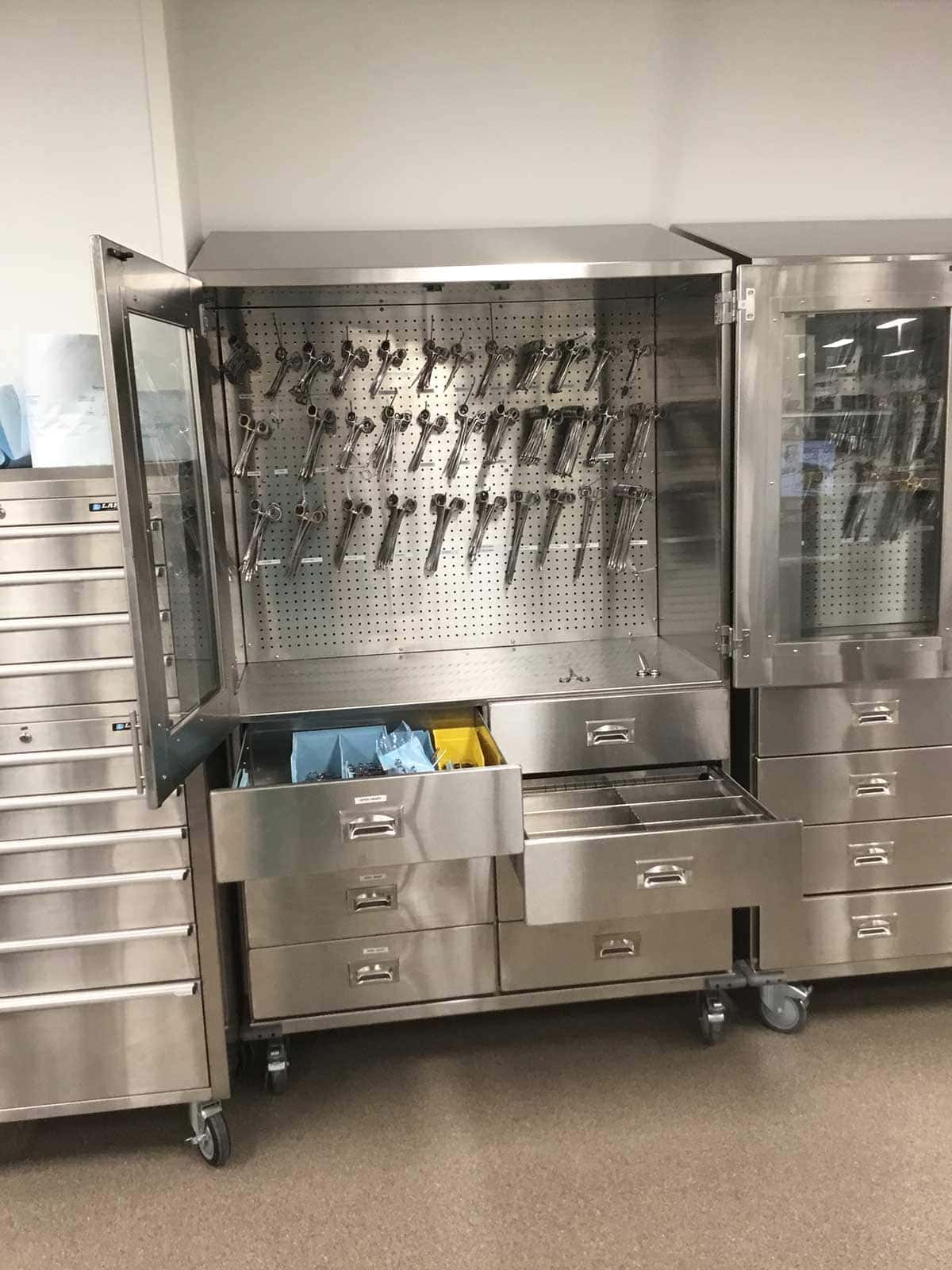
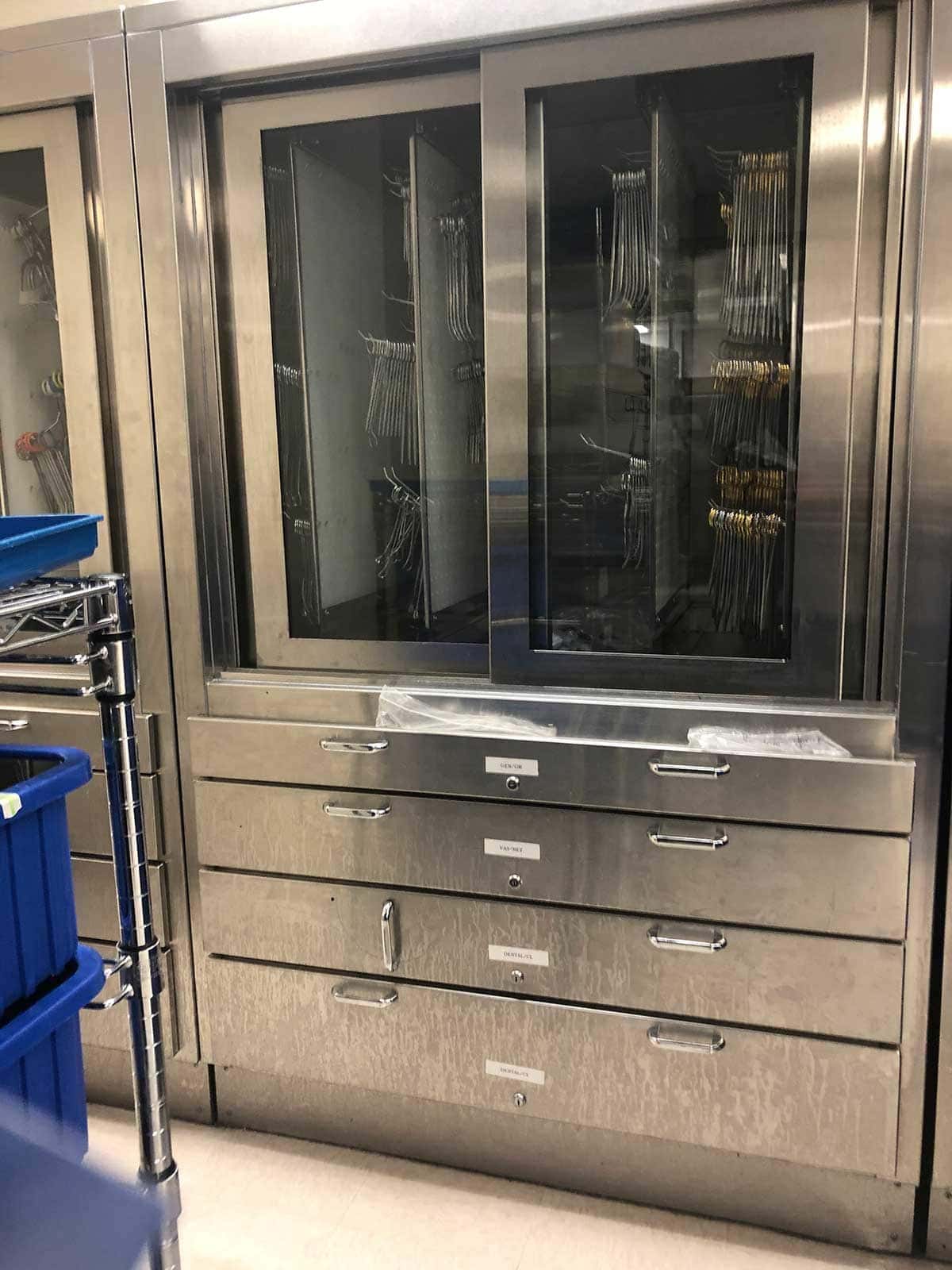
| Shelving | Non-porous, solid-bottom, compliant heights | Protects packages from contamination |
| Layout | Designated sterile areas; separated from traffic | Minimizes handling and exposure |
| Monitoring systems | Continuous temperature/humidity sensors | Documents compliance; alerts to deviations |
Design decisions made during construction or renovation determine long-term compliance feasibility. Retrofitting inadequate spaces costs more than building correctly from the start. Purpose-built OR sterile storage solutions address these requirements from the outset.
Standardization reduces variation. The right tools make compliance consistent and auditable.
| Tool Type | Function | Key Elements |
| Environmental monitoring logs | Continuous temperature/humidity documentation | Date, time, reading, initials, corrective actions |
| Audit checklists | Systematic compliance verification | AAMI ST79, CDC, Joint Commission, OSHA requirements |
| Labeling systems | FIFO enforcement | Color-coded expiration indicators, sterilization dates, lot numbers |
| Inspection forms | Package integrity verification | Visual checks, indicator verification, and disposition documentation |
| Training records | Competency documentation | Initial training, annual updates, and incident-triggered retraining |
| SOP templates | Standardized procedures | Receiving, storage, rotation, transport, and compromised item management |
Automated monitoring systems reduce human error and provide continuous, timestamped records. Manual logs work but require discipline and verification.
| Technology | Capability | Compliance Benefit |
| Barcode scanning | Item-level tracking from sterilization through use | Traceability, FIFO verification, usage analytics |
| RFID systems | Automated inventory counts, location tracking | Real-time visibility, reduced manual handling |
| Data analytics platforms | Root cause analysis, trend identification | Identifies systemic issues driving IUSS rates |
| Instrument tracking software | Cycle history, maintenance scheduling, par level management | Prevents inventory shortfalls |
Data-driven optimization delivers measurable results. One large health system implemented an analytics platform targeting high IUSS rates caused by insufficient inventory and workflow issues. Over 18 months, they achieved a 94.8% reduction in IUSS rates, significantly minimizing infection risk while improving operational efficiency.
Technology investment pays for itself when it prevents even one SSI.
Compliant sterile storage isn't complicated; it's disciplined. Maintain temperature at 68°F–73°F and humidity at 30%–60%. Ensure four air exchanges per hour with positive pressure. Store items on solid-bottom, non-porous shelving at proper clearances: 8–10 inches from the floor, 18 inches from the ceiling, and 2 inches from the walls. Enforce FIFO rotation. Document continuously. Train staff to understand the "why" behind every requirement. The Joint Commission looks for a culture of safety, proper shelving, and clear workflow design, which are visual proof of that culture.
Monitor IUSS rates as a performance indicator; high rates signal deeper problems. Data-driven optimization works: one health system achieved 94.8% IUSS reduction over 18 months through systematic analysis and correction. Compliance is not a cost; it's an investment in preventing a multi-million dollar SSI.
Ready to optimize your sterile storage program? Contact DSI Direct to discuss solutions for your facility.

With 21 years of sales management, marketing, P&L responsibility, business development, national account, and channel management responsibilities under his belt, Ian has established himself as a high achiever across multiple business functions. Ian was part of a small team who started a new business unit for Stanley Black & Decker in Asia from Y10’ to Y14’. He lived in Shanghai, China for two years, then continued to commercialize and scale the business throughout the Asia Pacific and Middle East regions for another two years (4 years of International experience). Ian played college football at the University of Colorado from 96’ to 00’. His core skills sets include; drive, strong work ethic, team player, a builder mentality with high energy, motivator with the passion, purpose, and a track record to prove it.