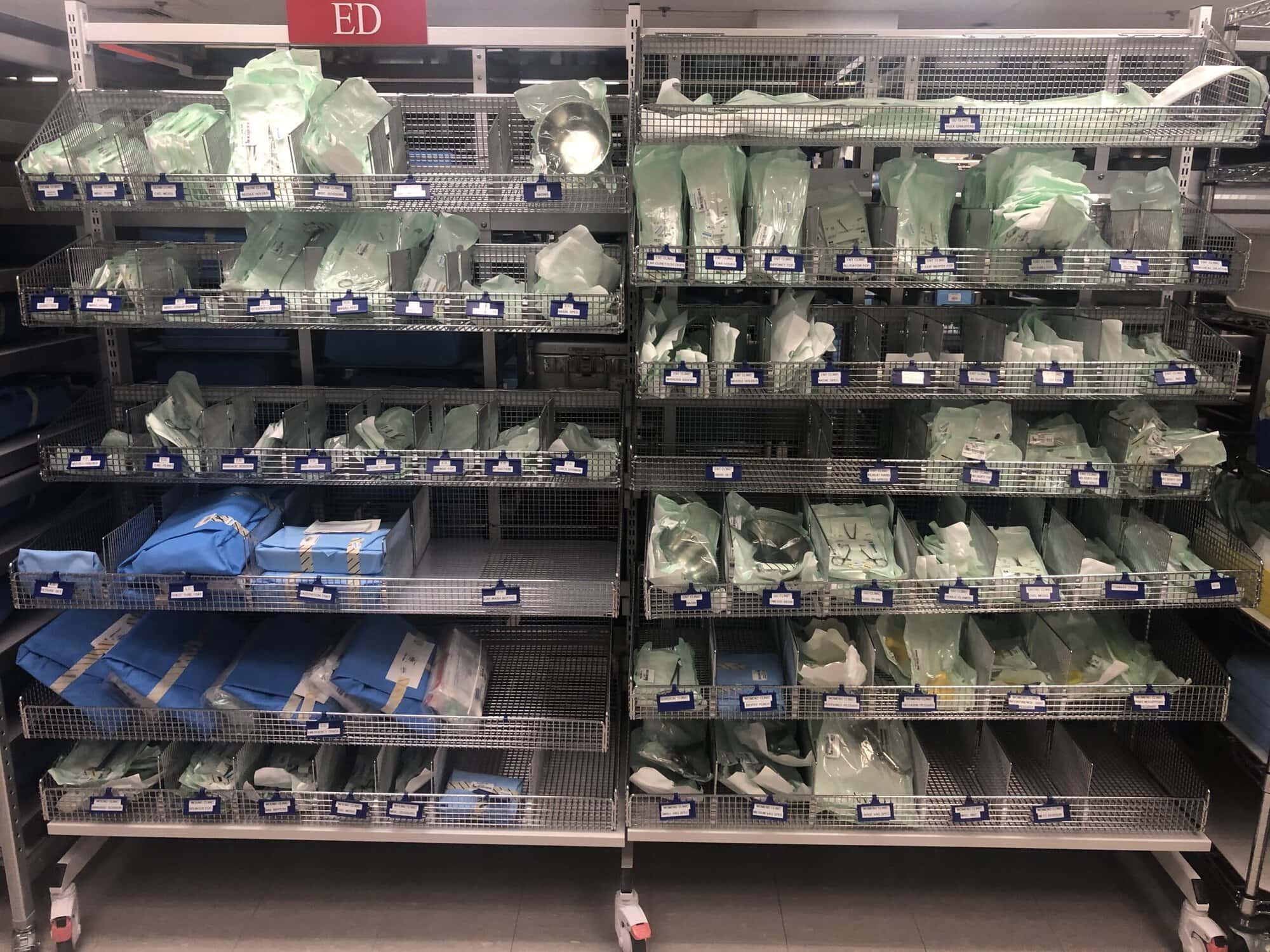
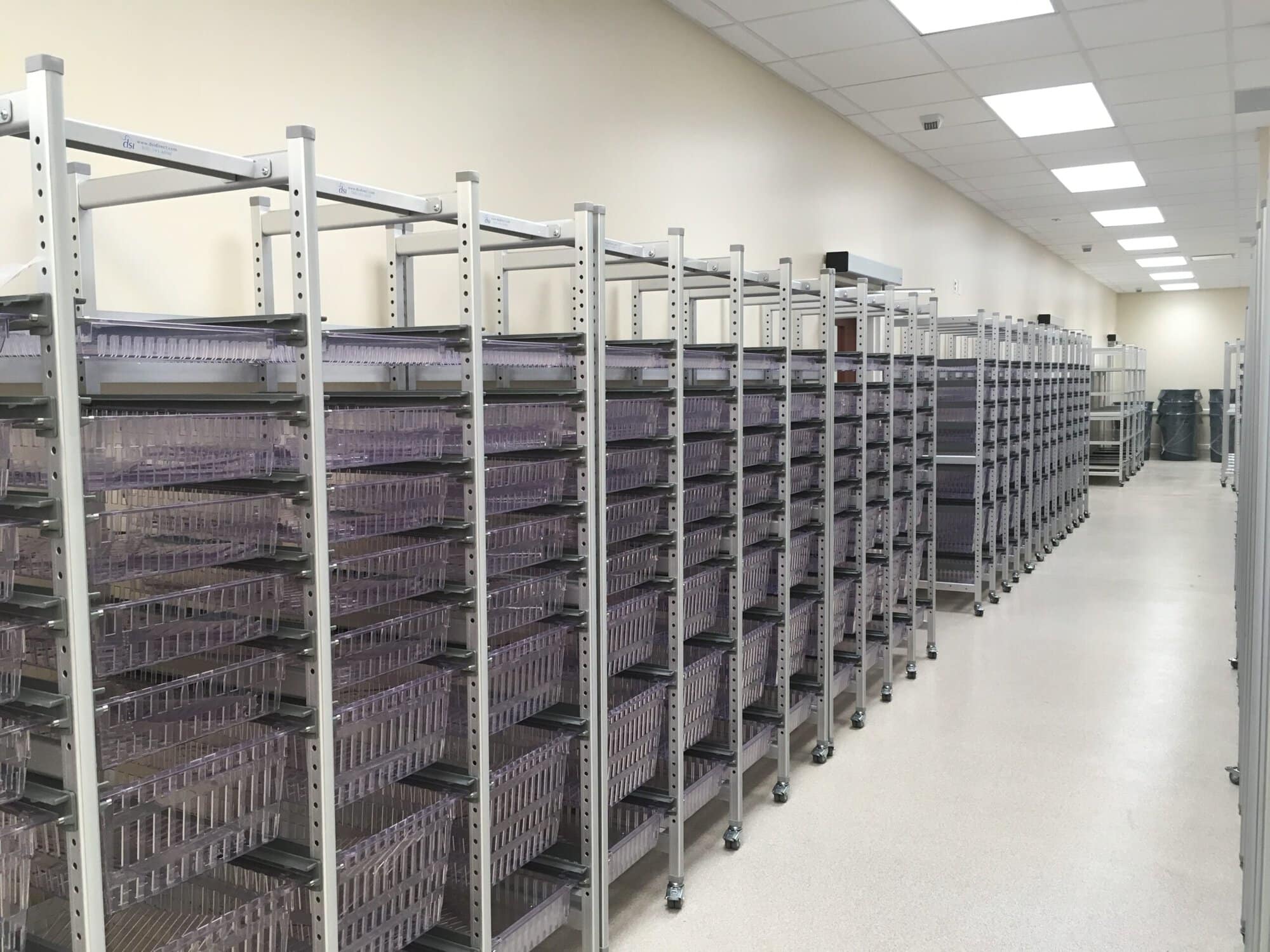
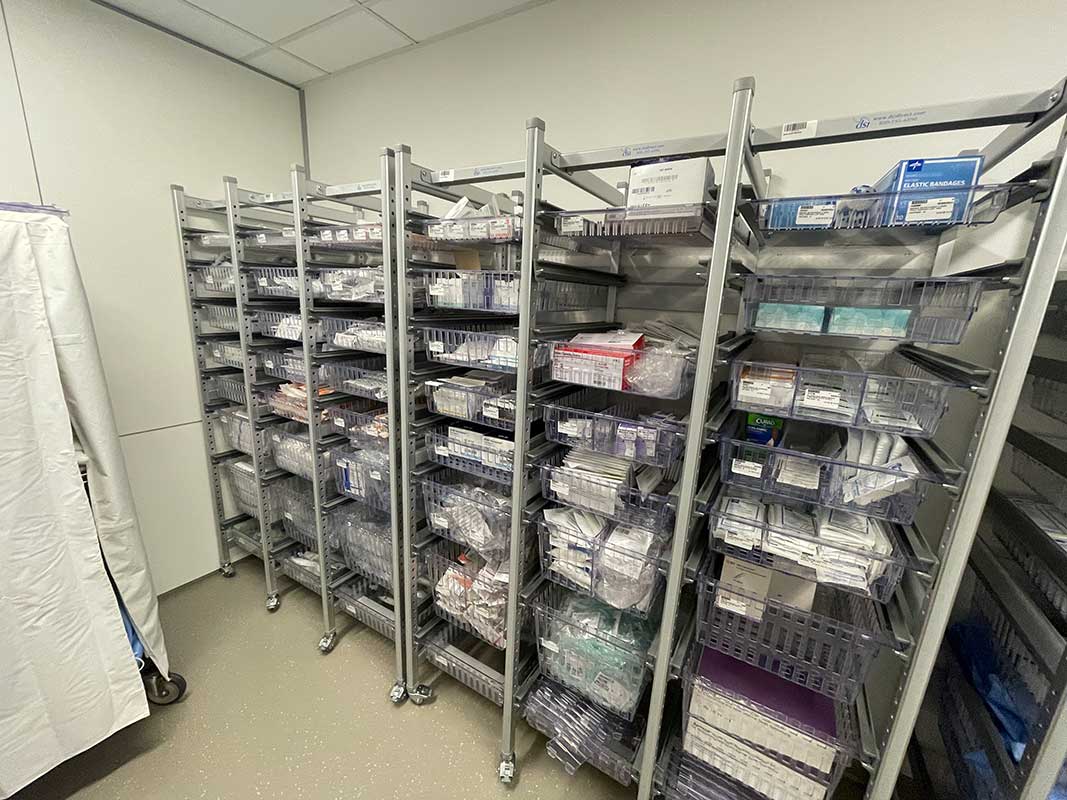
Sterile processing storage in 2026 reflects a fundamental shift from passive containment to active workflow orchestration. Hospitals are moving beyond traditional cabinets toward integrated systems combining RFID-enabled smart tracking, real-time location intelligence, and automated retrieval to address case readiness, compliance, and labor efficiency. The sterilization containers market reached USD 345.41 million in 2025 with 3.47% projected CAGR, while surgical instrument tracking systems reached USD 316.3 million with 11.9% CAGR, signaling where strategic investment is concentrating. RTLS in healthcare grew to USD 2.46 billion in 2024 at 16.87% CAGR, and healthcare ASRS reached USD 838.8 million, demonstrating strong momentum in automation and visibility.
The 2026 outlook is shaped by converging priorities: 90% of hospital leaders consider real-time inventory tracking vital, and 77% report excessive staff time lost searching for supplies. Technology integration is accelerating, with 68% planning RFID deployment and 69% planning RTLS within five years. Storage trends now emphasize instrument-level traceability, predictive analytics for replenishment, and ergonomic automation to reduce manual handling. Adoption remains stratified, with urban hospitals at 81% predictive-AI adoption versus 56% for rural facilities.
Sterile processing storage encompasses physical and digital systems used to contain, organize, track, and retrieve sterilized surgical instruments and supplies. Traditional solutions include rigid sterilization containers, passive shelving, and environmental cabinets relying on manual inventory counts. Modern systems layer these with RFID tags, barcode scanning, cloud dashboards, and automated retrieval for end-to-end visibility from decontamination through case-cart delivery. The global sterilization equipment market reached USD 7.9 billion in 2024, providing context for total SPD infrastructure investment.
Traditional sterilization containers serve as reusable rigid enclosures protecting instrument sets during sterilization, transport, and storage. The sterilization containers market was valued at USD 345.41 million in 2025, with North America holding 35.19% global share. Perforated aluminum containers dominate due to durability and cost-effectiveness. MetroWest Medical Center achieved 40% payback in 12 months after allocating USD 75,000 for 211 reusable hard cases.
Conventional cabinets provide passive visibility through open shelving or glass doors but lack automated tracking or replenishment intelligence. Universal Medical catalog pricing shows single-column carts around USD 3,500 and quad-column units above USD 8,500, reflecting the budget-to-mid-range baseline against which smart scope cabinets and automated systems are compared.
Surgical instrument tracking systems integrate barcode or RFID identification with workflow software to provide instrument-level traceability and real-time location updates. The surgical instrument tracking market reached USD 316.3 million in 2025 and is projected to grow at 11.9% CAGR through 2034. Censis CensiTrac offers cloud-based tracking with dashboards linking instrument, procedure, and patient records for compliance reporting and recall management.
Systems integrate with Epic, Cerner, Meditech, ASP, Belimed, Getinge, and Steris platforms to synchronize sterile processing with perioperative scheduling and documentation. Staff use mobile handheld scanning to log instrument flow from decontamination through case completion, reducing manual entry errors. Small-facility first-year implementation costs typically range from USD 10,000 to USD 30,000.
RTLS stands for Real-Time Location Systems, using wireless infrastructure to provide enterprise asset visibility and location intelligence across hospital campuses. The RTLS in the healthcare market reached USD 2.46 billion in 2024 and is projected to grow at 16.87% CAGR through 2033. Real-time location data flows to cloud analytics platforms, generating dashboards, alerts, and predictive insights for inventory management and workflow optimization.
RFID technology accounted for 32.43% of the RTLS market by technology type in 2024. Hardware represented 46.33% of 2024 RTLS revenue, encompassing tags, readers, antennas, and servers. RTLS adoption is expanding into sterile process management, enabling hospitals to monitor sterilization container movements, tray readiness, and instrument location with submeter accuracy.
Automation is transforming sterile processing storage by reducing manual handling, improving retrieval speed, and freeing staff from repetitive inventory tasks. The healthcare ASRS market reached USD 838.8 million in 2024, driven by demand for dense storage, ergonomic workflows, and integration with digital tracking. SPD automation addresses the 77% of hospital leaders reporting excessive staff time spent searching for supplies and the 75% citing difficulty recovering recalled or expired items.
Technology integration between ASRS and RFID-enabled track systems creates closed-loop visibility linking physical storage with real-time digital inventory. Gentofte Hospital deployed an advanced automated storage system, reducing manual lifting of 15 kg sterilization containers and improving ergonomics for SPD technicians.
ASRS stands for Automated Storage and Retrieval Systems, using vertical carousels, lifts, shuttles, or robotic cubes to store and retrieve items on demand. Healthcare ASRS deployments range from mini-load systems for instrument trays to unit-load configurations for bulk supplies. Gentofte Hospital integrated its automated storage with instrument tracking and surgical booking platforms, enabling automated case-cart preparation and reducing manual container handling.
Mini-load ASRS typically starts around USD 750,000, while robotic cube storage begins above USD 1,500,000. Vertical carousel modules offer entry-level automation starting near USD 70,000, and vertical lift modules begin around USD 95,000. Space requirements and workflow changes are significant, often necessitating dedicated automation rooms and revised SPD layouts.
Seventy-seven percent of hospital leaders say staff spend too much time searching for supplies, creating a strong productivity case for automation. Automated retrieval eliminates repetitive bending, lifting, and walking associated with manual storage, reducing musculoskeletal strain. Gentofte Hospital's system reduced manual handling of sterilization containers weighing up to 15 kg, improving technician safety.
Workflow redesign is necessary to realize SPD automation benefits, as systems must integrate with surgical schedules, decontamination throughput, and case-cart staging protocols. ASRS requires substantial space allocation and infrastructure investment, often best suited to new construction or major renovation. Successful implementations pair SPD automation with process improvement, ensuring technology supports optimized workflows.
The Omnicell RFID Cabinet provides restricted access control and automatic recognition of high-cost or traceable items entering or leaving storage. RFID tags applied to instruments and containers enable expiry-date monitoring, batch traceability, and automatic restocking alerts. Sixty-eight percent of hospital leaders planned RFID deployment within five years.
Smart cabinets function as hybrid hardware-software systems combining physical security with digital inventory intelligence. Automatic cost allocation by patient or procedure supports charge capture and revenue integrity, while expiry management reduces waste. Integration with central workstations and perioperative platforms enables coordinated replenishment and case-cart preparation.
Smart tracking technologies deliver instrument-level traceability and workflow visibility that manual systems cannot match. Hardware components such as RFID tags, barcode labels, and handheld scanners represented 46.33% of 2024 RTLS revenue. RFID tags applied to instruments and containers enable automated recognition at cabinets, washers, sterilizers, and case-cart staging areas.
Real-time location data flows to cloud analytics platforms, generating dashboards showing instrument status, container location, and workflow bottlenecks. Ninety percent of hospital leaders said real-time inventory tracking is vital, and 84% said hospitals must modernize asset inventory management. Smart tracking systems address these priorities by replacing periodic manual counts with continuous automated updates.
Hardware represented 46.33% of 2024 RTLS revenue, encompassing RFID readers, BLE beacons, Wi-Fi access points, and hybrid locating infrastructure. RFID tags are applied to instruments and containers using adhesive labels, embossed plates, or embedded chips designed to withstand repeated sterilization cycles. Smart tracking systems combine these hardware layers with workflow software, logging movements, and generating compliance records.
Instrument-level traceability systems use barcode or RFID identification to create digital chain-of-custody records linking each instrument to its decontamination, sterilization, and patient-use history. STERIS SPM Workflow Solution provides more than 200 reports, supporting audit readiness and continuous process improvement.
Ninety percent of hospital leaders said real-time inventory tracking is vital for knowing where critical assets are at all times. Real-time location data flows to cloud analytics platforms, generating dashboards, alerts, and predictive replenishment recommendations.
Location intelligence supports inventory management by reducing search time, preventing stockouts, enabling faster recall responses, and improving turnover visibility. RTLS infrastructure provides submeter accuracy, allowing hospitals to distinguish between instruments in decontamination, sterilization, or case-cart staging. Integration with ERP and perioperative systems enables automated reorder triggers and expiry monitoring.
Predictive AI use in non-federal acute care hospitals increased from 66% in 2023 to 71% in 2024, demonstrating rapid adoption of machine learning for inventory forecasting. Urban hospitals reached 81% predictive-AI adoption compared to 56% for rural facilities. STERIS SPM Workflow Solution provides more than 200 configurable reports supporting data-driven decision-making.
Analytics platforms process real-time location data, workflow timestamps, and usage patterns to forecast demand and identify inefficiencies. AI-driven insights enable proactive replenishment, reducing emergency orders and stock-out risk. Predictive models also support recall management by identifying affected instruments faster than manual searches.
The competitive landscape combines integrated sterile processing incumbents, pure-play tracking specialists, RTLS vendors, and automation providers. North America holds 47.8% of the surgical instrument tracking market, with Europe at 24.6% and Asia Pacific at 18.5%. Market leaders differentiate through ecosystem integration, workflow depth, analytics capabilities, and installed-base leverage.
Pricing strategies vary sharply across segments, from transparent catalog pricing for conventional cabinets to quote-based enterprise solutions for RTLS and ASRS. Vendors increasingly compete on platform breadth rather than isolated features, emphasizing seamless integration with perioperative systems and long-term support partnerships.
Censis CensiTrac provides cloud-based surgical instrument tracking with real-time visibility at instrument, procedure, and patient levels. STERIS SPM Workflow Solution offers configurable workflows, mobile handheld scanning, multi-site capabilities, and more than 200 reports for audit readiness. The Omnicell RFID Cabinet delivers restricted access control with automatic item recognition, expiry management, and batch traceability.
Integrated vendors leverage installed-base relationships and equipment service contracts to cross-sell software and smart tracking layers. Deep integration with Epic, Cerner, Meditech, ASP, Belimed, Getinge, and Steris washers and sterilizers reduces implementation friction. Competitive advantage increasingly depends on API openness, cloud-native architecture, and multi-site support.
Emerging innovators include RTLS specialists such as Zebra Technologies, CenTrak, Midmark RTLS, Kontakt.io, Vizzia Technologies, and Sonitor, emphasizing BLE-based deployment speed and cloud analytics. Pure-play sterile tracking vendors like SpaTrack Medical, RFID4U, and Xerafy focus on instrument-level traceability and SPD workflow optimization. Automation providers such as Kardex offer vertical carousels and lifts integrating with modu-max modular storage systems.
Competitive differentiation centers on deployment ease, infrastructure leverage, and analytics depth. Vendors enabling hospitals to use existing Wi-Fi or BLE infrastructure reduce the total cost of ownership. Cloud-native platforms support rapid updates and remote troubleshooting, reducing IT burden.
Universal Medical cabinet pricing ranges from USD 3,500 for single-column carts to above USD 8,500 for quad-column units. Kardex vertical carousel modules start around USD 70,000, while vertical lift modules begin near USD 95,000. Mini-load ASRS systems typically start above USD 750,000, and robotic cube storage exceeds USD 1,500,000.
Small-facility instrument tracking first-year benchmarks range from USD 10,000 to USD 30,000, making smart tracking accessible to ambulatory surgery centers and community hospitals. Quote-based pricing dominates RTLS and integrated workflow platforms. Hybrid pricing models combining upfront capital with recurring subscription fees are becoming more common.
Adoption patterns reflect significant disparities by hospital size, urbanization, and regional market maturity. Urban hospitals reached 81% predictive-AI adoption in 2024 compared to 56% for rural facilities, while large hospitals reached 96% versus 59% for small hospitals.
North America leads installed-base maturity, holding 47.8% of the surgical instrument tracking market and 46.08% of RTLS in healthcare. Asia Pacific represents the fastest-growing region for RTLS and SPD automation, driven by healthcare infrastructure expansion and government digitalization initiatives. Europe captured 24.6% of the surgical instrument tracking.
Urban hospitals demonstrated 81% predictive-AI adoption versus 56% for rural hospitals, reflecting infrastructure, workforce, and capital advantages. Large hospitals reached 96% adoption compared to 59% for small hospitals. Rural hospitals showed an odds ratio of 0.68 versus urban facilities for tracking technology adoption.
System affiliation and centralization significantly increase adoption likelihood, with supply-chain tracking odds ratios ranging from 1.87x to 3.07x higher in centralized networks. Integrated delivery networks prioritize standardization and shared infrastructure investment. Single-facility community hospitals face greater capital constraints and integration complexity.
North America holds 47.8% of the surgical instrument tracking systems market, reflecting mature installed bases and regulatory emphasis on traceability. Europe captured 24.6%, with particularly strong momentum in Northern Europe. Asia Pacific represented 18.5%, driven by rapid hospital construction, government digitalization mandates, and growing infection control awareness.
RTLS in healthcare shows similar regional patterns, with North America at 46.08% and the Asia Pacific representing the fastest-growing segment. Latin America and Middle East, and Africa remain smaller markets but show increasing interest in turnkey solutions bundling hardware, software, and implementation support.
Sixty-eight percent of hospital leaders planned RFID deployment within five years, and 69% planned RTLS deployment. Tracking technology adoption rose from 36.34% to 54.63% for clinical use and from 28.58% to 41.30% for supply-chain use between 2012 and 2015. Predictive AI adoption increased from 66% in 2023 to 71% in 2024.
Digital maturity creates self-reinforcing advantages, as hospitals with EHR integration, data governance, and IT support adopt new technologies faster. Facilities lacking foundational infrastructure face higher implementation barriers. The 2026 outlook suggests continued stratification, with digitally mature urban systems pulling ahead.
Hospital priorities center on real-time visibility, compliance traceability, labor efficiency, and cost reduction. Ninety percent of leaders rate real-time inventory tracking as vital, and 84% say asset management modernization is necessary. Seventy-seven percent report excessive staff time spent searching for supplies, and 75% cite difficulty recovering recalled or expired items.
Operational challenges include cancellations due to inventory issues affecting approximately 75% of facilities, with 76% reporting inadequate stock-out and lost-item visibility. These pain points drive demand for integrated systems combining modu-stor-cts container storage, RFID tracking, and automated replenishment. MetroWest Medical Center generated USD 29,843 in first-year savings by transitioning to reusable rigid containers.
Ninety percent of hospital leaders said real-time inventory tracking is vital, driven by case-readiness requirements and revenue protection. Eighty-four percent said hospitals must modernize asset inventory management. Real-time visibility enables proactive exception management, reducing delays and improving OR utilization. Location intelligence supports faster recall responses, better expiry monitoring, and more accurate charge capture.
Seventy-five percent of hospital leaders cite difficulty recovering recalled or expired items, creating regulatory and patient-safety risks. Seventy-six percent say reporting low-stock or out-of-stock items needs improvement. Cancellations due to inventory issues affect approximately 75% of facilities.
Digital chain-of-custody records generated by RFID and barcode smart tracking systems support regulatory audits and Joint Commission surveys. Instrument-level traceability links each device to decontamination validation, sterilization parameters, and patient use. Compliance requirements increasingly drive procurement decisions, with buyers prioritizing audit-ready reporting and automated record-keeping.
Seventy-seven percent of hospital leaders say staff spend too much time searching for supplies. MetroWest Medical Center generated USD 29,843 in first-year avoided blue-wrap costs after transitioning to reusable rigid containers, achieving nearly 40% payback in 12 months. The facility also reduced disposable blue-wrap waste by 5,606 pounds.
Labor savings result from reduced search time, automated replenishment, and elimination of manual inventory counts. Ergonomic improvements from SPD automation reduce musculoskeletal injuries and staff turnover. Projected ten-year savings of USD 233,000 at MetroWest demonstrate how storage investments deliver compounding returns.
Traditional passive storage remains relevant for budget-constrained facilities, low-volume departments, and applications where traceability requirements are minimal. Conventional cabinets provide basic environmental protection without software integration or capital investment. Manual counts and visual inspection continue to serve facilities lacking IT infrastructure or digital readiness.
Hybrid systems combining reusable containers, RFID tracking, and selective automation represent the most common 2026 deployment model. MetroWest Medical Center illustrates this approach with a 269-bed system operating 16 ORs that allocated USD 75,000 for rigid containers while maintaining integration with existing Epic and sterilizer platforms. Systems integrate smart tracking with Epic, Cerner, Meditech, ASP, Belimed, Getinge, and Steris equipment, enabling layered modernization.
Conventional cabinets provide passive visibility through shelving and glass doors without requiring IT integration or staff training. Manual counts remain necessary for inventory accuracy, making this viable for departments with stable demand and experienced staff. Limited traceability constrains recall responses but may be acceptable in low-risk applications.
Budget constraints drive continued use of traditional plastic bins and passive shelving in rural hospitals, ambulatory surgery centers, and departments under financial stress. Facilities planning for future technology integration often maintains conventional storage as a bridge strategy.
MetroWest Medical Center operates a 269-bed system with 16 operating rooms that allocated USD 75,000 for 211 reusable hard cases, demonstrating hybrid container modernization. Systems integrate smart tracking with Epic, Cerner, Meditech, ASP, Belimed, Getinge, and Steris platforms, enabling data flow across decontamination, sterilization, storage, and case-cart stages.
Hybrid approaches allow hospitals to layer SPD automation and smart tracking incrementally, reducing implementation risk and capital burden. Facilities can deploy RFID-enabled cabinets in high-value areas while maintaining conventional storage elsewhere. Modular deployment supports phased rollouts, aligning with capital budgets and organizational change capacity.
MetroWest Medical Center generated USD 29,843 in first-year avoided blue-wrap costs through rigid container adoption, achieving nearly 40% payback in 12 months. The facility projected USD 233,000 in ten-year savings when including disposal-fee reductions and labor efficiency. Transitioning approximately 66% of surgical instrumentation into reusable rigid containers reduced disposable blue-wrap waste by 5,606 pounds annually.
Operational returns extend beyond direct cost savings to include faster OR turnover, reduced search time, improved staff satisfaction, and better compliance documentation. Multi-year projections support capital requests by demonstrating compounding benefits.
The 2026 sterile processing storage landscape is defined by the convergence of traditional containment with digital traceability and automated handling. Hospitals are moving beyond passive cabinets toward integrated systems delivering real-time visibility, predictive analytics, and workflow orchestration. Fastest growth concentrates in surgical instrument tracking at 11.9% CAGR and RTLS at 16.87% CAGR, while traditional containers grow at 3.47% CAGR, confirming that strategic value centers on intelligence layers.
Adoption remains stratified by hospital size, urbanization, and digital maturity, with urban facilities at 81% predictive-AI adoption versus 56% for rural hospitals. As technology integration deepens, procurement decisions increasingly favor vendors offering ecosystem breadth, cloud analytics, and seamless perioperative integration. Organizations like DSIDirect support storage trends evolution by providing tailored storage solutions combining modular infrastructure with workflow optimization and measurable ROI.
Healthcare facilities seeking to modernize sterile processing storage should evaluate current digital readiness, compliance requirements, and operational pain points before selecting technology layers. Most successful implementations pair SPD automation and smart tracking with process redesign, ensuring technology supports optimized workflows. For expert guidance on implementing integrated sterile processing storage solutions that deliver measurable efficiency gains and cost savings, explore comprehensive planning and implementation services designed specifically for acute care environments.
The shift toward smart tracking, RFID integration, and automated retrieval is already underway in sterile processing departments across the country. But technology alone doesn't solve the problem — the physical storage infrastructure underneath it has to be built for it.
Distribution Systems International designs and installs SPD storage systems built for the demands of modern sterile processing. From high-density shelving and sterile instrument storage to full turnkey implementation with inventory transfer, DSI delivers the physical foundation your tracking and automation investments require.
Contact Distribution Systems International today to schedule a complimentary storage analysis and find out what your SPD is ready for.

With 21 years of sales management, marketing, P&L responsibility, business development, national account, and channel management responsibilities under his belt, Ian has established himself as a high achiever across multiple business functions. Ian was part of a small team who started a new business unit for Stanley Black & Decker in Asia from Y10’ to Y14’. He lived in Shanghai, China for two years, then continued to commercialize and scale the business throughout the Asia Pacific and Middle East regions for another two years (4 years of International experience). Ian played college football at the University of Colorado from 96’ to 00’. His core skills sets include; drive, strong work ethic, team player, a builder mentality with high energy, motivator with the passion, purpose, and a track record to prove it.