Key Takeaways
A single robotic surgical instrument can cost more than a mid-sized car, and it's designed to last only 10–20 uses. When storage conditions drift outside spec, that already-short lifespan gets shorter. Corrosion, condensation, calibration drift, and static discharge show up weeks later as intermittent failures, warranty denials, and six-figure replacement invoices.
This guide breaks down the temperature control and humidity control requirements that protect instruments valued at $15,000–$30,000 each, the environmental monitoring systems that catch problems early, and the implementation steps that make robotic instrument storage reliable and audit-ready.
The right storage environment prevents corrosion, condensation, static discharge, and calibration drift, the four environmental killers of robotic instruments. Standards from ANSI/ASHRAE/ASHE 170-2013 and the Joint Commission define narrow bands for instrument preservation. Hit them consistently, and you eliminate the most preventable category of instrument damage.
| Parameter | Target Range | Why It Matters | What Goes Wrong If Missed | Notes / Standard |
| Relative Humidity | 30–60% (±5%) | Balances corrosion prevention with ESD protection | >60%: corrosion within 30–90 days. <30%: ESD damages electronics | ANSI/ASHRAE/ASHE 170-2013; Joint Commission sterile-storage standard |
| Temperature | 64–73 °F / 18–23 °C (±2 °F) | Prevents expansion/contraction causing calibration drift | ±10 °F swings cause calibration issues; rapid changes trigger condensation | OR range is 68–75 °F; sterile storage max 75 °F |
| Dew Point | All surfaces ≥3 °F above dew point | Prevents condensation on connectors and circuits | Moisture forms in minutes on cold metal; damage is immediate | Most critical during cold starts and post-HVAC recovery |
| Temp Stability | ≤±2 °F/hr; ≤±5 °F/24 hr | Repeated thermal cycling fatigues materials and drifts calibration | Tip/wrist failures account for 46.9% of all instrument failures | Robot motors and electronics create local heat exceeding room averages |
Advanced instruments cost $15,000–$30,000 each. Hospitals maintain $500,000–$2,000,000 in inventory. About 20% of reusable robotic instruments fail prematurely, and instruments are designed for only 10–20 uses; any environmentally driven lifespan reduction is expensive.
Gradual drift is far less damaging than rapid swings. A ±10 °F fluctuation directly causes calibration issues in precision tip and wrist assemblies. Calibration drift from thermal cycling develops over weeks to months, making it hard to trace. That 12.6% of instrument failures classified as "unknown cause" likely includes subtle environmental factors that never get flagged.
Relative humidity within range doesn't guarantee robotic instrument safety. What matters is whether any surface falls below the dew point. Cold metal, exterior walls, and supply air diffusers routinely create condensation traps that standard RH readings miss.
| Room Temp | RH | Dew Point | Cold Surface Example | Condensation? | Takeaway |
| 73 °F | 55% | ~56 °F | 50 °F metal base plate near exterior wall | Yes | Cold metal near walls condenses even at mid-range RH |
| 68 °F | 45% | ~46 °F | 60 °F instrument stored mid-room | No | Standard controlled conditions with comfortable margin |
| 75 °F | 60% | ~60 °F | 58 °F supply diffuser surface | Yes | Upper-limit RH + cold supply air = condensation near diffusers |
| 65 °F | 50% | ~46 °F | 45 °F chilled water line nearby | Yes | Chilled piping creates hidden dew-point crossings |
| 72 °F | 58% | ~56 °F | 52 °F metal table after weekend HVAC setback | Yes | Monday morning startup is a classic condensation event |
For robotic surgical instruments, where the device failure rate per operation is already 7.8%, environmental excursions accelerate failure through mechanisms that are hard to detect and expensive to fix.
A metal surface cools below the room's dew point. Microdroplets form on precision electrical contacts and circuit boards. Damage begins within minutes as moisture penetrates electronics. Resulting failures may not appear for weeks, surfacing as intermittent malfunctions with no obvious cause.
Sustained humidity above 60% triggers multiple concurrent damage pathways. Corrosion forms on connectors, irreversible, requiring replacement at $10,000–$25,000 per instrument. Sensors drift, degrading surgical precision. Hygroscopic materials swell, changing tight tolerances. Microbial growth colonizes instrument surfaces and sterile packaging.
ESD damages internal electronics with latent effects that surface weeks later. Static attracts particulates to optical and mechanical surfaces. Cables become brittle; cables already account for 5.7% of all instrument failures.
Environmental excursions rarely come from catastrophic HVAC failure. They come from routine operations, door traffic, seasonal loads, weekend setbacks, and loading dock transitions.
The most common triggers are door openings introducing unconditioned air, outside-air infiltration (summer adds humidity; winter adds ESD risk), and HVAC cycling pushing swings beyond ±2 °F tolerance. Heat loads from robot motors create microclimates exceeding room averages.
Cold starts are the primary risk; instruments at ambient temperature get exposed to warm, humid air when the room comes online. Weekend HVAC setbacks create the classic Monday morning condensation event. Cold surfaces near exterior walls, diffusers, and chilled piping run 10–15 °F colder than room air.
Temperature transitions between trucks, loading docks, and conditioned storage cause ±10 °F shifts. Loading docks rarely maintain 18–23 °C / 30–60% RH. Delayed unboxing extends exposure into the short-term damage window where initial corrosion begins. See this guide to configuring custom storage systems for the receiving and staging area design.
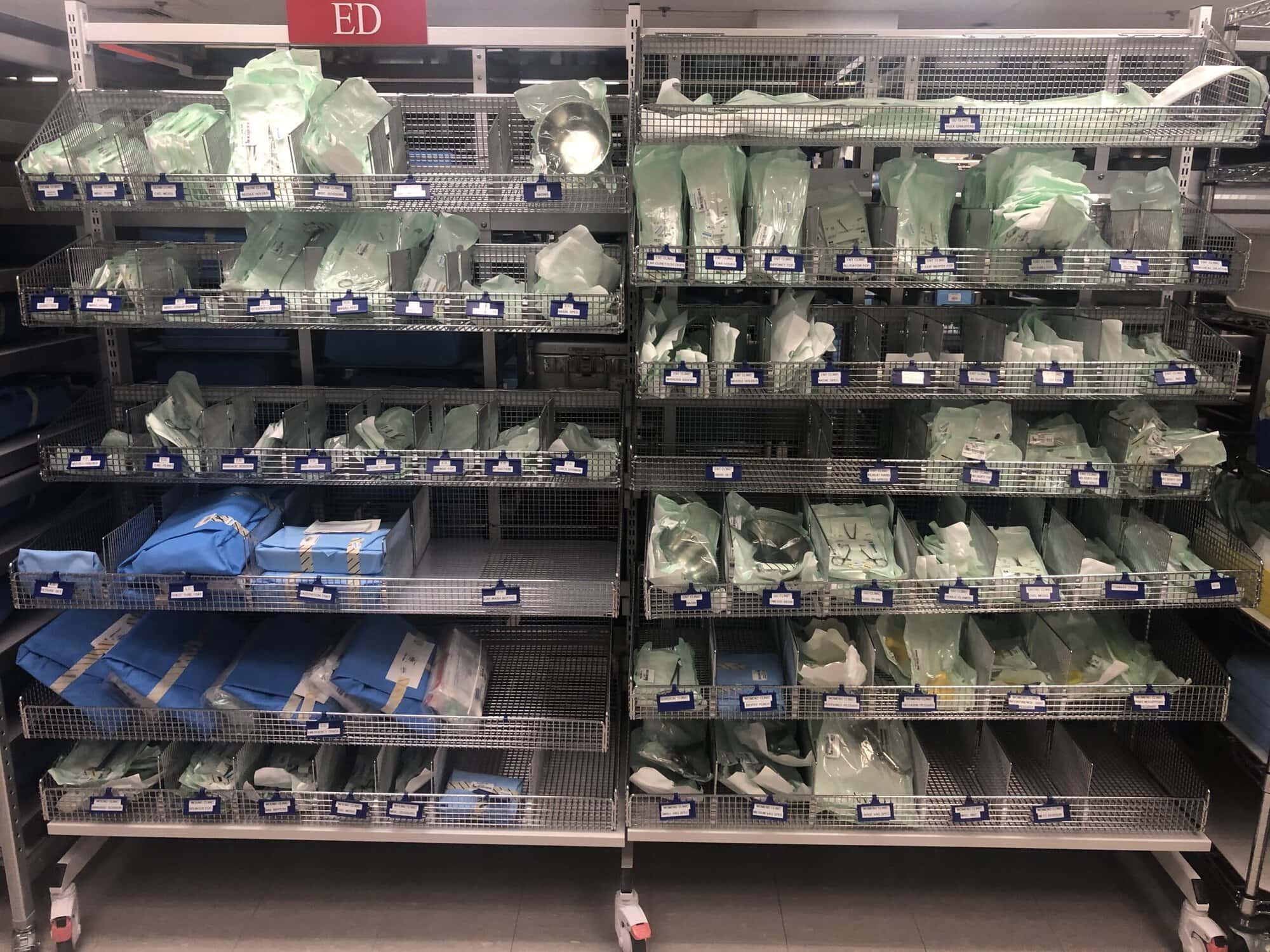
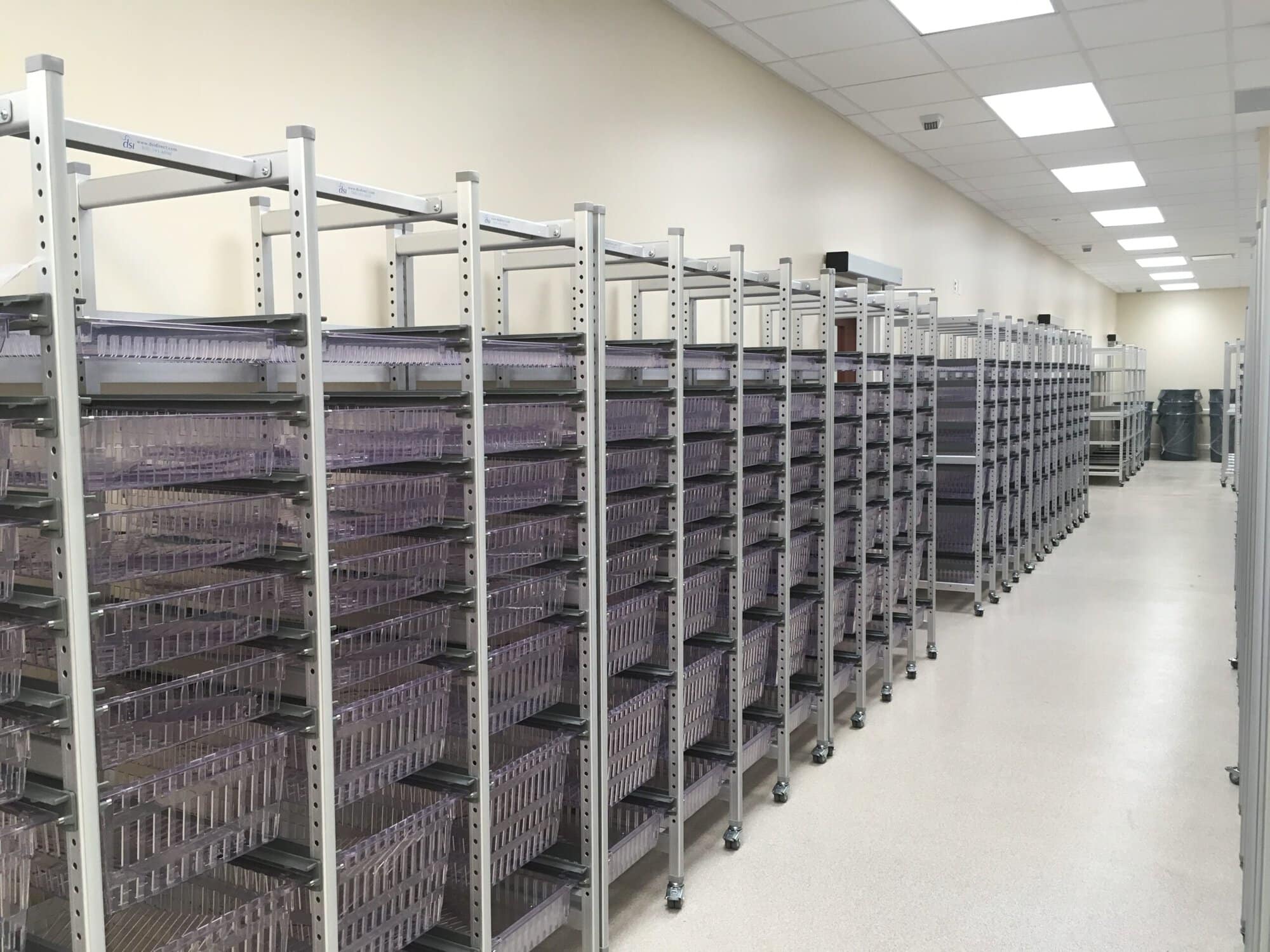
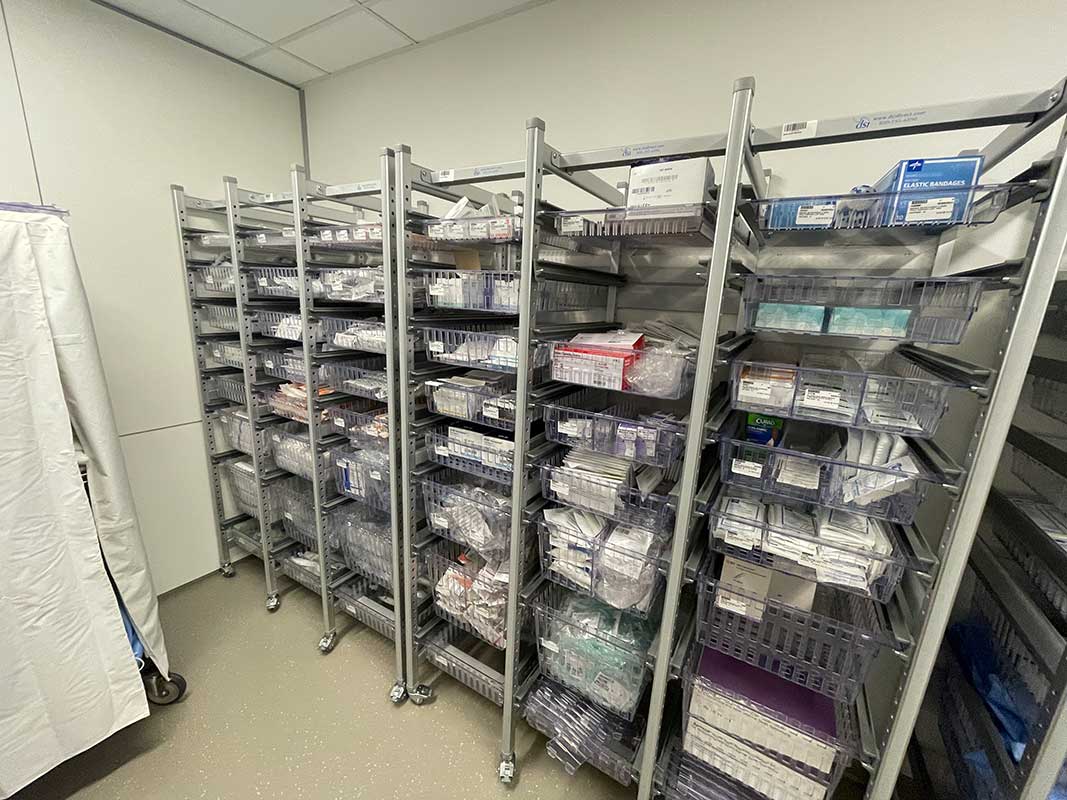
Most programs need room-level control as the baseline, with cabinet-level protection for the highest-value instruments.
Room control wins when staff need frequent access, and the Joint Commission mandates shelving ≥8 inches above the floor. It's the right choice for $500K–$2M inventories needing uniform conditions. High-density vertical storage, which increases capacity 60%+, requires room-wide climate control.
| Approach | Best For | Control Quality | Door-Open Response | CapEx / OpEx | Typical Risks |
| Room HVAC | Large programs, shared storage | Moderate (18–23 °C, 30–60% RH) | Slower; depends on 4 air changes/hr | $50K–$200K install | Seasonal drift, stratification |
| Local Enclosure | Critical instruments ($15K–$30K each) | High (±0.5 °F, ±2% RH, ISO 4 HEPA) | Fast recovery in sealed envelope | $20K–$32K per cabinet | Single-point failure; limited capacity |
| Dry Cabinet | Overflow, receiving staging | Good humidity; limited temp control | Minimal, sealed | $699–$9,000 | No independent temp control |
| Factor | Room Control | Enclosure | Choose When |
| Access frequency | No friction | Open/close overhead + recovery time | Room if >10 accesses/day |
| Cycle time | Retrieval time ↓25% with vertical storage | Cabinet adds per-access overhead | Room if OR turnover is priority (pit-stop model cut turnover 99→53 min) |
| Footprint | Needs dedicated room; modular shelving saves 30–40% | Compact but limited capacity | Room for >$500K inventory |
| Contamination control | Positive pressure + HEPA standard | ISO 4 cabinet = superior local control | Enclosure for highest-value items |
| Cost scalability | High upfront, low marginal per instrument | Each cabinet $5K–$32K | Room if growing (market growing 13.7%/yr) |
| Serviceability | Facilities-managed | May require instrument relocation during service | Room if zero displacement tolerance |
Refrigerant dehumidification works for general HVAC. Robotic instrument storage pushes it past its limits. Low target temperatures (64–68 °F), tight dew-point requirements, and fast recovery demands make desiccant the better fit.
Refrigerant systems struggle below ~65 °F, coils ice up, and capacity drops. They cannot hit dew points below ~45 °F. Part-load overcooling requires energy-wasting reheat to maintain 18–23 °C. Recovery after door-open spikes may exceed the 15-minute alert threshold.
| Requirement | Why Refrigerant Fails | Why Desiccant Helps | Cost Note |
| Low dew point (<45 °F) | Coil icing/cycling | Adsorbs moisture independent of temp | ~$5,056+ for commercial units |
| Cold room (64–68 °F) | Reduced capacity, icing | Efficient at any room temp | Regeneration heat adds energy cost |
| Fast recovery | Slow pull-down after spikes | Recovery within minutes | Less cycling-related wear |
| High outside air (min 2 changes/hr, ASHRAE 170) | Overwhelmed in summer | Handles high moisture without overcooling | May need larger sizing at peak |
| Seasonal extremes | Summer capacity issues; winter overcools | Modulates seasonally; pairs with humidification | BMS integration recommended |
Supply air more than 10 °F below the setpoint creates condensation on diffusers and nearby instruments. Cold air sinks to floor-level instruments; shelving ≥8 inches above the floor partially mitigates this. Poor mixing leaves dead zones with uncontrolled humidity while sensors read normal.
A single humidity sensor on the wall tells you nothing about the cold metal table near the exterior wall or the spike every time someone opens the door. Production-ready monitoring measures what matters at the point of risk.
Paired RH and temperature readings (for dew-point calculation), surface temperature at cold spots, gradients across the room, and rate-of-change tracking. Systems like SONICU track all parameters 24/7 with multi-channel alerts.
Place sensors near cold surfaces, doors, supply diffusers, and instrument air intakes, at instrument height. Avoid direct airflow, which reads supply conditions instead of room conditions.
| Alarm | Trigger | Why It Matters | Action |
| High RH | >60% for >15 min | Corrosion within 30–90 days | Increase dehumidification; inspect instruments if >2 hrs |
| Low RH | <30% for >15 min | ESD risk to electronics | Activate humidification; ESD handling protocols |
| Dew Point Margin | Surface within 3 °F of dew point | Condensation imminent (minutes) | Raise surface temp or lower humidity; cover instruments |
| Rapid RH Rise | >10% in 15 min | Infiltration event | Identify source; close doors; assess instruments |
| Rapid Temp Drop | >5 °F in 30 min | Condensation + thermal shock risk | Check HVAC; slow cooling; assess instruments |
| Sensor Fault | Out-of-range or data loss | Blind spot in protection | Manual checks every 15 min until restored |
| Prolonged Excursion | Any parameter out of spec >1 hr | Cumulative damage accelerating | Escalate; consider instrument quarantine |
Specifying what "good" looks like before procurement prevents vendor disputes and systems that pass commissioning but fail in daily operation.
| Metric | Target | Method | Duration | Pass/Fail |
| RH band | 30–60% (±5% of setpoint) | Calibrated sensor, ±1% accuracy | 72 hr (occupied + unoccupied) | Fail if >5% of readings outside band |
| Temp band | 64–73 °F (±2 °F of setpoint) | Calibrated sensor, ±0.1 °F | 72 hr | Fail if >5% outside band |
| Dew point margin | Surfaces ≥3 °F above dew point | Paired surface + ambient sensors | 72 hr incl. cold-start challenge | Fail if any surface breaches margin |
| Recovery time | ≤15 min after disturbance | Logging during door-open/load tests | 5 door cycles + 2 load changes | Fail if any recovery >15 min |
| Logging uptime | ≥99.5% over 30 days | Gap detection | 30 days post-commissioning | Fail if gaps >3.6 hrs total |
Log temperature and RH every 5 minutes. Log door access in real time. Retain all data 3+ years. Time-sync to the same NTP source, annotate events, log calibrations. Assign ownership: daily review to sterile processing, weekly trends to quality, monthly reports to leadership.
Run the full suite before sign-off: door-open (2 minutes open, measure recovery), cold-start, power-outage (30 minutes), HVAC cycle response, humid-day stress, and sensor redundancy check. DSI Direct's robotic instrument storage whitepaper provides additional commissioning guidance.
Define targets, measure reality, close the gap, prove it works, keep it working. Skipping baselining or commissioning is how facilities end up with expensive systems that don't protect inventory.
Pull RH and temperature limits from each instrument's IFU. IFU violations trigger warranty denial, and case delays cost over $2,000/min. Define dew-point margin (≥3 °F), stability limits (±2 °F/hr), and excursion policy (warn at 15 min, escalate at 1 hr).
Install 4+ sensors per room at cold spots, doors, diffusers, and instrument height (±0.1 °F / ±1% accuracy). Run 2+ weeks covering weekdays, weekends, and seasonal stress. Log every 5 minutes.
Room control suits high-volume programs ($850K/yr instrument cost at 425 cases). Enclosures suit fewer than 5 daily accesses to $15K–$30K items. Budget: room $50K–$200K; cabinet $5K–$32K; comprehensive $50K–$150K.
Map every cold surface. Set ≥3 °F margin. Avoid overcooling supply air. Create warm-up procedures for cold starts, Monday morning and post-holiday restarts are highest risk.
Floor at 30% RH (ESD threshold), ceiling at 60% (corrosion, $10K–$25K irreversible damage per instrument). Summer: dehumidification priority. Winter: humidification priority.
Run every validation test from Section 7. Document everything for Joint Commission and warranty compliance.
Calibrate sensors annually. Check filters and drains weekly. Audit alarms quarterly. Retain records 3+ years. Manufacturer reimbursement is only 57.9%, documentation is the difference between cost recovery and full loss.
Shipping transitions, regional humidity extremes, and cold-surface proximity fall outside normal HVAC design assumptions.
Allow acclimation before unpackaging, moving instruments from an unconditioned truck into a warm room triggers condensation inside sealed packaging. Use desiccant packs and humidity indicator cards in transit packaging. Electronic dry cabinets ($699–$9K) at receiving provide a buffer zone. InstruSafe cases (~$162 each) protect individual instruments.
Desiccant dehumidification may be required year-round alongside ASHRAE 170 outside-air mandates. Size for 95th-percentile humidity, not the average. Enforce door discipline. Pre-position backup dehumidification for peak-load days.
Keep instruments ≥12 inches from exterior walls. Insulate cold surfaces and seal infiltration paths. Install surface-temperature sensors on the coldest points, your early warning for dew-point crossings. Understanding why safety in storage matters starts with knowing where the hidden risks are.
Environmental failures rarely come from exotic causes. They come from measurement gaps, design shortcuts, and operational drift.
Single sensor on an interior wall. Wrong placement. No calibration. No dew-point calculation from paired data. Averaging that masks spikes, log at 5-minute intervals and review peaks, not averages.
Supply air >10 °F below setpoint without reheat. No stratification control. Short cycling. Unsealed infiltration paths. Enclosures with stagnant internal airflow.
Ignoring alarms. Propping doors. Skipped maintenance. Undocumented setpoint changes. Each is minor alone. Together, they erode the controlled environment protecting a $500K–$2M inventory.
A storage environment is only as reliable as the procedures that maintain it. Facilities meeting AAMI standards for sterile processing storage already have the documentation framework, environmental SOPs extend it.
Sterile processing verifies sensor status daily and reviews trends. Facilities checks filters and drains weekly. A supervisor confirms door discipline daily. Quality reviews alarm logs weekly. Assign each task to a named role.
Five-step sequence: contain the excursion → verify the sensor reading → protect instruments (cover, pause, or relocate) → restore conditions within 15 minutes → document everything including risk assessment and follow-up verification.
Retain trend logs (5-minute intervals) for 3+ years. Maintain calibration certificates, maintenance logs, incident reports, and commissioning results. Manufacturer reimbursement is only 57.9%, and the most common denial reason is documented mishandling. These records are the difference between cost recovery and full loss.
Start with minimum viable protection, then build toward production-ready as case volume and inventory value grow.
Protecting a $500K–$2M instrument inventory doesn't require exotic engineering. It requires the right environmental targets, dew-point monitoring at the point of risk, validated recovery times, and the operating discipline to maintain all three. Preventing 2–3 instrument losses per year pays for the entire climate-controlled storage system; every dollar spent on proper temperature control, humidity control, and documentation is a dollar you don't spend replacing a $30,000 instrument or absorbing a warranty denial.
Need help designing the right storage environment for your robotic program? Contact DSI Direct to discuss climate-controlled storage solutions sized to your facility.
With 21 years of sales management, marketing, P&L responsibility, business development, national account, and channel management responsibilities under his belt, Ian has established himself as a high achiever across multiple business functions. Ian was part of a small team who started a new business unit for Stanley Black & Decker in Asia from Y10’ to Y14’. He lived in Shanghai, China for two years, then continued to commercialize and scale the business throughout the Asia Pacific and Middle East regions for another two years (4 years of International experience). Ian played college football at the University of Colorado from 96’ to 00’. His core skills sets include; drive, strong work ethic, team player, a builder mentality with high energy, motivator with the passion, purpose, and a track record to prove it.