Healthcare facilities face mounting pressure to reduce supply chain costs while improving clinical staff productivity. Logistics activities account for 30 to 46 percent of hospital budgets, making partner evaluation criteria directly tied to operational performance. Selecting the right healthcare storage solutions partner that prioritizes total cost of ownership over unit price delivers measurable improvements in inventory efficiency, space utilization, and regulatory compliance.
Nurses lose up to 60 minutes per shift searching for supplies, representing an aggregate cost near 14 billion dollars annually. Choosing a storage system vendor comparison framework that addresses workflow disruption reduces this burden and redirects clinical hours toward patient care. The right logistics provider assessment methodology evaluates consultative capability, turnkey implementation, and compliance support as primary decision drivers.
A consultative partner approach differs sharply from transactional buying, and understanding that difference is the first step in vendor selection.
Storage decisions influence both clinical outcomes and financial performance in acute care settings. The American Hospital Association reports hospitals lose more than 25 billion dollars yearly to supply chain inefficiencies. Poor storage design creates compliance risks, extends procedure times, and forces clinical staff to spend hours searching instead of delivering patient care.
Time-study research shows nurses spend only about 31 percent of the day on direct patient care. Services that address storage workflow allow facilities to reclaim lost productivity and redirect labor toward higher-value activities. Purchased services can reach 40 to 50 percent of hospital operating expenses, making vendor selection a board-level strategic concern.
Storage decisions directly affect hospital operating budgets and clinical staff efficiency. Logistics activities account for an estimated 30 to 46 percent of hospital budgets, forcing leadership to treat storage as a strategic operational priority. Nurses lose up to 60 minutes per shift hunting for supplies, an aggregate cost near 14 billion dollars annually.
Nurses spend only about 31 percent of the day on direct patient care, with the remaining time consumed by documentation, medication administration, and material searches. These figures demonstrate why storage system design belongs in strategic planning rather than procurement.
Inventory carrying cost typically runs 20 to 30 percent of inventory value annually. A 400-bed hospital carrying 3.5 million dollars in supplies at a 27 percent rate spends roughly 945,000 dollars yearly just to hold it. AHRMM benchmarks put healthy inventory turnover at 3 to 5 turns annually.
Facilities evaluate solutions based on total operational impact rather than unit price alone. Storage inefficiency compounds over time, increasing carrying costs while reducing staff productivity and creating compliance exposure. Partners who document ROI projections before implementation address the financial accountability materials managers require.
Storage design directly determines how much time clinical staff spend preparing for procedures. OR supply assessment time reduced from 18 to 20 minutes down to 20 to 40 seconds with 2-Bin KANBAN and enclosed carts. Vertical lift modules report 60 to 70 percent reductions in picking time.
A peer-reviewed Lean Six Sigma study reduced clinical staff time preparing stock by 45 percent. The same study cut stock value held in the OR by 17.7 percent and reduced stock expiring before use by 91.7 percent. These workflow improvements translate directly into cost avoidance and increased procedure capacity.
Facilities weigh multiple factors when evaluating partner evaluation criteria for storage vendors. A synthesis of academic supplier selection studies and industry procurement research identifies 11 weighted criteria that drive healthcare storage selection decisions. The first five criteria account for more than 60 percent of total weight.
The four highest-weighted criteria are shown below.
| Evaluation Criterion | Weight in Decision Model |
| Institutional trust and reliability | 16% |
| Product quality and regulatory compliance | 14% |
| Total cost of ownership and ROI transparency | 13% |
| Consultative capability | 12% |
Institutional trust and reliability carry the highest weight at 16 percent in healthcare storage selection. A fuzzy multi-criteria study found institutional trust ranked highest in VMI supplier selection, followed by information sharing and IT readiness. Buyers evaluate track record, on-time delivery, and whether partners consistently deliver on commitments.
Trust encompasses both operational reliability and accountability for long-term outcomes. Facilities switching from transactional vendors cite fragmented contracts, poor data visibility, and no ownership of outcomes. A product gallery alone does not establish trust without documented case studies and named references.
Product quality, safety, and regulatory compliance rank second at 14 percent in partner evaluation criteria. Storage systems in sterile processing and OR environments must meet AAMI ST79 standards and Joint Commission accreditation requirements. The Joint Commission repeatedly cites items on floors, uncontrolled humidity, and overstuffed shelves during surveys.
Partners who cannot design storage holding AAMI ST79 environmental requirements create compliance liability. Quality extends beyond product durability to include design features supporting infection control, proper clearances, and environmental monitoring.
Total cost of ownership and ROI transparency weigh 13 percent, while consultative capability weighs 12 percent. Together, these criteria address the buyer's need for documented savings projections before contract signature. Data visibility and information sharing add 9 percent, acute-care specialization 8 percent, product range depth 7 percent, and contracts flexibility 3 percent.
Facilities weighing data visibility increasingly look for RFID-enabled inventory tracking that shows real-time stock counts and usage patterns across every storage location.
Consultative capability requires on-site workflow and space audits before proposing solutions. Vendors who recommend products without measuring current PAR levels, usage patterns, and space constraints fail the diagnostic standard. ROI transparency means modeling specific inventory reduction, labor recovery, and space avoidance for the facility's actual operational data.
Consultative partners and catalog-only suppliers operate under fundamentally different engagement models. A full-service consultative partner provides on-site audit and workflow analysis, while catalog-only suppliers provide order fulfillment only. The consultative partner acts as a single source that owns results, whereas catalog suppliers split accountability across many vendors.
Full-service partners design out wasted staff time through custom department layouts and LEAN methodology. Catalog suppliers do not address workflow impact, leaving integration and optimization as the buyer's responsibility.
Consultative partners deliver documented ROI projections with inventory, labor, and space savings modeled before installation. Catalog-only suppliers provide price lists only, leaving facilities to calculate total cost of ownership independently. Full-service partners design storage to AAMI and Joint Commission standards as core deliverables, while catalog suppliers make compliance the buyer's responsibility.
Many consultative partners also provide CAD-based layout design so materials managers can see the proposed storage configuration before signing a contract.
The consultative model includes change management, staff training, and post-install performance monitoring. Catalog transactions end at delivery, with no ongoing service or continuous improvement commitment.
Full-service consultative partners provide ongoing service and tuning after installation. Transaction-based suppliers end relationships at delivery, offering no mechanism to adjust PAR levels, refine layouts, or respond to workflow changes.
Catalog-only suppliers may appear less expensive upfront based on unit price comparison. Consultative partners include audit, design, implementation, training, and support in a single accountability structure, which raises initial investment but reduces total cost of ownership.
Satisfaction scores by evaluation dimension are shown below.
| Evaluation Dimension | Consultative Partners | Catalog-Only Suppliers |
| Problem diagnosis | 90 | 35 |
| Outcome accountability | 88 | 40 |
| Labor and workflow impact | 85 | 30 |
| ROI transparency | 84 | 45 |
| Compliance support | 86 | 55 |
| Upfront price perception | 60 | 78 |
This price advantage disappears once facilities account for integration costs, staff time, compliance risk, and the absence of documented savings.
Lean and 2-Bin KANBAN methodologies deliver quantifiable improvements in inventory cost, staff productivity, and compliance. Peer-reviewed quality improvement studies and industry program data document consistent results across multiple hospitals.
A three-year quality improvement study using modified KANBAN showed weekly consumable cost reductions of 40 to 50 percent. The same study improved compliance rates from 76 percent to 95 percent and raised staff satisfaction from 79 percent to 90 percent.
Inventory holding cost reduction with 2-Bin KANBAN averages 35 percent according to HFMA-cited survey data. Weekly consumable cost reduction with modified KANBAN shows 40 to 50 percent in three-year peer-reviewed studies. Stock value held in the OR decreased 17.7 percent with Lean Six Sigma DMAIC methodology, while stock expiring before use dropped 91.7 percent.
For a closer look at how 2-Bin KANBAN replenishment works day to day, see this 2-Bin KANBAN system overview.
Clinical staff time preparing stock was reduced by 45 percent in the same Lean Six Sigma study. These labor savings translate directly into increased procedure capacity and reduced overtime expense. Application gallery examples demonstrate how department-specific implementations achieve similar results across SPD, OR, and central supply environments.
Compliance improvement from 76 percent to 95 percent appears in peer-reviewed quality improvement studies. Staff satisfaction improvement from 79 percent to 90 percent occurs alongside operational gains, indicating LEAN methods reduce frustration rather than simply shifting workload. Annual medical supply expense reduction of 5 to 7 percent is reported by BlueBin across hospital KANBAN programs.
Overall inventory reduction of 15 to 25 percent is documented in multi-facility program data. Supply chain operational efficiency gains of approximately 30 percent reflect combined improvements in ordering accuracy, stock availability, and reduced emergency purchasing.
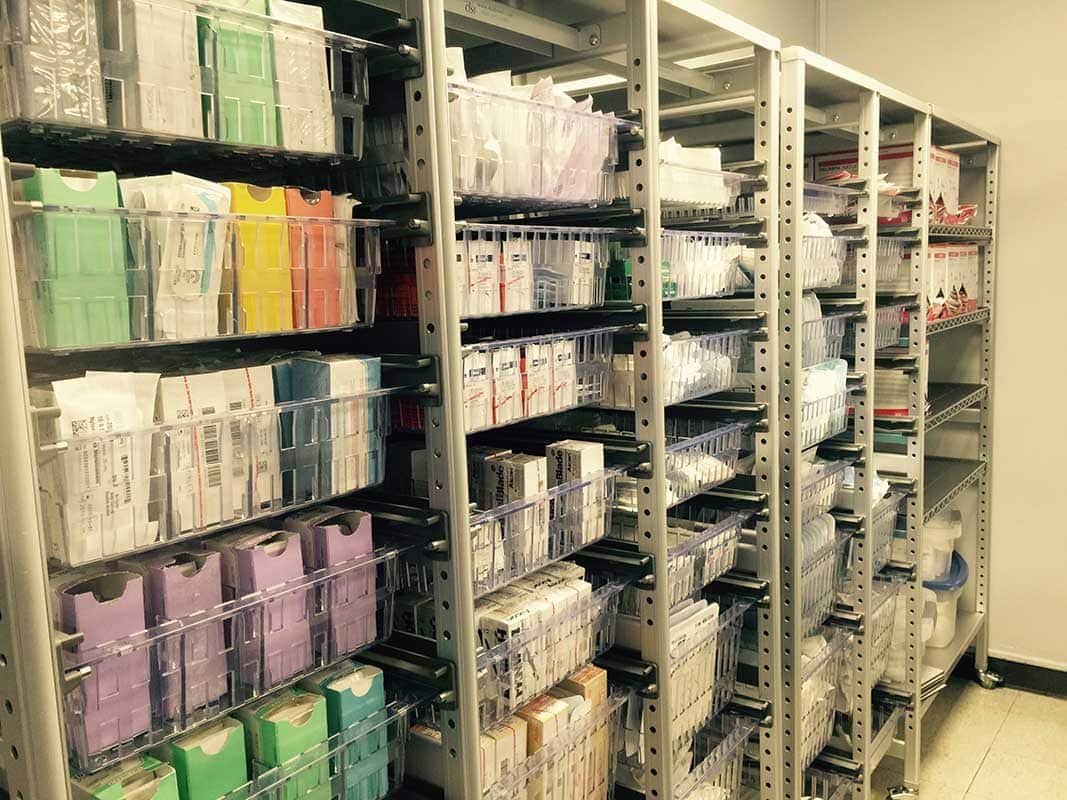
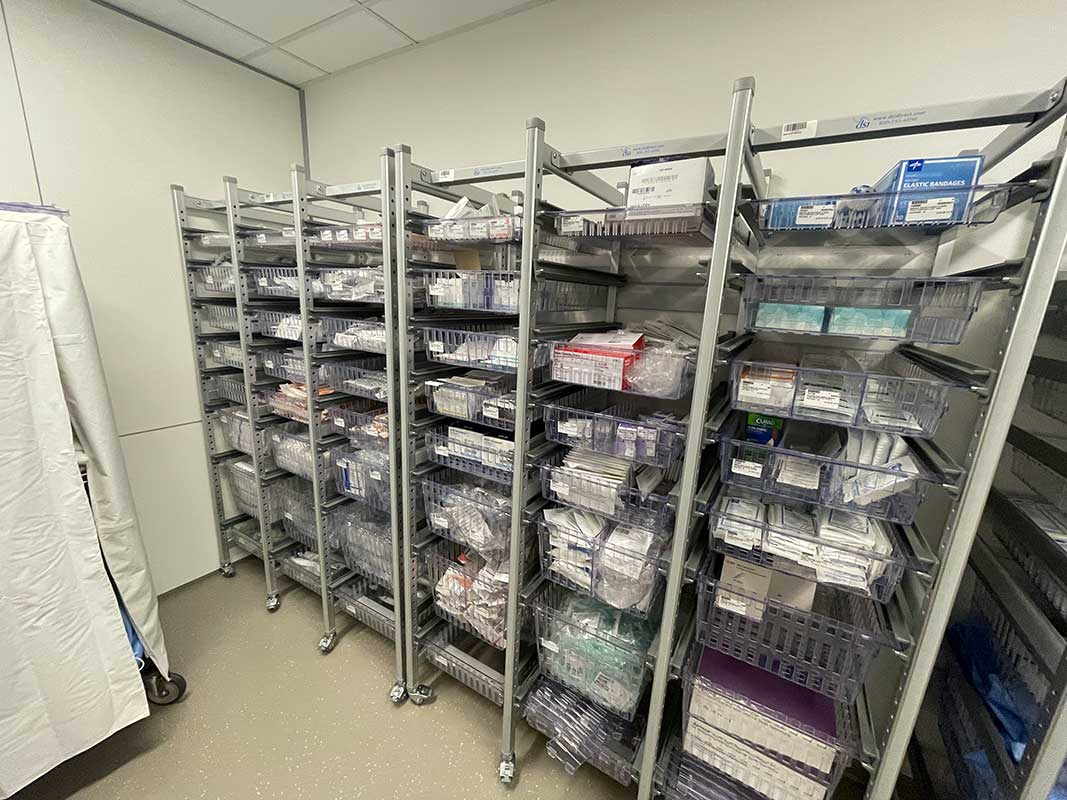
Mobile shelving recovers 40 to 50 percent of floor area by eliminating fixed aisles. Mobile systems can double or triple storage capacity in the same footprint, allowing facilities to defer or eliminate construction projects. Converting from six-level wire racks to nine-level drawer units adds around 33 percent capacity from shelving alone.
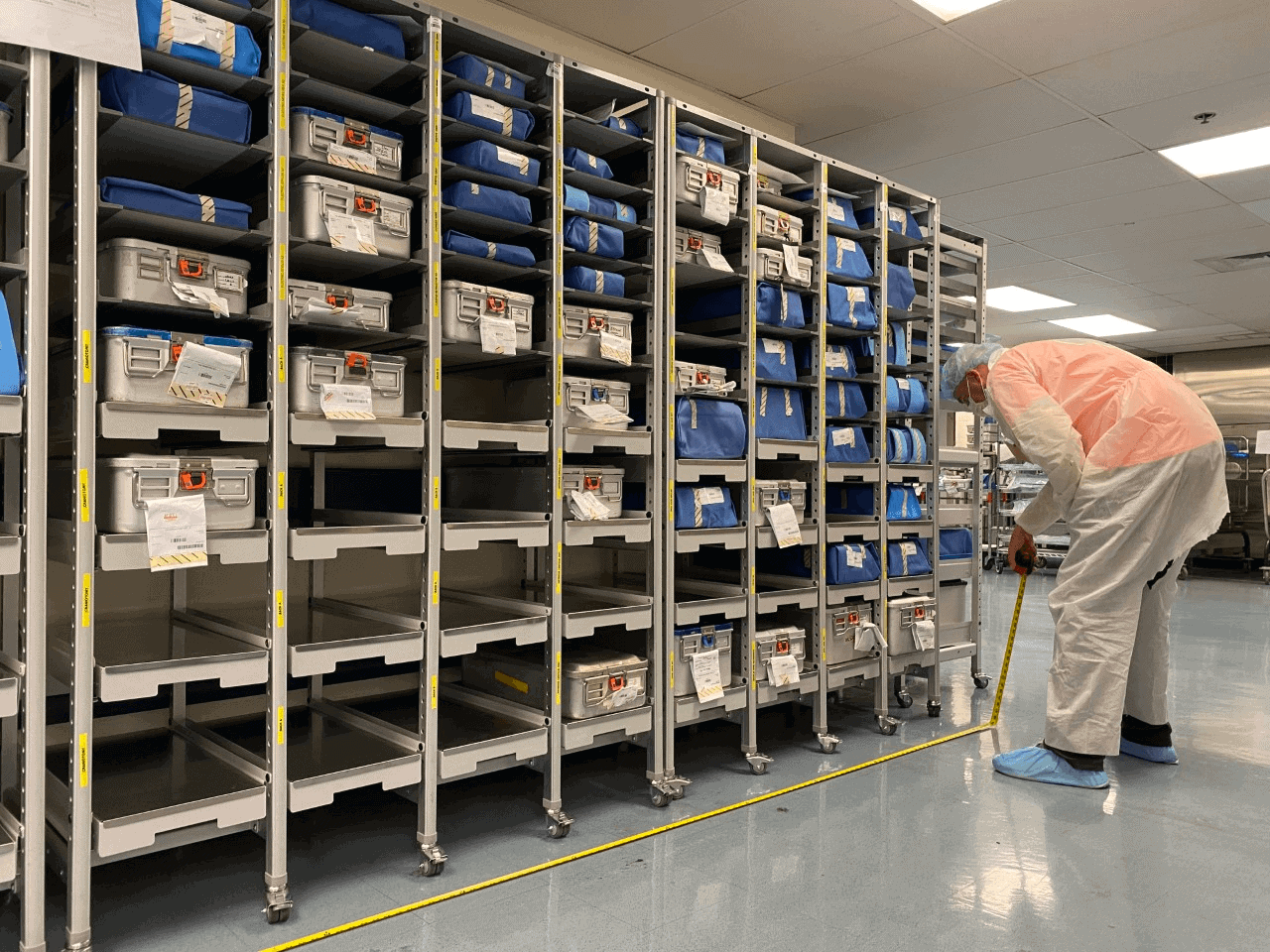
Typical high-density ROI is cited around 18 months based on avoided construction and lease costs. A 350-bed hospital gained 35 percent capacity with high-density mobile shelving redesign while maintaining AAMI ST79 environmental requirements. Stainless steel products designed for sterile environments support both density gains and compliance simultaneously.
Turnkey implementation carries an 11 percent weight in partner selection criteria. A single-source partner that handles delivery, assembly, inventory transfer, labeling, and post-install support reduces risk by eliminating coordination across multiple vendors. References and case study availability weigh 6 percent, while after-sales service and continuous improvement add 5 percent.
Contract flexibility accounts for 3 percent. Together, these implementation-related factors represent 25 percent of the decision model, underscoring execution capability alongside product quality.
Turnkey implementation provides a single point of contact for the entire project lifecycle. This structure eliminates finger-pointing between product vendors, installation contractors, and post-install service providers. When issues arise, the facility contacts one partner who owns resolution.
Single-source accountability also streamlines change management and staff training. The partner who designed the workflow delivers training, ensuring consistency between intended process and operational rollout. Workstations integrated into department layouts require coordinated installation with shelving, carts, and inventory transfer.
Fragmented contracts lead facilities to switch from transactional vendors to strategic partners. Poor data visibility prevents materials managers from modeling PAR levels accurately or identifying usage trends. Inconsistent pricing across multiple purchase orders creates budget unpredictability and off-contract spend.
No ownership of outcomes leaves facilities managing vendor relationships instead of managing performance. Transactional buying produces inconsistent pricing, off-contract spend, and redundant vendors. Facilities that consolidate to full-service partners reduce administrative burden while gaining access to usage data and continuous improvement support.
Credentials signal healthcare-specific competence rather than generic logistics knowledge. CMRP certification, Lean Six Sigma training, and sterile processing credentials provide qualifying filters for consultant evaluation. Facilities should treat these as minimum standards, not differentiators.
Proven process methodology matters as much as credentials. A qualified consultant follows DMAIC methodology: audit and measure current state, design and analyze custom solutions, implement with change management, and control through post-engagement monitoring.
CMRP (Certified Materials and Resource Professional) is administered by the American Hospital Association Certification Center for AHRMM. CMRP requires a baccalaureate degree plus three years of healthcare resource and materials management experience. CMRP tests five domains, with Procurement and Product Value Analysis carrying the largest exam weight at about 28 percent.
CRCST certification is for sterile processing technicians, while CIS certification covers instrument specialists. These SPD-specific credentials demonstrate understanding of the compliance layer where storage design and patient safety intersect.
DMAIC methodology stands for Define, Measure, Analyze, Improve, Control. This structured, data-driven approach drives the strongest documented results in hospital storerooms and operating rooms. First-pass yield in SPD quality programs moved from 81 percent to 97.4 percent using DMAIC process control.
SPD defect rates cut from 2.2 percent to under 0.1 percent through systematic problem diagnosis and continuous improvement. The Dublin OR Lean Six Sigma project that reduced stock 17.7 percent and expired inventory 91.7 percent worked the DMAIC loop with staff participation.
Red flags include no on-site assessment before recommending solutions. Consultants who propose products without measuring current PAR levels, usage patterns, and space constraints fail the diagnostic standard. No ROI documentation or savings model signals a product seller rather than a problem solver.
Cannot name reference facilities indicates limited experience or poor outcomes. Vague promises without specifics, jargon-heavy language that obscures rather than explains, and rigid one-size-fits-all methodology all warn of underqualified consultants. Green flags include complimentary on-site workflow audits, documented ROI projections, named references from comparable facilities, and specific measurable deliverables.
Compliance in sterile processing and OR storage is not optional. AAMI ST79 governs the environment sterile items are stored in, covering clearances, air changes, pressure relationships, and environmental monitoring. The Joint Commission accredits roughly 21,000 to 22,000 US healthcare organizations and enforces these standards through survey citations.
Storage design functions as a compliance instrument, not just a space plan. Consultants who cannot design storage that maintains AAMI ST79 standards create liability rather than solving operational problems.
AAMI ST79 governs the environment sterile items are stored in, including temperature, humidity, and physical clearances. The Joint Commission accredits roughly 21,000 to 22,000 US healthcare organizations and repeatedly cites items on floors during surveys. The Joint Commission also cites uncontrolled humidity and overstuffed shelves as common deficiencies.
For a full breakdown of HSPA, AORN, AAMI, and Joint Commission requirements for SPD storage, see this compliance guide.
Storage must be maintained at least 8 to 10 inches from the floor and 18 inches from the ceiling. Sterile storage requires positive pressure and a minimum of 4 air changes per hour. Decontamination areas require negative pressure and 10 air changes per hour to prevent cross-contamination.
Storage design must incorporate compliance parameters from the beginning, not retrofit them after product selection. A 350-bed hospital redesigned SPD with high-density mobile shelving while holding AAMI ST79 environmental requirements throughout. The design included clearances, airflow patterns, and material selection compatible with sterile environments.
Consultants must coordinate storage layout with HVAC, environmental monitoring, and departmental workflow to maintain compliance. Facilities preparing for Joint Commission surveys prioritize partners who document compliance design features in CAD drawings and specifications.
A consultant who cannot design storage that meets AAMI ST79 standards is not qualified for SPD or OR work. Compliance failures create patient safety risks, accreditation deficiencies, and potential legal liability.
Qualified consultants integrate compliance into ROI modeling, not as an add-on cost but as a baseline requirement. They specify materials, finishes, clearances, and environmental controls that support both operational efficiency and regulatory standards.
Selecting a healthcare storage solutions partner requires evaluating weighted criteria that extend beyond unit price. Institutional trust, ROI transparency, and consultative capability together account for more than 40 percent of the decision model, while turnkey implementation and compliance support add another 25 percent. Facilities that prioritize these factors over lowest upfront cost achieve measurable improvements in inventory efficiency, staff productivity, and regulatory compliance.
Consultative partners deliver satisfaction scores 50 to 55 points higher than catalog suppliers across problem diagnosis, outcome accountability, and workflow impact. Lean and 2-Bin KANBAN strategies reduce inventory holding costs by 35 percent and clinical staff time by 45 percent according to peer-reviewed studies. High-density storage recovers 40 to 50 percent of floor area, allowing facilities to avoid construction costs while maintaining AAMI ST79 compliance.
For more than three decades, Distribution Systems International has specialized in healthcare storage solutions that combine turnkey implementation, LEAN methodology, and regulatory expertise. Materials management professionals facing supply chain inefficiency, space constraints, or compliance risk benefit from partners who diagnose operational problems before proposing products. The right partner transforms storage from commodity purchase into strategic operational improvement that delivers documented ROI and sustainable performance gains.
A healthcare storage solutions partner shapes your costs and compliance for years. Distribution Systems International has served acute care facilities since 1990 with a consultative, data-driven process and full turnkey support. Contact Distribution Systems International at 800-393-6090 or request your free, no-obligation storage analysis to start the conversation.
Most facilities complete a full transition within 60 to 90 days once the design and CAD layout are approved. Turnkey implementation covers delivery, assembly, and inventory transfer, so clinical staff sees minimal disruption. Support and training typically continue for a few weeks after go-live.
A complimentary storage consultation includes an on-site audit of current PAR levels, usage patterns, and available space. The consultant maps existing workflow bottlenecks, then models projected inventory, labor, and space savings before proposing a design. Facilities receive a documented ROI estimate and CAD-based layout before committing to any purchase.
Peer-reviewed studies show 2-Bin KANBAN reducing inventory holding costs by an average of 35 percent, with some three-year programs reporting 40 to 50 percent reductions in weekly consumable spend. Results vary by department, so facility-specific modeling is the more reliable figure to plan around.
Ask whether the partner conducts an on-site workflow and space audit before recommending products, since skipping this step is a red flag. Request documented ROI projections and named reference facilities of a comparable size. Confirm the partner's process for maintaining AAMI ST79 and Joint Commission compliance.
Yes. Any partner designing storage for sterile processing or OR environments must meet AAMI ST79 requirements for clearances, air changes, and pressure relationships. A partner who cannot document this compliance creates accreditation risk during Joint Commission surveys.
With 21 years of sales management, marketing, P&L responsibility, business development, national account, and channel management responsibilities under his belt, Ian has established himself as a high achiever across multiple business functions. Ian was part of a small team who started a new business unit for Stanley Black & Decker in Asia from Y10’ to Y14’. He lived in Shanghai, China for two years, then continued to commercialize and scale the business throughout the Asia Pacific and Middle East regions for another two years (4 years of International experience). Ian played college football at the University of Colorado from 96’ to 00’. His core skills sets include; drive, strong work ethic, team player, a builder mentality with high energy, motivator with the passion, purpose, and a track record to prove it.